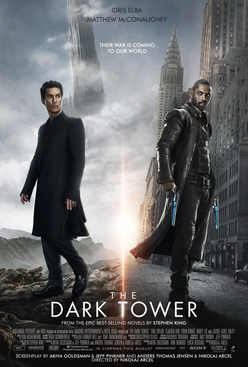
Playing Catch-Up With The Films of 2017: The Dark Tower (dir by Nikolaj Arcel)


What the Hell was The Dark Tower about, anyway?

It’s a legitimate question.  I know that the film was technically a continuation of Stephen King’s overrated Dark Tower books.  Matthew McConaughey was Walter, the Man in the Black, the man who is kidnapping psychic children so that he can weaponize their powers and destroy The Dark Tower.  Idris Elba was Roland, the last of the gunslingers, who is obsessed with killing Walter because Walter killed his father.  And Tom Taylor is Jake, an eleven year-old boy who lives in New York City and who keeps having visions of the Tower, Walter, and Roland.  Walter wants Jake.  Roland wants Walter.  Jake wants to understand it all…

And that’s pretty much the entire movie.  Jake switches back and forth between his world and Roland’s world.  Walter occasionally pops up in New York so that he can kill Jake’s family and assure that Jake won’t have any reason not to continue traveling with Roland at the end of the movie.  It all basically feels like the pilot for a television series and, to be honest, it probably wouldn’t be that bad of a show.  For one thing, if The Dark Tower was a tv show, there would be more of an opportunity to develop the characters of Roland, Walter, and Tom.  The Dark Tower movie only last 95 minutes and the majority of those minutes feel very rushed.

Obviously, if you’ve read Stephen King’s Dark Tower books, this film will be easier for you to follow than it will be for people who have never had to suffer through them.  I know I’m in the minority as far as this is concerned but I find The Dark Tower series to be King at his most pretentious.  Interestingly enough, a little bit of pretension probably would have helped the film version of The Dark Tower.  As it is, The Dark Tower is almost too workmanlike and straight-forward.  It could have really used a pointless Stephen King-style soliloquy about faith, innocence, and horror.  At the very least, they could have had someone in the background, droning on about politics in a Maine accent.

I have to admit that I really, really, really wanted to like The Dark Tower.  I love Idris Elba.  I love Matthew McConaughey.  Even more importantly, I love being a contrarian.  Whenever a film gets as many negative reviews as The Dark Tower, my natural instinct is always to assume that it has to be a secret masterpiece.  I mean, seriously, who trusts critics?  I really wanted to watch The Dark Tower and then write a 1,000-word defense of it.  I was hoping that, much like The Counselor, it would turn out to be a masterpiece that only I could recognize.

Sadly, that didn’t turn out to be the case.  I will say that Matthew McConaughey seemed to be having a sincerely good time playing the bad guy.  And Idris Elba had just the right mix of weariness and compassion to play Roland.  But otherwise, the movie just felt so pointless.

Overall, this has been a pretty good year for Stephen King film adaptations.  It deserves to be nominated for an Oscar, though it won’t be.  Gerald’s Game made people thankful for Netflix.  The Dark Tower, though, will be quickly forgotten.
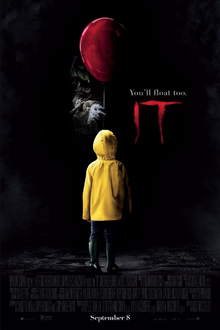
Horror Film Review: It (dir by Andy Muschietti)


Here’s something that Leonard Wilson and I have often pondered here at the TSL offices:

Why is it sometimes easier to write about a film that you hate than a film that you love?

Seriously, whenever I watch a film that I hate, the review is practically written in my head before the end credits have even finished.  Take Wolves At The Door, for instance.  It took me 15 minutes to write that review, largely because I hated the movie and I knew exactly why.  Perhaps it’s because the films that we hate are usually films that have absolutely nothing going on beneath the surface.  It’s a lot easier to write a review when you don’t have to consider things like nuance or subtext.

But, whenever I see a film that I absolutely love, it always takes me longer to write the review.  It’s intimidating to try to explain why you loved a film.  After all, if you loved it then you want everyone else to love it too.  And you want to be able to explain yourself with something more than just: “This was a really good movie.”

Take It, for instance.  It opened last month.  I saw it on opening weekend.  I thought it was a great movie, one that worked in almost every way possible.  I thought it was well-acted.  I thought Andy Muschietti did an excellent job directing it.  I thought that the film’s screenwriters did a wonderful job adapting a challenging novel.  When It was scary, it made me scream.  When It was funny, it made me laugh.  Most importantly, when It was dramatic, it brought tears to my eyes.  It was not just a brilliant horror movie but it was a brilliant movie period, one of the best of the year so far.

And yet, it’s taken me a month to write the 300 words that you just read.  Fortunately, back in September, Ryan C. posted a review of his own.

I assume that most of our readers have already seen It or, at the very least, they’re familiar with what the film is generally about.  It’s based on the famous novel by Stephen King, a work that many feel is King’s best.  It follows a group of 12 year-old outcasts, the so-called Losers Club, as they spend the summer of 1989 trying to avoid both local bullies and Pennywise the Dancing Clown (played by Bill Skarsgard), the cannibalistic demon who lives in the sewers and who awakens every 27 years so that it can feed.  Pennywise has already killed George, the younger brother of Bill Denborough (Jaeden Leiberher), the unofficial leader of the Losers Club.

Now, don’t get me wrong.  Pennywise is terrifying.  If horror films actually get Oscar nominations, Bill Skarsgard would, at the very least, be in the running for best supporting actor.  But what’s interesting is that Pennywise is not necessarily the scariest thing about the film.  As both outcasts and children, the members of the Losers Club are in the unique position to be able to understand that, despite its placid surface, Derry would be a scary place even without a killer clown.  Much like the town of Twin Peaks, there is much going on underneath the surface.

Overweight Ben Hanscom (Jeremy Ray Taylor) is attacked by bully Henry Bowers (a terrifying Nicholas Hamilton), who proceeds to try to carve his name into Ben’s stomach.

Hypochondriac Eddie Kaspbrak (Jack Dylan Glazer) is literally held prisoner by his domineering mother.

African-American Mike Hanlon (Chosen Jacobs) and Jewish Stan Uris (Wyatt Oleff) spend their days being targeted over their skin color and religion.

Beverly Marsh (Sophia Lillis) lives in poverty with her sexually abusive father.

Ever since the disappearance of George, Bill Denborough has watched his family fall apart.

Richie Tozier (Finn Wolfhard) tells jokes because making people laugh is the only way he can convince them not to beat him up.

Even the fearsome Henry Bowers lives with an abusive father who has obviously passed down his twisted worldview to his son.

And yet, despite all of that, It is not a relentlessly grim movie.  In some ways, it’s one of the most hopeful horror films that I’ve ever seen.  This may be a horror film but it’s also a celebration of friendship.  The members of the Losers Club may be outcasts but at least they have each other.  It may be a horror film but it’s also a coming-of-age story, an adventure of growing up that the members of the Losers Club will never forget.  (Except, of course, they will…but not until the sequel…)  All of the child actors are natural and believable in their roles.  Since he gets the funniest lines, Finn Wolfhard is an obvious audience favorite but really, the entire ensemble does a good job.

Between Get Out at the start of the year and It in September, this has been a very good year for horror.  It is one of the best films of 2017 so see it.