Retro Television Reviews: The Love Boat 3.10 and 3.11: “The Love Lamp Is Lit/Critical Success/Rent a Family/Take My Boyfriend, Please/The Man in Her Life”


Welcome to Retro Television Reviews, a feature where we review some of our favorite and least favorite shows of the past!  On Wednesdays, I will be reviewing the original Love Boat, which aired on ABC from 1977 to 1986!  The series can be streamed on Paramount Plus!
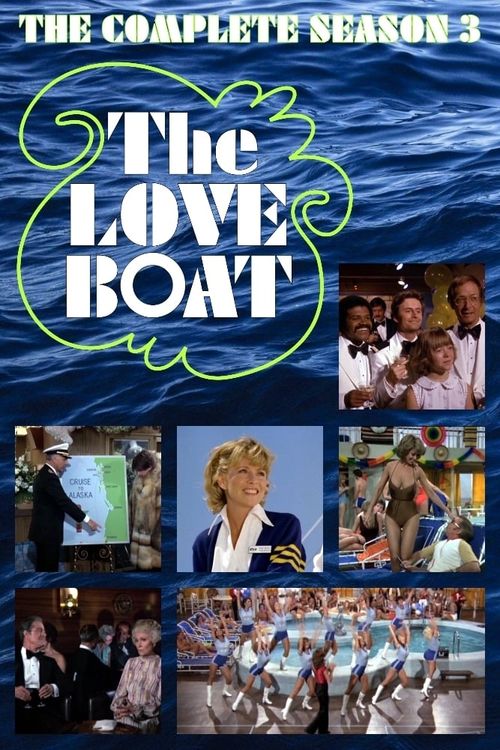
This week, it’s a double length episode of The Love Boat as the Dallas Cowboy Cheerleaders take over the cruise!

Episodes 3.10 and 3.11 “The Love Lamp Is Lit/Critical Success/Rent a Family/Take My Boyfriend, Please/The Man in Her Life”

(Dir by Roger Duchowny, originally aired on November 10th, 1979)

This episode features the first time that Jill Whelan (as Vicki) is included in the opening credits and what an episode to be included in!  It’s time for a special charity cruise of the Love Boat!  In order to raise money for an orphanage in Mexico, the Dallas Cowboys Cheerleaders will be performing on the boat!

I don’t really follow football but I do know that both the Cowboys and their cheerleaders were really popular back in the 70s and 80s.  (Living in Texas, I’ve become very good at sympathetically nodding whenever anyone starts talking about frustrated they are with the Cowboys.)  Still, the idea of the cheerleaders performing on a cruise ship for a charity drive seems a little off.  I mean, shouldn’t they be cheering at a football game?  As I always do when it come to things involving cheerleaders, I asked my sister Erin if any of this made sense to her.  Erin suggested that I not worry about it because it’s The Love Boat.  And really, she has a point.  The Dallas Cowboy Cheerleaders marching onto the boat in full uniform and practicing their routines by the pool makes about as much sense as 11 year-old Vicki suddenly living on a cruise ship.  With The Love Boat, you just have to kind of go with it.

The Cheerleaders play themselves, with three of them getting storylines of their own and I will say that they all came across as being likable and natural in their performances.  I always kind of dread any episode that features celebrities playing themselves because just because someone is famous, that doesn’t mean they’re going to be a good actor.  (I still remember all of those stiff basketball player cameos on Hang Time.)  But the cheerleaders all do a good job, even if none of them are given particularly challenging roles.

Stacy (Tami Barber), for instance, is shocked when Mark Scott (Stephen Shortridge) boards the cruise.  Mark was someone who pursued her in Dallas but she wanted nothing to do with him.  However, on the boat, Mark shows that he’s a nice guy underneath his smooth exterior.  He even choreographs a new routine for the charity performance.  Good for him!

Wendy Ames (Gaye Carter) boards the boat with her mother, Helen (Dina Merrill) and Helen’s boyfriend, Bill (William Windom).  Helen gets jealous of the amount of time that Wendy and Bill are spending together and, when she sees the two of them looking at wedding rings, she decides that they’re having an affair!  No, Helen — Bill wants to marry you!  This whole storyline was silly, to be honest.  Helen just came across as being unnaturally paranoid.

Lisa (Kim Kilway) meets and falls for Paul (Bill Daily), who is the newest vice president of the greeting card company that is sponsoring the cruise.  Paul loves Lisa to but he has a problem.  He’s traveling with his fake family!  Why does Paul have a fake family?  Apparently, Paul’s boss (John Hillerman) only hires family men.  (That sounds like a lawsuit in the making.)  Paul recruited a fake wife (Roz Kelly), mother (Patsy Kelly), and son (Jackie Earle Haley, who appears to be having a lot of fun playing bratty) to pretend to be his family.  The truth comes out, of course.  Fortunately, Lisa is remarkably forgiving and Paul avoids getting fired by promising to marry and start a family with Lisa as quickly as possible.  Again, this all sounds like the beginning of Supreme Court case.

Among the non-cheerleaders, Lou (Larry Linville) and Nora (Gunilla Hutton) are two jewel thieves who board the boat so that they can find some diamonds they hid the last time they took a cruise.  They hid the diamonds in a lamp and it turns out that the lamp is now in the possession of a member of the crew.  This leads to Nora flirting with Gopher, Isaac, and Doc and then quickly abandoning them once it becomes clear that they don’t have the lamp.  (These scenes were fun, largely because of Gunilla Hutton’s comedic timing.)  Finally, Lou and Nora get the diamonds but they have a change of heart and, along with declaring their love for each other, Lou and Nora also donate the $500,000 that they’re going to make from selling the diamonds to the orphanage!  Yay!  Assuming that Lou and Nora don’t get arrested while trying to fence the stolen merchandise, the orphanage will greatly benefit.

Meanwhile, an acerbic theatrical critic (Douglas Fairbanks, Jr.) tries to get an actress (Ginger Rogers) to agree to appear in his new play.  In the end, they realize they’re in love and Ginger Rogers sings Love Will Keep Us Together.

There was a lot going on in this episode but it was enjoyably silly in the way that the best episodes of The Love Boat usually are.  It was excessive and ridiculous, but fun.  On The Love Boat could you get Jackie Earle Haley mocking his fake father while Ginger Rogers sang a song.  This was an enjoyable episode and it did Dallas proud.

Lisa Reviews An Oscar Nominee: The Snake Pit (dir by Anatole Litvak)


The 1948 film, The Snake Pit, tells the story of a writer named Virginia Cunningham.

Virginia (Olivia de Havilland) is a patient at the Juniper Hill State Hospital, a psychiatric hospital that only treats female patients.  Some days, Virginia knows where she is and some days, she doesn’t.  Some days, she knows who she is and other days, she doesn’t.  Sometimes, she hears voices and other times, the silence in her head is her only companion.  Sometimes, she’s paranoid and other times, she’s quite lucid.

Virginia has been admitted against her will.  Her husband, Robert (Mark Stevens), visits frequently and sometimes, she knows him and sometimes, she doesn’t.  Through flashbacks, we see how Virginia and Robert first met.  Robert worked at a publishing house.  Virginia was a writer whose work kept getting rejected.  Robert and Virginia fell almost immediately in love but Virginia always refused to consider marrying him.  In fact, she even disappeared at one point, because things were getting too serious.  However, one day, Virginia suddenly declared that she wanted to get married.  Afterwards, her behavior became more and more erratic.

In the hospital, Virginia is treated by Dr. Kik (Leo Genn), who is depicted as being a compassionate and progressive psychiatrist, even as he puts Virginia through electroshock treatment.  (Remember, this film was made in 1948.)  With Dr. Kik’s guidance, Virginia starts to piece her life together and get to the cause of nervous breakdown.  Unfortunately, it often seems like every step forward leads to two steps back and Virginia still reacts to every bit of pressure by acting out, even biting one unhelpful doctor.

The hospital is divided into levels.  With each bit of progress that a patient makes, she’s allowed to move to a new level that allows her just a bit more freedom.  Everyone’s goal is to make it to the final level, Level One.  Unfortunately, Level One is run by Nurse Davis (Helen Craig), a tyrant who is in love with Dr. Kik and jealous of the amount of time he spends on Virginia.  Davis starts to goad Helen, trying to get her to lose control.  And what happens if you lose control?  You end up in the Snake Pit, the dreaded Level 33.  Being sent to Level 33 means being abandoned in a padded cell, surrounded by patients who have been deemed untreatable.

At the time that it was released, The Snake Pit was a groundbreaking film, the first major American studio production to deal seriously and sympathetically with mental illness.  Seen today, it’s still effective but you can’t help but cringe at some of the techniques that are used in Virginia’s treatment.  (Electroshock treatment, for instance, is portrayed as being frightening but ultimately necessary.)  The film works best as a showcase for Olivia de Havilland, who gives an absolutely brilliant and empathetic performance as Virginia.  Neither the film not de Havilland shies away from the reality of Virginia’s condition nor does it make the mistake of sentimentalizing her story.  For me, de Havilland’s best moment comes when she learns that she bit another doctor.  At first, she’s horrified but then she starts to laugh because the doctor in question was such a pompous ass that he undoubtedly deserved it.  de Havilland handles the character’s frequent transitions from lucidity to confusion with great skill, without indulging in the temptation to go over-the-top.  Arguably, The Snake Pit features de Havilland’s best lead performance.

(Olivia de Havilland is, at 103 years old, still with us and living, reportedly quite happily, in France.)

Olivia de Havilland was nominated for Best Actress but she lost to Jane Wyman in Johnny Belinda.  (A year later, De Havilland’s won an Oscar for The Heiress.)  The Snake Pit was also nominated for Best Picture but ultimately lost to Laurence Olivier’s adaptation of Hamlet.

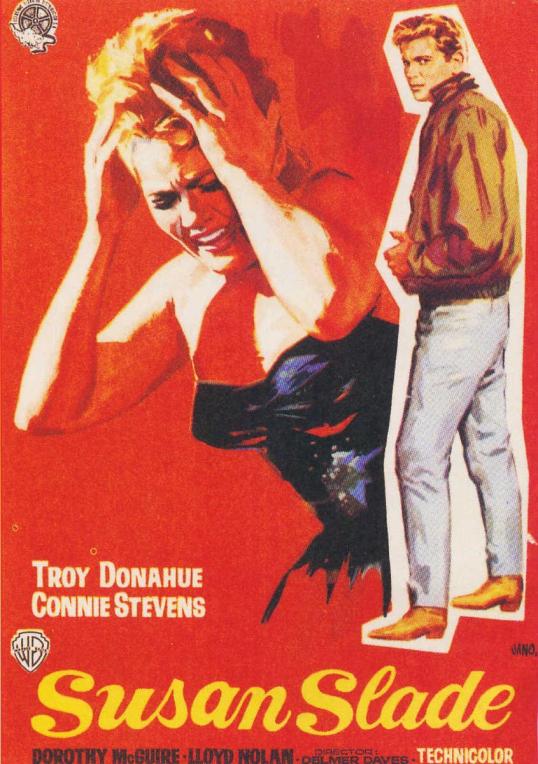
Film Review: Susan Slade (dir by Delmer Daves)


Shortly after this 1961 film begins, 17 year-old Susan Slade (Connie Stevens) announces, “We’ve been sinful!”

She’s talking to her first lover, Conn White (Grant Williams).  You would think that anyone — even someone as unbelievably naive and innocent as Susan Slade — would know better than to ever trust someone named Conn White but no.  From the minute that Conn and Susan met on an ocean liner heading from South America to California, it was love at first sight.  In fact, Susan was so sure of her love that she spent the night in Conn’s cabin, fully knowing that it would mean surrendering her status as an Eisenhower era good girl.

Conn laughs off her concerns about sin.  He also tells her that it makes perfect sense for her not to tell her parents (played by Dorothy McGuire and Lloyd Nolan).  “When we’re married,” he asks, “are you going to tell your mother every time that we make love?”

Wow, Conn still wants to get married even though he’s already had sex with her!?  And he’s also extremely wealthy and stands to inherit control of a multinational corporation!  He sounds like the perfect guy!  Way to go, Susan!

Unfortunately, it turns out that Conn does have one flaw.  He really, really likes to go mountain climbing.  In fact, he’s planning on scaling fearsome old Mt. McKinley.  While Susan and her family settle into life in Monterey, California, Conn heads up to Alaska.  He promises Susan that he’ll keep in touch but, when she doesn’t hear from him, she fears the worse.  Has he abandoned her?  Was he lying when he said he wanted to get married?  Then one day, she gets a call from Conn’s father, informing her that Conn fell off the mountain and died.  Susan’s almost father-in-law tells her that Conn’s body cannot be retrieved from the mountain.  Though it’s neither confirmed nor denied by the film, I decided that this was because Conn faked his own death to get out of having to spend any more time listening to Susan talk about sin.

Anyway, Susan’s single again but, fortunately, she does not lack for suitors.  For instance, there’s the spoiled Wells Corbett (Bert Convy), who is kind of shallow and arrogant but who has a lot of money.  And then there’s Hoyt Brecker (played, in reliably vacuous style, by Troy Donahue), who is poor but honest and who is also an aspiring writer.  “Someday,” Susan declares,”they’ll say that Robert Louis Stevenson, Jack London, and Hoyt Brecker wrote here!”  Who will Susan chose?  The sensitive artist who loves her unconditionally or the arrogant rich boy who smirks his way through the whole film?

Complicating matters is the fact that Susan is …. pregnant!  That’s right, this is another one of those movies from the early 60s where having sex outside of marriage always leads to an unplanned pregnancy.  And, because this movie is from 1961, the only solution is for the Slades to move down to Guatemala for two years, just so they can fool the people on Monterey into believing that the baby is actually McGuire’s and that Susan Slade is not an unwed mother but is instead an overprotective older sister.  Will either of Susan’s two suitors be waiting for her when she and her family return to California?

Now, please don’t get me wrong.  I do understand that there’s a big difference between 1961 and 2019 and that there used to be a lot more scandal attached to sex outside of marriage and unwed pregnancy.  In fact, I guess that difference is really the only thing that makes Susan Slade interesting to a modern viewer.  As soon as we see that this film was directed by Delmer Daves (the poor man’s Douglas Sirk) and that it stars Troy Donahue, we know who poor Susan is going to end up with so it’s not like there’s any real surprises lurking in the film’s plot.  And none of the actors, though Connie Stevens sometimes to be trying, seems to be that invested in the film’s story.  Instead, Susan Slade is mostly useful of a time capsule of the time in which it was made, a time when sex outside of marriage was unironically “sinful” and the only possible punishment was either pregnancy, death, or both.  Indeed, Susan Slade is less concerned about the hypocrisy of a society that would force Susan to lie about her new “brother” and more about whether bland lunkhead Troy Donaue will still be willing to marry Susan even if she’s no longer eligible to wear white at their wedding.  The film seems to be asking, “After being sinful, can Susan Slade become a good girl again?”  As a movie, it’s fairly turgid but as a cultural artifact of a time in which everyone was obsessed with sex but no one was willing to talk about it, Susan Slade is occasionally fascinating.

Poor Susan Slade!  If only she had gotten pregnant in a 1971 film instead of one made in 1961, her story could have been so different.  But no, she was sinful in the early 60s and that means she’ll be have to settle for Troy Donahue.


Horror on TV: Thriller 1.37 “The Grim Reaper” (dir by Herschel Daugherty)


For tonight’s episode of the Boris Karloff-hosted anthology series Thriller, we have “The Grim Reaper!”

The Grim Reaper tells the story of a mystery writer (Natalie Schaefer) who purchases a painting of the grim reaper.  She claims that she’s just bought the painting as a bit of an ironic joke but her nephew (William Shatner!) claims that the painting has a violent history.  Everyone who has owned it has died.  At first, Schaefer is dismissive of Shatner’s story.  But then, blood appears on the reaper’s scythe.

This enjoyable and fun little episode was written by Robert Bloch of Psycho fame.  It was originally broadcast on June 13th, 1961.

Enjoy!

http://www.youtube.com/watch?v=nlzJ9BNVYC0

A Movie A Day #111: I’m Dangerous Tonight (1990, directed by Tobe Hooper)


Sweet and repressed Amy (Madchen Amick) is a college student who has too much on her plate.  She has to take care of her greedy grandmother (Natalie Schaefer, of Gilligan’s Island fame).  She has to read a book for her study partner (Corey Parker).  She has to sew a dress for her older sister, Gloria (Daisy Hall).  She has to find props for the school play.  It is her search for props that leads to her buying an old chest at an estate sale.  Inside the chest is a red cloak.  Amy turns the red cloak into a dress but what she does not know is that the red cloak was previously won by Aztec priests while they conducted human sacrifices.  As Professor Buchanan (Anthony Perkins) later explains, anyone who wears the dress will be driven to do evil.

Like Hitler’s Daughter and Deadly Game, I’m Dangerous Tonight was a USA original film.  Like those two films, and despite the combined talents of the star of Psycho and the director of The Texas Chainsaw Massacre, I’m Dangerous Tonight is not very good. Perkins is mostly just used for exposition while Hooper’s direction suggests that his main concern was picking up his paycheck.  I’m Dangerous Tonight will be best appreciated by fans of Madchen Amick.  Amick is not only beautiful here but she also plays a character far different from Twin Peaks’s Shelly Johnson.

Also, be sure to keep an eye out for R. Lee Ermey, playing a tough, cigar-chomping police detective as only he can.

The Fabulous Forties #36: Dishonored Lady (dir by Robert Stevenson)


40s

15 to go!

That’s what I find myself thinking as I begin this review of the 35th film in Mill Creek’s Fabulous Forties box set.  I’ve only got 15 more of these reviews to go and then I will be finished with the Fabulous Forties.

Oh, don’t get me wrong.  Over the past two months, I’ve seen some very good movies from the 1940s — The Black Book, The Last Chance, Trapped, and a few others.  However, I have also had to sit through things like Jungle Man, Freckles Comes Home, and Lil Abner.  The Fabulous Forties has been an uneven collection, even by the standards of Mill Creek.  However, the important thing is that I’m getting to discover films that I probably would otherwise have never known about.  I love watching movies, even ones that don’t quite work.

Fortunately, the 35th film in the Fabulous Forties does work.

Dishonored_Lady_poster

The 1947 film Dishonored Lady stars the beautiful Hedy Lamarr as Madeline Damien.  Madeline would appear to have it all.  She’s wealthy, she’s socially well-connected, she lives in Manhattan, and she has a glamorous job as the fashion editor of a slick magazine called Boulevard.

So, if Madeline’s life is so perfect, why does she end up crashing her car outside of the house of psychiatrist Richard Caleb (Morris Carnovsky)?  Madeline says it was just an accident but Dr. Caleb immediately understands that she wrecked her car as part of a suicide attempt.  He takes Madeline as a patient and we quickly learn that Madeline is actually on the verge of a nervous breakdown.  When she’s not working, she’s usually drinking.  When she’s not drinking or working, she’s having sex with almost every man she meets.

(Or, as the film primly insists, “making love” to every man she meets.)

And what’s remarkable is that, for a 1947 film, Dishonored Lady is rather sympathetic to Madeline.  While it portrays her lifestyle as being self-destructive, it doesn’t condemn her.  It doesn’t attempt to argue that her problems are a fitting punishment for her decisions, as opposed to so many other 1940s films.  Even when Dr. Caleb’s counseling leads to Madeline quitting her job, the film refrains from criticizing Madeline for wanting to have a career.  Instead, it simply suggests that Boulevard is a toxic environment, almost entirely because of the sleazy men that Madeline has to deal with on a daily basis.

Madeline ends up renting a small apartment and rediscovering her love for painting.  Speaking of love, she also falls in love with her neighbor, Dr. David Cousins (Dennis O’Keefe).  At first, she doesn’t tell David anything about her past but, when she’s falsely accused of murder, she has no choice but to tell him everything.  Will David stand by her or will he prove to be yet another disappointment?  And will Madeline be able to prove her innocence even while her past in put on trial?

I really liked Dishonored Lady.  It’s a surprisingly intelligent film and Hedy Lamarr gives a great performance in the role of Madeline.  Dishonored Lady proved to be a pleasant surprise and you can watch it below!