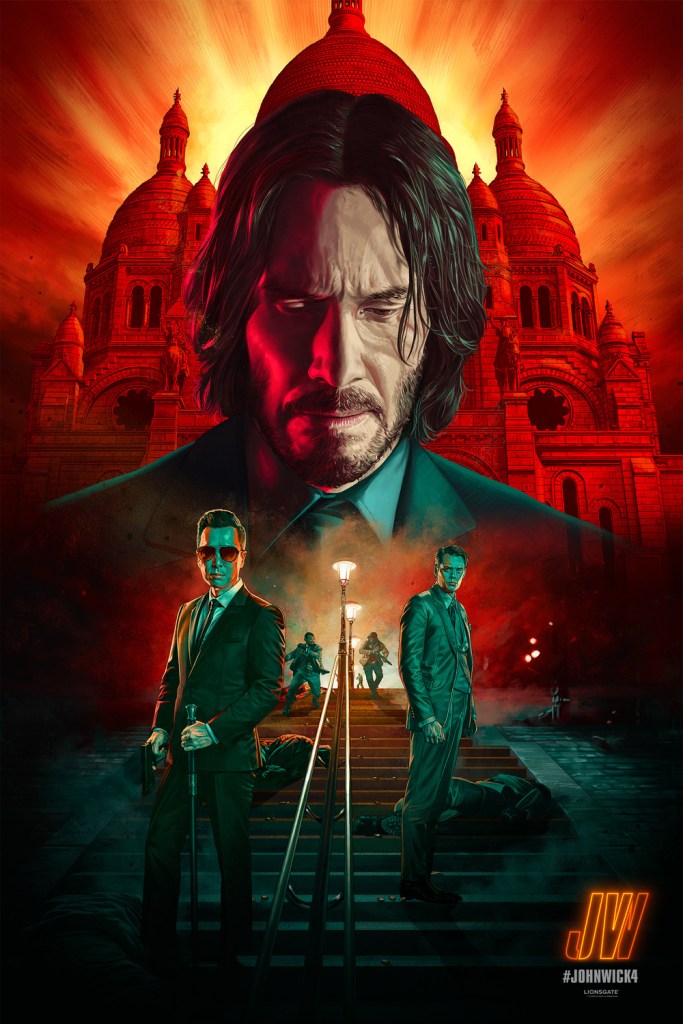
John Wick: Chapter 4 (dir. by Chad Stahelski) Review


“Those who cling to death; live. Those who cling to life; die.” – Caine

John Wick: Chapter 4 is the kind of action movie that doesn’t just lean into the spotlight—it steps into it, throws a flak vest over its suit, and then spends the next three hours filleting an entire world of assassins with brutal, balletic precision. At this point in the franchise, you’re either all‑in on the rules of the High Table, the Continental, and Wick’s endless mourning for his wife Helen, or you’re just here for the sheer spectacle of seeing Keanu Reeves beat up a continent’s worth of bad guys. The film not only respects that split audience, it tries really hard to satisfy both with a mix of operatic emotion, globe‑trotting locations, and a ridiculous amount of meticulously choreographed carnage.

One of the first things that stands out in John Wick: Chapter 4 is how much the world has expanded since the first film. The script doesn’t reinvent the core idea—Wick wants out, the system wants him broken, and the only way he can be free is by killing his way to the top—but it does layer on new zones, new factions, and a whole supporting cast of assassins who feel like they’re pulled out of their own B‑movies. From Morocco to Berlin, from New York to Paris, the film leans into a kind of hyper‑theatrical world‑building where every hotel lobby, nightclub, and underground fighting arena looks like it was designed by a comic‑book artist with a fetish for brutalism and neon lighting. That’s not a bad thing; it makes the universe feel lived‑in, even if it occasionally borders on self‑parody. The film also shuffles in a few fresh faces that give the usual assassin lineup some new flavors, including Donnie Yen as Caine, the stoic, blind assassin who carries both lethal efficiency and a quiet moral weight; Hiroyuki Sanada as the disciplined Shimazu, whose traditional demeanor and craftsmanship with a sword add a very grounded, almost old‑world element to the chaos; and Rina Sawayama as the high‑ranking assassin Akira, whose presence brings a mix of ruthless professionalism and a genuinely intriguing emotional arc that doesn’t feel like an afterthought.

There’s also Scott Adkins playing against his usual type as Killa Harkan, the head of the German Branch of the High Table, showing up in a surprisingly decent‑looking fat suit that gives him a grotesquely imposing presence while still hinting at the physicality audiences know from his other action roles. The character leans into the film’s tendency toward the theatrical, but he’s not just a walking gag; he fits into the world as one of the more visually exaggerated enforcers of the High Table’s rule. Alongside him, Shamier Anderson brings a lean, relentless energy as the Tracker, Wick’s shadowy, almost dog‑like pursuer whose loyalty to the system makes him more than just another interchangeable goon, while Marko Zaror crops up in the Berlin arena sequences as a brutal, wiry fighter whose style adds yet another distinct flavor to the movie’s unusually diverse fight roster. Taken together, these additions don’t just pad the body count; they give the film a sense that the John Wick universe is big enough to host everyone from classical swordsmen to modern martial‑arts specialists and even a few horror‑movie‑style fanatics, all orbiting the same doomed man.

The villain this time around is the Marquis Vincent Bisset de Gramont, played by Bill Skarsgård, and he’s the kind of High Table emissary who exists purely to make John’s life harder while reminding the audience that the system is more bureaucratic than it is mysterious. He’s got the cold, manipulative air of a corporate executive who’s never actually touched a gun but still has the power to ruin people’s lives on paper. His presence allows the film to spend more time on the politics of the assassin underground, which in turn forces John to pull in a wider network of allies, return favors, and, in a few cases, rebuild old friendships that were already on thin ice. That network includes the Bowery King, Caine, and the rest of the new cast, all of whom add texture to the usual slug‑fest even if the plot’s core emotional arc is still very much about a man who keeps remembering the wife he can’t get back.

Where Chapter 4 really flexes its muscles is in the action, and nowhere is that more obvious than in the extended Paris set‑piece that basically becomes the film’s centerpiece. It starts on the open city streets at night, with Wick already on the move, guns blazing and bodies piling up as the camera weaves through car‑chase energy and close‑quarters shoving. The chaos then escalates when the sequence shifts to the Arc de Triomphe roundabout, where the circular layout turns the whole area into a spinning, three‑dimensional shooting gallery. Cars whip around the monument, bullets ricochet off stone and metal, and the sheer spatial awareness of the choreography makes it feel like you’re watching a real‑time videogame map being systematically cleared in concentric circles, except the “map” is an iconic piece of Parisian infrastructure.

The escalation doesn’t stop there. The action migrates into a mostly empty, half‑abandoned apartment complex that feels like a brutalist concrete maze, each floor and hallway turning into a new arena for sprinting, reloading, and last‑minute dodges. The geography of the building becomes a character of its own, with shots that snake down stairwells, peer through doorways, and frame John as a lone figure ducking and weaving through a vertical death‑trap. It’s inside this apartment complex that the film drops one of its most memorable visual flourishes: a frenetic, prolonged shootout using dragon’s breath shotgun shells—incendiary rounds that send flaming pellets spraying outward—captured from an isometric, top‑down angle that directly evokes the look of indie action‑game favorites like The Hong Kong Massacre. The camera rides high above each room as Wick storms through, watching clusters of fire and bullets explode outward in geometric patterns, turning the interior layout into a living level map. It’s a moment that feels less like traditional cinema and more like a loving, hyper‑stylized homage to the way videogames can turn gunplay into a choreographed light show.

The final stretch of this extended Paris gauntlet is the brutal climb up the Rue Foyatier stairway to the Sacré‑Cœur steps, where the film’s choreographic and camera work reach their most expressionistic peak. The wide shots of Paris looming below, the narrowing of the stairway itself, and the way the camera sometimes drifts into an almost dreamlike, slightly elevated angle all combine to make the sequence feel like an endurance ritual rather than just another fight. By the time Wick reaches the top—after being hurled back down and forced to claw his way up again—the audience feels just as exhausted as he looks, which is exactly the point.

That’s part of what makes the film work when it isn’t just going hand‑to‑hand with you for nearly three hours. Beneath all the shooting and stabbing, John Wick: Chapter 4 is also quietly insistent on the idea that this is a tragedy. John Wick isn’t just a guy who happened to fall into a secret society of killers; he’s a man who has been reshaped by grief, loss, and the realization that every compromise he’s made along the way has only made his cage tighter. The film doesn’t over‑explain this; instead, it lets you watch him limp, cough up blood, and drag his battered frame through one more ambush, as if his body is the only thing strong enough to keep him breathing. The supporting characters—especially those tied to the High Table or to his past, including the newer faces like Caine, Shimazu, Akira, Killa Harkan, the Tracker, and the arena fighters—get a few moments to show that they’re not just cannon fodder, either. They have responsibilities, hierarchies, and codes that clash with the arbitrary cruelty of the Table, even if most of them still end up in the path of Wick’s bullets.

On the flip side, the movie is also unapologetically aware of how silly it is. There’s a knowing winking about the dialogue, the neon‑lit set designs, and the way lines like “You have until sunrise” are delivered with the gravity of a Shakespearean prophecy. The film doesn’t try to make you forget that this is ultimately a high‑end first‑person‑shooter turned into a live‑action ballet. It leans into the absurdity of escalating stakes, the way the world keeps conspiring to throw more and more assassins at John, and the fact that even when he’s bleeding out, he still insists on finishing a fight with a signature flourish. For some viewers, that will feel like a strength, a kind of self‑aware celebration of the genre. For others, it’ll feel like the moment the franchise tips from cool to camp, especially when the pacing starts to drag a bit in the middle section and the mix of formal duels, fat‑suited branch leaders, and endless negotiations begins to feel a little overstuffed.

The film’s length is its biggest liability. At around 169 minutes, John Wick: Chapter 4 is not shy about giving you more than enough time to live inside its world, but it also doesn’t always feel like it needs every last minute. The middle act, in particular, spends a lot of time on formalities, treaties, duels, and metaphysical negotiations with the High Table, which can slow the momentum when what you really want is for John to do another hallway‑fight or another truck‑pile‑up. There are times when the script feels like it’s stretching itself out to keep the spectacle going rather than tightening the storytelling, and that’s when the silliness of it all—like the deliberately over‑the‑top presence of Killa Harkan and the packed gallery of new faces—can start to work against the emotional weight the film is trying to build. A leaner, more ruthless edit would probably make the overall experience feel sharper and more focused.

Still, there’s a lot to admire in what the film manages to pull off. The sound design, the camera work, and the way the choreography is almost always shot in wide, relatively clear takes all combine to make the action feel substantial rather than edited into incomprehensible chaos. The supporting cast—Donnie Yen, Hiroyuki Sanada, Rina Sawayama, Scott Adkins, Shamier Anderson, Marko Zaror, and others—add texture and personality to a world that could otherwise feel like a series of interchangeable goons. They’re not just there to get shot; they’re there to give the film a sense of a larger, more complicated ecosystem of killers, each with their own rules and reasons.

In the end, John Wick: Chapter 4 is less a strict narrative continuation and more of a cinematic endurance event. It doesn’t reinvent the franchise, but it pushes the Wick formula into more extreme, more theatrical, and more emotionally committed territory. It’s messy in places, overstuffed in others, but it also has a few moments of pure, jaw‑dropping action that will probably end up in “best of the decade” lists among genre fans, especially that Paris mega‑set‑piece that starts on open streets, spirals through the Arc de Triomphe, invades an empty apartment complex for that dragon’s‑breath top‑down firefight, and climaxes on the Rue Foyatier stairs. If you’re someone who cares about emotional coherence and tight plotting, the film will probably test your patience. If you’re someone who’s here for the ballet of bullets, the operatic bloodshed, the eccentric new cast, and the sight of Keanu Reeves refusing to stay down no matter how many times the universe tries to kill him, then John Wick: Chapter 4 is a pretty satisfying send‑off—or at least a very loud, very stylish stop on the way there.

Weapons used by John Wick throughout the film

  • Glock 34 (TTI Combat Master Package) – His primary pistol early on, including the Morocco sequence against the new Elder and during the Osaka Continental battle.
  • Agency Arms Glock 17 – Used by Wick during the garden fight at the Osaka Continental after he takes it off a High Table enforcer.​​
  • TTI Pit Viper – The “hero gun” of the movie, custom‑built for Chapter 4, used heavily in the Paris staircase and duel lead‑up sequences.
  • Thompson Center Arms Encore pistol – custom-made single-shot pistols created specifically for the Sacre-Couer duel.
  • TTI Dracarys Gen‑12 – The dragon’s‑breath shotgun he grabs during the Paris apartment sequence, used in the isometric top‑down “videogame” style scene.
  • Spike’s Tactical Compressor carbine – Used by Wick after he takes it from High Table enforcers during the Osaka Continental fight.

John Wick Franchise (spinoffs)
Keanu Reeves returns in the John Wick 4 Trailer!


The High Table would like a word with John Wick.

I’m surprised there’s anyone left to fight, but on hand, we have Natalia Tena (Game of Thrones), Bill Skarsgard (Barbarian), Hiroyuki Sanada (The Wolverine), Scott Adkins (Accident Man), Clancy Brown (Thor: Ragnarok) and the legendary Donnie Yen (Ip-Man, Rogue One). They join the original cast that includes Keanu Reeves, Laurence Fishburne, Lance Reddick, & Ian McShane.

John Wick: Chapter 4 is set to release in theatres on March 24, 2023.

Review: Game of Thrones S2E10 “Valar Morghulis”


“We are the watchers on the Wall.” — Qhorin Halfhand

[spoilers within]

With last week’s explosive ninth episode, “Blackwater”, it was going to take much to make tonight’s season finale to really stand out. Just like the first season’s finale we get an episode that deals with the aftermath of the previous episode and also goes a long way into setting up events for the upcoming third season.

“Valar Morghulis” is the title of tonight’s episode and it’s spoken by Jaqen H’ghar to Arya as the two part ways. It’s a saying in Essos from ancient High Valyrian (a Roman Epire-like civilization which perished centuries before the series’ timeline) that translated means “All men must die”. Jaqen sees potential in Arya in becoming like him, a Faceless Man, assassins who follow the teaching of the so-called Many-Faced Gods. While Arya seems intrigued by the offer her need to re-connect with her family takes precedence over everything else. As the two part ways Jaqen imparts to Arya a coin that should she ever need passage to Braavos to start her journey into becoming a Faceless Man. In another instance that this series still has magic in it’s DNA we finally see why Jaqen is a Faceless Man as he walks away from Arya and her group wearing a new face.

Tonight’s episode lays the foundation that next season magic and sorcery may become more common place than the first two season of the series. We see Daenerys finally make her way into the House of the Undying to retrieve her dragonlings from the warlocks of Qarth. It’s a sequence that’s akin to spirit journey for the Targaryen Queen-to-be and Mother of Dragons as she walks the darkened halls and corridors of the House of Undying until an egress suddenly takes her North of the Wall to find a Dothraki tent where she discovers the two most precious things she has lost since coming to Essos. In what I could only see as a surprise that was kept by showrunners Benioff and Weiss from the press and bloggers (a feat nowadays) Daenerys sees her husband Khal Drogo and who could only be their son both alive and waiting for her.

Her reaction to this event was both poignant and tragic in that she finally has a chance to be with those she loves most but must give up the quest to retake Westeros with her dragons. Her decision to leave the tent and leave behind those she loves comes as her character finally realizing that sentimentality and the needs of her heart must take a back seat and wait. Daenerys comes out the other side a more confident ruler and one whose magic really is stronger than those warlocks who scheme to keep her and her dragons captive for themselves. It really sets up the Daenerys character on a much stronger footing for next season just like last season’s finale did. For all the moping around Daenerys did for most of season 2 the pay off in the end goes a long way into forgiving the show’s writers in their inability to write her character’s motivations consistently. Most likely the naive young girl being used by others for their own agendas and ends would be seen less and less next season while the Mother of Dragons reasserts her authority.

The same can’t be said for one of the five kings vying for control of Westeros. For those who have read the third novel the scenes with King Robb Stark were full of sentimentality but lacking in the cold-hearted logic that rulers must use in order to play the game of thrones successfully. Even his mother, Catelyn Stark, sees danger in Robb’s actions with the Volanti healer Talisa Maegyr. Catelyn knows well enough that Robb could destroy everything he has won and worked for since war begun because he has thought with his heart and not with his head. In what could almost be seen as more doom coming for the House of Stark, Robb cements his relationship with Talisa in secret even though we’ve come to learn through two season of this show that nothing ever remains secret for long.

Back in King’s Landing we see the balance of power shift once more as Tywin Lannister’s opportune arrival to take victory from the jaws of defeat at the end of last week’s episode sees him back as Hand of the King to Joffrey. Tyrion has lost all the advantages he had worked and gamed for all season as even Bronn has been removed as Commander of the Goldcloaks. We’ve not seen Tyrion laid so low as we have in this episode and the horrible scarring of his face looks to go deeper as he finally realizes that as much as he would enjoy running away with Shae and leave the politicla intrigues and backstabbing of the kingdom it’s something that he would miss terribly because it’s the one thing he’s best at. With Tywin now in charge of the kingdom and Petyr Baelish having earned himself the king’s good graces for manufacturing the alliance between the two most powerful houses in the kingdom with the Lannisters (Baratheon by name only) and the Tyrell’s of Highgarden. It’s going to be interesting to see how Tyrion readjusts to the new power dynamics in King’s Landing for season 3. If there’s one thing we’ve come to learn about Tyrion over two season’s worth of episodes it’s that he’s a survivor first and foremost.

Lastly, we come to Jon Snow and his dilemma North of the Wall. A captive of the wildlings and seen as someone very important for the still unseen Mance Rayder the so-called King-beyond-the-Wall, Jon must do the only logical thing (something Qhorin halfhand agrees as the only thing that could save Jon and maybe give him time to warn the Wall) and earn the trust of Ygritte, Rattleshirt and the rest of the wildlings even if it means killing one of his own to do so. In what would be one of several sweeping scenes that show the epic nature of this series lest we forget Ygritte shows Jon over the lip of a glacier the army of wildlings Mance Rayder has gathered.

Yet, it’s not that army that gives tonight’s episode that cliffhanger send-off that last season’s finale did with Daenerys coming out of the funeral pyre with her three dragonlings perched on her unharmed body. No, tonight’s episode gets a cliffhanger that is more ominous and reinforces the House Stark motto of “Winter Is Coming”. We see poor Samwell Tarly (having been abandoned by the two other Night’s Watch Brothers once they heard the three horn blasts in the distance) scared out of his wits as he realizes that the three horn blasts that hasn’t been heard for thousands of years could only mean one thing: the White Walkers are on the march towards the Wall. In a final acknowledgement that as realistically the show has tried to portray the series in terms of warfare and political intrigue there’s no getting away from the fact that magic is still alive in this world born out of George R.R. Martin’s fevered mind as a massive army of undead slouches south towards the Wall and the kingdoms beyond it.

This scene just ups the ante on what we could only imagine what would be season three of the show. Across the Narrow Sea we have Daenerys Stormborn gradually detaching sentimentality from how she operates and this could only mean more bad news for the warring kingdoms of Westeros. The power struggles against King Joffrey looks to be going the mad king’s way as Lannisters and Tyrells ally together to retake the rest of the rebelling kingdoms. Now we have two armies, one living and preparing to go south towards the Wall (most likely to get away from the gathering White Walker horde) and the other undead and also heading towards the only bastion (one that is ridiculously undermanned) protecting the southern kingdoms from a gathering darkness.

If there was a complaint about this season’s storytelling it was that so much of the novel this season was based on was condensed to make it fit in a ten-episode season. Despite lulls in character development with Jon Snow and Daenerys we get major pay-offs for these two with tonight’s season finale. It’s good news that showrunner Benioff and Weiss has decided to split book three, A Storm of Swords, into two with the first half comprising season three with the latter half set aside for season four. Even with missteps along the way tonight’s season finale goes a long way into proving that HBO’s Game of Thrones is currently the best genre show on tv and one of the best tv shows airing now.

Now we have ten months of waiting to see how Westeros and Essos will deal with the events that ended season two. One thing for sure is that we’ll see more people die before all questions get answered if ever.

Review: Game of Thrones S2E01 “The North Remembers”


“The night is dark and full of terrors old man, but the fire burns them all away.” — Melisandre

George R.R. Martin’s medieval fantasy epic novel series, A Song of Ice and Fire, made a triumphant debut on HBO with Game of Thrones in the Spring of 2010. The show was headed to be a big success due to the huge fan-base that have read and re-read the novels, but the show was able to attract those who wouldn’t know George R.R. Martin or his books. This was the show that further cemented the notion that genre has become the ruling king of quality tv.

A new season of Game of Thrones now arrives with the premiere episode titled “The North Remembers” and while it shows Robb Stark (now proclaimed King of the North by his bannerman and liegelords) flush with success against the forces of House Lannisters and thus King Joffrey at King’s Landing the episode also weaves in an ominous tone that looks to dominate this second season. It’s a season based mostly on the second novel in the series titled A Clash of Kings and tonight’s episode has set-up not just King Robb Stark of the North against King Joffrey Baratheon at King’s Landing, but the old king’s two surviving brothers (elder brother Stannis Baratheon at the Isle of Dragonstone and younger brother Renly Baratheon at Storm’s End) as these four kings begin their path into a clash for the Iron Throne.

One thing to be said about tonight’s episode is just how much happens throughout it’s running time. We see how life since the execution of Ned Stark has changed the kingdom of Westeros for the worst as refugees fleeing the war between Lannister and Stark has made things near-untenable in King’s Landing. While the peasants and commoners of the kingdom suffer we’re quickly re-introduced to the author of the war in King Joffrey (played with an almost psychotic glee by Jack Gleeson) who hold’s knightly games to commemorate his naming day and plays at being a conquering monarch by redecorating the throne room. Trying to manage this petulant boy king is both his manipulative mother, Cersei Lannister, and his dwarf uncle Tyrion Lannister who also has been appointed the latest Hand of the King to help advise.

While we see the North with Robb sending peace offerings and terms to the Lannisters in the hope of getting his sisters (Sansa and Arya) back we also see him in a nice scene confronting Jaime Lannister still his prisoner and still trying to gain an upper-hand on the young king. It’s a huge difference winning battles can do to a young man’s confidence as Jaime’s veiled insults about his age only amuses Robb. It helps that his direwolf looks to have grown double in size since we last saw Greywind. The episode went a long way to showing Robb not just becoming King of the North in name, but also in manner and deeds.

Tonight’s episode might have been called “The North Remembers” but it’s the arrival of Melisandre of Asshai (Carice van Houten), the priestess of R’hllor (Lord of the Light) and her sway over Stannis Baratheon that adds a sense of the magical to what had been a series steeped heavily in medieval realism. It’s the addition of Melisandre and her seeming real gift for magic plus a glimpse of Daenerys’ dragons that offers glimpses to a world of magic and shadows behind the reality of war and the suffering it puts a kingdom’s people through.

As one could see this is quite a lot for one episode to juggle, but series director Alan Taylor has done a great job of keeping things from becoming too confusing to follow. Even the dark turn into infanticide and bloody purge in the end of the episode was a consequence born out of one of the king’s advisors in Petyr Belish (aka Littlefinger) who thought himself witty and clever by telling the Queen Regent Cersei that he knew exactly what had gone on between her and Jaime and the true parentage of King Joffrey. Taylor kept the episode from being bogged down in one area but at the same time still gives each character in the episode some character growth. Everyone looks to have aged and grown since last season and some for the better (Tyrion enjoying the fruits of being Hand of the King but also reveling in the fact that of all his father’s children it is he who is now trusted and not the disappointment) while others for the worst (Joffrey continuing his path towards Caligula-level mania).

One thing tonight’s busy episode has done is re-introduce the show’s audience to the world of the Seven Kingdoms and it’s many interesting characters and stories that came out of season one. It’s a world that continues to be a complex web of intrigue, moral greyness and ambiguity. While we see certain character on the extreme spectrum of right and wrong (Stannis and Joffrey respectively) we’re truly shown by tonight’s season premiere that everyone has their own agenda. Even characters we might have been led to believe as good show signs of cruelty while those we’re to see as amoral show signs of benevolence.

“The North Remembers” was a great start to what looks to be a season that will blow the first season out of the water (I don’t just mean because of the epic Battle of Blackwater that would highlight the season), but it also showed that despite being a show that had a legion’s worth of characters and subplots it still remained must-see and captivating to watch. Let the clash of kings commence.

Notes

  • It was great to see the opening title sequence once more and this time with the addition of Dragonstone to the stable of clockwork strongholds that has become famous.
  • We see Sansa Stark still pretty much a hostage of King Joffrey and trying to keep her head by parroting what he wants to hear. She did redeem herself somewhat by keeping a drunkard looking to become a knight from being drowned to death in wine and instead becoming Joffrey’s latest court fool.
  • Tyrion’s entrance in the same scene may not have had him slapping Joffrey (a meme that grew out of a slapping scene early in season 1), but his veiled insults at Joffrey’s ability to rule as king shows us why Peter Dinklage was deserving of winning that Emmy for his role as Tyrion Lannister.
  • The scene with Tyrion visiting his mistress Shae in the manor he had set her up in King’s Landing was brief but showed just how much Tyrion seemed happiest when close to her. Though it still doesn’t stop him from keeping her secret from everyone especially his father.
  • Once again I like to point out just how huge the direwolf looked as it growled menacingly at Jaime Lannister while Robb Stark held onto it. It’s almost as if Robb had to keep Greywind from lunging forward to rip the Kingslayer’s throat out. Maybe Greywind thinks Jaime was partly responsible for the death of Sansa’s direwolf Lady in the first season.
  • Speaking of direwolves…we get more clues that the Stark boys may be closer to their direwolves more than we thought as Bran Stark back in Winterfell dreams of roaming the forest near the God’s Wood and seeing it all through the eyes of his direwolf Summer.
  • HODOR! HODOR! HODOR!
  • Great sequence between Littlefinger and Cersei in the castle courtyard. Littlefinger may think of himself as the smartest and cleverest man in King’s Landing, but he still finds himself outmaneuvered, manipulated and laid low by Cersei. Those who doubted that Lena Headey would make for a great Cersei shouldn’t be having any more doubts about that casting choice with tonight’s episode.
  • We get a hint at the future introduction of what could be another self-proclaimed king in what looks to be quite a busy batch already with Theon Greyjoy asking to be sent back to the Iron Isle to speak with his father, Balon Greyjoy, on behalf of Robb who will need those hundred of Greyjoy ships to take on King’s Landing.
  • Was surprised to see Robert Pugh as Craster. I thought he looked like Shipmaster Mr. Allen from Master and Commander.
  • Also great to see Liam Cunningham as Ser Davos the Onion Knight who looks to be the clear-headed counsel to Stannis Baratheon.
  • Was disappointed there was very little of one of the show’s more interesting players in Varys the Spider, but it looks like he gets to have a juicy little scene in next week’s episode, “The Night Lands”.