Horror Film Review: The Devils (dir by Ken Russell)


In 17th Century France, Louis XIII (Graham Armitage) may be king but it’s the devious Cardinal Richelieu (Christopher Logue) who holds the power. Richelieu has convinced that king that every walled city in France should have its walls blown up, the better to keep track of what’s actually happening within the city. Unfortunately, for Richelieu, Louis XIII promised the Governor of Louden that he would never harm any structure in the city, leaving its walls untouchable. While Louis XIII concentrates on throwing outdoor parties where murdering protestant is the main source of entertainment, Richelieu searches for an excuse to destroy the walls of Loudon.

Along with being frustrated by the fact that Loudon retains its walls, Richelieu is also upset that the unofficial leader of the city is Ubrain Grandier (Oliver Reed), a decadent priest who has not only criticized the discipline of clerical celibacy but who has also publicly opposed the Cardinal’s efforts to increase his own political power. Grandier has made it clear that, as long as he’s in control, the walls of Loudon will never came down and the people of Loudon, fearful of the plague that is ravaging the world outside of the walls, support him.

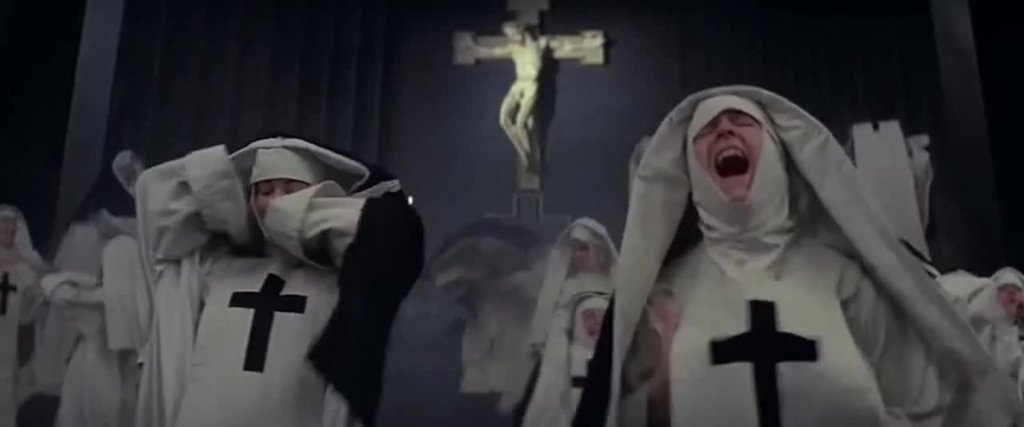
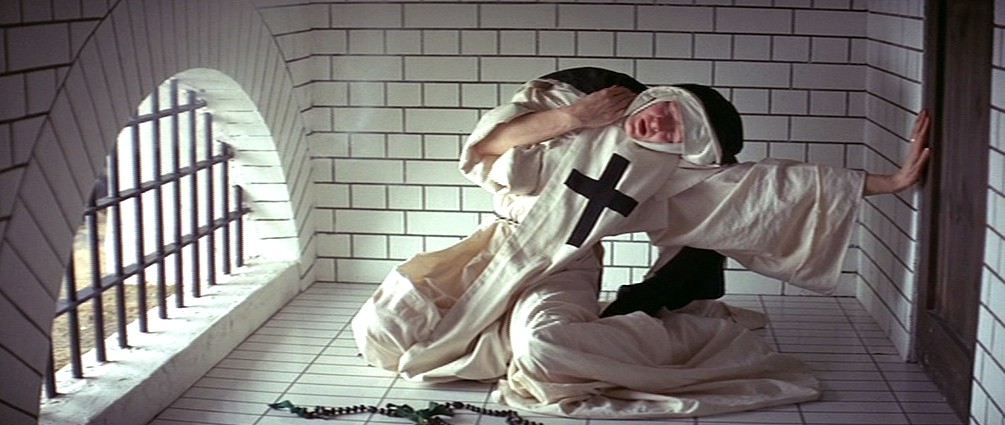
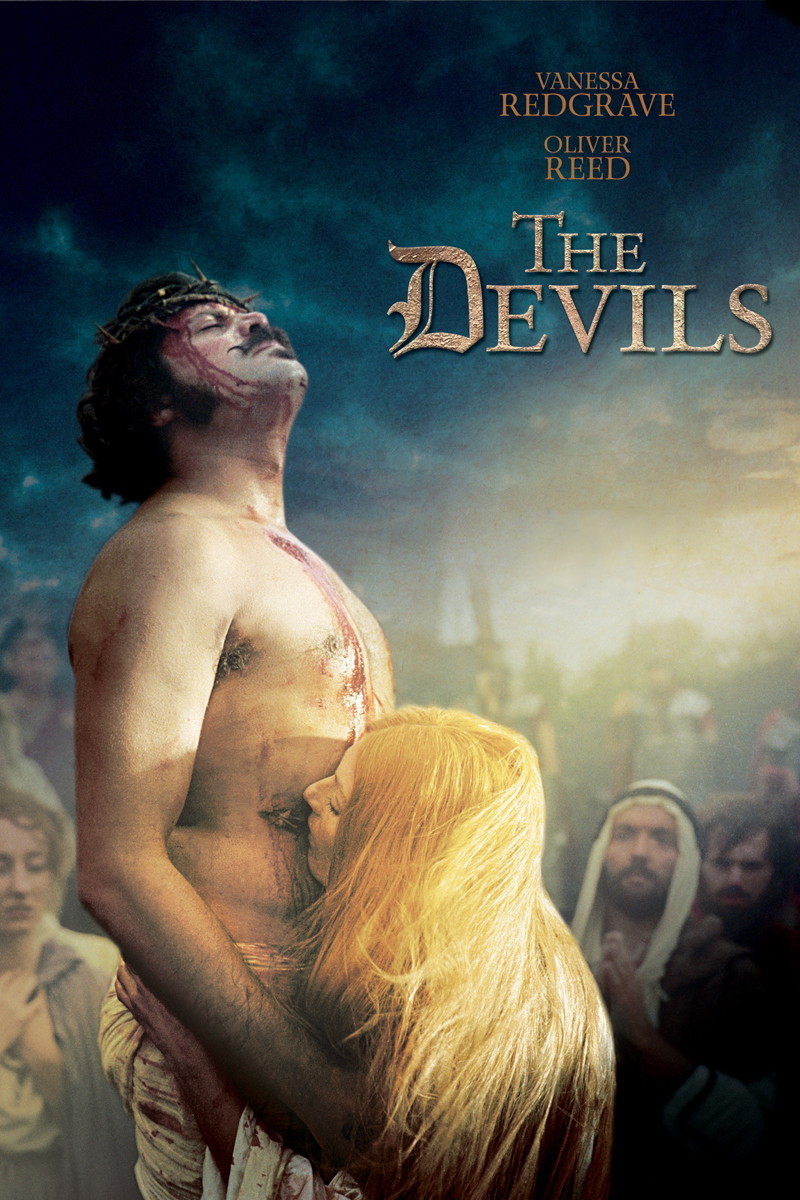
Among Grandier’s many admirers is Sister Jeanne des Agnes (Vanessa Redgrave), a hunchback who is also the abbess of the local convent. Having become sexually obsessed with Grandier, Agnes requests that he become the confessor of the convent. When Grandier refuses, it sets off a chain reaction that eventually leads to Grandier being accused of worshipping the Devil and “bewitching” Sister Agnes and several other nuns. With the arrival of Father Barre (Michael Gothard), a fanatical witch hunter, the city of Loudon descends into darkness and decadence.

Directed by the infamous (and, let’s just admit it, brilliant) Ken Russell and first released in 1971, The Devils is not an easy film to see. When the film was originally released in Britain, it was controversial for its uncompromising depiction of 17th century torture and its combination of religion and sexual imagery. (This, of course, was a recurring theme in almost all of Russell’s work.) The British censors demanded a few minor cuts before agreeing to approve the film for release. While the British censors focused on the scenes of violence, Warner Bros. also removed several sexually explicit scenes, the most infamous of which was a sequence in which a group of naked nuns sexually defiled a statue of Christ. Also removed was a scene of a priest masturbating while watching the nuns and finally, a scene in which Sister Jeanne masturbated with a charred femur bone. Russell was not happy with the changes and, needless to say, he was even more upset when Warner Bros. removed an additional three minutes before releasing the film in the United States.

In the U.S., The Devils was even more controversial than it had been in the United Kingdom and, while many critics praised it as being a powerful attack on hypocrisy, others described it as merely being pornographic. Despite the cuts that were made, the American version of The Devils was slapped with an X rating and Warner Bros. attempted to distance itself from the controversy that had developed around the film. As of this writing, The Devils has never been given a proper Region 1 DVD or Blu-ray release. It’s rare that ever shows up on any streaming platforms. Even YouTube has only a handful of scenes. If you want to watch The Devils in America, you’re going to have to track down a VCR player and watch it on VHS. And, even then, you’ll only be seeing the version that was cut for the U.S.

Will Ken Russell’s original, uncut version ever be seen in America? It’s a question that many film students have asked themselves. In 2002, a 117-minute edition of The Devils played in London, featuring some of the footage that was cut from the film’s original release. However, that version is still considered to be incomplete and it’s certainly not available here in the United States. The Devils does occasionally show up on Shudder, which is how I saw it earlier this year. Of course, the Shudder version was the cut American version, which Russell repeatedly disowned.

Watching the film, I could understand Russell’s anger. It wasn’t just that scenes had been cut out of the film. It was that the scenes were often edited out with such a lack of finesse that it made the film seem disjointed. Russell was a director known for his hallucinatory and deliberately over-the-top style. When the film abruptly cuts away from showing us its most shocking images, it feels antethical to everything that Russell was about as a filmmaker. On the one hand, it’s easy to say, “Who cares if a scene of Vanessa Redgrave masturbating with a charred femur bone has been removed from the film? Who wants to see that?” But if you watch The Devils, it becomes apparent that it’s not about what would be pleasant to see. Indeed, in many ways, The Devils is meant as a deliberate attack on the senses, one in which shocking imagery is used to awaken the audience from their complacency. As such, the controversy about how the film was cut is not about what’s acceptable. Instead, it’s about the fact that Russell has created a world where it somehow makes total sense that Sister Jeanne would pick up the femur and make use of it. By editing the scene so that it abruptly ends with Jeanne merely looking at the bone, Warner Bros. forced The Devils to not be true to itself.

And yet, despite all of that, The Devils remains a powerful and disturbing film, a hallucinatory collection of nightmarish images and haunting scenes. The excessive stylization that was Ken Russell’s trademark is perfect for this story of an entire community caught up in a frenzy of paranoia and repression. Though a period film (and based on a true story), Russell’s Loudon resembles an alien landscape, an almost expressionistic city of pristine walls and dirty streets. Vanessa Redgrave’s twisted nun stalks through the film like an ominous spirit, both wanting and hating Grandier at the same time. When the “possessions” begin, the possessed finally have the excuse to do what they truly want and to live just as wantonly as the men who previously controlled their lives. Because they’ve come to believe that they’re no longer responsible for their own actions, they can indulge in every depravity. But with Louis XIII casually murdering protestants for sport at his estate and Richelieu manipulating church policy to his own ends, the film asks why the people’s actions are more worthy of condemnation than the actions of the people who rule them.

The Devils has reputation for being blasphemous. It is, of course, nothing of the sort. After I watched the film, I did a little research and I was not surprised to discover that Ken Russell was a practicing Catholic because only a Catholic could make a film that both celebrated what the Church could be while also condemning it for so often falling short. While Richelieu represents the people who use religion as a vehicle for their own drive for power and Sister Jeanne and the witch-hunter Father Barre represents the fanatics who use church doctrine to justify their own madness, it is the sinner Father Grandier who represents what the Church should be. It is Grandier who is ultimately forced to put his own life at risk to protect the people of Loudon.

Is The Devils are horror film? Some would probably argue with my claim that it is. They would probably claim that it’s a historical drama with a heavy political subtext, However, for me, the imagery itself is disturbing enough to justify calling The Devils a horror film. The possessed of Loudon eventually prove themselves to be as mad as any of the infected people from George Romero’s The Crazies and the torture that Grandier suffers is frightening specifically because it’s all based on fact. There really was a town named Loudon that had walls. There really was a priest named Grandier who was accused of practicing witchcraft and who suffered the most vile torture as a result.. The Devils is a film about people driven made by a combination of repression and fanaticsm. It’s a horror film because it’s true and, needless to say, the madness that possessed Loudon didn’t die out in the 17th Century. It’s continued into the present day.

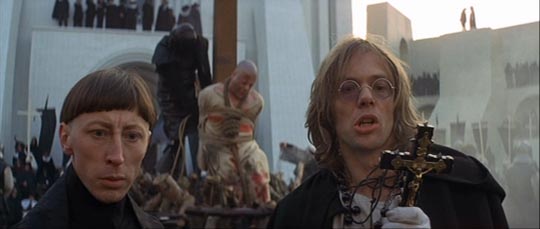
Oliver Reed may seem like an odd choice to play a priest but he gives one of his best performances as the charismatic but foolishly cocky Grandier. Vanessa Redgrave is frightening as the disturbed Sister Jeanne and British actor Murray Melvin is alternatively sympathetic and pathetic as a priest who comes to believe in Grandier’s innocence. For me, though, the film is stolen by Michael Gothard, who plays the fanatical witch hunter, Father Barre. With his long hair and his glasses, Father Barre bears a definite resemblance to John Lennon and the film portrays him as being the 17th century equivalent of a rock star, an arrogant and sensual man who encourages people to indulge in their most secret desires so that he can then declare them to be possessed and in need of an exorcism. Gothard had a magnetic screen presence, allowing him to steal scenes from even formidable talents like Oliver Reed and Vanessa Redgrave. Gothard would go on to play the silent assassin in the James Bond film, For Your Eyes Only and was, again, memorably threatening. Sadly, Gothard took his own life in 1992.

Someday, perhaps the full unedited version of The Devils will be available. Until then, even the edited version retains its power to shock, disturb, and make you think. Today, more than ever, its portrait of hypocrisy and mass madness feels relevant. The modern age is still ruled by hysteria and paranoia and our leaders are still looking for any excuse to take down any walls that might protect us from having to submit to their will. How different is Sister Jeanne from the people who are currently hurling accusations on social media? How different is Father Barre from the the people who were are currently told have all the answers? We may no longer burn people at the stake but we’ve found new ways to silence voices of dissent. The film may have been set in 17th Century France and first released in 1971 but Ken Russell’s masterpiece is all about the modern age. The Devils in not an easy film to watch or find but it is more than worth the effort to track down.


Lisa Reviews An Oscar Nominee: Alfie (dir by Lewis Gilbert)


alfie_original

One night, in the UK, in 1965…

In a London flat, a phone rings.  Up-and-coming actor Terrence Stamp answers.  On the other end, the producers of an up-coming film called Alfie ask Stamp if he would be interested in playing the lead role.  In many ways, Stamp seems like the obvious choice.  After all, he already starred in the stage version of Alfie.  He knows the character and everyone knows that he’s going to be a big star…

And that’s why Stamp turns down the role.  The character of Alfie is an irresponsible and self-centered womanizer who, over the course of the play, has numerous affairs, arranges for one illegal abortion, treats almost everyone terribly, and, at the end of the movie, ends up alone.  Not only will the film’s risqué subject matter provide a challenge, even if it is being made in “swinging London,” but Alfie just isn’t a heroic figure.  He has some good lines.  He makes a few good jokes and, after arranging an abortion for one of his girlfriends, he realizes just how empty his life really is.  But, as written, Alfie is hardly sympathetic.

Stamp says he’s not interested in playing Alfie on screen and then he hangs up.

Two minutes later, the phone rings again.  Stamp answers.  It’s the producers of Alfie.  They ask to speak to his roommate, a cockney actor who was born Maurice Micklewhite but who, at the start of his acting career, changed his name to Michael Caine.

And that’s how Michael Caine came to star in the 1966 film, Alfie.

Alfie not only made Michael Caine a star, it also landed him his first Oscar nomination.  It was especially a popular film in the States, where it tapped into a youth culture that was obsessed with all things British and a desire, on the part of many filmgoers, to see films that deal with “adult” topics that American films, at that time, wouldn’t dare touch.  Though Alfie may seem rather tame by today’s standards (for a film about a man obsessed with sex, there’s actually not much of it to be found in Alfie), one can still see why it would have taken American audiences by surprise in 1966.  At a time when American films still starred Doris Day and Bob Hope, here was a British film about a working class cockney who screws almost every woman he meets, both figuratively and literally.

And really, it’s fortunate that Michael Caine accepted that role.  Along with Stamp, Alfie‘s producers also tried to interest Richard Harris and Laurence Harvey in the role.  All three of them would have brought a harder edge to the character.  However, Michael Caine has just enough charm to make Alfie likable, even when his actions are not.  Since a good deal of the film is made up of Alfie breaking the fourth wall and talking straight to the audience (and, often times, not exactly saying that most charitable of words), that charm is essential to the film’s success.  Michael Caine’s Alfie is self-centered but, at the same time, you never doubt that there’s a better man lurking underneath the surface.  You forgive Alfie a lot because, thanks to Caine’s performance, you can see the man that he’s capable of being.

Alfie is pretty much Michael Caine’s show but he’s ably supported by the rest of the cast, especially Jane Asher as a poignantly insecure hitchhiker and Shelley Winters as a cheerfully promiscous American.  And then there’s Denholm Elliott, who plays an abortionist with a seedy intensity that catch you off-guard and drives home the dark reality lurking underneath Alfie‘s charm.

For a film that is often described as being very much a product of its time, Alfie holds up surprisingly well.  It was nominated for best picture but it lost to something far more sedate, A Man For All Seasons.


A Movie A Day #44: Let Him Have It (1991, directed by Peter Medak)


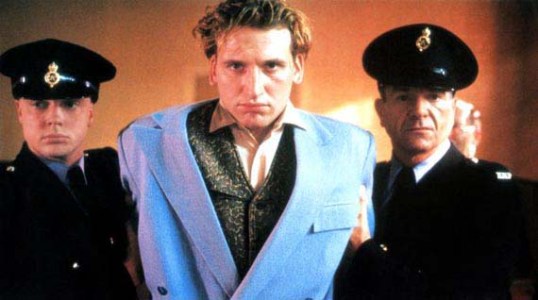
The year is 1953.  The place is Croydon.  Derek Bentley (Christopher Eccleston) is 19 years old but has the mental capability of an 11 year-old.  Unable to hold down a job and judged unfit for the national service, Derek drifts into a gang led by 16 year-old Christopher Craig (Paul Reynolds).  When Derek and Craig are caught burglarizing a warehouse, it leads to a tense rooftop confrontation between Craig and the police.  Derek has already been captured by the time that the police demand that Craig hand over his gun.  Bentley shouts, “Let him have it, Chris!”  Craig opens fire, killing one officer.

Because he’s a minor, Craig is only facing a prison sentence for killing the police officer.  But, as a legal (if not mental) adult, Derek will be hung if he’s found guilty.  Under the common purpose doctrine, it doesn’t matter that Derek didn’t actually shoot the gun.  The only thing that matters is what Derek meant when he said, “Let him have it, Chris!”  Derek says that he was telling Craig to hand over his gun.  The Crown says that Derek was ordering Craig to open fire.

Let Him Have It is based on a true story.  The case of Derek Bentley was one of the many cases that eventually led to the death penalty being abolished in the UK.  Let Him Have It was released at the height of a long campaign to secure a pardon for Derek.  That pardon was finally issued in 1998, though it was too late to help Derek Bentley.

Let Him Have It is a powerful and angry docudrama, one that reveals in searing detail how Derek was railroaded by the British legal system.  In his film debut, Eccleston gives a powerful performance as Derek and he is ably supported by both Paul Reynolds and, in the role of Derek’s father, Tom Courtenay.  Let Him Have It leaves little doubt as to why the case of Derek Bentley remained a cause célèbre for 45 years after his initial trial.

Lisa Watches An Oscar Nominee: Barry Lyndon (dir by Stanley Kubrick)


Barry_Lyndon_A

“It was in the reign of George III that the aforesaid personages lived and quarreled; good or bad, handsome or ugly, rich or poor, they are all equal now.”

— Barry Lyndon (1975)

As I may have mentioned yesterday on this site, Texas has finally caught up with the rest of this frozen country.  Starting on Sunday night, it has finally been cold and wintry down in my part of the world!  For two days straight, schools have been closed and the streets have been covered in ice.  And, even though the temperature got slightly above freezing today, I have been told that I can expect to wake up tomorrow morning to a snowy wonderland.

And I hope that’s the case because I would love to stay home on Wednesday!  Ever since the 31 Days of Oscar began, I have recorded so many movies off of TCM that I am running dangerously close to running out of space on the DVR.  The best thing about being snowed (or iced) in is that it gives me an opportunity to watch some of those films.

For instance, I spent this afternoon watching the 1975 best picture nominee Barry Lyndon.  And when I say that I spent an afternoon, I mean that literally.  Clocking in at a little over 3 hours, Barry Lyndon is a film that’s so long that it even provides an intermission so the you can stand up and stretch your legs.

Seriously, I was really thankful for that intermission.

Which not to say that Barry Lyndon is a bad film.  Far from it!  It’s actually one of the best films to be included in this year’s 31 Days of Oscars.  While I may have no first hand knowledge of what it was like to live in the 1700s, I can now say that I definitely have a clue on account of the fact that I’ve seen Barry Lyndon.

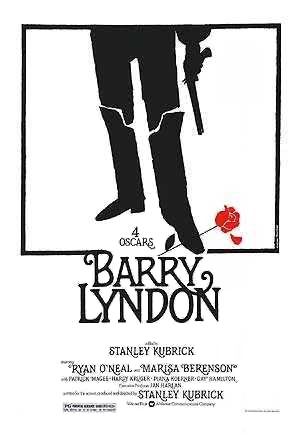
Directed by the great Stanley Kubrick and based on a novel by William Makepeace Thackery, Barry Lyndon tells the story of a penniless Irishman Redmond Barry (Ryan O’Neal) who, following a duel with a wealthy British captain, is forced to flee from his home.  After being robbed by a highwayman, Barry joins the British army but, upon being sent to fight in Germany, discovers that he has no love for combat.  As such, Barry deserts but is then captured by and forced to enlist in the Prussian Army.  Once the war ends, Barry is order to spy on a professional gambler who the Prussians suspect might, himself, be a spy.  Barry and the gambler soon become partners and travel around Europe together.  However, Barry has decided that he now wants to marry into wealth and he gets that chance when he meets the Countess of Lyndon (Marisa Berensen), whose husband is dying.

And that’s when the intermission kicks in.

http://www.youtube.com/watch?v=titZx8VA4DY

When we come back, Redmond Barry is now known as Barry Lyndon and appears to have everything that he’s ever wanted.  However, while Barry may have been naturally lucky when he was poor, the opposite is true once he’s rich.  Despite his new station in life, Barry is never truly accepted by his wife’s circle of friends.  Furthermore, his son, Bryan (David Morley) is injured while out riding a horse and Lady Lyndon has a nervous breakdown as a result.  Meanwhile, Barry’s stepson, Lord Bullington (Leon Vitali), hates him and spends most of his time plotting ways to get rid of his stepfather.

And, naturally enough, it all leads to one final duel in a barn, in which two men point guns while surrounded by the deafening sounds of hundreds of pigeons cooing.

I’m at something of a disadvantage when it comes to reviewing Barry Lyndon because I watched it on television and Barry Lyndon is one of those films that demands to be seen on a big screen.  For all of the dramatic moments and satirical asides (this film has a wonderfully snarky narrator), Barry Lyndon is ultimately most concerned with recreating the past as authentically as possible.  Watching this film, you really do feel as if you’ve traveled back to the 18th Century, where all of the rooms are lit by candle light and one’s station in life can be determined by the ornateness of his or her costume.

As I watched Barry Lyndon, I had to wonder — whatever happened to Ryan O’Neal?  I recently saw O’Neal in a film called The List and it was hard to believe that the terrible actor from that film was the same guy who starred in Barry Lyndon.  Kubrick may not have a reputation for being an actor’s director but Ryan O’Neal gives a great performance in Barry Lyndon.  (Compare O’Neal’s performance in the earlier Love Story to his performance here and you’ll see how good a job Kubrick did when it came to directing O’Neal.)  When we first meet Barry, he is an almost passive aggressive character, a cunning guy who has the patience necessary to wait for his opportunity to advance.  It’s only during the second half of the film that Barry becomes a truly sympathetic character, redeemed by both his love for his son and the fact that all of his enemies are even worse than him.  The strength of Ryan O’Neal’s performance can be found in the fact that Barry can be both amoral and sympathetic at the same time.

So, I’m glad that the streets were icy on Tuesday.  I’m thankful because it gave me a chance to watch Barry Lyndon.

And yes, I’m also very thankful for that intermission.

The Daily Grindhouse: The Devils (dir. by Ken Russell)


With Michael Reeves’ Witchfinder General having found some notoriety for it’s graphic depictions of the witchfinding and inquisition of suspected witches and sorcerers in ravaged England during it’s English Civil War during the 17th-century the world of film, especially the grindhouse and exploitation cinema of the day, founded a new subgenre of horror (folk horror) and also one in the niche world of exploitation. Nunsploitation would be ushered in during the late 60’s and right through the 1970’s of grindhouse cinema with films like Reeves and another which many thought was influenced heavily by the Vincent Price-starred production.

Ken Russell’s The Devils has had a recent rethinking as a film that was less exploitation and more of an arthouse film of the early 70’s which many called one of the more influential films of it’s era. No matter what recent thought on the film might have labeled Russell’s film I always thought it was one of the finer examples of nunsploitation cinema which has of late become more in tune with fetishic pornography than straight-out exploitation horror.

The film starred Oliver Reed and Vanessa Redgrave and was set in 17th-century France during the reign of King Louis XIII and the rise of his Catholic advisor in Cardinal Richelieu. Just like Reeves’ film, The Devils was based on the true historical account of the French priest Urbain Grandier of Loudon who was accused of witchcraft and subsequently executed because of these accusations.

Russell, who has mentioned that he got nothing from Reeves’ film as inspiration and actually hated the Witchfinder General, would take the graphic scenes of torture and sadism of Reeves’ film and ramp it up to the next level. He wouldn’t just include even more graphic scenes of sadistic violence in his own film, but add scenes of sex and perversion (even for the type of film it was The Devils pushed the boundaries of decency of the era) which would see Russell’s film banned from many areas in the UK. The film even split the critics of the day with some calling the film awful and debased while some would nominate the film and it’s director for prestigious film circle and festival awards.

The Devils would be heavily censored in its native UK and even in the US upon it’s release. As time went by the film began to garner new accolades as more open-minded critics began to look at Russell’s film under a new light. While more and more critics of todaycontinue to heap artistic and creative accolades upon this film that it’s begun to shed it’s exploitation roots I still believe that at it’s heart The Devils was and is still nunsploitation at it’s best.