Here’s twenty films for this weekend! It’s the start of a new month and that means there’s some new movies to chose from on your favorite streaming services.
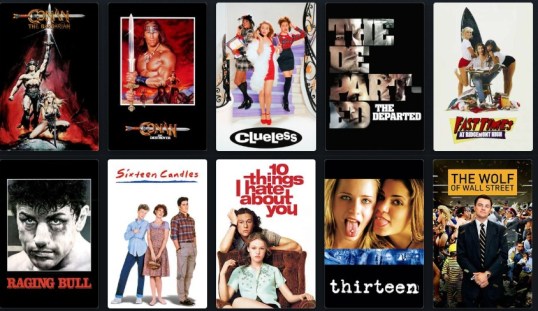
10 New(-ish) Arrivals
Let’s start with a few Scorsese films.
Over the course of his long career, Martin Scorsese has only received one Oscar for Best Director and that was for directing The Departed (2006). The Departed is also the only Scorsese film to win an Oscar for Best Picture. For the longest time, I was kind of annoyed by that fact because Scorsese has definitely made better films than The Departed. That said, The Departed has grown on me with subsequent viewings and I now appreciate it a lot more than I did originally. Jack Nicholson’s performance — his final performance that can really be called great — is a devilish delight. Matt Damon is wonderfully amoral. Leonardo DiCaprio’s performance seemed shrill the first time I watched the film but I’ve come to better appreciate it as a portrait of growing instability and paranoia. Mark Wahlberg brings some subtle humor to his profane cop. Even Martin Sheen and Alec Baldwin are better than usual! The Departed is now on Netflix.
Raging Bull (1980) tells the story of boxer Jake LaMotta (Robert De Niro), a brute of a man who is only capable of communicating through his fists. Raging Bull is not one of my favorite Scorsese films, just because LaMotta himself is such an abusive jerk that I find it hard to really care about him, regardless of how good of a performance Robert De Niro gives in the role. To me, the film is far more interesting when it concentrates on Cathy Moriarty as LaMotta’s abused wife and Joe Pesci as LaMotta’s brother. That said, the film’s black-and-white cinematography is gorgeous, the fight scenes are brutal, and the final scenes of LaMotta as an overweight night club comic have a certain karmic justice to them. It’s a testament to Scorsese’s talent that he can make even a film about someone like Jake LaMotta compelling. Raging Bull is on Prime.
The Wolf of Wall Street (2013) is one of my favorite Scorsese films. It’s a long and chaotic film but it totally draws you into its world and it features not only Leonardo DiCaprio’s best performance but also excellent work from Margot Robbie, Kyle Chandler, Matthew McConaughey, and Jonah Hill. I know that some critics have complained that the film doesn’t explicitly tell the viewer what to think of DiCaprio’s Jordan Belfort but I think they miss the point. Scorsese trusts the viewer to be able to come to their own conclusions about Jordan Belfort. If Belfort’s lifestyle wasn’t fun, he wouldn’t have gone to so much trouble to preserve it. As well, Belfort may be a crook but he’s absolutely right when he calls out Kyle Chandler’s SEC agent for just being a frustrated broker. The Wolf of Wall Street is now on Tubi.
Last week was Arnold Schwarzenegger’s birthday. Conan The Barbarian (1982) features a perfectly-cast Schwarzenegger as Robert E. Howard’s famous barbarian. John Milius was the perfect director to bring this character and his world to life and, even if you’re not a fan of Arnie’s, it’s hard to resist a film that features James Earl Jones as the leader of a snake cult. Conan is now on Prime.
Conan the Destroyer (1984) is a sequel that was not directed by John Milius. Instead, it was directed by Richard Fleischer, who is almost Milius’s exact opposite when it comes to filmmaking. Milius had a vision. Fleischer directs like a man on a deadline. Whereas the first Conan was a grim and serious barbarian epic, Conan the Destroyer features Conan punching a camel and getting spun around in a circle by a lizard monster. That said, Conan the Destroyer is campy but enjoyably silly. It’s best to think of it is a stand-alone film and not a continuation of Milius’s epic. Conan The Destroyer is on Prime.
With all of the back-to-school sales starting, this might be a good time to revisit Shermer, Ohio. The directorial debut of John Hughes, Sixteen Candles (1984) is a film that, today, tends to be dismissed as being problematic. In many ways, it definitely is but you know what? I can forgive the film its less-than-tasteful moments because Sixteen Candles captures something that feels very real. I defy anyone to watch this film and not relate to Samantha Becker (Molly Ringwald). If your heart doesn’t melt a little when Jake Ryan says he’s looking for true love, you don’t have a heart. Sixteen Candles is definitely a product of its time. Today, parents have a thousand apps available to them to make sure they never forget a birthday. That said, the film still captures the timeless feeling of being young, annoyed, and in love. Sixteen Candles is on Prime.
Fast Times At Ridgemont High (1982) is one of the greatest high school films ever made, one that may be dated but which still captures the universal experiences of being young and confused with an empathy and an honesty that few films have ever been able to match. It’s a comedy but it’s also a drama, much like high school itself. Jennifer Jason Leigh gives one of her best performances. Judge Reinhold’s life goes downhill. Sean Penn is so hilarious that it’s odd to consider how serious almost all of later work would be. Forest Whitaker, Nicolas Cage and Eric Stoltz make their film debuts. Robert Romanus’s Mike Damone is the wannabe bad boy who, had I been in highs school in 1982, I probably would have crushed on to my eternal regret. How could you abandon Stacy like that, Damone!? Fast Times At Ridgemont High is on Netflix.
From director Catherine Hardwicke, Thirteen (2003) is a harrowing coming of age story, one that I always kind of cringe at while watching just because of how much I relate to it. I was a handful when I was thirteen. Every time I watch this movie, I wish my mom was still here so I could apologize to her. That said, Thirteen is a good film that features excellent performances from Evan Rachel Wood and Holly Hunter. Thirteen is on Netflix.
I’ve always wanted to like Clueless (1995) more than I actually do but it’s still a likable and influential high school film. (When I first saw it, I assumed that, when I started high school, it would be just like the one in Clueless. Was I ever depressed to discover that my family didn’t live in Beverly Hills!) Director Amy Heckerling brings the same empathy to her characters that she previously brought to Fast Times At Ridgemont High. Seen today, Alicia Silverstone’s tendency to oversell every moment gets on my nerves but the performances of Paul Rudd and Brittany Murphy hold up well. Young Lisa has a massive crush on Breckin Meyer. Stop laughing. Clueless is on Netflix.
10 Things I Hate About You (1999) is the perfect high school romance. Heath Ledger singing in the stands, Julia Stiles reciting her poem, Joseph Gordon-Levitt and Larisa Oleynik having their own little love story, this is a film that makes me smile and cry every time I watch it. This is an adaptation of Shakespeare that’s worthy of the association. It’s now on Hulu.
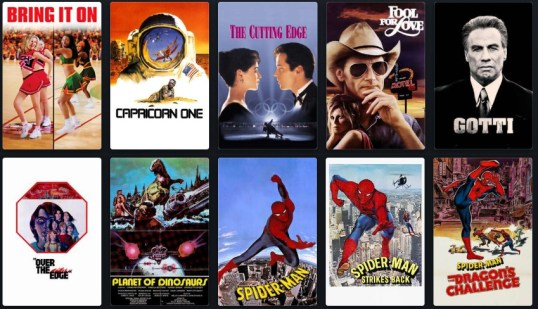
10 Odds and Ends
Today is Dinosaur Day. While some people might observe this day by rewatching one of the Jurassic Park films, I’m going to recommend a charmingly low-budget film called Planet of Dinosaurs (1977). In the far future, a group of human crash land on a planet that has a lot in common with Earth. They soon find themselves being preyed upon by dinosaurs! The stop-motion dinosaurs are really charming in their own way. This silly but enjoyable film can be viewed on Tubi.
Yesterday was Spider-Man Day. In the late 70s, there was a Spider-Man television series, starring Nicholas Hammond as the man who could climb any wall. This led to three Spider-Man made-for-television movies, Spider-Man (1977), Spider-Man Strikes Back (1978), and Spider-Man: The Dragon’s Challenge (1981). The movies are a bit uneven but I like Nicholas Hammond’s performance as Spider-Man and the first film featured an enjoyably villainous turn from character actor Thayer David. These three movies are very much a product of their time and it’s interesting to compare them to what’s coming out of Disney and Marvel today. Spider-Man, Spider-Man Strikes Back, and Spider-Man: The Dragon’s Challenge can all be viewed on YouTube.
Robert Altman’s Fool For Love (1985) is an adaptation of a Sam Shepard play, one that stars Shepard himself. Kim Basinger, Randy Quaid, and Harry Dean Stanton also appear in this southwestern love story. The film can’t quite escape its theatrical origins but Shepard, Quaid, and Stanton all give excellent performances. (Basinger is good but doesn’t quite have as much romantic chemistry with Shepard as one would hope.) This film was a part of Cannon’s ultimately unsuccessful effort to escape its reputation for producing violent schlock. Personally, I like it. Shepard was both a great writer and a great actor and this film proves it. It can be viewed on Tubi.
The Cutting Edge (1992) is a personal favorite of mine. A hockey player learns how to become an Olympic figure skater. An Olympic figure skater learns how to loosen up and enjoy life. Moira Kelly and D.B. Sweeney are so adorable together that you can’t help but smile when Kelly realizes that she’d rather be with Sweeney than with her boyfriend, Stuffy Q. McBorington. Not many films make me cheer but this one does. Go for the gold, USA! The Cutting Edge is on Tubi.
Bring It On (2000) is another favorite of mine and my sister’s. Erin was a cheerleader at our high school. I was asked but I turned down the opportunity because I was trying to do the whole emo thing. It’s probably for the best. Erin was the greatest cheerleader ever but I’m a natural-born klutz. As for the film, it’s great. Kirsten Dunst, Eliza Dushku, Jesse Bradford, and Gabrielle Union all bring a lot unexpected depth to their roles. Spirit fingers! Bring It On is on Tubi.
Over the Edge (1979) is a far darker portrait of being a teenager. In a desolate Colorado “planned’ community, a group of directionless teens finally rebel while their parents are all at a meeting about what to do about their children. Young Matt Dillon is incredibly charismatic as a doomed teen. Harry Northup plays Doberman, the cop of everyone’s nightmares. The climax is violent, disturbing, and — considering how terrible the grown-ups are in this movie — totally understandable. This a powerful and ultimately sad movie. Oh, Child, things are going to get easier…. Over the Edge is on Tubi.
Lovers of conspiracy theories should be happy to know that Peter Hyams’s deliriously paranoid and enjoyably absurd Capricorn One (1977) is on Tubi! Hal Holbrook fakes a mission to Mars. Astronauts James Brolin, Sam Waterston, and OJ Simpson are considered to be expendable. OJ eats a snake! Elliott Gould investigates the case! Karen Black and Telly Savalas have bizarre cameos. Peter Hyams is a filmmaker who deserves more attention than he gets. This film is a hundred times more effective than it has any right to be and it’s on Tubi.
Finally, Gotti (2018) has a terrible reputation but I find it oddly compelling. Whether it was the director’s intention or not, the film does force us to consider how someone like John Gotti could go from being a brutal gangster to becoming an almost beloved cultural institution. (Remember Growing Up Gotti?) So, sure …. I’ll defend Gotti. It’s less a film about John Gotti and more a film about those of us watching and our fascination with gangsters. It’s most intriguing moments may be accidental but so be it. The fact that John Travolta’s Gotti gets visibly older through the film while his son always remains in his mid-20s is your first clue not to take the film literally. Gotti can be viewed on Tubi.
Click here to check out last week’s movies!




 Through the Shattered Lens