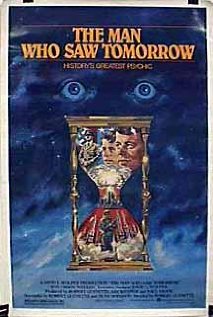
 If you have ever wanted to witness the sad fate that awaits most geniuses who challenge the system, you could not do any worse than to watch The Man Who Saw Tomorrow.
The Man Who Saw Tomorrow is a low-budget “documentary” about Nostradamus, the 16th century French alchemist who some people consider to be a prophet and others consider to be a charlatan. Nostradamus has been credited with predicting everything from the rise of Napoleon and Hitler to the 9-11 terror attacks. Others argue that the writings of Nostradamus were so obscure and prone to mistranslation that they could be interpreted in just about any way. While he did write about an evil dictator that he called “Hister,” he was also widely credited with predicting an atomic war in 1999.
The Man Who Saw Tomorrow argues that Nostradamus was indeed a prophet and it makes its case through cheap historical reenactments and a lot of stock footage. The Zapruder film is used. So is footage from A Tale of Two Cities, War and Peace, Earthquake, and Waterloo (Be sure to keep an eye out for Rod Steiger). Some of the predictions, like Edward Kennedy becoming President and World War III starting in 1986, are easy to laugh at. Others, like conflict in the Middle East leading to a nuclear war, would be frighteningly credible if the film wasn’t so obviously made on the cheap. No skepticism of Nostradamus is implicitly acknowledged but there are interviews with a few believers, including psychic Jeane Dixon (whose first name the film misspells).
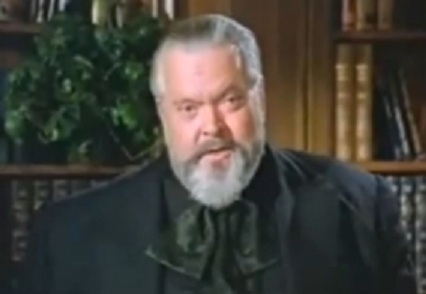
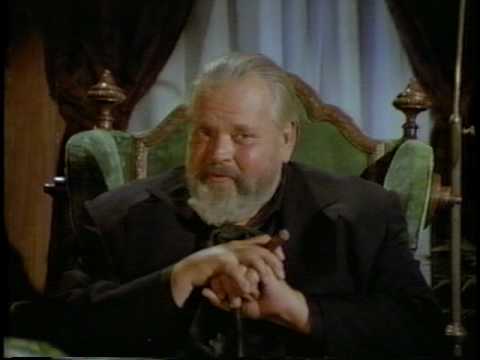
And narrating it all is none other than one of the most important filmmakers of all time, Orson Welles. Sitting at a desk in front of a bookcase and occasionally puffing on a cigar, the director of Citizen Kane lends his deep and recognizable voice to the film’s narration but also adds just a touch of sarcasm to his tone. The movie may believe that Nostradamus saw the future but Welles is going to damn well make sure that everyone understands that he does not. When Welles talks about Nostradamus’s predictions for the future, he says, “But before continuing, let me warn you now that these predictions of the future are not at all comforting – and I might go on to add that these visions of the past, these warnings of the future, are not the opinions of the producers of this film. They’re certainly not my opinions.” He really emphasizes that last sentence, as if he had already grown weary of people approaching him in the streets and asking him if he thought Nostradamus had predicted Watergate.
Sadly, Welles spent a good deal of his career doing jobs like this. The films and the roles were often beneath his talent but they provided Welles with the money that he needed to pursue his own projects, many of which were never to be completed. At the time he did The Man Who Saw Tomorrow, Welles was trying to raise the money to complete post production on his final film, The Other Side of The Wind. The Other Side of The Wind would remain unfinished at the time of Welles’s death but it now appears that, 41 years after principal photography was completed, the film may finally see the light of day thanks to Netflix.
As for The Man Who Saw Tomorrow, it seems only fair to give Orson Welles the final word. When asked about the film and Nostradamus on The Merv Griffin Show, Welles replied, “”One might as well make predictions based on random passages from the phone book.”
Well said, Orson. Well said.

 The Rev. Fred Sultan (Samuel L. Jackson) has a problem. He is the richest and the best known fight promoter in America but the current (and undefeated) heavyweight champion is just too good. No one is paying to watch James “The Grim Reaper” Roper (Damon Wayans) fight because Roper always wins. Sultan has a plan, though. Before Roper turned professional, he lost a fight to Terry Conklin (Peter Berg). Conklin has long since retired from boxing and is now a heavy metal, progressive musician. Sultan convinces Conklin to come out of retirement and face Roper in a rematch. Since Conklin is white and Roper is black, Sultan stands to make a killing as white boxing fans get swept up in all the hype about Conklin being the latest “great white hope.”
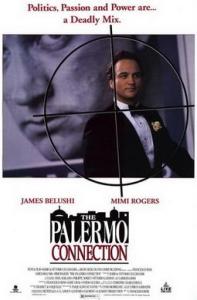 Carmine Bonavia (James Belushi) is an idealistic New York City councilman who wants to be mayor. Despite an easily understood slogan — “Make A Difference!” — his reform campaign is running behind in the polls. Having nothing to lose, Carmine announces that he supports the legalization of drugs. By taking out the profit motive, the Sicilian Mafia will no longer have any incentive to sell drugs in the inner city. Carmine shoots to top of the polls. Now leading by 11%, Carmine marries his campaign manager (Mimi Rogers) and returns to his ancestral home of Sicily for a combination honeymoon and fact-finding tour. The Mafia, realizing that Carmine is serious about legalizing drugs, conspires to frame him for the murder of a flower boy. If that doesn’t work, they are willing to resort to other, more permanent, methods to prevent Carmine from ever becoming mayor.
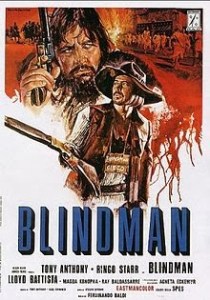 In the old west, a professional gunman (played by Tony Anthony) has been hired to escort 50 women to a Texas mining town. The gunman is known as Blindman, precisely because he is a blind man. He is also a fast and deadly with a gun and has an apparent psychic connection with his horse. Unfortunately, for Blindman, it turns out that his partners double crossed him and sold the 50 women to a Mexican bandit. Blindman must go to Mexico to rescue the women from the ruthless Domingo (Lloyd Battista) and his crazy younger brother, Candy (Ringo Starr).
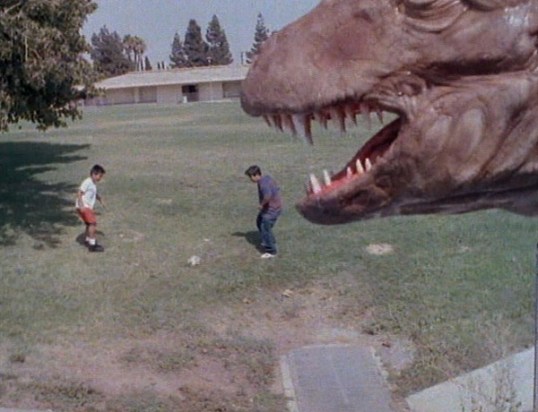
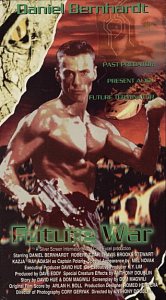 “Four days ago, a fire fell from the sky.”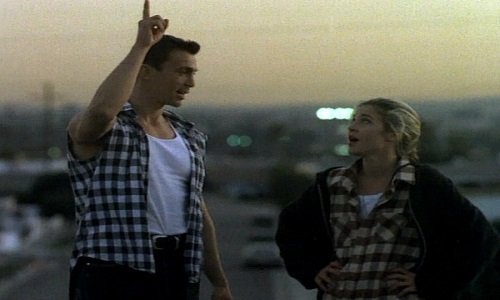
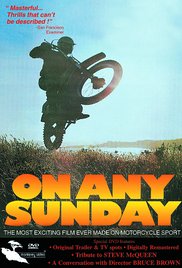 Why pay money to see CHiPs in the theaters when you can watch On Any Sunday, the greatest motorcycle movie of all time, on YouTube for free?
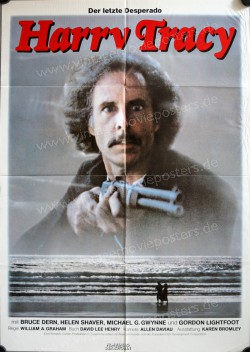 The year is 1902. The old west is coming to an end. Almost all of the famous outlaws are either dead or imprisoned. Only a few, like Harry Tracy (Bruce Dern), continue to make a living by robbing banks and trains. Though he is often captured and even sentenced to death a few times, Harry is always able to escape. His latest escape, from a prison in Washington, has led to the largest manhunt in American history. Harry is being pursued by a trigger-happy army, led by U.S. Marshal Morrie Nathan (played by singer Gordon Lightfoot). Harry has been in this situation before but this time, things are different. Harry is traveling with Catherine Tuttle (Helen Shaver), the daughter of a local judge. Harry and Catherine are in love but that does not matter to the men with the guns.
 This made-for-TV sequel to
  Travis Graham (Stephen Baldwin, before he found God) is a doofus who owns a farm. His late father sent all of the family’s money to a crooked televangelist but he did leave Travis a valuable coin collection. But then two blondes enter his life. Kelly Ann (Jennifer Rubin) is a penniless hitchhiker who needs a place to stay and a bed to sleep in. Jolene (Patsy Kensit) is a British realtor who says she wants to help Travis sell his farm. Faster than you can say “I don’t know the exact pronunciation but I believe it’s ménage à trois,” that’s exactly what happens. Travis can’t believe his luck but it turns out that Kelly Ann and Jolene have plans of their own. Then, in a strangely unrelated subplot, a banker robber who shot the local sheriff (M. Emmett Walsh) shows up at the farm. Travis kills the bank robber but then Kelly Ann and Jolene start pressuring him to use the robber’s plan to rob a bank himself.
 Through the Shattered Lens