A Movie A Day #102: Space Riders (1984, directed by Joe Massot)


Since today’s episode of Twin Peaks featured Gavan O’Herlihy, I decided that today’s Movie A Day would also feature him.  I nearly reviewed O’Herlihy’s best known film, Death Wish 3, but then I remembered that, at some point in the future, I am going to review all of the Death Wish films together.  Instead of reviewing Death Wish 3, I watched Space Riders on YouTube.

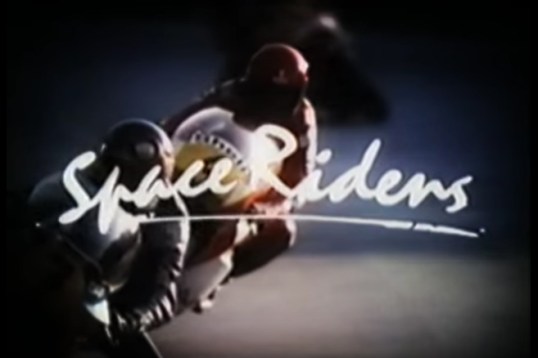
In Space Riders, Gavan O’Herlihy plays Ron Harris, a Grand Prix motorcycle racer who is lured out of retirement (and away from Marina Sirtis, who also appeared with O’Herlihy in Death Wish 3) to join a racing team sponsored by a Japanese motorcycle company.  Also on the team are Japanese racer Masao Yamashta (played by Toshiya Ito) and 2-time Grand Prix champion, Barry Sheene.  Sheene plays himself and Space Riders even opens with a recreation of an accident that nearly cost Sheene his life in 1982.  (In the movie, Sheene is trying to make a comeback after the accident.  In real life, the accident eventually led to Sheene’s retirement from the sport.)

There is no real plot to Space Riders.  It’s just one race after another, with the emphasis on the motorcycles and less on the men riding them.  The racing scenes are occasionally exciting and there’s some spectacular stunt work but it is nearly impossible to tell who is on each motorcycle until the race is over and everyone takes off their helmets.  There is an interesting scene where Yamashta imagines that he is being chased by a samurai on a motorcycle but that is pretty much it as far as character development is concerned.  O’Herlihy does okay with the role Ron, playing one of his few good guy roles.  (Even on Happy Days, the main thing that stuck out about O’Herlihy’s Chuck Cunningham was that no one liked him.  After O’Herlihy left the show, Chuck was never mentioned again, leading everyone to wonder what terrible fate has befallen Richie’s older brother.)

One thing that does distinguish Space Riders is the classic 80s soundtrack.  Who would have guessed that Hungry Like The Wolf would turn out to be perfect racing music?  Even though it’s no On Any Sunday, Space Riders will be enjoyed by motorcycle racing enthusiasts.
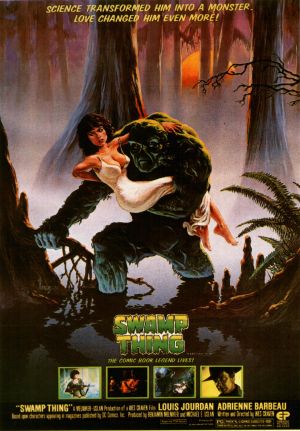
A Movie A Day #101: Swamp Thing (1982, directed by Wes Craven)


I have been dreading this moment for a while.
Ever since I decided that, while we are reviewing every episode of Twin Peaks, that every entry in Movie A Day would have a connection with the show, I knew that I would have to eventually review Swamp Thing.  I didn’t want to because I hate Swamp Thing but, outside of his work as Leland Palmer, it is also Ray Wise’s most famous role.  One of the good things about Twin Peaks is that it saved Ray Wise from being forever known as Swamp Thing.

Of course, Ray Wise does not really play Swamp Thing.  He plays Alec Holland, the human scientist who is working on a formula that will allow animals and plants to thrive in extreme environments.  When the evil Dr. Arcane (Louis Jourdan) sends his henchmen (including veteran bad guys David Hess and Nicholas Worth) to steal the formula, Alec gets set on fire and runs into the Louisiana bayou.  When Alec emerges, he has become Swamp Thing, half-human and half-plant.  He is also now played by Dick Durock.  Swamp Thing must protect both bodacious Alice Cable (Adrienne Barbeau) and streetwise swamp kid Jude (Reggie Batts) while trying to prevent Arcane from using the formula to turn himself into a werewolf and conquer the world.

Despite the easily mocked name, Swamp Thing has often been one of the best characters in the DC universe.  The movie does not being to do the character justice.  At the time, Wes Craven was best known for movies like Last House on the Left and The Hills Have Eyes.  Swamp Thing was an attempt to show that he could direct a big-budget, studio production.  Unfortunately, Craven takes a deliberately campy approach to the material, to the extent that, if not for a handful of scenes like Swamp Thing crushing David Hess’s skull, Swamp Thing could have easily been directed by Joel Schumacher during his Batman years.  Just the name Swamp Thing is campy enough.  There’s no need to toss in Louis Jourdan turning into a werewolf.  Fans of Adrienne Barbeau will do better to rewatch Escape from New York than sit through Swamp Thing.

Fortunately, for Ray Wise, Twin Peaks came along and saved him from forever being known as Swamp Thing.

A Movie A Day #100: Satan’s Touch (1984, directed by John D. Goodell)


She is not in this movie.

Bill Parrish (James Lawless) is an honest, midwestern grocery store owner who admonishes one of his regular customers about her shoplifting habits.  When she attempts to blame the devil, Bill reminds her that we all have a duty to resist the devil’s temptations.  What Bill does not realize is that not only is the Devil (Paul Davies) listening in but he also looks like a member of the Bee Gees.  The Devil gets offended and decides to tempt Bill with a trip to Las Vegas.  The Devil gives Bill unlimited luck when it comes to placing his bets, something that gets Bill in trouble when he hits the jackpot on a slot machine that is specifically programmed to never pay off.

This month, I am reviewing films that have a Twin Peaks connection and that is the only reason why I am reviewing this low-budget oddity.  In Satan’s Touch, the casino manager is played by Doctor Hayward himself, Warren Frost.  What is interesting is that, for once, management is the hero.  The manager does not hire a private detective to investigate Parrish out of spite or a desire for revenge.  Instead, he is just worried that this man’s luck will cause Vegas to go bankrupt and put a lot of good people out of work.

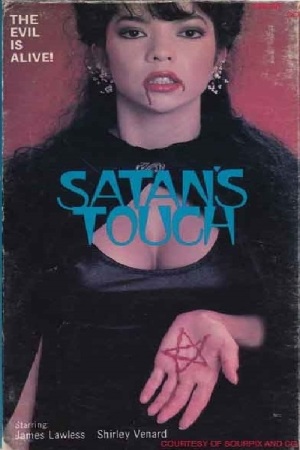
Originally called Jackpot and made to play on the church circuit, the movie was retitled and released as a horror film in 1984.  I rented a copy when I was 12 because there was a picture of an evil-looking woman with ample cleavage on the cover.  As long as it has been since I saw the film, I do remember that she was nowhere in it.  What I do remember is that Satan’s Touch was slow, not very interesting, and, whenever the Devil got bored, he would say, “I’m getting the Hell out of here.”

A few final notes about Warren Frost: Frost was married to the same woman from 1949 until his death earlier this year.  He had three children, actress Lindsay Frost and writes Mark and Scott Frost.  Mark, of course, co-created Twin Peaks while Scott also wrote for the show.  If you don’t know Warren Frost from Twin Peaks, you probably know him as Mr. Ross on Seinfeld.  On that show, his wife was played by his Twin Peaks co-star, Grace Zabriskie.

A Movie A Day #99: A Regular Bouquet: Mississippi Summer (1964, directed by Richard Beymer)


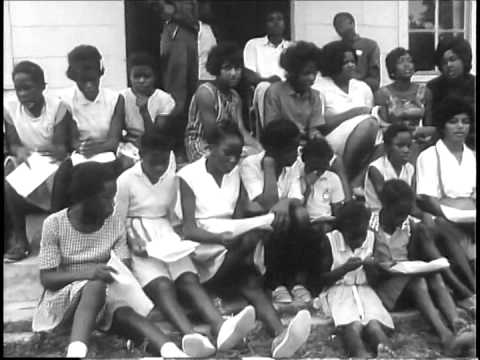
In 1964, having starred in several movies, including West Side Story, Richard Beymer put his acting career on hold and spent the summer in Mississippi, where he was one of several activists who worked to register blacks to vote and who taught at Freedom Schools.  He brought a Bolex camera with him, filmed what he saw, and later edited that footage into a 30-minute documentary called A Regular Bouquet: Mississippi Summer.

Set to a soundtrack that is a mix of rock and roll and the blues, A Regular Bouquet is a heartfelt and often angry portrait of day-to-day life in the Jim Crow era.  Over footage of black women and children working in a cotton field, a woman explains how, every year, she picks more cotton and gets paid less money for her work.  There is positive and hopeful footage of young black children learning at a Freedom School but, at the same time, the murders of James Chaney, Andrew Goodman, and Michael Schwerner hang over the documentary.  One of the documentary’s most strongest moments is a montage of still photographs that illustrate how far the authorities were willing to go to try to stop the civil right movement from reaching Mississippi.

A Regular Bouquet is available on YouTube.  If some of the footage looks familiar, that is because it has regularly been reused in other documentaries about the civil rights movement.  If you only know Richard Beymer as the evil Ben Horne on Twin Peaks, A Regular Bouquet is an eye-opening movie.


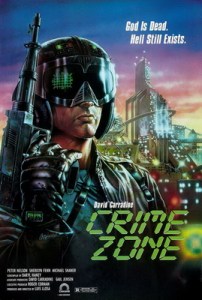
A Movie A Day #98: Crime Zone (1989, directed by Luis Llosa)


Welcome to the future.   To quote Leonard Cohen, it is murder.
The police state of Soleil is engaged in perpetual war with the nation of Frodan.  In Soleil, being rich means living a life of carefree decadence while the poor struggle to survive from day to day.  Criminals are routinely executed on live TV and the government forces women to work as prostitutes, servicing only the rich and powerful.  When Bone (Peter Nelson) and Helen (Sherilyn Fenn) meet, they break the law by falling in love.  Desperate to escape to the legendary paradise of Frodan, Bone and Helen accept an offer from the mysterious Jason (David Carradine).  If Bone and Helen agree to commit a series of crimes, Jason will help them escape Soleil.  Bone and Helen soon become the two most wanted criminals in Soleil but Jason may not be what he seems.

David Carrdine’s performance is typically strange and Crime Zone has a few interesting ideas but the main reason to see the movie is because of the performance of a pre-Twin Peaks Sherilyn Fenn.  As Helen, Sherilyn Fenn is sexy, tough, and always better than the material that she was given to work with.

Executive produced by Roger Corman, Crime Zone was an ambitious project that did not have the budget necessary to reach the heights of Blade Runner, Mad Max, A Clockwork Orange, or any of the other dystopian science fiction films that it tried to rip off.  Crime Zone was filmed, on location, in Peru but that mostly for a budgetary reasons.  Since almost the entire movie was shot on cramped and dark sound stages, it could have just as easily been filmed in West Baltimore.  To its credit, Crime Zone has more on its mind than a lot of the movies that Corman executive produced in the 1980s but the main reason to see it will always be Sherilyn Fenn.

A Movie A Day #97: Dracula’s Widow (1988, directed by Chistopher Coppola)


Since we are looking at and reviewing each and every episode of Twin Peaks, every movie-a-day this month has a Twin Peaks connection.  Today’s entry, Dracula’s Widow, stars Lenny von Dohlen, who played reclusive shut-in Harold Smith on Twin Peaks.

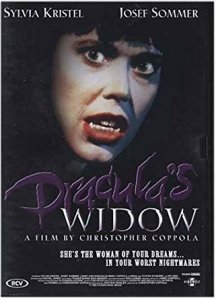
Von Dohlen plays Raymond, the nerdy owner of a Los Angeles wax museum.  When he receives six antique chests from Romania, he does not realize that one of them contains, Vanessa (Sylvia Kristel).  Vanessa is a vampire and soon, she is killing the usual collection of perverts, muggers, and occultists.  She also bites Raymond and turns him into her Renfield.  Under her influence, Raymond even dumps his girlfriend, Jenny Harker (Rachel Jones).

However, Vanessa is not just a vampire.  Vanessa is the wife of Dracula, himself.  When she demands that Raymond take her to her husband, Raymond tells her that Dracula was killed nearly a hundred years ago by Prof. Van Helsing.  (How did Vanessa not already know this?)  Vanessa hunts down and kills Van Helsing’s grandson (Stefan Schnabel) but this brings both her and Raymond to the attention of Inspector Lannon (Josef Sommer).

In the 1990s, Dracula’s Widow was a late night HBO mainstay and it still has a cult following.  I could sit here and count out all the ways that Dracula’s Widow does not make any sense but I’ve got a deadline.  For all of this low-budget movie’s flaws, Dracula’s Widow is saved by the sexy presence of Sylvia Kristel and the atmosphere that can only be provided by neon lighting and a fog machine.  Josef Sommer’s hard-boiled narration, in which he refers to Los Angeles as being Tinsel Town, is another highlight.  As for Lenny von Dohlen, his performance as Raymond feels like a dry run for his turn as Harold Smith.

Dracula’s Widow was the directorial debut by Christopher Coppola, whose uncle Francis would later make Bram Stoker’s Dracula and whose brother, Nicolas Cage, ate a cockroach while making Vampire’s Kiss.

A Movie A Day #96: Gladiator (1992, directed by Rowdy Herrington)


What ever happened to James Marshall?

Whenever the subject of Twin Peaks comes up, that question gets asked a lot.  Marshall played the sensitive (and oft-ridiculed) motorcycle-riding rebel James Hurley on Twin Peaks and, after the show’s cancellation, he went on to play a key supporting role in A Few Good Men.  Marshall’s role may not have been huge but he managed to hold his own against actors like Tom Cruise, Jack Nicholson, and Kevin Bacon.

And then after A Few Good Men, nothing.

Why did James Marshall disappear?

He starred in a movie called Gladiator.

No, not the Russell Crowe movie that won all the Oscars.  This Gladiator is about Tommy Riley (played by James Marshall), a teenager who moves to Chicago from Massachusetts.  As one of the only white kids in his new neighborhood, Tommy finds himself being harassed by the local gangs.  One night, he gets into a fight in a parking lot.  (Fortunately, none of the neighborhood gangs carry guns or knives.  They settle everything with fists.)  Pappy Jack (Robert Loggia) is so impressed with Tommy’s fighting skills that he recruits Tommy to fight in illegal, underground boxing matches. Normally, Tommy would say no but he needs the money to help his father (John Heard) pay off his gambling debts.

Once recruited, Tommy is trained by the wise Noah (Ossie Davis) and works for boxing promoter, Jimmy Horn.  Horn is played by all-purpose bad guy Brian Dennehy, who gives such a villainous performance that even Lance Henriksen would say, “Dude, dial it down a notch.”  Tommy befriends two other boxers, Romano (Jon Seda) and Lincoln (Cuba Gooding, Jr.).  At the time that Gladiator was filmed, Marshall was hot off of Twin Peaks and Gooding was hot off of Boyz ‘n The Hood.  Fortunately, Gooding’s role is actually pretty small so he survived Gladiator and was able to go on to win an Oscar for Jerry Maguire and play O.J. Simpson in American Crime Story.  Marshall was less lucky.

At one time, I thought that no one could be a least convincing boxer than Damon Wayans was in The Great White Hype.  Then I watched Gladiator and saw James Marshall dancing around the ring and throwing punches.  Normally, good editing can be used to disguise a lack of athletic ability but both Marshall and Gooding are so miscast as boxers that all the editing in the world can’t help.  Jon Seda, who actually was an amateur boxer before getting into acting, is more convincing in the ring but his character is so saintly that anyone watching will know better than to get too attached to him.

A still notorious flop at the box office, Gladiator was directed by Rowdy Herrington but it’s no Roadhouse.

A Movie A Day #95: The Return of Josey Wales (1986, directed by Michael Parks)


Four years before he played Jean Reanult on Twin Peaks, actor Michael Parks starred in and made his directorial debut with the obscure western, The Return of Josey Wales.

As is obvious from the title, The Return of Josey Wales is a sequel to the iconic Clint Eastwood western, The Outlaw Josey Wales.  In fact, The Return of Josey Wales was based on a novel that author Forrest Carter wrote after the initial success of Eastwood’s film.  Originally, Clint himself was going to direct and star in the sequel.  However, Eastwood withdrew from the project and it would be years before The Return of Josey Wales would eventually be made with a miniscule budget and given a very limited theatrical release.  By the time the film was released, it had long since been discovered that Forrest Carter, who had always portrayed himself as being a Cherokee shaman-turned-writer, was actually Asa Earl Carter, a former member of the Ku Klux Klan who had previously worked as a speech writer for arch segregationist, George Wallace.

Along with taking over from Eastwood as the film’s director, Michael Parks also took over the role of Josey Wales.  Having faked his death, Josey is now living on a small farm in Texas and going out of his way not to draw attention to himself.  One day, a man named Paco (Paco Vela) shows up and tells Josey that a corrupt Mexican policeman has killed one of Josey’s friends and locked another one up in prison.  It’s time for Josey to say goodbye to his new wife, jump on a horse, and head down to Mexico.

The Return of Josey Wales never escapes the shadow of The Outlaw Josey Wales, even though the two films have little in common.  As a director, Michael Parks is no Clint Eastwood and his reliance on stock footage reveals how little of a budget he had to work with.  As an actor, Parks gives a totally different performance from Clint Eastwood’s.  Clint’s Josey Wales was hardened and embittered by his experiences.  Michael Parks plays Josey more as an underestimated hick who is not afraid to use a gun if he has to.  There is a lot of Earl McGraw in this version of Josey Wales.  That does not mean that Michael Parks gives a bad performance.  In fact, his performance is the best thing in the film.

The Return of Josey Wales is for Western completists only.

(This review originally stated that Eastwood left the project after it was revealed that Forrest Carter was Asa Carter.  According to Dan T. Carter’s comment below, Eastwood actually left the sequel long before Forrest Carter’s actual identity was revealed.)

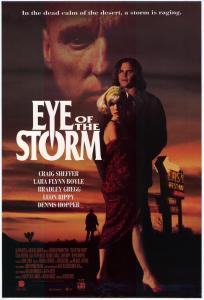
A Movie A Day #94: Eye of the Storm (1991, directed by Yuri Zeltser)


A motel sits off of a highway in the Nevada desert.  One night, two criminals (Ally Walker and German boxer Wilhelm von Homburg) brutally murder the husband and wife who own the motel.  Their youngest son, Steven, flees the criminals by jumping through a window and is left for dead.
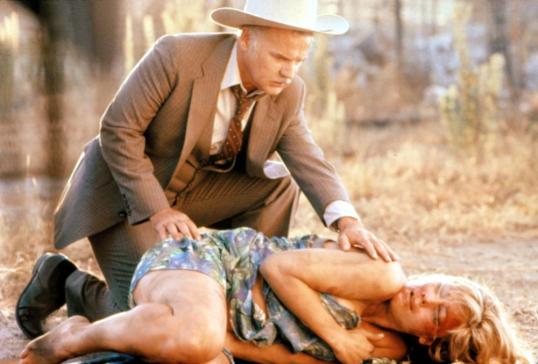
Ten years later, the motel is still sitting off the highway, operated by the blind Steven (Bradley Gregg) and his older brother, Ray (Craig Sheffer).  Ray is very protective of his brother and, when a car pulls up to the motel, he does not even want to turn on the vacancy sign.

The motel’s newest guests are a very unlikely couple.  Marvin Gladstone (Dennis Hopper) is an alcoholic gambler who regularly berates at his much younger trophy wife, Sandra (Lara Flynn Boyle).  Marvin and Sandra were heading to Las Vegas to renew their vows but the drunk Marvin accidentally drove their car off the road.  Now, Marvin and Sandra are stranded at the motel while a dust storm approaches and one of the brothers turns out to be psychotic.

Eye of the Storm is another low-budget and predictable thriller from the 1990s but, taken on its own terms, it’s not bad.  Along with some striking shots of the desert, Eye of the Storm features a quartet of strong performances.  For fans of David Lynch, the main interest here will be seeing Blue Velvet‘s Dennis Hopper and Twin Peaks‘s Lara Flynn Boyle as a couple in trouble.  Hopper especially seems to be enjoying himself and when his character leaves the movie, Eye of the Storm becomes much less interesting.  Lara Flynn Boyle is sexy throughout, enough to make you reconsider everything you thought you knew about Donna Hayward.

See this one on a double bill with Red Rock West.

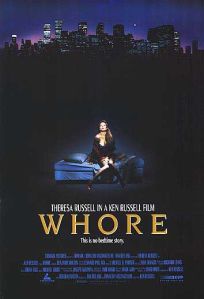
A Movie A Day #93: Whore (1991, directed by Ken Russell)


Liz (Theresa Russell) is a prostitute trying to survive on the mean streets of Los Angeles.  With the help of a homeless performance named Rasta (Antonio Fargas), Liz tries to escape from her abusive pimp, Blake (Benjamin Mouton).
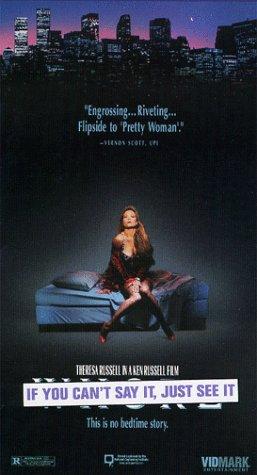
To its credit, Whore was made as a response to the glamorous and irresponsible way that prostitution was portrayed in Pretty Woman but Whore had too much going against it to succeed.  It was based on a theatrical monologue, which was almost always a bad sign.  The majority of the movie was Liz talking straight to the camera, which was another red flag.  Most ominously, it was a Theresa Russell movie that was not directed by Nicolas Roeg and those never seemed to turn out well.  The director of Whore was Ken Russell but it featured none of the excess that Russell was known for.  Stuck with a low-budget and a reportedly unenthusiastic studio, Russell’s direction was uncharacteristically restrained.  (That’s a polite way of saying boring.)

The one good thing about Whore, and the reason why I’m writing about it during this site’s look back at Twin Peaks, was the presence of Jack Nance, playing one of the few men who actually tries to help Liz.  Nance, of course, not only played fishing-obsessed Pete Martell in Twin Peaks but also starred in Eraserhead and appeared in all of Lynch’s films (with the exception of The Elephant Man) up until Nance’s mysterious death in 1996.  Literally credited as playing “Helpful passerby.” Nance only had a few minutes of screen time but made a definite impression as one of the few kind people to be found in Liz’s dark world.

As a reflection of how much times have changed, Whore‘s title was so controversial that, in 1991, it was released in some areas under an alternative title: If You Can’t Say It, Just See It.