Film Review: The Baader Meinhof Complex (dir by Uli Edel)


Released in 2008, Germany’s The Baader Meinhof Complex begins in 1967.  The entire world appears to be in the grip of protest and revolution.  The Viet Nam War is raging.  Economic inequality is increasing.  For neither the first nor the last time, the Middle East is consumed with conflict.  All across Europe, young Leftist activists protest against what they consider to be American imperialism.

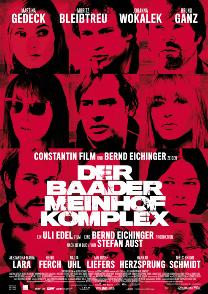
At a protest in Berlin, the police shoot and kill an unarmed student.  Outraged by not only the shooting but also the lack of accountability on the part of the police, journalist Ulrike Meinhof (Martina Gedeck) announces on television that, even though the Nazis may no longer be in power, Germany is still a fascist state.  Her words scandalize many viewers but they inspire two young activists named Andreas Baader (Moritz Bliebtreu) and Gudrun Ensslin (Johanna Wokalek).  Baader and Ensslin protest by blowing up a department store.  Their subsequent arrest and trial makes them celebrities.  It also leads to them meeting with Meinhof, who finds herself drawn to the two charismatic radicals.  Though convicted, both Baader and Ensslin are released pending an appeal and they soon become the leaders of the Red Army Faction.  They amass a following of other young radicals, many of whom are searching for some sort of purpose for their lives.  Among those who join them is Meinhof herself, who abandons her safe, middle-class liberalism and instead commits to Baader and Ensslin’s revolution.  For every violent act that Baader and Ensslin mastermind, Meinhof writes the press release that justifies it by pointing out the violent acts being carried out by governments acoss the world.

At first, the revolution itself is almost fun.  Baader and Ensslin both obviously enjoy their celebrity.  When the RAF goes to Jordan to attend a sort of terrorist training camp, they promptly get on their host’s nerves by appearing not to take their training particularly seriously.  The heads of the camp want to teach combat skills.  Baader just wants to learn how to rob a bank and he and Ensslin take such delight in upsetting the stuffy heads of the camp that it’s hard not to like them.  From the start, though, there are hints that the fun isn’t going to last.  Baader may be charismatic but he’s also arrogant, temperamental, and lacking in self-awareness.  He’s the type of revolutionary who will goad his lawyer into stealing a woman’s bag but who throws a fit when, moments later, someone else steals his car.  For all their talk of how they’re willing to do whatever it takes to bring about a revolution, neither Baader nor Ensslin seem to initially understand the true risks of their activities.  When a member of their group is killed in a shoot-out with the police, they are stunned and angered, as if it never occurred to them that the police would kill someone who opened fire on them.  As the RAF’s action grow more violent and more people are killed as a result, Meinhof struggles to justify the violence.  Eventually, not even Baader and Ensslin can control the organization that they’ve created.

It’s a familiar story.  What starts off as idealism is eventually consumed by fanaticism and cynicism.  The belief that’s one cause is right leaves people on both sides convinced that anything they do to promote that cause is correct.  The film presents the violence of the 60s and 70s as being a never-ending cycle, with the violent response of each side merely fueling the anger on the other.  At one point, a government official wonders why Baader has such a hold on his followers and the reply is that Baader has become a living myth, an activist celebrity who is idealized by his followers but who, in reality, can be just as arrogant, petty, and egotistical as those that he’s fighting.  For many, he and his organization offer an escape from a pointless bourgeois existence but, in the end, he and Ensslin and Meinhof are perhaps the most bourgeois of all.

Aided by a strong cast, director Uli Edel captures the feel of a world that seems like it’s perpetually on the verge of revolution. Though the film is full of scenes of car chases, bombs exploding, and bullets being fired, Edel never allows us to forget the real costs of such actions. The film ends with the suggestion that the cycle of violence and revolution is destined never to end as one act leads to another.  As the film reminds us, it’s a story that has played out many times in the past and will continue to play out in the future.
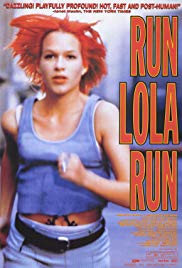
Run Lola Run


RLR.jpg

Run Lola Run has been on my film bucket list since I had hair.  It was one of those films that you heard about from the cooler people you knew.  It was the movie that the cool girls who babysat you when you were little talked about.  It was pure Gen-X and I always looked up to that generation.  I’m not an X-er, but they were damn cool.  Lola embodies that generation.  She’s so self-secure and tough and cool and hip and if you don’t like her- Whatever!

Yes, Gen-X women had a go F-yourself streak that if you didn’t like them, piss off.  I was the beginning of the Millennial/Y generation who I guess got into avocado sandwiches or whatever they say about us.  X was the generation that knew they were getting passed over because there was a bigger generation coming and the boomers did not want to get out of the way, but X embraced the suck of it all.

It is really sucky that Lola is in love with Manni who is a really mediocre criminal.  Manni also loses things; such as, a bag of 100,000 Marks (60,000 USD) that belongs to a gangster. Oopsy!  He is like the Anti-Lola: whiny, dumb, insecure, and unlike Lola -NO screaming telekinesis powers AT ALL! Yes, when she screams, it destroys or moves objects. Honestly, I couldn’t figure out why she liked Manni so much – FFS she has superpowers.

When Manni tells Lola that he lost the gangster’s money and says that he will rob a grocery store if she doesn’t get to him in twenty minutes, Lola literally RUNS into action. Yes, there is A LOT of running in this film.  She runs in hallways, on sidewalks, on streets, away from cops, and accidentally towards cops.  As she runs past people, we get a glimpse of the extras’ lives in THIS timeline and boy are these extras a bunch of cretins.

Timeline?! WHAT?! Yes, this movie is ALL about time travel.  Lola needs to get the day right or she or her boyfriend or David Duchovny will die. I’m assuming Duchovny too because he was a 1990s GOD! She time trips three times to get it, to get it, to get it right child. I was going to reference some 1998 songs, but I looked them up and The Thong Song just sounds sad.

The movie blends light surrealism with action and really believable performances.  You have this guttural feeling that this is a woman on her own, fighting her own fight, and you better get out of her way. Also, she’s the only person in the film who is pure-hearted.  Her dad is a philandering banker asshat, her boyfriend is a milquetoast, and the people she bumps into show glimpses of their sinful lives.  Lola is literally running around evil.  She has great running form too; I ran track in high school and she’s got talent.

I hope she wins and saves her loser boyfriend.

Merry Christmas!!!

RLR.gif

Review: World War Z (dir. by Marc Forster)


WorldWarZ

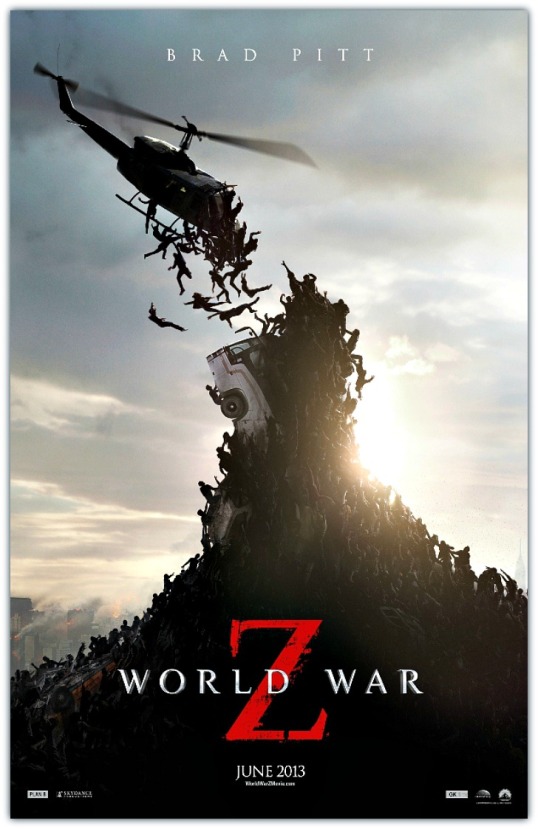
I’ll get this out of the way and just say it: World War Z the film pretty much has nothing in common with the acclaimed novel of the same name by author Max Brooks (reviewed almost at the very beginning of the site). Ok, now that we have that out of the way it’s time to get to the important part and that’s how did the film version turn out on it’s own merits.

World War Z was a film that took the long, winding and rough road to finally get to the big-screen. Whether it was the five different writers brought in to work on the script (J. Michael Straczynski of Babylon 5 fame came onboard first with Christopher McQuarrie coming unofficially to help tighten a few scenes in the end) to the massive changes made to the original source material that was bound to anger the fans of the novel, the film by Marc Forster had an uphill climb to accomplish even before the final product even came to market.

I was as surprised as man others were that the finished product was better than I had anticipated. Some had very low expectations about World War Z coming in due to the rumors and news reports coming in about the problems during production, but it doesn’t change the fact that the unmitigated disaster predicted by every film blogger and critic beforehand never came to fruition.

World War Z might not have been what fans of the novel had wanted it to be, but when seen on it’s own merit the film was both exciting and tension-filled despite some flaws in the final script and use of well-worn horror tropes.

The film begins with a visual montage interspersing scenes of nature (particularly the swarming, hive-like behavior of certain animals like birds, fish, and insects), alarmist news media reporting and the mindless celebrity-driven entertainment media that’s so big around the world. From there we’re introduced to the main protagonist of the film in one Gerry Lane (played by Brad Pitt) and his family. We see that the Lane family definitely love and care for each other with his wife Karin (Mireille Enos in the supportive wife role) and their two young daughters, Rachel and Constance. The film could easily have spent a lot of time establishing this family and their relationship towards each other, but we move towards the film’s first major sequence pretty much right after the opening. It’s this choice to not linger on the characters too long that becomes both a strength and a weakness to the film’s narrative throughout.

WorldWarZPhilly

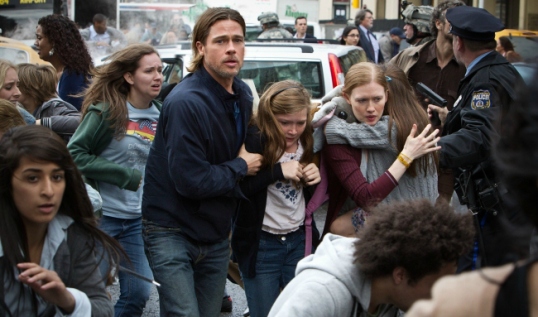
World War Z finally shows why it’s not your typical zombie film with it’s first major sequence in the center of downtown Philadelphia as Gerry and his family sees themselves in bumper-to-bumper traffic. As they wait there are some subtle hints that something might just be somewhat awry ahead of them as we see more and more police racing towards some sort of emergency ahead of the family and more and more helicopters flying overhead. There’s a brief lull in the scene before all hell breaks loose and the film’s zombie apocalypse aspect goes from 0 straight to 11 in a split second.

It’s this sequence of all-encompassing chaos overtaking a major metropolitan city seen both on the ground through the eyes of Gerry Lane and then on flying overhead wide shots of the city that gives World War Z it’s epic scope that other zombie films (both great and awful) could never truly capture. It’s also in this opening action sequence that we find the film’s unique take on the tried-and-true zombie. While not the slow, shambling kind that was described in the novel, these fast-movers (owes a lot more on the Rage-infected from 28 Days Later) bring something new to the zomgie genre table by acting like a cross between a swarm of birds or insects with the rapidly infectious nature of a virus.

These zombies do not stop to have a meal of it’s victims once they’ve bitten one but instead rapidly moves onto the next healthy human in order to spread the contagion it carries. We even get an idea of how quickly a bitten victim dies and then turns into one of “Zekes” as a soldier has ended up nicknaming them. It’s this new wrinkle in the zombie canon that adds to the film’s apocalyptic nature as we can see just how the speed of the infection and the swarm-like behavior of the zombies could easily take down the emergency services of not just a city and state but of entire nations.

WorldWarZJerusalem

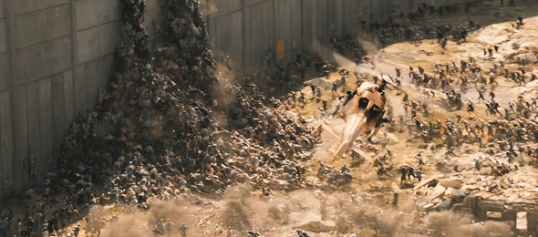
World War Z works best when it doesn’t linger too long between action sequences. Trying to inject some of the themes and ideas that made the novel such a joy to read only comes off as an uncomfortable attempt to try and placate fans of the novel. When we get scenes like Philadelphia in settings like Jerusalem and, in smaller scales but no less tense, like in South Korea and on a plane, the film works as a nice piece of summer action fare. This works in the first two thirds of the film but a sudden shift in the final third in Cardiff, Wales could be too jarring of a tonal shift in storytelling for some.

While the change from epic and apocalyptic to intimate and contained in the final third was such a sudden change this sequence works, but also shows just how bad the original final third of the film was to make this sudden change. It proves to be somewhat anticlimactic when compared to the epic nature of the first two-thirds of the film. We get a final third that’s more your traditional horror film. In fact, one could easily see World War Z as two different films vying for control and, in the end, the two halves having to try to co-exist and make sense.

World War Z doesn’t bring much of the sort of societal commentaries and themes that we get from the very best of zombie stories, but it does bring the sort of action that we rarely get from zombie films. The film actually doesn’t come off as your traditional zombie film, but more like a disaster story that just happened to have zombies as the root cause instead of solar flares, sudden ice age or alien invasion.

So, while World War Z only shares the title with the source novel it was adapting and pretty much not much else, the film wasn’t the unmitigated disaster that had been predicted for months leading up to it’s release. It’s a fun, rollercoaster ride of film that actually manages to leave an audience wanting to know more instead of being bombarded with so much action that one becomes desensitized and bored by it. There’s no question that a better film, probably even a great one, lurks behind the fun mess that’s the World War Z we’ve received, but on it’s own the film more than delivers on the promise that most films during the summer fails to achieve and that’s to entertain.