Lisa Marie Reviews An Oscar Winner: The Graduate (dir by Mike Nichols)


Hello darkness, my old friend….

After watching 1967’s The Graduate, I defy anyone to listen to Simon and Garfunkel sing about the darkness without immediately picturing a young-looking Dustin Hoffman (he was 30 when the film was made but he was playing 22) standing on a moving airport walkway with a blank expression on his face.

If you don’t picture that, maybe you’ll picture Dustin Hoffman floating in a pool, wearing dark glasses and barely listening to his parents asking him about graduate school.

Or maybe you’ll remember him driving his car across the Golden Gate bridge.  Or perhaps sitting at the bottom of his pool with a scuba mask on.  Or maybe you’ll see him awkwardly standing at the desk in the lobby of a fancy hotel, trying to work up the courage to get a room.  Or maybe you’ll just see him and Katharine Ross sitting at the back of that bus with a “what do we do now?” expression on their faces.

(Supposedly, that expression was not planned and was just a result of the shot running longer than expected.)

Ah, The Graduate.  Based on a novel by Charles Webb, Buck Henry’s script remains one of the quotable in history.  “Mrs. Robinson, you’re tying to seduce me …. aren’t you?”  “Plastics.”  “Elaine!”  Myself, I have an odd feeling of affection for the line “Shall I get the cops?  I’ll get the cops.”  Perhaps that’s because the line is delivered by a young and uncredited Richard Dreyfuss, appearing in his second film and adding to the film’s general atmosphere of alienation.

Alienation is the main theme of The Graduate.  As played by Hoffman, Benjamin Braddock feels alienated from everything.  He was a track star.  He was a top student in high school and college.  Now, he’s just a college graduate with no idea what he wants to do with the rest of his life.  One can argue, of course, that Braddock brings a lot of his alienation on himself.  He can be a bit judgmental, even though he’s the one who is having an adulterous affair with Mrs. Robinson (Anne Bancroft) while also falling for Mrs. Robinson’s daughter, Elaine (Katharine Ross).  His parents (William Daniels and Elizabeth Wilson) can be overbearing but it’s possible they have a point.  Is he planning on spending the rest of his life floating in their swimming pool?  Benjamin says that he just needs time to finally relax.  After being pushed and pushed to be the best, he just wants time to do what he wants to do before his life becomes about plastics.  When I first saw this movie, I was totally on Benjamin’s side.  Now, as I’ve gotten older, I’ve started to understand where his parents were coming from.  Still, it’s hard not to feel that Benjamin deserves at least a little bit of time to enjoy himself.  That’s what Mr. Robinson (Murray Hamilton) thinks, at least initially.

Mrs. Robinson is the most interesting character in the film, a force of chaos who lives to disrupt the staid world around her.  She’s bored with her marriage and her conventional but empty lifestyle so she has an affair with Benjamin.  Later, she grows bored with Benjamin and his desire to “just talk” for once and she moves on from him.  Benjamin and Elaine are both likable and you find yourself wishing the best for them but Mrs. Robinson is the character who you really remember.  Mrs. Robinson grew up without losing her sense of rebellion.  One doubts that Benjamin and Elaine are going to do the same.

A portrait of American suburbia and 60s alienation, The Graduate would prove to be one of the most influential social satires ever made.  A box office hit, it was nominated for seven Academy Awards.  It was nominated for Best Picture, Best Director (Mike Nichols), Best Actor (Dustin Hoffman), Best Actress (Anne Bancroft), Best Supporting Actress (Katharine Ross), Best Adapted Screenplay (Buck Henry and Calder Willingham), and Best Cinematography (Robert Surtees).  The Simon and Garfunkel songs that set the film’s mood were, for the most part, not eligible.  (Only Mrs. Robinson was written specifically for the film.)  I would argue that the film deserved to be nominated for its editing as well.  In the end, the film only won one Oscar, for Mike Nichols.  But, regardless of what awards it won or lost, The Graduate‘s legacy lives on.
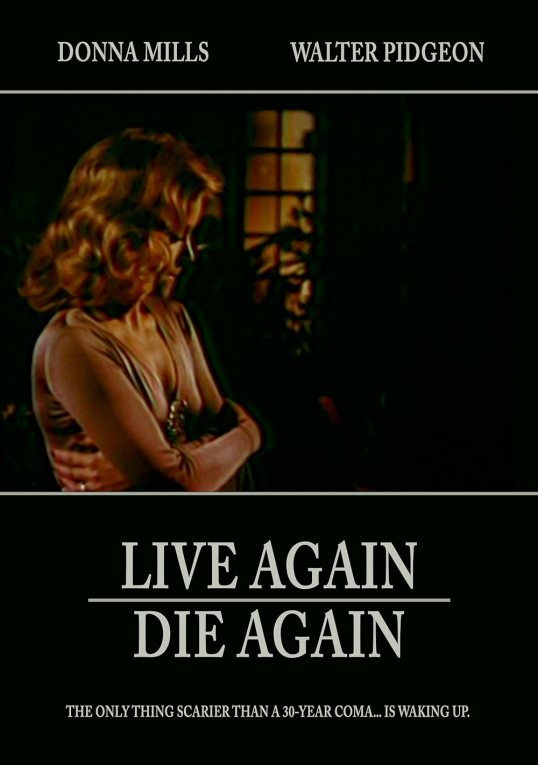


Retro Television Reviews: Live Again, Die Again (dir by Richard A. Colla)


Welcome to Retro Television Reviews, a feature where we review some of our favorite and least favorite shows of the past!  On Sundays, I will be reviewing the made-for-television movies that used to be a primetime mainstay.  Today’s film is 1974’s Live Again, Die Again!  It  can be viewed on YouTube.

30 years ago, Caroline Carmichael (Donna Mills) died.

Except, she really didn’t.  Instead, when on the verge of death, she was put into cryogenic suspension.  She has spent the last three decades in suspended animation and, as a result, she has not aged in all that time.  In fact, her hair still looks perfect.  (I have some doubts about the scientific validity of any of this but let’s just go with it.)  As this movie begins, Caroline Carmichael finally wakes up.

Caroline has an entirely new world to discover.  At a party to celebrate her awakening, Caroline is shocked to discover that, while she still appears to be young, all of her friends are now in their 60s. Her husband, Thomas (Walter Pidgeon), is now old and sickly.  Her beautiful home is now looked after by a strict and suspicious housekeeper (Geraldine Page).    Her two children (played by Mike Farrell and Vera Miles) both appear to be older than her.  In fact, her daughter was so traumatized by Caroline’s “death,” that she is now terrified of being left alone with her mother.

You might expect that this film would be dedicated to Caroline adjusting to the world of the 70s and that it might feature some thoughts on whether it’s ethical to keep someone in suspended animation for 30 years.  And there are elements of that.  Caroline is amazed by all the tall buildings.  Her daughter’s reaction to Caroline’s return is hardly heart-warming and even Caroline’s whiny son doesn’t seem to be quite as happy about it as one might expect.  Her husband has spent the last 30 years of his life waiting for Caroline to wake up and it’s hard not to consider how many opportunities for happiness or success that he missed as a result.

That said, the film itself quickly becomes more of a gothic murder mystery, as Caroline comes to realize that someone is trying to kill her.  That’s kind of a shame because I actually found all of the cryogenic stuff to be much more interesting and the idea that one could basically just stop aging for 30 years was an intriguing one.  It’s an interesting question.  If it could save your life at some undetermined point in the future, would you be frozen?  Myself, I think I would be reluctant to do so because you never know what type of world you might wake up in.  Caroline is lucky enough to wake up wealthy in the 70s but what if you woke up and discovered that your entire family had died while you were in your coma?  What if you woke up and discovered that your country had become some sort of socialist Hellhole?  Imagine if someone went into hibernation in 1994 and then woke up in 2024?  They would probably want to go back to sleep.

The film was written Joseph Stefano, who also did the script for Psycho and was one of the producers behind The Outer Limits.  Not surprisingly, the script is full of snappy dialogue and the cast features two Psycho cast members, Vera Miles and Lurene Tuttle.  Director Richard Colla keeps the action moving and, early on in the film, he does a good job of depicting Caroline’s disorientation with finding herself in an entirely new world.  The film is well-acted by the entire cast, with Donna Mills especially doing a good job as Caroline.  This was an intelligent, well-made, and — most importantly — short made-for-TV movie.  At a time when almost all movies and TV shows seem to be too long for their own good, it’s hard not appreciate Live Again, Die Again‘s 73-minute runtime.

Horror On TV: Ghost Story 1.10 “Elegy For A Vampire” (dir by Don McDougall)


On tonight’s episode of Ghost Story, college co-eds are being drained of their blood!  Who could the culprit be?  Oddly, some say that they saw a recently deceased college professor near the scene of the crime.  What was that professor studying when he died?  Vampirism!

This one is kind of silly but I always enjoy a vampire story.  This episode aired on December 1st, 1972.

Halloween TV Havoc!: GHOST STORY “Elegy for a Vampire” (1972)


gary loggins's avatarcracked rear viewer

ghst1

NBC-TV tried to bring a horror anthology series back to prime time during the 1972-73 season with GHOST STORY, executive produced by the one-and-only William Castle . Sebastian Cabot played Winston Essex, introducing the tales from haunted Mansfield House hotel. GHOST STORY had great writers, including Richard Matheson (who helped develop the concept), Robert Bloch, Harlan Ellison, Henry Slesar, and Hammer vet Jimmy Sangster, some good directors (Richard Doner, John Llewelyn Moxey, Robert Day), and a plethora of Hollywood talent: Karen Black, Kim Darby, Angie Dickinson, Melvyn Douglas, Patty Duke, Jodie Foster, Helen Hayes, Tab Hunter, John Ireland, Janet Leigh, Patricia Neal, Jason Robards, Gena Rowlands, Martin Sheen, and William Windom.

Despite all this, the show got clobbered in the ratings by the CBS FRIDAY NIGHT MOVIE and ABC’s comedy duo of ROOM 222 and THE ODD COUPLE. A mid-season title change to CIRCLE OF FEAR (dropping the Cabot segments in the process) didn’t help, and…

View original post 57 more words