Today’s horror scene that I love comes from the 1994 Italian film, Dellamorte Dellamore.
Viewed out of context from the rest of the film, this is not an easy scene to explain. My suggestion is enjoy it for the beauty of the images and Rupert Everett’s mournful performance. And, if you haven’t seen it, watch Dellamorte Dellamore as soon as possible.
4 Shots From 4 Films is just what it says it is, 4 shots from 4 of our favorite films. As opposed to the reviews and recaps that we usually post, 4 Shots From 4 Films is all about letting the visuals do the talking.
This October, I am going to be using our 4 Shots From 4 Films feature to pay tribute to some of my favorite horror directors, in alphabetical order! That’s right, we’re going from Argento to Zombie in one month!
This October, I’m going to be doing something a little bit different with my contribution to 4 Shots From 4 Films. I’m going to be taking a little chronological tour of the history of horror cinema, moving from decade to decade.
Today, we continue the 90s!
4 Shots From 4 Films
Dellamorte Dellamore (1994, dir by Michele Soavi)
In the Mouth of Madness (1994, dir by John Carpenter)
Scream (1996, dir by Wes Craven)
From Dusk Till Dawn (1996. dir by Robert Rodriguez)
This October, I’m going to be doing something a little bit different with my contribution to 4 Shots From 4 Films. I’m going to be taking a little chronological tour of the history of horror cinema, moving from decade to decade.
A lot of what you need to know about Demons, an Italian horror film from 1985, can be summed up by the fact that one of the leading characters is named Tony the Pimp. Demons is a very self-aware film, one that is not only over-the-top and ludicrous but which is cheerfully aware that it’s over-the-top and ludicrous. Considering that Demons is an apocalyptic film that ends with nearly the entire cast dead, Demons is a surprisingly good-natured horror film.
The film opens in Berlin. There’s a mysterious man hanging out at a subway station. He’s wearing a silver half-mask and, from what we can see of his face, he appears to be heavily scarred. Interestingly enough, the man is played by Michele Soavi. (Though Soavi is now best remembered as the director of Dellamorte Dellamore, he was an actor and assistant to Dario Argento when Demons was produced.) The man doesn’t speak. Instead, he hands out flyers to random people, inviting them to attend the premiere of a new horror film.
The man obviously does a very good because a truly diverse group of characters show up for the premiere. There’s a wealthy blind man who comes with his assistant. (The assistant is played by Dario Argento’s oldest daughter, Fiore.) There’s an older couple who keep shushing everyone in the audience. There’s Cheryl (Natasha Hovey), who ends up sitting next to the handsome George (Urbano Barberini, who would later co-star in Dario Argento’s Opera). And, of course, there’s Tony the Pimp (Bobby Rhoades) who shows up wearing a white suit and with two prostitutes.
The film-within-the-film is a horror film that plays out like an homage to every Italian horror film released in the 1980s. It deals with four teenagers who stumble across the grave of Nostradamus and end up transforming into blood-thirsty demons. One of the teenagers is played by Michele Soavi, though it’s never clear whether the teenager and the man in the mask are supposed to be the same person.
As they watch the movie, something strange starts to happen in the audience. One of the prostitutes scratched her face when she put on a prop mask. When the same mask appears in the movie, the cut on her face starts to throb. Soon, she is transformed into a … DEMON!
JUST LIKE IN THE MOVIE!
Needless to say, the arrival of a real-life demon leads to a panic in the theater but guess what? The doors are locked! There’s no way out! When Tony the Pimp breaks into the projection booth, he discovers that there’s no projectionist and the movie cannot be stopped! On top of that, getting scratched by a demon means that you transform into a demon yourself!
In other words — remember the debate about whether or not horror movies can turn their viewers into murderous monsters? Well, Demons says that they definitely can…
Demons was directed by Lamberto Bava, son of the famous Mario Bava, and it remains one of the most popular Italian horror films of all time. With a script that was co-written by Dario Argento (who also produced), Demons is a fun and exciting horror film that cheerfully dares you to take it too seriously. Watching this energetic film, you can tell that Bava was having a lot of fun with the idea that the world could end as a result of watching just one horror movie.
Demons was a huge box office hit so, naturally, there were hundreds of unofficial sequels. Though Michele Soavi’s The Churchwas a Demons film in every way but name, the only official sequel was Demons 2. We’ll look at that film tomorrow.
I’ve been using this October’s horrorthon as an excuse to rewatch and review the films of Dario Argento! Today we take a look at one of Argento’s best and most underrated films, 1980’s Inferno!
“There are mysterious parts in that book, but the only true mystery is that our very lives are governed by dead people.”
— Kazanian (Sacha Pitoeff) in Inferno
When 20th Century Fox released Dario Argento’s Suspiria in 1977, they weren’t expecting this Italian horror film to be a huge box office success. That it was caught them totally off guard. Though the studio executives may not have understood Italian horror, they did know that Suspiria made them a lot of money and they definitely wanted to make more of it.
As for Dario Argento, he followed up Suspiria by producing George Romero’s Dawnof the Dead. He also supervised the film’s European cut. (In Europe, Dawn of the Dead was known as Zombi, which explains why Lucio Fulci’s fake sequel was called Zombi2.) When Dawn of the Dead, like Suspiria before it, proved to be an unexpected box office hit, it probably seemed as if the Argento name was guaranteed money in the bank.
Hence, when Argento started production on a semi-sequel to Suspiria, 20th Century Fox agreed to co-finance. Though the majority of the film was shot on a sound stage in Rome, Argento was able to come to New York to do some location work, hence making this Argento’s first “American” film. The name of the movie was Inferno.
Sadly, Inferno proved to be a troubled production. Shortly after production began, Argento became seriously ill with hepatitis and reportedly, he had to direct some scenes while lying on his back while other sequences were done by the second unit.
As well, Argento had a strained relationship with 20th Century Fox. Argento wanted James Woods to star in Inferno but, when it turned out that Woods was tied up with David Cronenberg’s Videodrome, the studio insisted that Argento cast an actor named Leigh McCloskey instead. As a performer, James Woods is nervy, unpredictable, and compulsively watchable. Leigh McCloskey was none of those things.
Worst of all, as a result of a sudden management change at 20th Century Fox, Inferno was abandoned by its own distributor. The new studio executives didn’t know what to make of Inferno and, in America, the film only received an extremely limited release. The few reviews that the film received were largely negative. (Like most works of horror, Argento’s films are rarely critically appreciated when first released.) It’s only been over the past decade that Inferno has started to receive the exposure and acclaim that it deserves.
Argento has said that he dislikes Inferno, largely because watching it remind him of a very difficult time in his life. That’s unfortunate, because Inferno is one of his best films.
The Mother of Tears (Ania Pieroni) in Inferno
“Have you ever heard of the Three Sisters?”
“You mean those black singers?”
— Sara (Eleonora Giorgi) and Carlo (Gabriele Lavia) discuss mythology in Inferno
As I stated previously, Inferno is a semi-sequel to Suspiria. Whereas Suspiria dealt with an ancient witch known as the Mother of Sighs, Inferno deals with her younger sister, the Mother of Darkness. The Mother of Sighs lives underneath a German dance academy. The Mother of Darkness lives underneath a New York apartment building. The Mother of Sighs was a witch. The Mother of Darkness is an alchemist.
Beyond that and the fact that Alida Valli is in both films (though apparently playing different characters), there aren’t many references to Suspiria in Inferno. The tone of Inferno is very different from the tone of Suspiria. If Suspiria was perhaps Argento’s most straight-forward films, Inferno is one of his most twisted. It makes sense, of course. Suspiria is about magic but Inferno is about science. Suspiria casts a very Earthy spell while Inferno often feels like a scientific equation that cannot quite be solved.
The film deals with Mark Elliott (Leigh McCloskey), an American music student in Rome. After he gets a disturbing letter from his sister, Rose (Irene Miracle), a poet who lives alone in New York City, Mark heads back to the U.S. to check in on her. (That’s right — Mark and Rose are two more of Argento’s artistic protagonists.) However, when Mark arrives, he discovers that his sister is missing and it’s obvious that strange inhabitants of the building are trying to cover something up.
“May I ask a strange question?”
“How strange?”
— Sara (Eleonora Giorgi) and Mark Elliot (Leigh McCloskey) in Inferno
Even more than with some of Argento’s other films, the plot of Inferno isn’t particularly important. One reason why it’s easy to get annoyed with Mark is because he spends the entire film demanding to know where his sister is, despite the fact that those of us in the audience already know that she’s dead. Argento showed us her being murdered shortly before Mark’s arrival. Argento makes sure that we know but he never bothers to reveal the truth to Mark and one of the more curious aspects of the film is that Mark never discovers that his sister is dead. (By the end of the film, one assumes that he’s finally figured it out but even then, we don’t know for sure.) The fact of the matter is that Mark and his search for his sister are never really that important. Argento doesn’t particularly seem to care about Mark and he never really gives the viewer any reason to care either. (Of course, it doesn’t help that Mark is rather stiffly played by Leigh McCloskey.)
Instead, Argento approaches Inferno as a collection of increasingly surreal set pieces. Much as in Lucio Fuci’s Beyond trilogy, narrative logic is less important than creating a dream-like atmosphere. Often time, it’s left to the viewer to decide how everything fits together.
There are so many odd scenes that it’s hard to pick a favorite or to know where to even begin. Daria Nicolodi shows up as Elise Stallone Van Adler, a neurotic, pill-popping aristocrat who briefly helps Mark look for his sister. Eventually, she’s attacked by thousands of cats before being stabbed to death by one of Argento’s trademark black-gloved killers. After Elise’s death, her greedy butler makes plans to steal her money. Did the butler kill Elise? We’re never quite sure. Does the butler work for The Mother of Darkness or is he just being influenced by her evil aura? Again, we’re never sure. (By that same token, when the butler eventually turns up with eyes literally hanging out of their sockets, we’re never quite sure how he ended up in that condition. And yet, somehow, it makes a strange sort of sense that he would.)
Cats also feature into perhaps the film’s most famous scene. When the crippled and bitter book seller Kazanian (Sacha Pitoeff) attempts to drown a bag of feral cars in a Central Park pond, he is suddenly attacked by a pack of a carnivorous rats. A hot dog vendor hears Kazanian’s cries for help and rushes over. At first, the vendor appears to be a good Samaritan but suddenly, he’s holding a knife and stabbing Kazanian to death. Why did the rats attack in the first place? Is the hot dog vendor (who only appears in that one scene) a servant of the Mother of Darkness or is he just some random crazy person? And, in the end, does it matter? At times, Inferno seems to suggest that the real world is so insane that the Mother of Darkness is almost unnecessary.
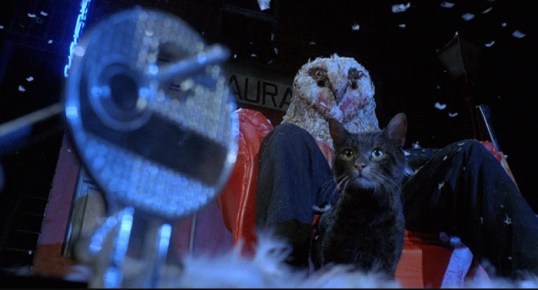
Meanwhile, in Rome, Mark sits in class and reads a letter from his sister. When he looks up, he immediately sees that a beautiful young woman is looking straight at him. She’s petting a cat and staring at him with a piercing stare. (She is played Ania Pieroni, who later achieved a certain cult immortality by appearing as the enigmatic housekeeper in Lucio Fulci’s The House By The Cemetery.) The film later suggests that the woman is the third mother, the Mother of Tears, but why would she be in the classroom? Why would she be staring at Mark?
When Mark’s girlfriend, Sara (Eleonora Giorgi), does some research in a library, she finds a copy of a book about The Three Mothers and is promptly attacked by a mysterious figure. When she flees back to her apartment, she meets Carlo (Gabriele Lavia, who was also in Deep Red) who agrees to stay with her until Mark arrives. Is Carlo sincere or is he evil? Argento does eventually answer that question but he certainly keeps you guessing until he does.
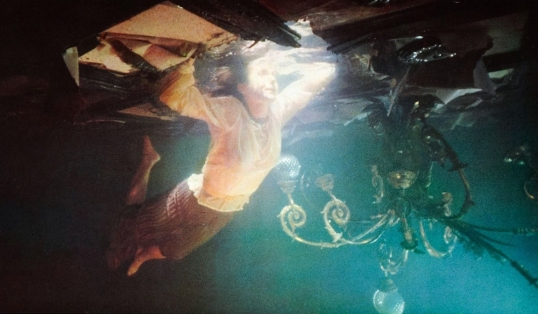
Finally, I have to mention the best and most haunting scene in the film. When Rose searches a cellar for a clue that she believes will lead her to the Mother of Darkness, she discovers a hole that leads to a flooded ballroom. When Rose drops her keys into the hole, she plunges into water and swims through the room. (The first time I saw this scene, I immediately said, “Don’t do that! You’re going to ruin your clothes!”) As Rose discovers, not only keys get lost in that flooded ballroom. There’s a dead body as well, one which floats into the scene from out of nowhere and then seems to be intent on following Rose through the entire room. It’s a sequence that is both beautiful and nightmarish. (It certainly does nothing to help me with my fear of drowning.)
In the end, Inferno is a dream of dark and disturbing things. Does the plot always make sense? Not necessarily. But that plot’s not important. The film’s surreal imagery and atmosphere of doom and paranoia casts a hypnotic spell over the viewer. Inferno is perhaps as close to a filmed nightmare as you’ll ever see.
“She writes poetry.”
“A pastime especially suited for women.”
— Mark and the Nurse (Veronica Lazar) in Inferno
Finally, no review of Inferno would be complete without discussing some of the people who worked behind-the-scenes.
Along with acting in the film, Daria Nicolodi also worked on the script. As is so often the case with Daria and Dario’s collaborations, there are conflicting reports of just how involved Nicolodi was with the final script. Daria has said that she would have demanded co-writing credit, if not for the fact that it had previously been such an ordeal to get credited for Suspiria. Others have claimed that, while Nicolodi offered up some ideas, the final script was almost all Argento’s creation.
(Comparing the films that Argento made with Nicolodi to the ones that he made without her leads me to side with Nicolodi.)
Working on the film as a production assistant was William Lustig, the famed exploitation film producer and director who would later become the CEO of Blue Underground. Reportedly, during filming, Lustig attempted to convince Nicolodi to star in a film that he was going to direct. Nicolodi’s co-star would have been legendary character actor Joe Spinell. Disgusted by the film’s script, Nicolodi refused the role and, as a result, Caroline Munro ended up playing the stalked fashion photographer in Lustig’s controversial Maniac.
Future director Michele Soavi worked on several of Argento’s films. I’ve always been under the impression that Soavi was a production assistant on Inferno but, when I rewatched the film, he wasn’t listed in the credits. Inferno is also not among his credits on the imdb. I guess the idea that one of my favorite Italian horror directors worked on one of my favorite Italian horror films was just wishful thinking on my part.
However, you know who is listed in the credits? Lamberto Bava! Bava, who would later direct the Argento-produced Demons, worked as an assistant director on Inferno. That leads us to perhaps the most famous member of Inferno’s crew…
Mario Bava!
Inferno was the final film for the father of Italian horror. As so often happens, there are conflicting reports of just how involved Bava was with the production. It is know that he worked on the special effects and that he directed some second unit work while Argento was bed ridden with hepatitis. Irene Miracle has said that almost all of her scenes were directed by Mario Bava and that she rarely saw Argento on set.
Mario Bava is often erroneously described as being Dario Argento’s mentor. That’s certainly what I tended to assume until I read Tim Lucas’s All The Colors of the Dark, the definitive biography on Mario Bava. Bava was certainly an influence and it’s certainly true that Argento appears to have had a better relationship with him than he did with Lucio Fulci. But the idea that a lot of Italian horror fans have — that Mario Bava was hanging out around the set of The Bird With The Crystal Plumage and offering Argento fatherly advice — does not appear to be at all true. (It’s a nice image, though.) With all that in mind, it’s still feels somewhat appropriate that Bava’s final work was done on one of the best (if most underappreciated) Italian horror films of all time.
“I do not know what price I shall have to pay for breaking what we alchemists call Silentium, the life experiences of our colleagues should warn us not to upset laymen by imposing our knowledge upon them.”
— The Three Mothers by E. Varelli, as quoted in Dario Argento’s Inferno
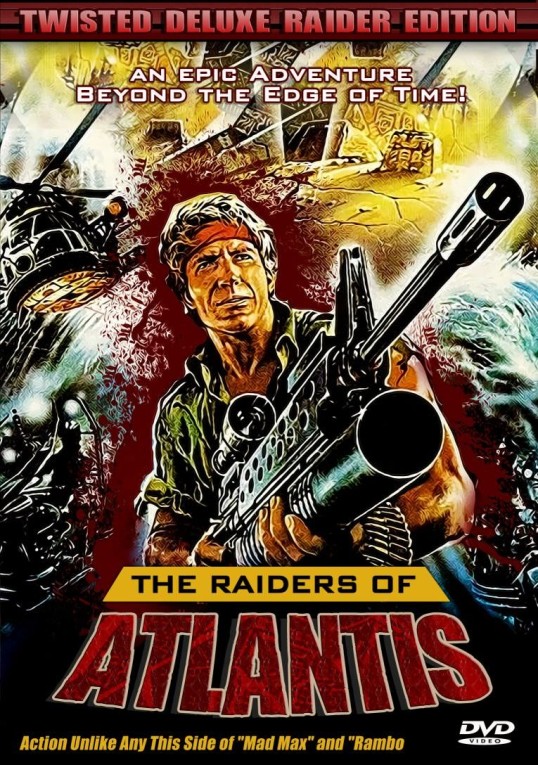
It’s been a while since I’ve done an entry in the Daily Grindhouse here at the Shattered Lens. (And please, no snarky comments about the definition of the word “daily.” I’ve been doing such a good job of controlling my temper lately…) So, I figured I’d correct that oversight by taking a few moments to tell you about The Raiders of Atlantis, an Italian film from 1983.
(If you’re a regular reader, you know how much I love Italian exploitation films.)
On many a Saturday night, I have gotten together with my fellow members of the Late Night Movie Crew (including TSL’s own Patrick Smith) and we’ve watched movies with titles like Samson Vs. The Vampire Women, Cruel Jaws, and Space Raiders. Whenever it’s my night to pick the movie, I’ve always been tempted to select The Raiders of Atlantis. In many ways, it’s the perfect film to watch with a group of snarky and outspoken friends. The film is action packed, it features a lot of over-the-top melodrama, the pace is relentless, and the film is so defiant in its refusal to follow any narrative logic that you can’t help but respect its defiant soul.
(If Raiders of Atlantis could talk, it would say, “I do what I want!” before giving the finger to anyone complaining about not being able to follow the plot.)
I’ve come very close to picking it on a few occasions but then I always remember just how violent this film can be. By the standards of Italian exploitation, The Raiders of Atlantis is actually rather tame but it still features a lot of people dying in a lot of disturbingly graphic ways. People are set on fire. People are graphically shot in the face. One unfortunate woman gets a dart fired into her neck. Heads roll, literally.
The Raiders of Atlantis tells the story of what happens when a bunch of scientists on an oil rig accidentally cause the lost continent of Atlantis to rise up out of the ocean. A Caribbean island is conquered by an army of heavily made up, motorcycle-riding, mohawk-sporting “interceptors,” who claim to be the descendants of the original inhabitants of Atlantis. Led by the evil Crystal Skull (Bruce Baron), the Interceptors are determined to kill everyone who does not possess Atlantean blood. When they’re not randomly killing, they’re searching for an artifact that will … well, to be honest, I’m not sure why they wanted that artifact but they certainly were determined to find it.
Who can stop the Interceptors? Well, how about Mike (Christopher Connelly) and Washington (Tony King)? They’re two mercenaries who just happened to be nearby when the continent of Atlantis rose out of the ocean. Along with a group of scientists, an escaped convict, and a random bald guy in tuxedo, it’s up to Mike and Washington to save the world!
(Washington, incidentally, has just converted to Islam and spends most of the movie demanding that Mike call him by his new name, Mohammad. I imagine this is one of those subplots that would be abandoned if the film were remade today.)*
So, as I said before, The Raiders of Atlantis makes absolutely no sense but that’s actually a huge part of the film’s charm. This is one of those relentless action films that truly does seem to be making it up as it goes along. There’s something very enjoyable about seeing how many movies The Raiders of Atlantis can rip-off in just 98 minutes and you soon find yourself thankful that the film didn’t waste any time trying to justify itself. The film may not be traditionally “good” but it is flamboyantly bad and, in many ways, that’s even better. Maybe you have to be a fan of Italian exploitation cinema to truly understand.
Speaking of which, if you have any experience at all with Italian exploitation, you will immediately recognize half the cast of The Raiders of Atlantis. You may not know they’re names, because these actors frequently changed their Americanized screen names from film to film. But you’ll definitely recognize the faces and one of the more enjoyable aspects of The Raiders of Atlantis is that you get to see all of these familiar faces together in one movie.
For instance, Christopher Connelly is best known for starring in Lucio Fulci’s ill-fated Manhattan Baby. Tony King gave memorable performances in both The Last Hunter and Cannibal Apocalypse. The cast also features giallo and spaghetti western mainstays George Hilton and Ivan Rassimov, along with Filipino Z-movie veteran Mike Monty. Stefano Mingardo, who appeared in a handful of violent actions films, shows up as an escaped convict and livens up every scene in which he appears. Even Michele Soavi, years before he would direct the brilliant Dellamorte Dellamore, appears in a small role. Unfortunately, George Eastman is nowhere to be found but still, The Raiders of Atlantis is worth seeing for the cast alone.
The Raiders of Atlantis was directed by Ruggero Deodato, who is best known for directing such controversial films as Cannibal Holocaust and The House At The Edge of the Park. Raiders of Atlantis is nowhere close to being as extreme as either one of those films. If anything, it feels like a more violent than usual SyFy movie.
The Raiders of Atlantis has apparently slipped into the public domain and, as of this writing, it’s been uploaded to YouTube. You can watch the trailer below. This trailer not only captures the feel of the film but it also features the film’s enjoyably vapid theme music.
—–
*And why not remake it!? Chris Pratt and Tyrese Gibson could play Mike and Washington.
I will be the first to admit that I can occasionally be a little moody but tonight, as I sit here typing, I am in such a good, extremely hyper mood. Maybe it’s because I’m wearing my beloved black Pirates shirt. Or it could be because, for once, this house is neither too cold nor too warm. Then again, it could just be because it’s time for me to bring you another edition of Lisa Marie’s Favorite Grindhouse and Exploitation Trailers!
This is a trailer for a “double feature of horror,” featuring I Dismember Mama and The Blood-Splattered Bride. When I’ve spoken with other grindhouse movie fans on the web, this trailer is often cited as being a favorite. Personally, I think it goes along for about a minute too long but I can understand why it’s so popular. For one thing, it’s nothing like the trailers that are currently playing in theaters across America in that it’s a short film in itself. By the way, the trailer for Blood-Splattered bride sans I Dismember Mamma can be viewed here.
From the wonderful nation of Italy comes this example of the odd little grindhouse genre known as nunsploitation. I can probably count the number of good nunsploitation films on one hand. And yet when confronted with a film like this, I cannot look away. Maybe it’s because I was raised in the Catholic church. Or it could just be because the totally hot and lickable Joe Dallesandro is in so many of them. Along with Dallesandro, Killer Nun features Anita Ekberg of La Dolce Vita fame and Alida Valli of Third Man, Suspiria, and Inferno fame.
(Sidenote: Once when I was going to Catholic school, this really mean, fat girl was jealous of me because I was prettier than her so she whacked me in the face with a ruler so hard that it actually broke the skin right over my right eye and I had to get 3 stitches to close the cut and I’ve still got this little scar and sometimes, when I wink or seductively arch my right eyebrow, it still hurts a little. I hope somebody eventually went all Killer Nun on that girl…)
When I showed my sister Erin this trailer, she said, “You’re not going to jump up and start trying to do any of that stuff yourself, are you?” “Uhmmm…no,” I replied but, to be honest, I was totally about to do it. I don’t know much about Angela Mao but just, on the basis of this trailer, she’s my hero. This trailer is just infectious and, as I watched, I wondered, “How difficult can it be?” Well, apparently, it’s very difficult but that’s a story for a different time.
4) The Bullet Machine (1969)
“He can hack it!” Uhmmm….well, yes, okay then. At first, I thought I had actually found a trailer that was more violent than the trailer for Massacre Mafia Style but, upon careful reflection, I have to say that Massacre Mafia Style is still the king. The two hitmen in Massacre Mafia Style may not fire as many bullets but they still manage to kill everyone else in the trailer. Whereas The Bullet Machine is constantly shooting his gun but doesn’t really seem to accomplish much as a result. Plus, the mafia hitmen had style whereas the Bullet Machine just seems to be kind of a prick. If ever I have to prove the thesis that most men use guns as a substitute for their own limp penis, this trailer will be exhibit one.
I don’t know much about this film other than it’s obviously an Italian attempt to capitalize on the success of the original Alien and it is not — as I originally assumed — the same film as Luigi Cozzi’s Alien Contamination. One of the things that I love about Italian exploitation cinema is just the pure shamelessness of it all. I imagine there had to have been about a thousand remakes of Alien in the early 80s but only the Italians would have the balls to actually name a film Alien 2.
As for this trailer, it has its slow spots but seriously, stick with it for the final shot. And remember — you could be next!
(On the plus side, a young Michele Soavi is in this film. YAY!)
I’m in such a good mood right now that I’m just going to have to end this latest entry with a little Jean Rollin. Now, just in case anyone out there is unfamiliar with the unique cinematic vision of Jean Rollin, you should understand that this trailer is far more explicit than any of the other trailers featured in this post. In fact, I’m surprised that Youtube hasn’t taken it down yet. So, if you’re easily offended, I don’t know why you would be visiting this site in the first place. But anyways, if you’re easily offended, consider yourself warned.
As for Fascination, it’s actually one of the more accessible of Jean Rollin’s vampire films. The image — seen towards the end of this trailer — of Brigittie LaHaie with a scythe has become iconic.
I’m not, by any stretch of the imagination, a comic book reader and there’s really only been four comics that I’ve ever actively made it a point to track down and/or read. One was Strangers in Paradise, which I was introduced to by my first college roommate, who told me that she was my Katchoo. Secondly, there was an old comic book series from the 70s called Tomb of Dracula that Jeff loves. The entire series has been collected in four trade paperbacks and, last Christmas, I ordered all four of them. Of course, since I ordered them all in August (patience and impulse-control not being my strong suit), I had a lot of time to read through them before wrapping them up and giving them away. (And, to my surprise, I enjoyed them in all of their platform shoed glory.) Third, there’s The Walking Dead which Arleigh introduced me to. And finally, there’s Dylan Dog.
I haven’t read a lot of Dylan Dog, largely because it’s an Italian comic and English translations aren’t easy to come across. (And apparently, when an American company did try to reprint the series in English, they ended up getting sued by the estate of Groucho Marx.) So, I can’t claim to be an expert on Dylan Dog because almost all of my information about this series comes second-hand. Honestly, if you asked me to tell you about Dylan Dog, I could probably give you the Wikipedia equivalent of an answer (i.e., that Dylan Dog is a private investigator in London who deals with super natural cases.)
Why does Dylan Dog fascinate me? Well, some of it is because of what I’ve heard about it from sources that I trust. I hate that answer because it sounds so flakey and simple-minded but luckily, that’s not the only reason. There’s also the fact that Dylan Dog’s investigative partner is a guy named Groucho who looks (and apparently acts) just like Groucho Marx. The other is that Dylan Dog was created by the same author — Tiziano Scalvi — who is responsible for inspiring one of the greatest movies ever made, Michele Soavi’s Dellamorte Dellamore. In fact, Dellamorte Dellamore started off as an attempt to make a Dylan Dog film and the film’s main character had appeared — in a supporting role — in Dylan Dog. From what I’ve heard, Dellamorte Dellamore — with its use of the paranormal as a metaphor for alienation and other deeper philosophical concerns — captured the sensibility of Dylan Dog.
Finally, one of my favorite authors — Umberto Ecco — is on record as saying, “I can read the Bible, Homer, or Dylan Dog for several days without being bored.”
So, that’s why I raised an eyebrow when I came across the trailer for Dylan Dog: Dead of Night while looking up grindhouse movie trailers on youtube.
And then I watched the trailer and that eyebrow quickly went down.
Number one, no Groucho. That already indicates that this is a compromised film. Number two, I may not be able to “read” Dylan Dog but I can look at it well enough to know that Dylan Dog is not a firing-two-guns-at-once type of hero. Number three — New Orleans? Bleh. I’m officially bored with movies that try to be “colorful” by filming in New Orleans. Number four, Taye Diggs? I’m sorry but any series that could inspire Dellamorte Dellamore deserves better than New Orleans and Taye Diggs.
Dylan Dog: Dead of Night is scheduled to be released in the U.S. on April 29th, 2011.
The Italian horror cinema scene has always been dominated by such names as Mario Bava, Dario Argento and Lucio Fulci. Their films became Italy’s contribution to horror cinema and one cannot find a fan of the genre who don’t hold these three gentlemen in high regard. Other names of the Italian horror scene were not as well-known beyond the most hardcore horror fans and some just don’t deserve to be in the same company as the previously mentioned trio. One filmmaker who should be part of their company is one Michele Soavi. He rose through the ranks as an actor at first before moving on to becoming assistant directors for mentors such as Joe D’Amato and Dario Argento. The latter would become a major influence in Soavi’s work and would help produce some of his films. One of those Argento would end up producing for Soavi is the 1989 supernatural horror film, The Church (known in Italy as La Chiesa).
The Church wasn’t one of Soavi’s best films, but it was still one of the better horror films to come out of Italy during the waning years of the 80’s when Italian horror began a slow decline. Starring a very young Asia Argento (hard to believe that a career which began with reports of nepotism would turn out to be a successful one in and out of Italy) and an Italian-American actor named Tomas Arana (people would know him best as the ambitious Quintus in Ridley Scott’s Gladiator), the film starts off with a cohort of Teutonic Knights who destroy and kill a town suspected of witchcraft. The bodies of all killed soon get dumped into a mass grave and sealed with a huge metal cross and prayers to keep the evil that was done from ever coming out.
The beginning does have a somewhat ambiguous tone to it as we the audience don’t know if the villagers were indeed evil. Soavi definitely leaves that up in the air until the final third of the film kicks in and most of the horror scenes appear to satisfy gore fans. The knights destroying the village was well-staged and executed with some cool kill-scenes and effects.
It’s the middle reel where the film slowed down to the point that could lose the more casual horror fan. We get the usual non-believer researcer (Arana) who stumbles upon the ancient cross sealing the mass grave beneath the church that had been built over it down the centuries. Even this researcher and another knows that they should leave it alone, but being the scientists one of them proceeds to unseal the find with the reasoning that pursuit of knowledge should triumph over supersitition. Thus, the church becomes the scene of demonic possessions of various individuals. First, the initial researcher who opens unseals the cross then the parents of Asia Argento’s character before moving on to churchgoers who become trapped in the church after some demonic force seals all exits.
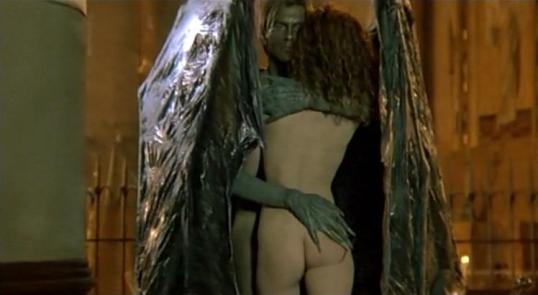
The rest of the film once that church seals itself is one person either getting killed by those possessed by the demons escaping from the sealed grave or someone getting possessed. This third act actually has a touch of Fulci’s nightmarish-style and less of Argento’s more dream-like quality. There’s a beautiful scene of Tomas Aranas’ character made-up to be some verdigrised-bronze angel statue, wings and all, embracing a very naked young woman that looked straight out of a Luis Royo painting. Another scene where regular Soavi actor Barbara Cupisti was shown in sexual congress with a demonic being that should give more than a few people nightmares despite being framed and shot in a beautiful manner.
The final nightmare scene of beauty which pushes The Church over into Fulci territory is when a mass of naked, muddied bodies of all those possessed entwine and writhe to form the likeness of a demon’s head. This sequence alone was worth watching through the much slower middle section of this film and Soavi’s eye for staging and lighting the scene made it look like something out of the pages of Dante Alighieri’s Divine Comedy.
One could say that The Church just didn’t live up to the usual quality one expected out of a Michele Soavi film after a he made the excellent giallo-slasher film Stage Fright just two years prior. This second full-lenght feature by Soavi showed him still honing his talent as a filmmaker which would finally culminate five years later in one of the best Italian horror films and one of the best films in the zombie subgenre with his Dellamorte Dellamore. Plus, even when he’s not on top of his craft like with The Church it is still worth a watch and better than the stuff released by his contemporaries like Bruno Mattei.






 Through the Shattered Lens