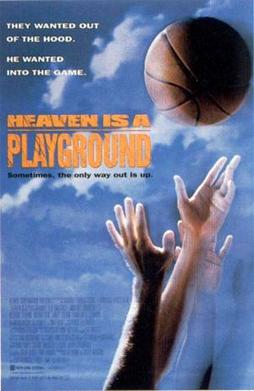
Heaven Is A Playground (1991, directed by Randall Fried)


In the projects of Chicago, Byron Harper (Michael Warren) runs a nonprofit basketball farming system and helps black kids, many of whom would have no other prospects other than a live of poverty or crime, to find a home in college basketball programs.  Byron is passionate about what he does but he’s also a stern taskmaster and not quick to forgive.  When one of his best players, Casey (Nigel Miguel), developed a drinking problem, Byron kicked him off his team.  Byron’s main concern is his stepson, Truth (Victor Love).  Truth is a great basketball player but also has an addiction to cocaine and an attitude problem.

For reasons that are never made clear, white lawyer Zack Telander (D.B. Sweeney) shows up on the court and says he wants to play one-on-one with Byron.  Everyone assumes that Zack is a drug dealer and they tell him to get lost.  But when one of the players is shot, Zack is the only person at the court who has a car.  Zack rushes the player to the hospital and he wins Byron’s trust.  Byron needs Zack to look over a professional contract that is being offered to Truth by sleazy sports agent David Racine (Richard Jordan).

For reasons that are again never made clear, Byron tells Zack to coach some of the more troubled players on the court, including Casey.  At first, Zack isn’t much of a coach but eventually, he gets the players to trust him and start playing like a team.  He also tries to get burned-out Matthew Lockhart (Bo Kimble) to start playing the game again.

Heaven Is A Playground is a mess of a movie that doesn’t really seem to be sure what it wants to say about basketball, the projects, or race relations.  The main problem is that a lot of the decisions made by Byron and Zack don’t make any sort of logical sense.  Moments of broad comedy are mixed with moments of high drama and it makes for an unconvincing and overly melodramatic sports movie.

Heaven Is A Playground had a long pre-production phase.  At one point, a young Michael Jordan agreed to play the role of Matthew Lockhart.  By the time the film actually went into production, Jordan was a superstar and had neither the time (nor, probably, the desire) to co-star in a low-budget sports movie.  After the movie flopped, director Randall Fried sued Jordan for breach-of-contract, claiming that he caused the film’s box office failure by refusing to appear in it and, as a result, Fried’s directorial career stalled.  In the suit, Fried claimed that he was on the verge of being “the next Steven Spielberg” until Jordan refused to do his film.  The jury found Jordan not liable and awarded him $50,000.

(Trying to sue Michael Jordan was a terrible idea in 1998 and it’s probably still a terrible idea today.  People love Jordan!)

Personally, I have to say that Mike made the right decision.

The TSL Horror Grindhouse: Dreamaniac (dir by David DeCoteau)


In 1986’s Dreamaniac, Adam (Thomas Bern) is a total dork who lives with his much more popular sister, Pat (Ashlyn Gere).  Adam aspires to be a heavy metal superstar and he is very much interested in the occult.  He’s been having dreams about being visited by a sultry and mysterious woman named Lily (Sylvia Summers).  When he performs a Satanic ritual to summon her for real, Lily offers him anything that he wants.  Instead of asking her to turn him into the world’s greatest guitarist or something smart like that, Adam asks to be irresistible to women.

Seriously, Adam, if you were the world’s greatest guitarist, you would be getting laid all the time whether you were irresistible or not.  The ugliest guy in the world is still be sexy if he can play guitar.  Take a look at the Rolling Stones and its long history of ugly guitar players who all looked good as long as they were playing.  Take a look at …. oh, I don’t know.  I’m tired and I’m just trying to pad out this review because there’s not much to be said about this movie.  Let’s move on.

Anyway, Adam gets his wish but he also has to kill the women so that Lily can take their soul and …. eh, that’s stupid.  Like Adam, why would you agree to such a counter-productive agreement?  Adam was so desperate to get a girlfriend that he apparently didn’t consider that none of them would really live long enough for him to have a real relationship with them.  What an idiot.

After Adam sells his soul or whatever it is that he’s supposed to be doing with Lily, Pat throws a party at the house and a bunch of shallow sorority girls and fraternity boys come over and everyone dies one-by-one, usually right after having sex.  No one really notices that everyone at the party is dying but then again, no one in this movie really seems to like anyone else so maybe they just don’t care.

Dreamaniac kind of ticked me off, largely because the title should have been Dream Maniac instead of Dreamaniac.  I guess I would have let them even get away with something like Dreammaniac.  But Dreamaniac, with only one m, just doesn’t make sense and looking at the word makes my multi-colored eyes tear up.  This may sound like a petty complaint but there’s honestly not much to be said about Dreamaniac.  It’s one of those low-budget, shot on video horror films where the lighting is often so dark and the soundtrack so muddy that you’re never really sure what’s happening on-screen.  I dare anyone to watch this film and seriously try to tell one character a part from another.  I had no idea who half the characters were and quite frankly, I didn’t care.  This was one of David DeCoteau’s earlier films and it has none of the subversiveness that distinguished DeCoteau’s better efforts.  (Considering the harsh tone of this review, I feel like I should point out that DeCoteau has directed some truly entertaining movies.  Dreamaniac is certainly not the film that should be used to judge his overall career.)

Of course, today, DeCoteau is best known for directing the “Wrong” films for Lifetime.  And really, I think the only thing that could have saved Dreamaniac would have been Vivica A. Fox showing up and saying, “Adam, you picked The Wrong Succubus.”

Film Review: Drive, He Said (dir by Jack Nicholson)


First released in 1971, Drive, He Said tells the story of two college roommates.

Hector (William Tepper) is a star basketball player who everyone expects to turn pro.  His intense coach (Bruce Dern) is always yelling at him to stop fooling around on the court but Hector is more interested in fooling around elsewhere as he’s having an affair with Olive (Karen Black), the wife of a self-styled “hip” philosophy professor named Richard (Robert Towne).

Gabriel (Michael Margotta) is Hector’s best friend.  They live together, even though Hector’s coach thinks that Gabriel is a bad influence.  Gabriel is a self-styled campus radical.  He has a devoted group of followers who will do just about anything that he tells them to do.  Gabriel is big into guerilla theater and symbolic protests.  Nothing he does seems to add up too much but, unlike Hector, he’s good at giving speeches.

Together, they worry about the draft!

Of course, they’re both worrying about two different types of drafts.  Hector is worried about the NBA draft and whether he should enter it.  He’s been playing basketball for as long as he can remember.  The only thing that he’s really good at is playing basketball.  And yet, Hector isn’t sure if he wants to spend the rest of his life taking orders from his coaches and devoting every minute to playing the game.  However, Hector’s worked himself into a corner.  When one NBA official asks him what he’s going to do if he’s not drafted, Hector admits that he doesn’t know.  When asked what his major is, Hector replies, “Greek.”

Gabriel, on the other hand, is worried about being drafted into the military and being sent to Vietnam.  Gabriel considers himself to be a revolutionary but it soon becomes clear that he really doesn’t have much of a plan for how to start his revolution.  Indeed, the film suggests that his activism is more about his own insecurity over his own sexuality than anything else.  Gabriel particularly seems to be obsessed with Hector’s affair with Olive.  While Hector reaches new highs on the court, Gabriel comes closer and closer to having a psychotic break.

Director Jack Nicholson found a way to work in shout out to his friend, Harry Dean Stanton

Drive, He Said was one of the many “campus rebellion” films that were released in the early 70s and, much like Getting Straight, it’s definitely a product of its time.  Today, it it’s known for anything, it’s for being the directorial debut of actor Jack Nicholson.  (Nicholson has said that, before he was cast in Easy Rider, he was actually planning on abandoning acting and pursuing a career as a director.)  The film features many of the flaws the are typically present in directorial debuts.  The pacing is terrible, with some scenes ending too quickly while others seem to go on forever.  At times, the film feels a bit overstylized as Nicholson mixes jump cuts, odd camera angles, and slow motion to little effect. It’s very much a film about men, so much so that the film’s ultra-masculinity almost verges on self-parody.

And yet, there are moments of isolated brilliance to be found in Drive, He Said.  Some of the shots are genuinely impressive and the army induction scene shows that Nicholson could direct comedy, even if he does let the scene drag on for a bit too long.  Though Nicholson doesn’t appear in the film, his approach to the story features his trademark cynicism and sense of fatalism.  Though he was often associated with the counterculture, Nicholson was more a member of the Beat generation than of the hippies.  As such, Drive, He Said has more in common with Jack Kerouac than Abbie Hoffman.  Drive, He Said is definitely an anti-establishment film but, at the same time, it doesn’t make the mistake of glorifying Gabriel or his followers.  Gabriel, with his constant demand that everyone join him in his ill-defined revolution, is almost as overbearing as basketball coach and, towards the end of the film, he commits an act of violence that leaves no doubt that his “revolution” is all about his own self-gratification.  The film is less a polemic and more a portrait of people trying to find their identity during a time of political and cultural upheaval.

The film’s biggest flaw is that neither William Tepper or Michael Margotta really have the charisma necessary to carry a movie, especially one in which even the main characters often do unlikable things.  Tepper is dull while Margotta overacts and, at times, comes across as if he’s trying too hard to imitate his director.  It falls to the film’s supporting cast to provide the energy that Tepper and Margotta lack.  Fortunately, Bruce Dern and Karen Black are both perfectly cast.  Bruce Dern seems to be having a blast as the fanatical basketball coach while Karen Black brings a fierce intelligence to the role of Oliva, an intelligence that one gets the feeling wasn’t really in the original script.  Considering how misogynistic every other character in the film is, it’s impossible not to cheer when Olive announces, “I’m not going with anybody, anywhere.”

(For whatever reason, there was a definite strain of misogyny that seemed to run through the majority of the late 60s and early 70s counterculture films.  Just consider the amount of time Getting Straight devoted to Elliott Gould shouting at Candice Bergen.)

Drive, He Said is flawed but interesting.  As a director, Nicholson understood how to frame a shot but he wasn’t quite sure how to tell a cohesive story.  That said, the film itself is a definite time capsule of a very specific cultural moment.