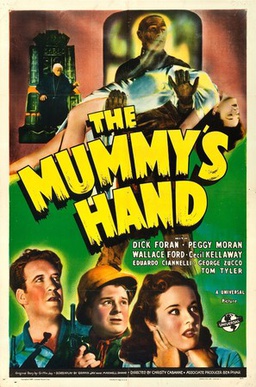
Horror Film Review: The Mummy’s Hand (dir by Christy Cabanne)


In 1940, having brought back The Invisible Man and Frankenstein’s Monster, Universal Pictures decided that it was also a good time to bring back The Mummy!

The Mummy’s Hand takes place in what we’re told is Egypt, though it’s obvious just a Universal backlot.  Two archeologists — Steve Banning (Dick Foran) and Babe Jenson (Wallace Ford) — are penniless and stuck in Egypt.  Babe wants to find a way to return to Brooklyn and his ex-girlfriend.  Steve is a bit more serious about archeology, though it must be said that he’s no Indiana Jones when it comes to discovering relics and taking them to museums.  If Indiana is the type who will risk his life to search a hidden cave in the Amazon Rain Forest, Steve is far more likely to just wander around an Egyptian market until he comes across someone selling an ancient vase.

Which is exactly what happens!  Steve finds someone selling a vase and, after he learns where it came from, he buys the vase.  He takes the vase to Prof. Andoheb (George Zucco), not knowing that Andoheb is an Egyptian high priest who has been sworn to protect the tomb of Princess Ananka.  When Andoheb realizes that the vase could lead to the discovery of the tomb, he lies and claims that it’s a forgery.  He then “accidentally” breaks it in order to keep Steve from showing the vase to anyone else.  Steve, however, is not deterred and a chance meeting with an American magician named Tim Sullivan (Cecil Kellaway) leads to Sullivan agreeing to finance Steve’s expedition to discover where the vase came from.  Sullivan’s daughter, Marta (Peggy Moran), worries that Steve and Babe are just trying to steal her father’s money so she insists on coming on the expedition with Steve.  Also following the expedition is Andoheb, who is himself starting to fall for Marta and who is hoping that he can use a secret serum hidden in the tomb to make both himself and Marta immortal.

Of course, the tomb itself is protected by Kharis (Tom Tyler, under a ton of bandages), a mummy who is immortal due to the serum and who has sworn to protect the tomb from any outsiders.  Kharis moves slowly but efficiently.  He’s a ruthless and silent killer, one whose eyes appears to just be two black holes, the better to reflect his own lack of a soul.

The main problem with The Mummy’s Hand is that it takes forever for the Mummy to actually show up.  This is only a 67-minute film and the Mummy mayhem doesn’t really start until around the 50 minute mark.  As a result, the viewer spends a lot of time watching Steve and Babe wander around Egypt and essentially act like stereotypical American tourists.  Even when the expedition finally gets started, the audience still has to sit through endless scenes of Marta accusing Steve of being some sort of con artist.  This is a movie that will truly leave you saying, “When is the mummy going to show up!?”

That said, The Mummy itself is a frightening creature, especially with his empty eyes.  Mummy’s are naturally frightening, especially when they’re walking towards you and dragging their decaying bandages  behind them.  The Mummy is effective, I just wish he had been featured in more of the movie.
Previous Universal Horror Reviews:

  1. Dracula (1931)
  2. Dracula (Spanish Language Version) (1931)
  3. Frankenstein (1931)
  4. Island of Lost Souls (1932)
  5. The Mummy (1932)
  6. The Invisible Man (1933)
  7. The Bride of Frankenstein (1935)
  8. Dracula’s Daughter (1936)
  9. Son of Frankenstein (1939)
  10. Black Friday (1940)
  11. The Invisible Man Returns (1940)
  12. The Wolf Man (1941)
  13. Ghost of Frankenstein (1942)
  14. Invisible Agent (1942)
  15. Frankenstein Meets The Wolf Man (1943)
  16. Son of Dracula (1943)
  17. House of Frankenstein (1944)
  18. The Invisible Man’s Revenge (1944)
  19. House of Dracula (1945) 
  20. Creature From The Black Lagoon (1954)
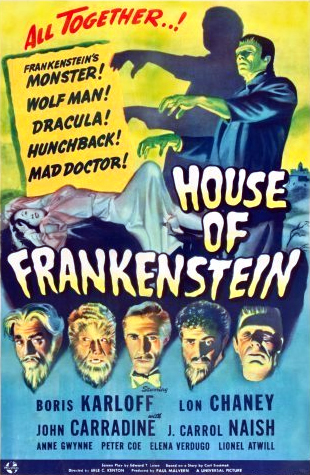
Horror Film Review: House of Frankenstein (dir by Erle C. Kenton)


House of Frankenstein opens in a prison.  Dr. Gustav Neimann (Boris Karloff), the bother of one of Baron Frankenstein’s assistants, has been convicted of robbing graves and attempting to carry on the Baron’s work.  Dr. Neimann’s faithful assistant is the hunchback, Daniel (J. Carroll Naish).  Daniel is loyal to Neimann because Neimann has promised to someday place Daniel’s brain in a stronger body.

When a sudden earthquake allows Neimann and Daniel to escape, they waste no time in getting revenge on Neimann’s enemies.  First, they murder a traveling showman named Prof. Lampini (George Zucco) and steal both his identity and his mobile horror exhibit.  Included in the exhibit is a coffin that Lampini claimed held the skeleton of Dracula.  (There’s even a stake sticking out of the skeleton’s chest.)  When Neimann returns to his original hometown, he removes the stake from the skeleton so that he might use it on the Burgomaster, Hussman (Sig Ruman).  The skeleton transforms into Dracula (John Carradine).  Because he is relieved to have been brought back to life, Dracula does not attack Neimann but instead agrees to help Neimann get revenge on Hussman in return for Neimann looking after his coffin.  Dracula soon learns that he should have thought twice before trusting either Neimann or Daniel.

Neimann moves on, stopping off at Frankenstein’s village and recovering the bodies of both Frankenstein’s Monster (Glenn Strange) and Larry Talbot (Lon Chaney, Jr.) from the frozen chamber in which they were trapped at the end of Frankenstein Meets The Wolf Man.  Revived from suspended animation, Larry immediately starts whining about how much his life sucks.  (I love The Wolf Man but subsequent films turned Larry into the whiniest of the Universal monsters.)  Neimann promises to put Larry’s brain in a new body if he helps to revive the Monster.  Larry agrees.  Meanwhile, Daniel falls in love with a gypsy girl named Ilonka (Elena Verdugo) while Ilonka falls in love with Larry.  Daniel wants Neimann to put his brain in Larry’s body, Larry won’t stop whining about the approaching full moon, and the villagers are getting suspicious!

House of Frankenstein has never been a favorite of critics or horror historians and the film does have its share of flaws.  For instance, though it would have been fun to see Bela Lugosi return to his signature role, John Carradine seems like ideal casting for Dracula.  Unfortunately, Dracula is only in the film for about ten minutes and he comes to an end that really doesn’t feel worthy of a character of his stature.  The film reduces Larry Talbot to just being a dumb lug who won’t stop feeling sorry for himself.  Finally, Glenn Strange has the right physique for the Monster but, much as with John Carradine, he is underused.

That said, I still enjoyed House of Frankenstein.  A lot of that is because of Boris Karloff, who brings a lot of sly humor to his performance as the mad scientist.  (That said, Karloff himself later said that he did the role solely for the money and was bored with the whole thing.)  J. Carroll Naish turns Daniel into a rather sympathetic henchman, one who is so desperate to be “normal” that he’s willfully blinded himself to the fact that Neiman really doesn’t care about anyone other than himself.  (In many ways, he’s the equivalent of the hapless characters that Michael Ripper later played for Hammer Films.)  Finally, Elena Verdugo brings a lot of life to the stock role of the dancing gypsy girl who falls in love with Larry Talbot despite the fact that Larry is kind of a dumb lug.

For a modern viewer, the main appeal of House of Frankenstein is that it is one of the original Universal horror films, even if it came out long after the first Dracula and Frankenstein films.  As such, it has all the things that we associate with and love about those films.  There’s a ruined castle.  There’s angry villagers.  The cast is full of Universal horror mainstays, including Lionel Atwell and Anne Gwynne.  And, yes, the film features a mob descending on the castle with torches.  Flaws and all, House of Frankenstein is an enjoyable time capsule.  It’s a horror film from a far more innocent age and it’s one that remains a fun watch.

Previous Universal Horror Reviews:

  1. Dracula (1931)
  2. Dracula (Spanish Language Version) (1931)
  3. Frankenstein (1931)
  4. Island of Lost Souls (1932)
  5. The Mummy (1932)
  6. The Invisible Man (1933)
  7. The Bride of Frankenstein (1935)
  8. Dracula’s Daughter (1936)
  9. Son of Frankenstein (1939)
  10. The Wolf Man (1941)
  11. Ghost of Frankenstein (1942)
  12. Frankenstein Meets The Wolf Man (1943)
  13. Son of Dracula (1943)
  14. Creature From The Black Lagoon (1954)

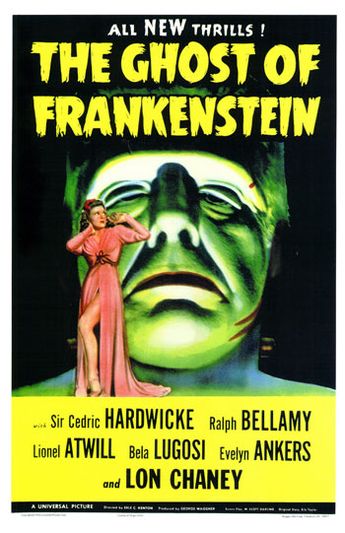
Horror Film Review: The Ghost of Frankenstein (dir by Erle C. Kenton)


the_ghost_of_frankenstein_movie_poster

In 1942, three years after Son of Frankenstein, Universal Pictures continued the story of the Frankenstein family with The Ghost of Frankenstein!

However, The Ghost of Frankenstein was a far different film from the three that came before it.  The budget was lower.  The story was less complicated.  The running time was much shorter.  Whereas the previous films in the franchise clearly took place in Germany, the setting for The Ghost of Frankenstein is less easily defined.  (Considering that the film was made during World War II, this isn’t surprising.)  The biggest change is that, in The Ghost of Frankenstein, the monster is not played by Boris Karloff.  Instead, the role is taken by Lon Chaney, Jr.  Chaney’s hulking frame was perfect for the monster but his face is never as expressive as Karloff’s.  Whereas Karloff turned the monster into as much of a victim as a victimizer, Chaney plays the monster like a … well, a monster.

Returning from Son of Frankenstein, Bela Lugosi is back as Ygor.  At the start of the film, we learn that Ygor actually wasn’t killed at the end of Son of Frankenstein.  Instead, he was just wounded.  He’s spent the last few years hiding out in the old castle, trying to once again revive the monster.  When the villagers attempts to blow up the castle, he and the monster flee.

It turns out that there’s one other Frankenstein son.  His name is Ludwig and he’s played by a very dignified Sir Cedric Hardwicke.  Ludwig, who has been hiding his identity and denying the family legacy, has a successful medical practice in another village.  Working with his assistants, Dr. Kettering (Barton Yarbrough) and the bitterly jealous Dr. Bohmer (Lionel Atwill, who played a far different role in Son of Frankenstein), Ludwig has developed a procedure in which a damaged brain can be removed from the skull, repaired, and then stuck back inside the skull…

Uhmmm … wow, I have no idea what to say about that.  That’s quite a medical breakthrough, though…

When Ygor and the monster show up in the village, searching for Ludwig, the monster ends up getting arrested.  The local prosecutor (played by Ralph Bellamy, Cary Grant’s romantic rival in both The Awful Truth and His Girl Friday) asks Ludwig to examine the prisoner.  Ludwig is shocked to discover that the prisoner is his father’s creation!

Ygor wants Ludwig to perform a brain transplant on the Monster.  At first, Ludwig is hesitant but then he’s visited by Henry Frankenstein’s ghost.  (Since Colin Clive died 5 years before Ghost of Frankenstein went into production, Hardwicke plays both Ludwig and Henry.)  The ghost asks Ludwig to perfect the monster.

Ludwig finally relents and agrees to give the monster a new brain.  Ludwig wants to use the brain of kindly colleague but Ygor has different plans…

The Ghost of Frankenstein is only 67 minutes long but, oddly, it still feels just a little bit draggy.  Director Erle C. Kenton does a workmanlike job but, at no point, does Ghost feature the wit that distinguished James Whale’s films or Rowland V. Lee’s work on Son of Frankenstein.  Chaney is not a particularly interesting monster but Bela Lugosi is a lot of fun as Ygor.  With Chaney showing even less emotion than he usually did and Hardwicke appearing to be occasionally embarrassed by the whole film, it falls to Lugosi to keep the audience awake and he manages to do just that.  Lugosi’s performance may be overly theatrical but that’s exactly what The Ghost of Frankenstein needed.

The Ghost of Frankenstein is occasionally entertaining but ultimately forgettable.  It’ll best be enjoyed by Universal horror completists.

Horror On The Lens: Son of Frankenstein (dir by Rowland V. Lee)


son_of_frankenstein_movie_poster

For those who might have a hard time keeping their Universal monster films straight, 1939’s Son of Frankenstein is the third Frankenstein film, following the original and Bride of Frankenstein.  It’s the first one to have been directed by someone other than James Whale.  It’s the one that features the one-armed policeman.  It’s the one that features Bela Lugosi as a vengeful grave robber named Ygor.  It’s also the final film in which Boris Karloff would play the monster.

And, on top of all that, it’s also a pretty good movie, one that holds up as both a sequel and stand-alone work!

Son of Frankenstein opens decades after the end of Bride of Frankenstein.  (How many decades is open for debate.  I’ve read that the film is supposed to be taking place in 1901 but there’s a scene featuring a 1930s-style car.  Let’s just compromise and say that the film is taking place in 1901 but someone in the village owns a time machine.  I think that’s the most logical solution.)  Henry Frankenstein is long dead, but his name continues to strike fear in the heart of Germans everywhere.  Someone has even tagged his crypt with: “Heinrich von Frankenstein: Maker of Monsters.”

Needless to say, everyone in the old village is a little uneasy when Henry’s son, Wolf von Frankenstein (Basil Rathbone) shows up at the castle.  In fact, they’re so uneasy that the local constable, Krogh (Lionel Atwill), pays Wolf and his family a visit.  Krogh explains that, when he was a child, the Monster ripped his arm out “by the roots.”  AGCK!

(That said, that really doesn’t sound like the Frankenstein Monster that we all know and love, does it?  I suspect there’s more to the story than Krogh is letting on…)

Wolf explains that he has no plans to bring the Monster back to life.  He then sets out to do just that.  Wolf wants to redeem Henry’s reputation and the only way to do that is to prove that Henry was not misguided in his quest to play God.  Helping Wolf out is Ygor (Bela Lugosi).  Ygor is a former blacksmith who was due to be hanged but, because of a malfunction with the gallows, he just ended up with a disfigured neck.

It turns out that Ygor happens to know where the Monster’s body is being hidden.  When Wolf brings the Monster back to life, he quickly discovers that Ygor’s motives weren’t quite as altruistic as Wolf originally assumed.  It turns out that Ygor wants revenge on the jury that sentenced him to death and now, he can use the Monster to get that revenge.

As for the Monster, he no longer speaks.  Instead, he just angrily grunts and he kills.  Whatever kindness he developed during the previous film was obviously blown up with Elsa Lanchester at the end of Bride of Frankenstein.  On the one hand, it’s fun to see Karloff as the monster.  On the other hand, it’s impossible not to regret that he doesn’t get to do much other than stumble around, grunt, and strangle people.  There are only two scenes where Karloff gets to show any real emotion and, in both cases, he does such a great job that you can’t help but regret that the monster is such a one-dimensional character in Son of Frankenstein.

But no matter!  Regardless of how the film uses (or misuses) the Monster, it’s still an entertaining 1930s monster film.  Basil Rathbone does a great job as the imperious but ultimately kindly Wolf von Frankenstein.  And Bela Lugosi’s natural theatricality makes him the perfect choice for Ygor.  To be honest, I actually think Lugosi does a better job as Ygor than he did as Dracula.  I know that’s blasphemy to some but watch the two films side-by-side.  Lugosi is clearly more invested in the role of Ygor.  Considering that Lugosi reportedly felt that he was mistreated in Hollywood, it’s tempting to wonder if some of his own anger informed his performance as the perennially mistreated and bitter Ygor.

Son of Frankenstein closed out the Karloff Frankenstein trilogy.  When Frankenstein’s Monster made his next appearance, he would be played by the same actor who later took over the role of Dracula from Lugosi, Lon Chaney, Jr.

(And interestingly enough, Lugosi would subsequently take over the role of the Monster from Chaney.  But that’ll have to wait for a future review…)

Horror on the Lens: Wasp Woman (dir by Roger Corman and Jack Hill)


Today’s Horror on the Lens is the 1959 Roger Corman film, Wasp Woman!

In this film, Janice Starlin (Susan Cabot) is the head of a cosmetic company.  When she discovers that her sales are suffering because the public has noticed that she is getting older, Janice does what any dedicated CEO would do!  She agrees to undergo a radical treatment involving the royal jelly taken from a queen wasp.

Do you think this treatment will make Janice look younger?

Or will it lead to her periodically transforming into a monstrous creature?

Or will it lead to both!?

Watch the movie to find out!

Horror Film Review: Frankenstein (dir by James Whale)


frankenstein_poster_1931

Pity poor Frankenstein.

No, not Victor von Frankenstein, though he certainly suffered greatly for playing God.  How much he suffered depends on which version of the story you see or read.  If you’ve read the book, you know that Victor lost his family, his love, his mentor, his best friend, and eventually his own life.  Victor is usually a bit more resilient in the films.  For instance, if you go by what we’ve seen in the Hammer films, Baron Frankenstein was pretty much indestructible.  The only thing he lost was his sanity, sacrificed as he continually insisted on making the same mistake over and over again.

And when I say “Pity poor Frankenstein,” I’m not referring to the monster either, though he certainly deserves some sympathy as well.  The monster never asked to be brought to life.  He may have destroyed castles and killed people and tossed little girls into a lake but Frankenstein’s Monster rarely seemed to mean any harm.  He was just scared, confused, and often abused.

Instead, when I say pity poor Frankenstein, I’m referring to the 1931 film.  It’s a classic horror film, one that, after 85 years, still holds up remarkably well.  It’s probably the best directed of all the Universal horror films, with James Whale bringing his own dark wit and idiosyncratic style to the film.  As was often the case with films of the era, some of the performances are better than others but no one can find fault with Boris Karloff’s definitive portrayal of Frankenstein’s monster.

And yet, for a lot of filmgoers, Frankenstein will always just be that movie where Colin Clive rants, “It’s alive!  IT’S ALIVE!”  That scene is justifiably famous but it always bothers me when it shows up as an isolated clip, devoid of context.  I’ve seen it used in documentaries.  I’ve seen it used on snarky news programs where it’s almost always used to poke fun at someone.  I’ve even seen it used in a car commercial.

You’ve seen it too.  It’s one of those scenes that everyone has seen, regardless of whether or not they’ve sat through the entire movie:

When you watch this scene without any context, it’s easy to smirk.  You might assume that the entire film is Colin Clive ranting and Dwight Frye snorting.  It’s only after you’ve seen the entire film that you appreciate Clive’s performance.  Throughout the entire first part of the film, Colin Clive plays Henry Frankenstein as being unstable but also rather withdrawn.  He’s almost vampiric, hiding inside of his laboratory all day and only coming out at night to rob graves with the hunchbacked Fritz (Dwight Frye).  He’s almost a recluse, which is why his fiancée, Elizabeth (Mae Clarke) asks his best friend, Victor (John Boles), and his mentor, Dr. Waldman (Edward Van Sloan, who also played Van Helsing in Dracula) to check in on him.

When the monster does move its hand and Clive shouts, “It’s alive!,” it’s the first sign of true emotion that Frankenstein has shown through the entire film.  He’s spent a lifetime dreaming of playing God and, now that he has, it overwhelms his mind.  Much like poor Ralph Norton in The Mummy, Clive sees something that defies all reason and he has a breakdown.

I have to admit that, for me, the first third of the film drags.  That may not have been as much of a problem in 1931, when audiences were seeing the story for the first time and didn’t already know what was going to happen.  In 1931, the slow start undoubtedly helped to build up suspense.  But, when seen today, there is a temptation to say, “Get on with it!”

(Of course, I tend to say that with all Frankenstein movies, because I’m impatient and there always seems to be an endless number of scenes people digging graves and stealing brains until we finally get to the good part.  If anything, the 1931 Frankenstein doesn’t take as long to get going as some of the later Hammer films, many of which treated the monster as almost an afterthought.)

Fortunately, Frankenstein does get on with it.  When the monster finally comes to life and Colin Clive has his moment of divine madness (“This is what it feels like to be God!”), the film shifts in tone.  If anything it becomes a bit of a dark comedy.  Henry (who is noticeably more subdued after his outburst, a bit like a drug addict who is only now starting to come down after being awake for a week) and his friends now have to not only hide the monster but try to figure out how to deal with it.  Every few minutes, it seems like another villager or Frankenstein relative is dropping by the castle.  Having created life, Henry now has no idea what to do with it.  Being God isn’t as easy as it looks.  Having created life, all Henry can now do is keep the doors locked and attempt to go back to living a relatively normal life.  In this case, that means preparing for his wedding.

It’s not until the sadistic Fritz torments the frightened monster with a torch that this horror classic truly becomes a horror film.  And it’s significant that the true monster here is not Frankenstein’s Monster but instead Fritz.  When the monster kills Fritz, he does it out of self-defense.  When he strangles Dr. Waldman, it’s because Waldman was about to cut into him with scapel.

And then there’s the little girl.  How this scene must have shocked audiences in 1931!  It’s still shocking today, because we’re not used to children dying in movies, not even horror movies.  Of course, the monster doesn’t mean to hurt the girl.  The girl is the first person to show the monster any sort of kindness.  It’s just that the monster doesn’t understand that the girl won’t float like the flowers.

The sequence where the girl’s father carries her body into the town square is perhaps one of the most devastating ever filmed.   Not only does the father’s grief contrast with the happiness of the villagers but it also contrasts with the attitude of Henry and Elizabeth who are busy preparing from their wedding, ignorant of what Henry’s creation has done.

Or, at least, they are until the monster confronts Elizabeth in her bedroom.

karloff-boris-frankenstein_11

I love that dress.

It all ends, of course, with a confrontation between Henry and his monster and a windmill being set aflame.  There’s also a happy coda that, in the best tradition of horror, feels a bit tacked on.  Fortunately, those of us who know our film history know that the story didn’t end with this film.  It continued with The Bride of Frankenstein, which I’ll be reviewing tomorrow.

As for Frankenstein, it’s a classic and it’s pretty much required viewing for any film lover.  Boris Karloff’s performance as the confused and often child-like monster is both poignant and menacing.  Watching the film, you just wish that the world had been nicer to him.

(Then again, that approach didn’t exactly work out well for the little girl with the flowers…)

Frankenstein is so much more than just Colin Clive shouting, “It’s alive!”  If you haven’t actually sat down watched the entire movie from beginning to end, you owe it to yourself to do so today.

http://www.youtube.com/watch?v=McUce_xwxeA