Melissa Joan Hart — Sabrina! — plays the events coordinator at a ski lodge in this 2019 Christmas movie. It’s the holiday season and the everyone wants to go skiing …. including her ex-boyfriend!
I like this film. It has nice scenery, it has holiday cheer, it has Ted McGinley, and it has Melissa Joan Hart. It has all the necessary ingredients for a fun Lifetime holiday film.
2012’s MeantToBe tells the story of …. well, it tells a few stories.
Tori (Erin Sossamon) is a teenage girl who has a bright future but only if she can survive her less-than-wonderful present. She has an abusive boyfriend. Her parents seem to be absent. She’s a photographer and her high school counselor (Michael Gross) has helped her to find a scholarship but Tori has recently discovered that she’s pregnant!
Linda Dickson (Erika Eleniak) is a social worker, who lives in a nice house and who has a wonderful husband (Dean Cain) but who also seems to be struggling with an overwhelming depression. Maybe it’s because her 18 year-old daughter has recently left home for college. She obsesses on finding newspaper stories about 20 year-olds doing wonderful things. She cuts them out of the paper and puts them in a shoebox. (I do the same thing with well-written obituaries.) When a call comes in about a loud argument at Tori’s house, Linda is the one who investigates. When she realizes that Tori is pregnant, Linda becomes a part of Tori’s life, giving her advice. Linda is determined to convince Tori to not get an abortion, even if it means that Tori will lose her scholarship.
And finally, there’s Nathan (Bradley Dorsey), a twenty year-old aspiring writer who doesn’t know what he should write about. In a voice-over, he says that he’s learned that writing about only what you know can be a trap so he’s decided to write about what he doesn’t know. (By that logic, my next short story should be about trigonometry.) Nathan grew up in the foster system. He doesn’t know who his mother was. He’s not even fully sure where he was born. But he’s still going to search for her so he can discover not only where he came from but also why he was abandoned.
Nathan finds himself staying at a mysterious hotel, one where all of the other guests also appear to be people who never knew their mother. Even though Nathan puts a do-not disturb sign on his door, the motel maid (Della Reese) still regularly enters his room and encourages him to get out of bed and continue his search. With the help of two other guests, Shelly (Kristen Renton) and Becky (Colleen Foy), Nathan is able to track down his mother and her address….
Can you guess who she is?
Of course, you can! Now, in all fairness to the movie, it doesn’t present the fact that Linda is Nathan’s mother as some sort of surprise twist. From the moment that Nathan figures out that his mother was named Linda and then Becky comes across an old glamour shot of Erika Eleniak in a high school yearbook, it’s pretty clear that Linda Dickson gave up Nathan and she’s never stopped thinking about him and that’s why she’s so obsessed with Tori. That’s not the twist.
But there is a twist and here it is….
Are you ready?
Nathan and all the residents at the hotel and most of the passengers on the flights that Nathan takes in and out of town are …. ABORTION GHOSTS! That’s right. Linda had an abortion. Nathan was the son she was meant to have but didn’t.
Is it heavy-handed? Yes. Is it effective? Well, the answer to that question probably depends on how you feel about abortion. That’s one thing about all of these abortion movies. It’s hard for me to imagine that any of these films — whether it’s the church-produced Pro-Life films or the studio-produced Pro-Choice films — have ever changed anyone’s mind about abortion. As such, movies about abortion largely exist to preach to the choir. Abortion movies, regardless of which side they come down on, are largely movie that people watch so that they can nod and think to themselves, “My side really is the only correct one.”
As for the film itself, it’s rather slow and the voice-over tends to get rather portentous. Dean Cain was probably on the set for one day. Colleen Foy gave the best performance while Erika Eleniak was a bit bland in the lead role. On the plus side, it looked like a real movie, which is more than one can say for a lot of faith-based films. Again, how you react to the film will largely depend on whether or not you agree with its message.
2012’s Atlas Shrugged: Part II picks up where Part I left off.
The time is still the near future. (Part I specifically set the story as taking place five years into the future. Part II declines to use a specific date but it does feature some news personalities playing themselves so it’s still clearly only meant to be a few years from 2012.) The economy has gotten even worse. The poor are only getting poorer while the rich are getting richer. Under the direction of Head of State Thompson (Ray Wise) and his main economic advisor, Wesley Mouch (Paul McCrane), the government has nationalized nearly every business. Halfway through the film, Thompson declares a national emergency and uses the Fair Share Law to invoke Directive 10-289. All inventors, businessmen, and other creative people are required to sign their patents over to the government and to stop trying to develop now techniques. Wages are frozen. No one can be fired and no one can be hired. Creative thinking is discouraged. Asking questions or expressing doubt is forbidden. People are encouraged to snitch on anyone not following the Directive. Thompson and Mouch insist that it’s for the “good of the people,” and anyone who disagrees runs the risk of being dragged into court and sent to prison for ten years. Meanwhile, gas now costs $42.00 a gallon. One of the funnier moments of the film features someone paying $865.72 to fill up a truck.
Dagny Taggart (Samantha Mathis), the Vice President of Taggart Transcontinental Railways, is still trying to discover who invented an experimental motor that she found hidden away in a mine. The motor could potentially change the way that goods are transported but it appears to be missing one component. Unfortunately, all of the great scientists and inventors have been vanishing, with many of them leaving behind notes that ask, “Who is John Galt?” Meanwhile, Dagny’s lover, Hank Rearden (Jason Beghe), fights to protect Rearden Metal from being taken over by the government and Dagny’s brother, James (Patrick Fabian), sells out to Wesley Mouch with the end result being that there’s no one left at Taggart Transcontinental with the intelligence or the experience necessary to keep two trains from colliding in a tunnel.
Given that Ayn Rand herself was an atheist who wrote very critically of religion, it’s interesting how much of Atlas Shrugged: Part II feels like one of those evangelical films where the Rapture comes and the entire world falls apart because all of the believers have suddenly vanished. In the case of Atlas Shrugged, the world falls apart because all of the creatives and all of the leaders of industry and all of the innovative thinkers have abandoned it so that they can create a new community with John Galt. (They’ve “stopped the motor of the world.”) In many ways, this is the ultimate in wish fulfillment, a way of declaring, “They’ll miss me when I’m gone!” Indeed, the majority of people who keep a copy of Rand’s novel displayed on their bookcase do so because they believe that they would be one of the lucky ones who was approached by Galt. No one expects that they’ll be the person left behind to try to run the railroad. It’s a bit like how like the most strident Marxist activists always assume they’ll be the ones organizing the workers as opposed to being a worker themselves.
Not surprisingly, the same critics who attacked Part I didn’t care much for Atlas Shrugged Part II. When I first saw it, I thought the film was a bit too long and I was annoyed that, with the exception of a few minutes at the end, the film didn’t really seem to move the story forward. At the same time, just as with the first film, I appreciated the fact that the second film was proudly contrarian in its portrayal of the government as being inherently incompetent. After all, this was 2012, back in the “good government” era, when a lot of people still reflexively assumed that the government was staffed only by hyper-competent policy wonks who knew what they were doing and who were only concerned with making sure that “the trains ran on time,” to borrow an old expression.
Rewatching the film this weekend, I have to say that I actually appreciated Atlas Shrugged Part II a bit more than the first time I watched it. Yes, Part II was still a bit too long and the domestic drama between Hank and his wife fell flat but Part II is still a marked improvement on the first film. Some of that is because Part II had a higher budget than Part I and, as a result, it didn’t look as cheap as the first film. The corporate offices looked like actual corporate offices and the factories looked like real factories. Secondly, the second film had an entirely different cast from the first film. Samantha Mathis, Jason Beghe, and especially Patrick Fabian were clear improvements on the actors who previously played their roles. That’s especially important when it comes to Mathis and Beghe because, as opposed to the first film, Part II convinces the viewer that Dagny and Hank actually are as important as they think they are. When the trains collide in the tunnel, the viewer never doubts that Mathis’s Dagny could have prevented the disaster if not for the government’s attempts to force her out of her own company. As well, the viewer never doubts that Beghe’s Hank would fight to the end to protect his business, even if it means prison. One wouldn’t have necessarily believed that while watching the first film.
Finally, having lived through the COVID era, the film’s portrait of government overreach and incompetence feels a lot more plausible when watched today. One doesn’t have to be a fan of Rand’s philosophy or agree with her solutions to see the parallels between Directive 10-289 and the policies that led to children being kept out of schools and numerous small business having to shut their doors. In an era when most people’s faith in governmental institutions has been broken to such an extent that it might never be fixed in our lifetime, Atlas Shrugged Part II resonates. Whereas the film once felt subversive, now it feels downright prophetic.
Johnny Van Owen (Robert “Vanilla Ice” Van Winkle) is a rapper who travels across the country on his big yellow motorcycle, with his loyal crew traveling behind him. When one of the motorcycles is damaged, Johnny and the crew pull into a repair shop owned by Roscoe (Sidney Lassick) and Mae (Dody Goodman). Even though their repair shop looks like something out of Pee Wee’s Playhouse, Mae says that Roscoe can fix anything.
Johnny says it’s all cool because he’s got his eye on Kathy Winslow (Kristin Minter), an honors student who is about to leave for college and who is dating Nick (John Haymes Newton). Johnny is so in love with Kathy that he rides his motorcycle in front of her while she’s riding a horse and she nearly breaks her neck as a result. Johnny doesn’t apologize because Johnny’s cool as ice. Instead, Johnny renames Kathy “Kat” and then takes one look at Nick and says, “Drop that zero and get yourself a hero.” Just to make sure there’s no confusion how Johnny feels about his romantic rival, he also calls Nick “Dick.” Later, Johnny performs a rap just for Kat and Kat agrees to go on a date with him to an abandoned construction site.
Kat’s father (Michael Gross) is in the witness protection program but, when he and Kathy appear on the news, he’s spotted by two gangsters who kidnap Kat’s younger brother. Kat’s father assumes that Johnny must be working with the gangsters so Johnny has to clear his name by defeating the gangsters and performing the rap to end all raps.
Cool As Ice was an attempt to update the old Elvis formula with infamous white rapper Vanilla Ice in the place of the King of Rock and Roll. The end result was a box office flop that hastened the demise of Vanilla Ice’s career. (At the same time the film came out, some journalists dug into Ice’s background and discovered that he wasn’t a gangster from Miami but instead he was a douchey ex-jock from Lake Highlands, Texas.) Even today, it’s still surprising to see what a terrible actor Vanilla Ice truly was. The role doesn’t demand that he do much, other than smirk and rhyme a few insults but Vanilla Ice wasn’t even up to successfully doing that. Most musicians at least have enough stage presence that they can get by onscreen, even if they don’t have a large amount of range. Vanilla Ice is a blank onscreen. It doesn’t do Vanilla Ice any favors that he’s surrounded by people who actually can act, like Michael Gross, Kristin Minter, and Sidney Lassick. Even John Haymes Newton, playing the stock bad boyfriend role, gives a better and more sympathetic performance than Vanilla Ice.
I went into this movie knowing that it would be bad but I had no way of preparing myself for just how bad it was. It’s almost so bad that it’s watchable, though for all the wrong reasons. Watching Vanilla Ice in this movie, I saw why grunge (and not poppy white boy rap) replaced hair metal as the 90s favorite music.
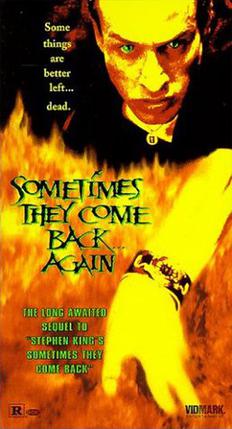
When Jon Porter was a child, he witnessed the murder of his sister by three delinquents named Tony (Alexis Arquette), Vinnie (Bojesse Christopher), and Sean (Glen Beaudin). The three thugs would have killed Jon too except that they were electrocuted by an electrical wire in a puddle of water. Years later, the now adult Jon (Michael Gross) returns to his hometown for the funeral of his mother. Jon is now a psychologist and has a daughter named Michelle (Hillary Swank).
The death of Jon’s mother was no accident. Tony has come back to life and Michelle, not knowing that he’s a demon, has a crush on him. Tony soon brings Vinnie and Sean back to life and they seek revenge on the man who they blame for their deaths.
This straight-to-video sequel to Sometimes They Come Back is slightly better than the first film, mostly because Tony and his gang are more intimidating than the ghost greasers that haunted Tim Matheson and Michelle wanting to date the man that her father killed adds a new wrinkle to the story. There’s nothing about Hillary Swank’s performance that would make you think she was a future Oscar winner but she is likable and sympathetic. The member of the cast who make the biggest impression is Jennifer Elise Cox, playing Michelle’s Tarot card-reading friend. (Cox is probably best known for playing Jan Brady in The Brady Bunch movies.) Cox brings a lot of kooky charm to the movie and is featured in the film’s most memorable scene. Sometimes They Come Back… Again may not reinvent the horror genre but it’s a passably entertaining straight-to-video horror film.
The 2018 film, Power of the Air, tells the story of David Williams (Nicholas X. Parsons). David thinks that he can be a committed Christian despite the fact that he spends every weekend at the movies. In fact, he and his friends have a streak going. For over 40 weekends, they have gone to the movies and David has never once worried about all of the violence, nudity, and adult language that he sees.
Some might say that this is because David is an adult who has found a way to relax after work. However, a Nigerian missionary named Emeka Odum (played — quite well, it must be said — by Veryl Jones) says that it’s because David is using the movie theater as a substitute for church. As Odum explains it, the movie theater has become America’s new house of worship and, as a result, America is now a second-rate nation that has lost its way. Why, in three years, America might even have a president who obviously doesn’t know where he is half the time. And it’s all Hollywood’s fault! Well, actually, the movie suggests that it’s really your fault for going to the movies.
If that sounds like an old-fashioned message, that’s because Power of the Air is a very old-fashioned movie. That is perhaps not surprising, as this is a Dave Christiano production, but it still feels strange to hear David — the character and not the director, though one gets the feeling that it’s not a coincidence that they share the same name — announce that he can no longer watch any movies that feature people cursing. I mean, avoiding a movie because of violence makes sense to me. Avoiding a movie because of nudity or political messaging is also understandable. Everyone has different things that they’re looking for. But avoiding a movie because of cursing is basically just another way of announcing that you’re never going to watch another movie. I mean, I’ve known plenty of Christians who do curse. At the same time, I do have to admit that I hardly ever curse but that’s just because I don’t want to sound like everyone else. I gave up cursing for Lent and my sisters all accused me of cheating because, according to them, it’s not really a sacrifice if you give up something that you don’t actually do.
Anyway, David wants to use mass media to spread a good Christian message so he comes up with the idea of broadcasting a commercial on all fifteen of his city’s radio stations at the exact same time. As he sees it, this will mean that everyone will hear the commercial whether they try to change the station or not. (Or, you know, they might just turn off their radio. Or they might turn down the volume. Or they might resent having David’s message forced upon them and respond by going to a Marvel film.) Unfortunately, Charlie (Patty Duke), the manager of the biggest station in town, doesn’t want to run a religious commercial. Can David change her mind?
Of course, I think the real problem with David’s plan is that the days of people spending all day listening to the local radio stations are pretty much over. That’s true today and it was true when this film was made in 2018. There are now so many options out there and so many other ways to keep oneself entertained during the day that the idea of everyone in the city listening to local AM radio seems a bit naïve. David really should have started a podcast or something.
Anyway, Power of the Air is a fairly slow-moving film and it’s one of those films that will mostly appeal to people who already agree with its message. The film is probably most interesting as Dave Christiano’s feature-length justification for making the type of movies that he does. The main message seems to be that if only more people watched Christiano’s films, then David wouldn’t have had to spend all that money on those radio ads.
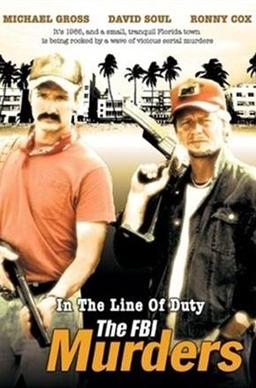
In The Line of Duty: The FBI Murders is the one that started it all. This was the first installment and it set the general format of all the In The Line of Duty films to follow. It was based on a true story. The movie was evenly split between the criminals and the members of the law enforcement trying to catch them. Here, the criminals were two bank robbers played by David Soul and, in an effective turn against type, Michael Gross. (When this film was released, Gross was best known as the wimpy father on Family Ties. Today, he’s better known as the survivalist from the Tremors films. He went on to play cops in two subsequent In The Line of Duty films.) The FBI agents pursuing them were played by Ronny Cox, Bruce Greenwood, and several other recognizable TV actors.
The FBI Murders was not only the first In The Line of Duty film but it was also the best. All of the subsequent installments, both good and bad, pale in comparison. Though the story is familiar and the foreshadowing is sometimes obvious (“Try not to get shot,” one FBI agent’s wife tells him), The FBI Murders still holds up today because of the strong cast and Dick Lowry’s direction of the final shootout between the cops and the criminals. No matter how many times David Soul gets shot, he keeps getting up and firing more rounds. Making this part of the film all the more effective is that it’s based on fact. During the actual incident, the real-life criminals played by Soul and Gross continued firing and killing even though they had been shot a tremendous number of times. Remarkably, it was discovered that neither had been on any type of pain-killing drug at the time. Instead, they were determined to just keep shooting until the end. Though the two men were outnumbered by the FBI, the agents were not prepared to go up against the military-grade weapons that the men were carrying with them.
The actors who play the FBI agents are all effective, especially Ronny Cox as the veteran who has seen it all. As with the other In The Line of Duty films, a lot of time is spend showing the comradery between the agents and how, even when they’re not at work, they’re all still together. In other In The Line of Duty films, the comradery could sometimes feel forced but, in The FBI Murders, it feels natural and scenes like Bruce Greenwood’s character finally getting a nickname and one of the older agents deciding to go on a stakeout just for old times sake carry a lot more emotional weight than you might expect. It makes the final shootout all the more powerful.
Eleven more In The Line of Duty films would follow but none of them would top The FBI Murders.
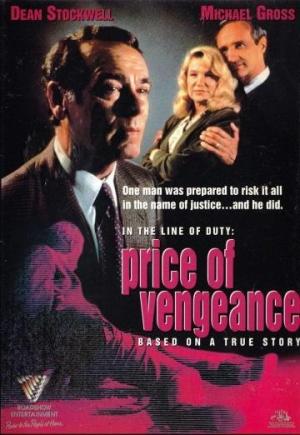
Johnnie Moore (Brent Jennings) is a former limo driver turned criminal mastermind. The members of his gang look up to him with cult-like admiration. On his orders, they have been robbing businesses all over town. Johnnie says that he is a man of God but he has no hesitation when it comes to ordering his men to threaten and sometimes kill any witnesses. When Detective Tom Williams (Michael Gross) comes to close to finally convincing someone to testify against the gang, Moore orders his assassination. When the members of his gang fail to get the job done because none of them want to shoot Tom when his family is around, Johnnie does it himself by dressing up as a clown and gunning Tom down in front of Tom’s son. That was Johnnie’s biggest mistake because now, he’s got Tom’s best friend, Detective Jack Lowe (Dean Stockwell), after him.
After Street Wars, NBC’s next two In The Line of Duty films both focused on FBI sieges. Both The Siege at Marion and Ambush in Waco featured true stories of the FBI trying to arrest religious fanatics and having to wait out a stand-off. Ambush in Waco was controversial because it was not only based on the Branch Davidian stand-off but it was actually filmed while the stand-off was still going on. Perhaps because of the controversy, The Price of Vengeance tells a much simpler and less exploitive story. Johnnie Moore is a criminal who kills a cop. Jack Lowe makes it his mission to put him away. There’s no risk of anyone watching siding with Johnnie Moore like they may have done with David Koresh while watching Ambush in Waco. Moore kills a man in front of his son and then laughs about it. Everyone watching is going to want to see him get punished and they are going to cheer on the efforts of law enforcement to make sure the punishment fits the crime.
The Price of Vengeance is a typical police procedural but it has a good cast. After playing a killer in the first In The Line of Duty movie and the lead FBI man in the third one, Michael Gross is cast as the victim here and he’s so likable that you’ll be angered when he gets gunned down. Dean Stockwell brings his no-nonsense, down-to-Earth style to the role of Gross’s best friend and Brent Jennings is smug and evil as Johnnie Moore. Mary Kay Place, Kathleen Robertson, and Justin Garms play the members of Gross’s family and they all do a good job of showing the trauma that they’ve suffered as a result of his murder. Keep an eye out for Courtney Gains, playing a member of Moore’s criminal crew. Gains played this same character in a dozen different films. If you see Courtney Gains in a movie, look out because he’s up to no good!
The Price of Vengeance is a standard 90s cop show. Nothing about it will take you by surprise but it’s partially redeemed by its cast.
On February 13th, 1983, a group of U.S. Marshals attempted to arrest a man named Gordon Kahl in North Dakota. Kahl was an outspoken tax resistor. He had already served time in Leavenworth for refusing to pay his taxes. When he was released, he continued to refuse to pay and, in violation of his parole, started to attend meetings of the Posse Comitatus, an organization that refused to recognize the authority of any government above the county level. Because Kahl was so prominent in anti-government circles, the plan was to make an example out of him by arresting him as he left a Posse Comitatus meeting. Instead, Kahl, his son, and an associate opened fire on the U.S. Marshals, killing two of them. Kahl escaped and, for several months, was the subject of an FBI manhunt.
To make clear, Gordon Kahl was not a good man. Gordon Kahl was a white supremacist and an anti-Semitic conspiracy theorist who was a follower of the Christian Identity movement. While Kahl’s supporters claimed that Kahl originally fired on the marshals in self-defense, eyewitnesses testified that Kahl personally executed one marshal after he had already been wounded and was no longer a threat. Gordon Kahl was no hero but, at a time when many farmers were struggling financially and felt helpless as they watched the banks and the government seize their land, many locals did sympathize with him. The government’s attempt to publicly arrest Kahl and make an example out of him was seen as a classic example of government overreach. The government was so eager to catch Kahl and Kahl was initially so successful in eluding them that Gordon Kahl became a folk hero. When Kahl was discovered hiding out in an Arkansas farmhouse, it led to Kahl killing another deputy and the the government firing over a thousand rounds into the house before eventually setting it on fire. In their effort to capture Gordon Kahl, the government behaved just as destructively as Kahl always said they would.
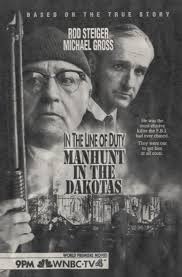
The hunt for Gordon Kahl served as the basis for the third of NBC’s In The Line of Duty films, Manhunt in the Dakotas. Rod Steiger played Gordon Kahl. Michael Gross, fresh off of playing a tax resistor in Tremors, played the FBI agent who headed up the manhunt. Dick Lowry, director of the previous two installments of In The Line of Duty, returned to direct.
Manhunt in the Dakotas is a fair and even-handed look at the search for Gordon Kahl. The film doesn’t shy away from Kahl’s racism and his paranoia but, at the same time, it also shows why many people instinctively distrust anyone who says that he’s from the government. The film shows why so many supported Kahl without supporting Kahl itself. Gross’s FBI agent may start out as rigid and by-the-book but he quickly learns that’s not the best way to get people to answer his questions. Having come to understand why the people of the Dakotas don’t trust the government, he can only helplessly watch as the government does everything in its power to make Kahl’s paranoid claims seem plausible. The FBI agent is determined to bring Gordon Kahl in alive but Kahl would rather be a martyr and it seems that the rest of law enforcement is all too happy to help Kahl achieve that. Other than a few scenes were he indulges in his tendency to overact, Steiger gives a convincing performance as Kahl and he is well-matched by Michael Gross as the agent who comes to realize that there’s more to enforcing the law than giving orders and threatening to send people to prison.
Manhunt in the Dakotas would be followed by In The Line of Duty: Mob Justice, which I will review tomorrow.
For those who aren’t familiar with the term, the Graboids are the giant, ravenous sandworms that were first introduced in the 1990 film, Tremors. Graboids are always on the hunt for food and, over the course of the original film, four sequels, and one prequel, they’ve attacked and devoured a countless number of communities, all while helping to spread all sorts of comedic mayhem. For whatever reason, the mere presence of a Grabboid tends to lead to human beings getting very quippy.
This year, the Graboids return for a sixth time with Tremors: A Cold Day In Hell. This time, the Graboids are up in Canada and they’re eating a bunch of scientists. Normally, Canada would be too cold for a Graboid infestation but apparently, climate change has altered the rules of the game. That’s one good thing about climate change. It can be used to explain away just about anything. Why does Northern Canada look so sunny and warm? Climate change! Why are the Graboids no longer limited to the desert? Climate Change!
Anyway, this is pretty much a typical Tremors sequel. A bunch of people end up getting trapped in one location and are then picked off by the Graboids. There’s some sinister scientists and bio-weapon subplot but those are mostly afterthoughts. The film promises Graboids and, eventually, it delivers them. Especially when compared to some of the other films in the franchise, A Cold Day In Hell is rather slowly paced and the CGI isn’t always as convincing as you might want it to be. On the one hand, the film delivers pretty much what you would expect it to deliver. On the other hand, it’s also rather bland.
Oh well. At least Burt Gummer is back!
As any fan of the franchise can tell you, the Graboids are pretty much secondary to the presence of Burt Gummer. Brilliantly played by Michael Gross, Burt is the only character to have appeared in not only every Tremors film but also the TV series as well. (Okay, technically, the fourth film featured Burt’s great-grandfather but Hiram Gummer might as well have been Burt Gummer.) Burt is a heavily armed doomsday prepper who lives out in the middle of the desert and who hates the government. Though the IRS may just view him as someone who refuses to pay his taxes, fans of the franchise know that Burt is the world’s greatest Graboid hunter.
What is Burt’s appeal? Well, some of it has to do with the fact that Burt is always honest and consistent. It’s been 28 years since Burt was first introduced and, in that time, he has always loved guns and hated the government. He doesn’t hold back on his views and he makes absolutely no apologies and that’s exactly the type of guy who you want by your side when you’re dealing with a bunch of killer sandworms.
In the end, though, Burt’s greatest appeal is that he’s a thowback. If Tremors had been produced in the 21st Century, there’s no way that a character like Burt would have survived the movie. His anti-government stance would have been viewed as being unpatriotic during the Bush and Obama years and his love of guns would have gotten the movie picketed by Shannon Watts and denounced on twitter by the writers at Slate and Vox. The AV Club would declare the character to be problematic and Michael Gross would have to go on Colbert and personally apologize to everyone who was hurt by his performance. But since the first Tremors was made way back in the 90s, Burt is allowed to thrive in all of his anti-PC glory. At a time in which monster movies are dominated by grimly-written heroes and overly rational scientists, Burt is a reminder that films like this should, at the very least, attempt to be fun.
As for Tremors: A Cold Day In Hell, it was released on Netflix earlier this year and it premiered on SyFy last night. It’s forgettable but at least Burt’s back.





 Through the Shattered Lens