Thinner (1996, directed by Tom Holland)


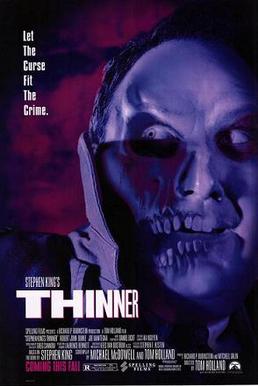
Billy Halleck (Robert John Burke, in a fat suit) is a morbidly obese attorney who might be destined to die of a heart attack but who definitely will not be serving jail time despite running over an old gypsy woman. After a corrupt judge and crooked cop, both of whom are friends of Billy’s, conspire to get Halleck acquitted, all three of them are cursed by the woman’s husband (Michael Constnatine). The judge turns into a lizard while the cop is covered in sores. Halleck, however, finally starts to lose weight! At first, he’s happy. He’s finally getting thin and all he had to do was run over an old woman! But then, he realizes that he’s never going to stop getting thinner and he’s going to just waste away.

Thinner is based on a novel by Richard Bachman, who was actually Stephen King. Like most of the Bachman books, Thinner is nastier than most of the King books. Billy is a terrible character and he deserves exactly what’s coming to him. The book is not usually listed as being one of King’s better efforts and the movie doesn’t get much love either. I’ve always liked Thinner, though. It’s like a really good episode of Tales From The Crypt, with Billy paying the price for his sins. Billy actually gets several chances to redeem himself but, because he’s such a terrible character, he keeps messing them up. Instead of begging for forgiveness, Billy hires a gangster (Joe Mantegna) to try to take out the gypsies. Even when the dead woman’s husband gives Billy a chance to escape his fate with some shred of dignity, Billy would rather go after his perceived enemies. Many bad things happen to Billy but he brings them all on himself. Even when it becomes obvious that he’s under a curse, he still thinks he can plea bargain his way out of it.  He’s a lawyer, through and through.

Thinner is frequently cartoonish and broad but that works for the story that it’s telling. Robert John Burke’s performance may not have many shadings to it but again, it’s right for the story that’s being told.  My favorite performance in the film was Joe Mantegna’s turn as the gangster and fans of Late Night Cinemax will feel a rush of nostalgia when Kari Wuhrer makes an appearance as the beautiful daughter of the woman that Billy ran over.  Thinner is a middle-tier King adaptation, neither as bad nor as good as some others. I dug it.

Horror on TV: Friday the 13th: The Series 1.24 “Pipe Dreams” (dir by Zale Dalen)


On tonight’s episode of Friday the 13th: The Series, Ryan discovers that his own father has been using a cursed pipe to get ahead in business!

This episode originally aired on July 16th, 1988.  Ryan’s father is well-played by Michael Constantine, a familiar character actor (he was the father in My Big Fat Greek Wedding) who passed away on August 31st of this year.

https://youtu.be/OnCh64YnbSU

TV Review: Night Gallery 2.1 “The Boy Who Predicted Earthquakes/Miss Lovecraft Sent Me/The Hand of Borgus Weems/Phantom of What Opera?”


The second season of Night Gallery premiered on September 15th, 1971.  Once again, Rod Serling led viewers through a darkened museum, inviting them to look upon macabre paintings and imagine the story behind image.

The first episode had four — that’s right, four! — different stories!  Apparently, the show’s producers demanded that, for the 2nd season, each episode feature shorter stories along with some light-heated segments.  From what I’ve read, Rod Serling was not particularly happy with the directive and it’s perhaps significant that, after writing every story featured in Night Gallery‘s first season, he only wrote one of the stories featured in the second season premiere.

The Boy Who Predicted Earthquakes (dir by John Badham, written by Rod Serling)

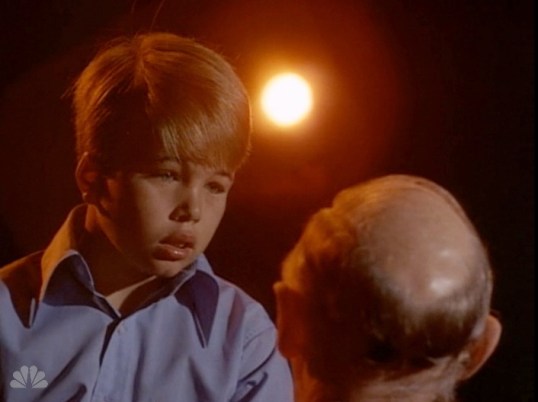
Herbie (played by 12 year-old Clint Howard, younger brother of Ron) is a little boy with a very special gift.  He can see the future.  He seems like a normal child, the type who rambles about random subjects except that, at random, he’ll suddenly stop and ominously predict the future.  After Herbie correctly predicts both the rescue of a missing girl and an earthquake, Herbie is given his own TV show.  For a year, Herbie makes predictions, all of which come true.  Then, suddenly, Herbie refuses to shares his latest prediction and says that he doesn’t want to do the show anymore.  What has Herbie seen and is it a good thing or a bad thing?

The Boy Who Predicted Earthquakes gets the second season of Night Gallery off to a good start.  Centered by a natural performance from Clint Howard, The Boy Who Predicted Earthquakes is an intelligently written and thought-provoking story.  Not only does it examine the burden of being able to see the future but it’s also a provocative look at how society exploits the gifted.  With the exception of Herbie’s grandfather (William Hansen), the people around Herbie are less concerned with what he predicts than that people keep watching.  The segment ends on an appropriately dark note, one that will keep the viewer thinking.

Miss Lovecraft Sent Me (dir by Gene Kearney, written by Jack Laird)

A gum-chewing babysitter (Sue Lyon) show up for her latest job.  It’s at a castle!  And the owner of the castle (played by Joseph Campanella) has gray skin, is wearing a cape, and has a Transylvanian accent!  What could it all mean?

This is a short comedic segment.  Apparently, the producer of Night Gallery, Jack Laird, had the idea to liven things up with sketches like this one.  Serling was apparently not a fan of the idea but Miss Lovecraft Sent Me isn’t that bad.  It’s silly and insubstantial because Joseph Campanella and Sue Lyon handled their roles well.  It’s impossible not to laugh when the babysitter reads aloud the names of the books that Campanella has sitting on his bookshelf.

The Hand of Borgus Weems (dir by John M. Lucas, written by Alvin Sapinsley)

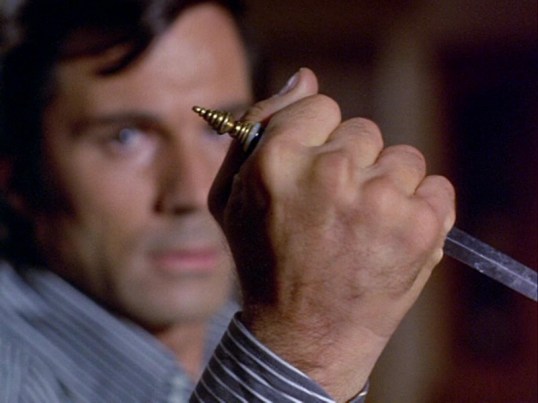
Peter Lacland (George Maharis) sits in a doctor’s office and asks Dr. Ravadon (Ray Milland) to remoe his right hand.  Peter explains that his right hand has a mind of its own and that it keeps trying to kill everyone who Peter comes into contact with.  Peter explains that his hand has been possessed!

There’s a surprisingly large number of stories out there about possessed hands.  The Hand of Borgus Weems doesn’t necessarily bring anything new to the genre and it gets a bit bogged down with its flashback structure but it’s still an enjoyably creepy little segment, featuring good performances from George Maharis and Ray Milland.  Possessed hands are also creepy, no matter what.  Like The Boy Who Predicted Earthquakes, it also has an effective ending, which is quite a contrast to the often insubstantial conclusions of Night Gallery’s first season.

Phantom Of What Opera?  (written and dir by Gene Kearney)

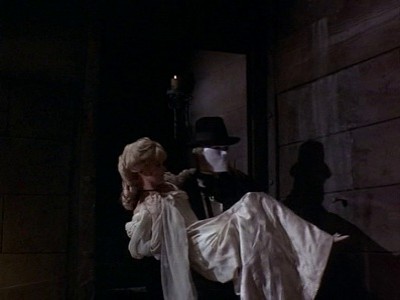
This is a short, 4-minute comedic story — a skit really — featuring Leslie Nielsen as the Phantom of the Opera and Mary Ann Beck as Christine. This version starts out like a typical Phantom segment, with the Phantom kidnapping Christine, taking her down to the dungeon, and telling her never to remove his mask.  Christine, of course, removes his mask while he’s playing the organ just for him to then discover that she’s also wearing a mask.  It all leads to love and a happy ending!  It’s kind of a sweet segment, actually.

So the 2nd season of Night Gallery got off to a pretty good start!  Would future episodes continue the trend?  We’ll find out soon as I continue to watch Night Gallery.

Previous Night Gallery Reviews:

  1. The Pilot
  2. The Dead Man/The Housekeeper
  3. Room With A View/The Little Black Bag/The Nature of the Enemy
  4. The House/Certain Shadows on the Wall
  5. Make Me Laugh/Clean Kills And Other Trophies
  6. Pamela’s Voice/Lone Survivor/The Doll
  7. They’re Tearing Down Tim Riley’s Bar/The Last Laurel

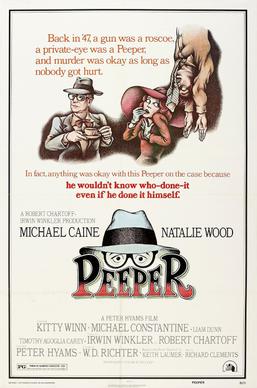
Peeper (1975, directed by Peter Hyams)


Peeper gets off to a good start, with a Humphrey Bogart look alike standing on a dark street corner and reading the opening credits in a reasonable approximation of Bogart’s unmistakable voice.  It all goes down hill from there.

Peeper stars Michael Caine as Leslie C. Tucker, a cockney private detective who is working in Los Angeles in the late 40s.  Tucker is hired by a shady businessman named Anglich (Michael Constantine).  Anglich explains that he knows that he has a daughter but he doesn’t know who or where she is.  He wants Tucker to track her down.  It doesn’t take much time for Tucker to conclude that Anglich’s daughter might be a member of the wealthy and quirky Pendergrast family.  In fact, Tucker thinks that Anglich’s daughter might be Ellen Pendergrast (Natalie Wood, who seems to be bored with the role).  It should be a simple enough case to solve but there are numerous complications along with two thugs (played by Timothy Carey and Don Calfa) who, for some reason, are out to get Anglich and Tucker.

It’s hard to know what to make of Peeper.  It’s meant to be an homage to the detective films of the 40s but it also tries to parody the genre.  Unfortunately, Peter Hyams has never been a director known for his light touch and, in this film, his idea of comedy is to have everyone shout their lines.  (Michael Constantine is the worst offender.)  Michael Caine is also miscast in the lead.  The film tries to get some comedic mileage out of Caine delivering Bogart-style dialogue in his cockney accent but it’s a joke that’s never as funny as the film seems to think.

Peeper was a critical and box office failure but fortunately, there were better things in store for both Michael Caine and Peter Hyams.  Hyams went on to direct Capricorn One while Michael Caine established himself as one of the most durable character actors around.

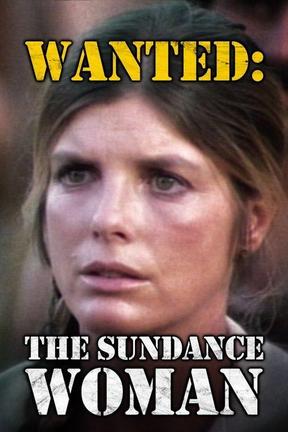
A Movie A Day #75: Wanted: The Sundance Woman (1976, directed by Lee Philips)


This made-for-TV sequel to Butch Cassidy and the Sundance Kid opens several years after the death of Butch and Sundance in Bolivia.  Etta Pace (Katharine Ross, reprising her role from the original film) is now a wanted woman.  Hiding out in Arizona, she does her best to keep a low profile.  But when Pinkerton detective Charlie Siringo (Steve Forrest) comes to town and one of Etta’s friends (Michael Constantine) is arrested, Etta knows that she’s going to need help to survive.  Crossing the border into Mexico, she teams up with revolutionary Pancho Vila (Hector Elizondo).  In return for helping him get his hands on a shipment of guns, Vila agrees to protect Etta.

Wanted: The Sundance Woman was ABC’s second pilot for a possible television series about Etta Pace’s adventures at the turn of the century.  The first pilot starred Elizabeth Montgomery as Etta and directly dealt with Etta’s attempts to come to terms with the death of Butch and Sundance.  While Katharine Ross returned to the role for the second pilot, Wanted: The Sundance Woman does not actually have much of a connection to Butch Cassidy and The Sundance Kid.  Katharine Ross could have just as easily been playing Etta Smith as Etta Pace.

Wanted: The Sundance Woman is held back by its origins as a TV movie and a rather silly romance between Etta and Pancho Vila.  Hector Elizondo is hardly convincing as a fiery revolutionary and Steve Forrest is reliably dull as Siringo.  It is not really surprising that this pilot didn’t lead to a weekly series.  On the positive side, the film does feature an exciting train robbery and Katharine Ross is just as good in this sequel as she was in the original.  Even though she was talented, beautiful, and had important roles in two of the most successful films of the 60s (The Graduate and Butch Cassidy and the Sundance Kid), Hollywood never seemed to know what do with Katharine Ross.  While she did have a starring role in The Stepford Wives, Katharine Ross spent most of the 70s appearing in stuff like The Swarm, They Only Kill Their Masters, and The Betsy.  It’s unfortunate that Hollywood apparently did not want Katharine Ross as much Pancho Vila wanted the Sundance Woman.