Film Review: The Last Innocent Man (dir by Roger Spottiswoode)


In 1987’s The Last Innocent Man, Ed Harris plays Harry Nash.

Harry is a criminal defense attorney, one who specializes in defending people who have been charged with committing murder.  He’s good at his job but he’s not sure that he’s happy with his life.  He went into the law to save people from Death Row but years of getting acquittals for guilty people have taken their toll on Harry’s psyche.  His most recent client was Jonathan Gault (David Suchet), a man accused of having killed his wife.  The verdict was “not guilty” but Harry suspects that Gault may have been guilty of both what he was charged with and also countless crimes for which he hasn’t been charged.  It doesn’t help that Gault confronts Harry in a parking lot and says he wants Harry to co-write a book about how he got Gault acquitted.  Gault proceeds to tell Harry that he did kill his wife, before suddenly laughing and saying that he’s only joking.

Despite all of the money and the fame, Harry needs a break from dealing with guilty people.  He tells his shocked partner that he will be temporarily stepping back from their practice.  Along with being burned out, Harry is also interested in pursuing a romantic relationship with Jenny Stafford (Roxanne Hart).  Jenny is married but she assures Harry that she is in the process of getting a divorce from her husband, Philip (Darrell Larson).

However, when Philip is arrested and accused of murdering a policewoman who was working undercover as a prostitute, Harry finds himself defending Philip in court.  Philip swears that he’s innocent of the crime and that he’s never even been with a prostitute.  He claims that, when the murdered occurred, he was at home with his wife.  Jenny is willing to collaborate Philip’s alibi, even though Harry suspects that she’s lying.

As you can probably guess, there are plenty of twists and turns to the plot of The Last Innocent Man.  Unfortunately, they’re not exactly shocking twists and turns.  The Last Innocent Man is a courtroom drama and it pretty much sticks to the rules of the genre, which means a lot of snarky comments between Harry and the prosecutor and also plenty of scenes of various lawyers snapping “Objection!” and demanding a recess.  This is the type of film where people fall apart on the witness stand and the audience in the courtroom murmurs whenever something shocking happens.  The Judge can’t pound that gavel hard enough to make The Last Innocent Man anything more than a standard courtroom drama.

That said, director Roger Spottiswoode keeps the action moving at a quick-enough pace and Ed Harris is ideally cast in the role of the morally conflicted Harry Nash.  As well, there’s an entertaining supporting performance from Clarence Williams III, cast here as a cocky pimp, and David Suchet is chillingly evil as the worst of Harry’s clients.  The Last Innocent Man doesn’t quite reach the Hitchcockian heights that it was reaching for but, still, fans of courtroom dramas will enjoy it or, at the very least, show a little leniency in their judgment.
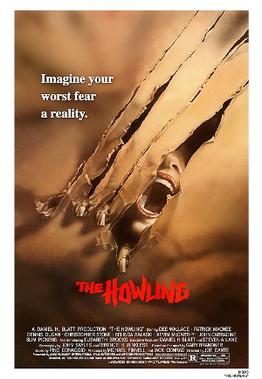
Horror Film Review: The Howling (dir by Joe Dante)


The 1981 film, The Howling, takes place at The Colony.

The Colony is a lovely place, a nice resort out in the middle of the countryside.  It’s a place that celebrity therapist George Waggener (Patrick Macnee) sends his clients so that they can recover from trauma.  It’s a bit of a grown-up version of the ranch to which Dr. Phil used to send juvenile delinquents.  Of course, the Colony is full of adults and they’re an eccentric bunch.  I mean, one of them — named Erle Kenton — is actually played by John Carradine!  That’s just how eccentric the place is.  Sheriff Sam Newfield (Slim Pickens) keeps an eye on the place but everyone knows that there’s nothing to worry about when it comes to The Colony.  Dr. Waggner does good work.

Karen White (Dee Wallace) is a Los Angeles news anchor who was held hostage by a serial killer named Eddie Quist (Robert Picardo).  While she was with Eddie, she was forced to not only watch videos of Eddie’s crimes but she also saw something happen with Eddie that terrified her to such an extent that she has blocked it from her mind.  Karen was rescued by the police but she is haunted by nightmares.  Dr. Waggner arranges for Karen and her husband, Bill Neill (Christopher Stone, who was married to Dee Wallace when they co-starred in this film), to spend some time at the Colony.

Bill loves the Colony, especially after he attracts the eye of Marsha (Elisabeth Brooks), the resort’s resident seductress.  Karen, however, is less enamored of the place.  The Colony feels off to her and she’s not happy about the howling in the distance or the fact that Bill has suddenly started to grow distant from her.  Could it be that The Colony is actually crawling with werewolves and that Bill has become one of them?  (It’s totally possible and, to The Howling‘s credit, it doesn’t waste any time letting us know that.)  Karen’s friend, Terry Fisher (Belinda Balanski), and her boyfriend, Chris Halloran (Dennis Dugan), do some research of their own into Eddie Quist, The Colony, and whether or not werewolves exists and they meet a helpful bookstore owner named Walter Paisley (Dick Miller).

To understand the approach that director Joe Dante and screenwriter John Sayles take to The Howling, one needs to only consider the names of some of the characters.  George Waggner.  Bill Neill. Terry (which can be short for Terence) Fisher.  Fred (or is that Freddie) Francis.  Erle Kenton.  Sam Newfield.  Jerry Warren.  All of these characters are named after horror film directors.  This is the type of werewolf film where Chris Halloran has a copy of The Three Little Pigs sitting on his desk.  Veteran actors like Kevin McCarthy, John Carradine, Slim Pickens, and Kenneth Tobey show up in small roles.  Roger Corman mainstay Dick Miller plays yet another character named Walter Paisley and he kicks Forrest J. Ackerman out of his bookstore.  Roger Corman himself plays a man making a phone call.  After a werewolf is shot on live TV, the program immediately cuts to a dog food commercial and we see a blank-faced child telling his unconcerned parents that someone just turned into a wolf.  The Howling was made by people who obviously love B-horror and that love is present in every frame of the film.

Like Dante’s Piranha, The Howling is a film with a sense of humor but it’s not a comedy.  The werewolves are still impressive, even forty-two years after the film was first released.  The character of Eddie Quist (“I’m going to give you a piece of my mind”) is a terrifying monster and the sight of his signature smiley face will fill you with dread, especially when it shows up in a place where it really shouldn’t be.  The film cynically ends on a note of noble sacrifice that will apparently not make much difference, with the suggestion being that human beings are either too distracted or too jaded to realize that there are monsters among them.  The Howling is a fast-paced and well-directed homage to B-horror and it’s still terrifically entertaining.

Horror Film Review: Damien: Omen II (dir by Don Taylor)


DamienomenII

The first sequel to The Omen was 1978’s Damien: Omen II.  Damien: Omen II is an odd film, one that is not very good but yet remains very watchable.

Damien: Omen II takes place 7 years after the end of the original Omen.  Antichrist Damien Thorn (now played by Jonathan Scott-Taylor) is now 12 years old.  He lives with his uncle Richard (William Holden) and Richard’s 2nd wife, Ann (Lee Grant).  His best friend is his cousin Mark (Lucas Donat).  In fact, the only problem that Damien has is that his great-aunt Marion (Sylvia Sidney) can’t stand him and views him as a bad influence.  Fortunately, as usually seems to happen whenever someone puts an obstacle in Damien’s life, there’s always either a black dog or a black crow around to help out.

Damien and Mark are cadets at a local military academy where Damien deals with a bully by glaring at him until he falls to the ground, grabbing at his head.  In history class, Damien shocks his teacher by revealing that he knows the date of every battle ever fought.  Damien’s new commander, Sgt. Neff (Lance Henriksen), pulls Damien to the side and tells him to stop showing off and to quietly bide his time.

Meanwhile, Richard is busy running Thorn Industries.  One of his executives, Paul Buhler (Robert Foxworth), wants to expand Thorn’s operations into agriculture but his plans are opposed by Richard’s executive vice president, Bill Atherton (Lew Ayres), who considers Paul to be unethical.  However, during an ice hockey game, Bill falls through the ice and, despite the efforts of everyone to break through the ice and save him, ends up floating away.  Paul is promoted and pursues his plans to make money off of world famine.  In between all of this, Paul finds the time to speak to Damien and tell him that he has a great future ahead of him.

Along with Thorn Industries, Richard also owns the Thorn Museum in Chicago.  The museum’s curator is Dr. Charles Warren (Nicholas Pryor) who was a friend of the archeologist Karl Bugenhagen (Leo McKern) who, in the first film, revealed that not only was Damien the antichrist but that the only way to kill him was by stabbing him with the Seven Daggers of Meggido.  Dr. Warren is also friends with Joan Hart (Elizabeth Shepherd), a reporter who both knows the truth behind Bugenhagen’s death and who has also seen an ancient cave painting that reveals that the Antichrist looks exactly like a 12 year-old Damien Thorn.

Much as in the first film, just about everyone who comes into contact with Damien ends up getting killed in some odd and grotesque way.  Crows peck out eyes.  Trucks run over heads.  One unfortunate victim is crushed between two trains.  Another is chopped in half by an elevator cable.  At times, Damien: Omen II feels less like a sequel to The Omen and more like a forerunner to Final Destination.

Damien: Omen II is one of those films that I like despite myself.  It’s bad but it’s bad in a way that only a film from the 1970s could be and, as such, it has some definite historical value.  The script is full of red herrings, the acting is inconsistent, and the film can never seem to make up its mind whether Damien is pure evil or if he’s conflicted about his role as Antichrist.  As I watched the film, I wondered why the devil could so easily kill some people but not others.

And yet, Damien: Omen II is so ludicrous and silly that it’s undeniably watchable.  If the first film was distinguished by Gregory Peck’s defiant underplaying, the second film is distinguished by the way that William Holden delivers every line through manfully clenched teeth.  Everyone else in the cast follows Holden’s lead and everyone goes so far over-the-top that even the most mundane of scenes become oddly fascinating.

For me, the film is defined by poor Lew Ayres floating underneath that sheet of ice while everyone else tries to rescue him.  On the one hand, it’s absolutely horrific to watch.  I’m terrified of drowning and, whenever the camera focused on Ayres desperately pounding on the ice above him, I could barely bring myself to look at the screen.  But, at the same time, we also had William Holden screaming, “OH GOD!” and Nicholas Pryror enthusiastically chopping at the ice with a big axe and dozens of extras awkwardly skating across the ice.  Somehow, the scene ended up being both horrifying and humorous.  It should not have worked but somehow, it did.

And that’s pretty much the perfect description of Damien: Omen II.  It shouldn’t work but, in its own way, it does.