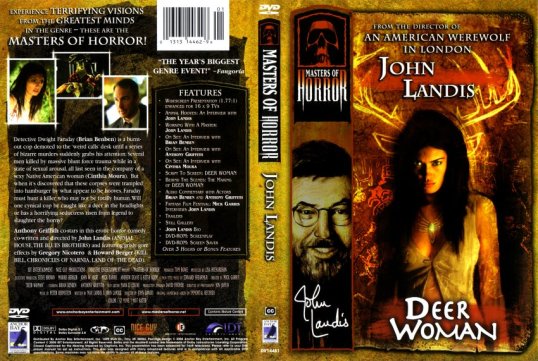
Happy Horrorthon! There’s a Half-Deer woman (DeerTaur?) on the loose and only Martin Tupper…I mean Detective Dwight Faraday can stop her…maybe. Many of you don’t remember Dream On from the late 80s-early 90s on HBO, but it was awesome. Benben played this kinda cranky book editor Martin Tupper who always thought in movie clips and seeing him act again was like being a wee kid again who quietly watched Dream On after his parents fell asleep. Dream On BTW was hilarious and created by John Landis- Check it Out! Yes, The American Werewolf in London director and he did Thriller.
Well, in the early 2000s Mick Garris got a lot of the greats from the 80s and 90s to do short horror films and Deer Woman was one of them. In Deer Woman, Drunk dudes are getting trampled to death and Detective Faraday is assigned to the case.
Faraday is a down and out detective who no one respects. Martin Tupper was a down and editor who no one respected. Faraday is actually not a terrible detective. He follows up leads and sees where they go. He checks with the coroner and sees that the bodies are riddled with hoof prints. You know what makes hoof prints? Deer-Taurs!!!!
Also, men are really portrayed as dumb and horny. The Deer-Taur picks her next victim up at a hotel bar without speaking a word, but the dudes don’t seem to mind. Once the seduction is on, she tramples him with her hooves! Yes, hooves. I love this show!
What’s not to like?! Deer-Taurs, Detectives, and hooves! There’s also a great dream sequence when Faraday imagines how the kill went down where a Deer in flannel carries off a victim Creature from Black Lagoon style. It’s hilarious. This is what’s great about Landis; his horror is always interspersed with great comic relief.
Anywho, bodies keep dropping and they’re so beat up that their arms are found on rooftops! AWESOME!!! Does Detective Faraday stop the Deer-Taur? Who Cares?! It’s got Deer-Taurs and Brian Benben! I would definitely recommend finding this show however you can. Pretty much all of the Masters of Horror episodes are great. Cheers!
It is hard to categorize John Landis’ contribution to the Showtime horror anthology series, The Masters of Horror. Landis made a name for himself in the horror genre as the director of the classic early 80’s werewolf film, An American Werewolf In London, and the cult classic vampire-noir film, Innocent Blood. With his “Deer Woman” episode, John Landis reaches back to his past work and comes up with an episode that mixes horror, absurd situations and a healthy dose of black comedy.
“Deer Woman” has something in common with An American Werewolf In London in that this episode deals with a creature born out of folklore and myth. This time around its a creature from Native American folklore. The creature in question is the Deer Woman. A legendary creature who takes the form of a beautiful woman from the waist up and that of a deer from the waist down. The Deer Woman will then go on a spree of seducing random men then trampling them to mincemeat. In this respect she has a bit of the mythical succubus mixed in with the shapeshifting. It is during the aftermath of one of her killings that we’re introduced to the main player in this horrifically absurd little tale. Detective Faraday (masterfully played with a dry wit and comedic timing by Brian Benben) gets called in to the scene thinking it is an animal attack, but the crime scene leaves him confused, perplexed and a tad more than intrigued by the case after it’s unceremoniously taken away from him.
We learn through the length of the hour-long episode that Faraday is a disgraced cop due to an incident in the past that’s made him a pariah in his own department. Faraday’s sidekick in his hunt to solving the murders and thus finding the Deer Woman is a beat cop played by Anthony Griffin. Former Brazilian, and still smoking hot and stunning, Cinthia Moura does duty as the abovementioned Deer Woman. She goes through the entire episode without uttering one line. Her eyes, expressions and body language conveying whatever motivations and thoughts may be in her head. She did pretty well and it didn’t hurt she looked very natural baring it all on the screen.
The dialogue in the episode was where the absurdity of the moments in the story shone through to give “Deer Woman” its black-comedy. The characters in the film react to murders and the clues leading to what might be their only suspect with incredulity, denial and dismissal. Yet, no matter how much the characters of Faraday and his partner try to deny what they know in their mind is the real killer, they inevitably see the truth of the matter dangerously up close and personal. The teleplay for the episode was primarily written by Max Landis (the director’s son) with some brief rewrites and treatments by John himself. They both run with a very absurd situation and run with it fult-tilt and non-stop. They both know how silly the story sounds and its that silliness that makes this episode memorable. In fact, if I really had to categorize this episode I would call it a comedy with small bits of horror slipped in (horror and gore effectively done — once again — by the master effects people from KNB EFX.
Despite “Deer Woman” being closer to a comedy-horror than a straight-up horror tale, I found the episode to be very entertaining and worth the viewing. John Landis stuck to his guns in crafting an absurd tale and making it believable to his audience. With shades and hints of An American Werewolf In London, Landis’ contribution to The Masters of Horror marks a bright spot in the an uneven series, so far. Landis’ has once again shown that horror and comedy are more intertwined than most people would think.
Cigarette Burns was John Carpenter’s episodic contribution to the Showtime series, Masters of Horror. This 13-episode horror anthology thought up by Mick Garris (a fellow horror director best known for adapting Stephen King stories) which includes eleven other directors known for their work in the horror genre.
John Carpenter works off of a screenplay that posits an interesting premise about an infamous film that caused the audience it was shown to the first time to go homicidal. The story itself involves a man known in the film community as someone who can find and hunt down any copy of film no matter how rare. Norman Reedus (he of Blade II, The Boondock Saints) plays the cinephile who takes on the job to hunt down a copy of this infamous film titled Le Fin Absolue Du Monde. His client was played with relish by resident weirdo Udo Kier. Really, Kier could be given any role and he’ll add his brand of idiosyncracy and weirdness to the part. In Cigarette Burns he plays an obsessive fan of the rare film to the hilt. His contribution to the the climactic ending will bring a smile to gorehounds everywhere. Alas, it’s Kier’s performance that’s the highlight of the acting in Cigarette Burns. Reedus’ performance as Kirby Sweetman the cinephile leaves much to be desired. The screenplay itself was already average, but with genuine ideas that could be explored if the acting could raise it beyond its C-grade pedigree, but Reedus wasn’t up to it.
Carpenter’s directing really can’t be faulted for the major flaws in the screenplay and in his lead’s performance. It’s not early Carpenter, but his work in Cigarette Burns was much better than what he’s done in his last couple films. In fact, this tv show entry in Carpenter’s body of work resembles one of his more underrated films. I am talking about his ode to Stephen King and H.P. Lovecraft with In the Mouth of Madness. Instead of a book influencing the sanity of the reader, its a film that does it instead. A film that may or may not have divine origins that doesn’t just turn its viewers homicidal but bend their sense of reality.
I think with a better cast and a screenplay that’s worked on a bit more by its writers, Cigarette Burns could’ve been a great episode in the Masters of Horror anthology or, better yet, become a full-fledged feature film. Instead, it’s just a very good work from Carpenter with great gore sequences (courtesy of KNB EFX), but brought low due to a very rough screenplay and a lead actor in Norman Reedus who seemed stoned, drunk or both throughout his entire performance. It’s not something great, but a good showing from Carpenter that said he’s not as washed-up as many seem to be calling him.
Masters of Horror has been good but very uneven in its execution during it’s two season run on Showtime. Haeckel’s Tale is the last episode for Season One (Takashi Miike’s episode never got an official airing) and it sure ends the season on a disturbingly kinky compilation of twisted grotesqueries. The story is from a Clive Barker short story that’s been adapted by Mick Garris (fellow Masters of Horror director and also its brainchild) and produced by George A. Romero to be directed by John McNaughton.
One wonders why Romero would be producing instead of directing the piece. Scheduling conflicts prohibited Romero from taking the director’s chair and he instead recommended John McNaughton (his one film which earned him Master of Horror status is one of the best horror films of the last quarter century: Henry – Portrait of a Serial Killer). The fact that Romero was originally chosen to direct Barker’s Garris adapted short story means there’s got to be zombies or some form of undead within. I, for one, was glad that Romero decided that he wouldn’t be able to direct and chose another in his stead. Barker’s short story does indeed include zombies but it also has a heavy sense of the old classic technicolor Hammer Films vibe to it. Haeckel’s Tale under the capable hands of McNaughton takes those Hammer Films conventions and ramps it up into overdrive.
Even though John McNaughton really has only one true horror film under his belt (he also directed a little-known cult scifi-horror called The Borrowers which had fledgling effects shop KNB EFX still doing things guerilla-style), but his work in Henry: Portrait of a Serial Killer more than earned him his horror creds. In Haeckel’s Tale, John McNaughton clearly has a bit of fun making the only true period piece in the whole Masters of Horror series. McNaughton goes for the classic Hammer Films look for this episode and it shows in the gothic, fog-shrouded atmosphere in the outdoor scenes. The look of the costumes and even the dialogue harkens back to those Christopher Lee and Peter Cushing Hammer Films.
The story is a mixture of the Frankenstein tale with a some Cemetary Man (aka Dellamorte Dellamore) mixed in. Haeckel’s Tale begins somewhere around the 1800’s and I’m assuming close to the end of it from the costume worn by Steve Bacic who played Mr. Ralston who arrives to seek the help of Miz Carnation who is purported to be a necromancer who can grant him his wish to have his dead wife brought back to life for him. Miz Carnation rebuffs Ralston, but after some begging she makes a deal with him to hear Haeckel’s Tale. If he still wants his wife brought back to life after hearing it then she would do so.
Ernst Haeckel (played by Derek Cecil)is a young medical professor whose obsession to conquer death mirrors that of a certain eccentric European scientist he so admires. Unlike his idol, Haeckel’s attempt to use electricity to put the spark of life back into a corpse fails dramatically. He’s soon investigating the rumor of a certain traveling necromancer who goes by the name of Montesquino (played by Joe Polito) who he thinks to be a fraud, but he soon finds out that Montesquino is all he says he is when Haeckel stumbles upon Wolfram (played by Stargate SG-1‘s own Maybourne, Tom McBeath) and his stunning young wife Elise (the drop-dead gorgeous Leela Savasta).
Haeckel quickly lusts after the young Elise, but as Wolfram will later tell him as the story nears it’s climax (in more ways than one), Elise cannot be satisfied by him or Haeckel. Her obsession with a dead husband she loves and cannot let go brings Haeckel to a scene that he cannot comprehend nor accept as something she truly wants. I must say that Leela Savasta’s performance as the dead-obsessed Elise is only surpassed by Anna Falchi’s own work as “She” in Dellamorte Dellamore. Leela’s pretty much spending most of her screentime fully naked and writhing around in an orgy not typical of most horror movies. It’s also in this orgy scene where we get the biggest Clive Barker feel to the story. Anyone how has read Barker earlier work knows the man can mix horror and sex like no other.
The ending of the episode brings to it a slight twist with Miz Carnation being more than she says she is. This Masters of Horror episode is not the best of the lot, but it is one of the better looking ones in terms of cinematography and it’s leads. It also doesn’t have much in terms of genuine scares. The story gradually builds up the dreads and disturbing images but never anything that will put a genuine heart-stopping scare on the viewer. Like McNaughton’s own foray into horror with Henry, Haeckel’s Tale lets the story’s own disturbing themes on obsession and the darker side of love put the horror in the story. It does have a nice gore-laden sequence courtesy of Howard Berger and Greg Nicotero and their KNB FX team.
In the end, Haeckel’s Tale is a very good episode which has its flaws like the rest of the Masters of Horror episodes. What sets it apart from the rest of the series entries is its unique Hammer Films look and the return of McNaughton back in the director’s chair as a horror filmmaker. It’s no Henry: Portrait of a Serial Killer, but Haeckel’s Tale will have enough disturbing images to burn itself to its audiences’ minds.



 Through the Shattered Lens