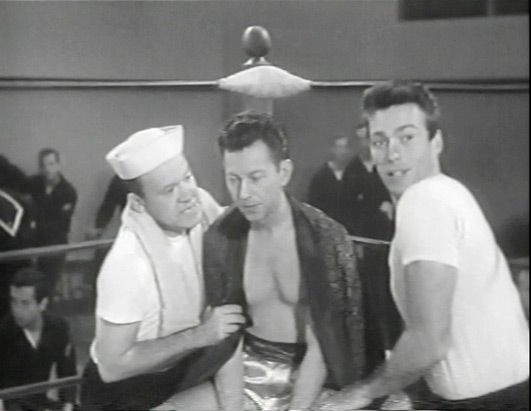
In 1955’s Francis In The Navy, Donald O’Connor plays Lt. Peter Sterling, an officer in the U.S. Army who gets word that his best friend, a talking mule named Francis (voice of Chill Wills), is about to be auctioned off by the U.S. Navy. Sterling rushes to the Naval base but, along the way, his wallet gets stolen, he gets mistaken for an AWOL soldier, and Francis gets sold to a laboratory.
Hold on, I’m re-reading that last paragraph to make sure that I didn’t hallucinating typing all that…
Peter argues that he’s not the AWOL soldier, he’s just someone who looks just like him. Peter gets tossed into the psychiatric ward. Francis advices Peter …. yes, the mule that can talk gives Peter advice on how to get out of the mental ward …. to pretend to be the AWOL sailor. Unfortunately, the sailor is a champion boxer so that means Peter will have to enter the ring. Peter, needless to say, is not a boxer. Peter also falls for a nurse (Martha Hyer) but — uh oh! — she’s the sister of the AWOL soldier. Well, that’s kind of awkward. I don’t have a brother but if I did, I doubt I would ever want to make out with anyone who looked like him. Like seriously….
Hold on, I’m re-reading that last paragraph to see if there’s anything that I need to add.
Like, seriously, what the Hell? This movie has a talking mule, an oddly incestuous subtext, and Donald O’Connor playing two roles. Doing some research, I discovered that this was the sixth film to deal with the adventures of Peter Sterling and Francis. This was the last one of them to star Donald O’Connor, who apparently resented getting upstaged by a mule. There was one more Francis movie after this one and it starred Mickey Rooney. It was called Francis In The Haunted House so who knows? Maybe I’ll review it for our October horrorthon. (Don’t count on it.)
As weird as this film is, it’s kind of likable. Donald O’Connor is a favorite of mine and this one featured O’Connor in two roles, as both the hapless Peter and also the sailor who goes AWOL and repeatedly refuses to help Peter out. And, while I’m not really sure why he’s talking, Francis was actually cute. I enjoyed the boxing scene where he attempted to help Peter out. Unfortunately, there’s only so much a mule can do.
As for why I’m reviewing this movie, it’s because Clint Eastwood is in the cast. He plays Jonesy, a friend of the AWOL sailor who becomes a friend of Peter’s. Now, to be clear, Clint doesn’t do a lot in the movie. He works Peter’s corner during the boxing match. Otherwise, he spends most of the time in the background and he has a few scenes where he hangs out with the rest of the AWOL sailor’s friends. That said, Clint does make an impression. Even in this very early role, he had an impressive screen presence. He’s the tallest guy there and he’s got the best hair. Once you spot him in a scene, it’s hard to look away.
Francis In The Navy is historically significant because it’s the first film for which Clint Eastwood received on-screen credit. (Eastwood previously appeared in films like Revenge of the Creature and Tarantula but his name wasn’t included in the credits.) It’s an odd film, one that’s likable if you’re in an undemanding mood and you enjoy goof — extremely goofy — humor. It would be forgotten if not for Eastwood’s appearance. Seen today, this film, like Eastwood’s other early appearances, reminds us that everyone started somewhere.
Welcome to Retro Television Reviews, a feature where we review some of our favorite and least favorite shows of the past! On Tuesdays, I will be reviewing the original Fantasy Island, which ran on ABC from 1977 to 1984. Almost the entire show is currently streaming on Daily Motion, YouTube, Plex, and a host of other sites.
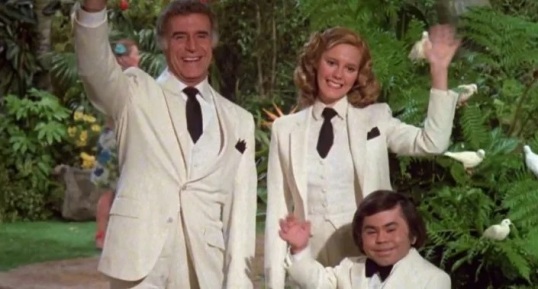
Smiles, everyone, smiles! It’s time to start the 5th season!
Episode 5.1 “Show Me A Hero/Slam Dunk”
(Dir by Phillip Leacock, originally aired on October 10th, 1981)
The fifth season brings some changes to Fantasy Island.
For instance, at the start of the season premiere, Roarke gifts Tattoo a platform that he can stand on while greeting and saying goodbye to the guests and so that he can, visually, be on equal footing with Mr. Roarke. From what I’ve read, this was something that Herve Villechaize specifically requested as a condition for agreeing to continue with the show. Considering that the previous season didn’t give Tattoo much to do, I can understand Villechaize’s logic.
The other big change is that Roarke has a new assistant. His goddaughter, Julie (Wendy Schaal), has spent the summer working on Fantasy Island. She only appears briefly in this episode, asking Mr. Roarke if she can greet the guests with him. Roarke tells her that she’s not quite ready but perhaps next week, she will get the opportunity….
And really, Julie should feel good about that because neither fantasy is really that interesting this week.
Matt Kane (Sonny Bono) is a short sportswriter who wants to become a great basketball player and play for a team called the California Top Hatters (who the Hell came up with that name?) because he thinks that’s the only way that he’ll be able to win the heart of Ginger Donavon (Jenilee Harrison), the daughter of the team’s coach (Forrest Tucker). Mr. Roarke warns Matt that there’s more to love than being able to play basketball but he still gives Matt a pair of magic sneakers.
Matt becomes a great basketball player. (For some reason, the team is practicing on Fantasy Island). Coach Donavon says that, if Matt wants a place on the team, he’ll have to beat out rookie sensation Skyhook Schuyler (Peter Isacksen). Fortunately, Matt comes to realize that he can’t win Ginger by being the best player. Instead, he has to be a better person. He removes his shoes and bombs the try out. But he gets to leave the island with Ginger.
Sonny Bono was a frequent guest star on both this show and The Love Boat. He always played dorky guys who tried too hard to be cool. That’s certainly the case here but what should be charming is made a bit bland by the total lack of chemistry between him and Jenilee Harrison. On the plus side, Tattoo actually gets to do something in this fantasy, serving as a confidante to Skyhook. It turns out that Skyhook is just as insecure about being tall as Tattoo is about being short. To help Skyhook, Tattoo paints a picture of him so that Skyhook can see his kind soul. Awwww! Seriously, Herve Villechaize totally earned his right to stand on that platform.
As for the other fantasy, Helen Ross (Connie Stevens) is engaged to Ted Kingman (Martin Milner) but she can’t get over her former lover, John Day (David Hedison). She thinks that John died while serving in the military but Mr. Roarke reveals that John actually survived the war and he lives on a nearby island. Helen is reunited with John, just to discover that he’s a cad who faked his own death and became a deserter. Helen leaves the Island feeling confident in her decision to marry Ted.
It’s only after she leaves that the truth is revealed. Ted is currently serving a prison sentence. Mr. Roarke arranged for Ted to have a weekend with freedom, on the condition that he lie about his situation to Helen so that she could move on from their failed romance. So, basically, Mr. Roarke took Helen’s money and then lied to her. Uhmm …. seriously, what the Hell, Mr. Roarke?
This was a bit of an underwhelming start for the fifth season but fear not! Next week …. Roddy McDowall returns as the Devil and he wants Mr. Roarke’s soul!
Welcome to Retro Television Reviews, a feature where we review some of our favorite and least favorite shows of the past! On Tuesdays, I will be reviewing the original Fantasy Island, which ran on ABC from 1977 to 1984. Almost the entire show is currently streaming on Daily Motion.
This week, the Island is full of damn liars.
Episode 4.13 “The Man From Yesterday/World’s Most Desirable Woman”
(Dir by Robert C. Thompson, originally aired on January 31st, 1981)
Bill Keating (Martin Milner) is a photojournalist who has reported from some of the most war-torn areas of the world. He has spent years searching for a notorious mercenary named Calvin Doyle (Dennis Cole) and he believes that he has finally tracked Doyle down to Fantasy Island. Bill swears to Mr. Roarke that his fantasy is to only do an interview with Doyle.
Of course, Bill’s lying. Once Bill tracks down Doyle and discovers that Doyle has not only renounced his previous ways but is also the foster father of three native children, Bill reveals that his true fantasy is to shoot Doyle and get revenge for all the terrible things that Doyle did during his former life.
Marsha (Barbi Benton) is a frumpy, 39 year-old woman who says that she just wants to know what it’s like to be young and beautiful for a weekend. Maybe she could even enter and win The World’s Most Desirable Woman pageant that’s being held on Fantasy Island. Mr. Roarke and Tattoo take Marsha to the Island’s fountain of youth. Marsha enters the fountain as a 39 year-old wearing a modest one-piece bathing suit. She steps out of the fountain as a 21 year-old wearing a bikini.
Of course, Marsha isn’t being totally honest about her motives. She is married to Hal Garnett (Bert Convy), the owner of Erotic Magazine and the sponsor of the pageant! Her fantasy is to get revenge on Hal for all the years in which he’s neglected her for the younger women who appear in his magazine.
Two fantasies, two liars. Mr. Roarke is fairly busy this week, showing up frequently in both fantasies (and even singing at the Most Desirable Woman pageant). Mr. Roarke warns Marsha that she is getting too caught up in her newdound beauty. Mr. Roarke also warns Calvin that Bill Keating wants to kill him. Roarke allows Keating to take his shot at Calvin but he also arranges for the confrontation to happen on a rickety bridge so that the wounded Calvin can escape into the water below. It’s interesting to see Roarke getting involved for once and Ricardo Montalban knew exactly how to deliver the character’s occasionally ominous lines. Still, you have to wonder why he let these two liars on the Island on the first place. Usually, he has pretty firm rules about stuff like this. What if the bridge hadn’t broken and Doyle had died? Mr. Roarke would look pretty dumb.
Fortunately, it all works out. Having faked his own death, Doyle is able to leave the Island with his children. And Marsha is informed that she will not go back to being 39 at the end of the weekend but will instead remain 21 and just age naturally. Hal freaks out, realizing that men are going to be chasing his wife. Roarke tells him that he better be good to her.
(Of course, Tattoo later takes a picture of Marsha and is shocked to see that picture is of the old Marsha, suggesting that the young Marsha is just an illusion that only Marsha, Hal, and I guess Tattoo can see. It’s weird.)
Barbi Benton and Dennis Cole were regular guests to Fantasy Island and they both do well with their roles. All of the lying felt a bit out-of-place for this show but at least Roarke got to be an active force in both fantasies. All in all, this was a good trip to the Island.
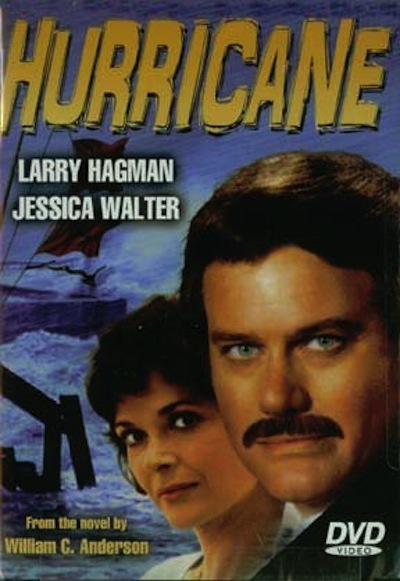
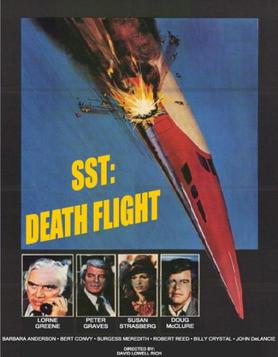
Hurricane Hilda is crashing down on the Gulf Coast and everyone in its path is about to get all wet. While Will Geer and Michael Learned try to warn everyone about the approaching hurricane, coast guard pilot Martin Milner observes the storm from the air and tires to rescue everyone in its path. Some people listen and some people don’t. Milner’s own father, played by Barry Sullivan, ends up getting stranded in a cabin while Larry Hagman and Jessica Walter play a married couple on a boat who find themselves sailing straight into the storm. On temporarily dry land, Frank Sutton (a.k.a. Gomer Pyle’s Sgt. Carter) plays a homeowner who refuses to evacuate because he’s convinced that he knows everything there is to know about hurricanes. He and the neighbors have a drunken party while waiting for the storm. When Patrick Duffy and his wife announce that they’re heading for safety, Sutton demands that they come in and have a beer with him. When Hilda finally makes landfall, some survive and some don’t.
Hurricane is a by-the-numbers disaster movie. It was made after The Poseidon Adventure and during the same year as The Towering Inferno and it hits all the usual disaster movie beats. Survival is determined by karma, with Hilda going after anyone who was too big of a jerk during the first half of the movie. It’s predictable stuff but it does feature footage from an actual hurricane so it’s at least not too dragged down by any of the bad special effects that always show up in made-for-TV disaster films.
This is one of those films where the cast was probably described as being all-star, even though most of them were just TV actors who needed a quick paycheck. Seen today, the film feels like a MeTV reunion special. Years before they played brothers in Dallas, both Larry Hagman and Patrick Duffy appeared in Hurricane, though neither of them shares any scenes. Will Geer and Michael Learned were starring on The Waltons when they appeared in this movie and they’re in so few scenes that they probably shot their scenes over a weekend before returning to Walton’s Mountain. The best performance is from Frank Sutton, who died of a heart attack just a few weeks after this movie aired. He’s a convincing hothead, even if he doesn’t have Gomer around to yell at.
Hurricane may be bad but it’s still not as terrible as most made-for-TV disaster movies. People who enjoy watching TV actors pretending to stare at a tidal wave of water about to crash down on them will find this film to be an adequate time waster.
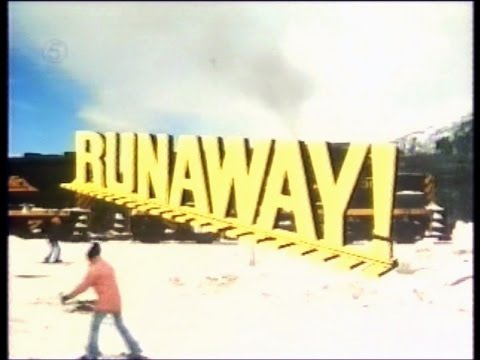
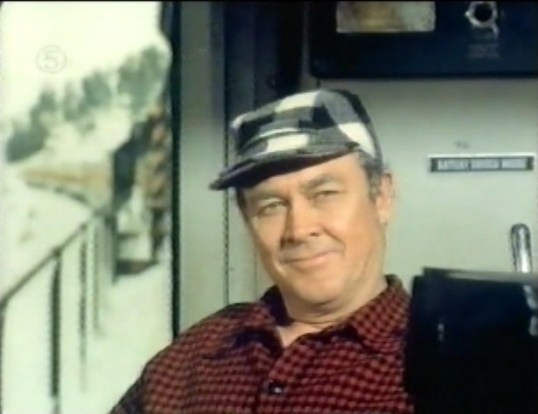
Runaway! begins with a train starting a slow descent down a snowy mountain. On board the train are collection of skiers, gigolos, conductors, and engineers. One couple discusses their upcoming divorce. An athletic father tries to bond with his less-athletic son. A slick con artist tries to convince a depressed young woman not to throw herself from the train. A group of skiers put on an impromptu concert, banging on their suitcases like bongo drums. They get so loud that the conductor doesn’t even hear the engineer desperately trying to contact him. What none of the passengers realize is that the train’s brake engines have frozen and the train is about to start hurtling down the mountain. Unless the chief engineer can figure out a way to stop the train, everyone’s going to die!
Made for television in the year between the release of The Poseidon Adventure and The Towering Inferno, Runaway! is a low-key but entertaining disaster movie. With a running time of only 70 minutes, Runaway! doesn’t waste any time getting down to business and, even if it is a low-budget movie, there’s no way that an out-of-control train racing down a mountain can’t be exciting.
Compared to the other disaster movies of the era, Runaway! does not exactly have an all-star cast though there are some familiar faces. Vera Miles and Ed Nelson are the divorcing couple while Martin Milner is the father who puts too much pressure on his son. Ben Murphy is the gigolo who refuses to pay for a ticket on general principle while Darleen Carr is the woman who wants to jump to her death. Most of them are just there as placeholders. It’s obvious from the start that the real stars of the film are going to be the train and the mountain. However, the famously gruff character actor Ben Johnson manages to make an impression just by being Ben Johnson. Johnson plays the chief engineer and, as long as he’s manning the engine, you know that the train’s passengers are in good hands.
Runaway! has never been released on DVD or even VHS but it is currently available on YouTube.
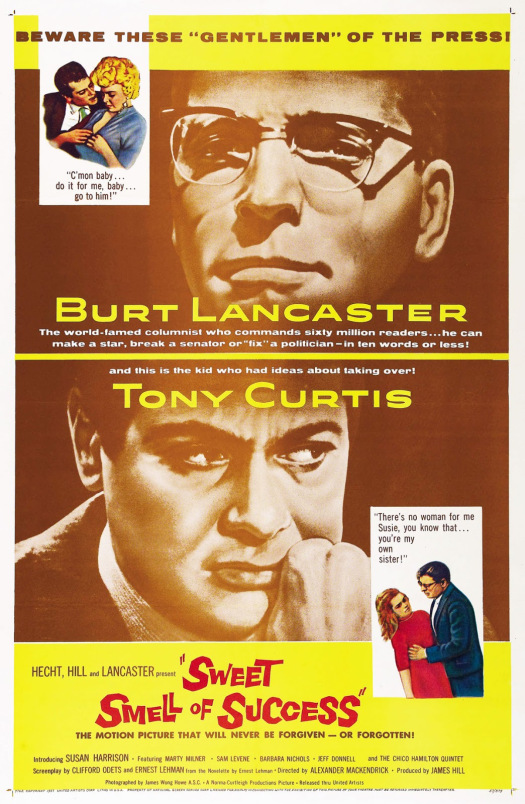
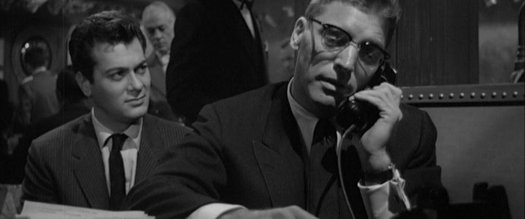
Watching SWEET SMELL OF SUCCESS is like taking a slog through a sludge-filled, rat infested sewer. It’s “a cookie full of arsenic”, with two of the most repellant characters to ever worm their way across the silver screen. It’s also a brilliant film, with superb performances from stars Burt Lancaster and Tony Curtis, wonderfully quotable dialog by Clifford Odets and Ernest Lehman, tense direction by Alexander Mackendrick, and stunning black and white photography by James Wong Howe . It’s a movie that demands repeated viewings; just make sure to take a shower after each one!
Powerful Broadway columnist J.J. Hunsecker is dead set on destroying the relationship between his kid sister Susie and up-and-coming jazz guitarist Steve Dallas. To achieve this goal, he uses his toady, press agent Sidney Falco. Sidney, forever trying to curry favor with the great Hunsecker, pimps out cigarette girl Rita to rival columnist Otis Elwell, in exchange for…
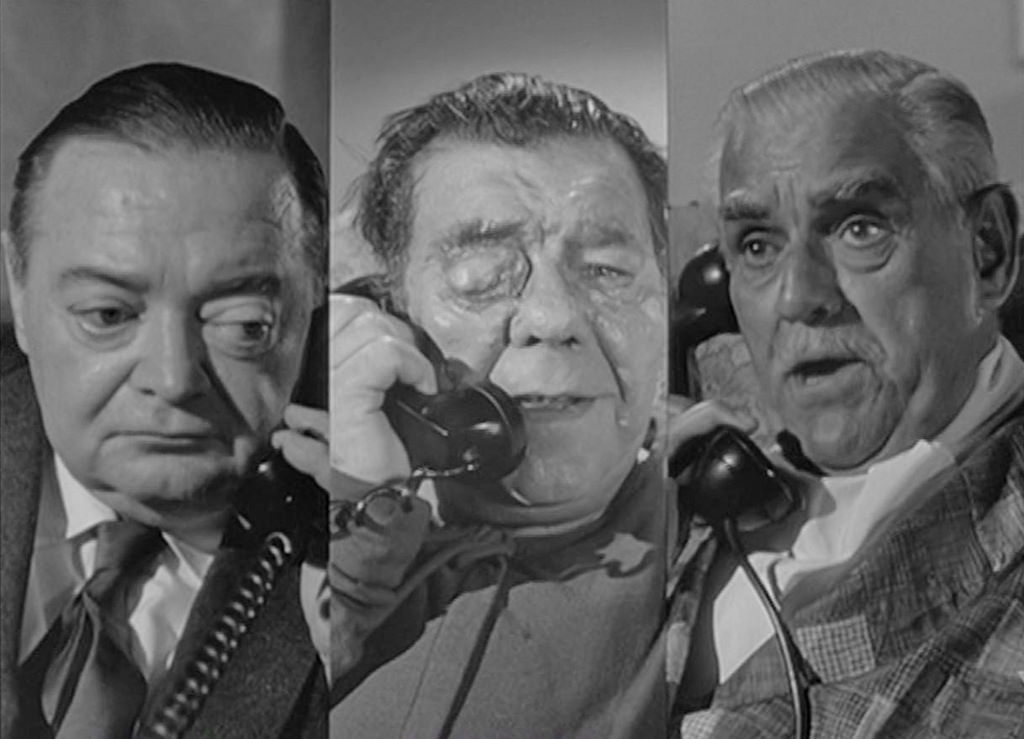
The TV series ROUTE 66 followed the adventures of two young men (Martin Milner, George Maharis) as they cruised the fabled highway in their spiffy Corvette. The 1962 Halloween episode featured a special treat for horror fans, with Boris Karloff, Peter Lorre, and Lon Chaney Jr. guesting as themselves. The three screen ghouls are debating the value of their old Gothic-style chillers vs the modern, “adult” horrors like PSYCHO. Karloff makes his final appearance in his Frankenstein makeup, while Lon dons the Wolf Man and Mummy makeups once again (and his dad’s Hunchback, too!). If you’re a classic horror lover, you’re absolutely gonna LOVE watching this Trio of Terror Titans (especially Chaney!) in “LIZARD’S LEG AND OWLET’S WING”:
(Also in the cast are Betsy Jones-Mooreland (Corman’s THE LAST WOMAN ON EARTH), Martita Hunt (GREAT EXPECTATIONS, Hammer’s THE BRIDES OF DRACULA), veteran Conrad Nagel (whose nephew Don co-starred in BRIDE OF THE MONSTER)…
Now, William Castle was famous for his gimmicks. For instance, theaters showing The Tingler were wired to give electrical shocks to random patrons. He had a special gimmick for 13 Ghosts, a film about a house haunted by ghosts that you can only see while wearing special goggles. Since I’m a lazy film blogger, I’m going to quote the film’s Wikipedia article on this particular gimmick:
“For 13 Ghosts, audience members were given a choice: the “brave” ones could watch the movie and see the ghosts, while the apprehensive among them would be able to opt out of the horror and watch without the stress of having to see the ghosts. The choice came via the special viewer, supposedly “left by Dr. Zorba.”
In the theatres, most scenes were black and white, but scenes involving ghosts were shown in a “process” dubbed Illusion-O: the filmed elements of the actors and the sets — everything except the ghosts — had a blue filter applied to the footage, while the ghost elements had a red filter and were superimposed over the frame. Audiences received viewers with red and blue cellophane filters. Unlike early 3D glasses where one eye is red and the other is cyan or blue, the Illusion-O viewer required people to look through a single color with both eyes. Choosing to look through the red filter intensified the images of the ghosts, while the blue filter “removed” them. Despite Castle’s claims to the contrary, not many heart failures or nervous breakdowns were averted by the Illusion-O process; although the blue filter did screen out the ghostly images, the ghosts were visible with the naked eye, without the red filter.”
Personally, if I had been alive in 1960, I totally would have watched the whole movie through the red filter. Go ghosts go!
Anyway, 13 Ghosts is actually a lot of fun in a low-budget, 1960s drive-in sort of way. Watch it below and, as always, enjoy!
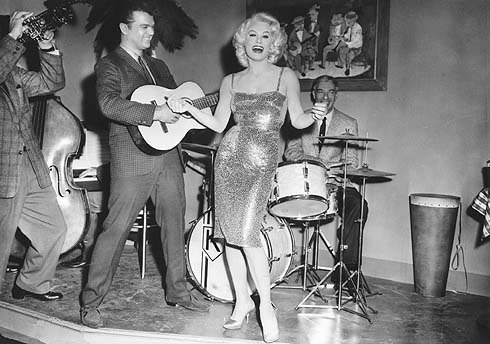
Let’s get it out of the way right now- SEX KITTENS GO TO COLLEGE is bad. Real bad. Like mind-numbingly bad. Despite the presence of sex kittens Mamie Van Doren and Tuesday Weld, this movie is a smelly litter box in desperate need of cleaning. It’s an Albert Zugsmith extravaganza, so you know right off the bat it’s gonna be a stinker. Zugsmith had once been a producer at Universal, overseeing prestige films like WRITTEN ON THE WIND and TOUCH OF EVIL. But when he went into independent productions, Zugsmith chose to go the low-budget exploitation route and even though he managed to attract some well-known names, his little epics usually stunk to high heaven.
The movie revolves around the talents of Mamie Van Doren, a beautiful creature whose best assets weren’t her acting. She plays Dr. Mathilda West, a genius hired to take over the science department at Collins College. Thinko, a supercomputer/robot type thing…
(Warning: This review contains spoilers. A lot of them.)
Last week, I posted a poll and I asked you, the Shattered Lens readers, which film I should watch on March 20th and then subsequently review. You voted and the winner was the classic 1967 trashfest, Valley of the Dolls.
Based on a best-selling (and trend-setting) novel by Jacqueline Susann, Valley of the Dolls starts out with a disclaimer that informs us that the story we’re about to see is totally fictional and purely imaginative. That disclaimer is probably the funniest part of the entire film as Valley of the Dolls is notorious for being one of the first films dedicated to showing middle America just how miserable and screwed up those famous show business types truly are. As such, the main reason for watching a movie like this is so you can sit there and compare the cinematic troubles of a character like Neely O’Hara to the true-life troubles of an actress like Lindsay Lohan. Valley of the Dolls tells the story of three aspiring stars who, as they find fame, also find themselves dealing with heartbreak, insanity, and dolls. No, not the type of dolls that my mom used to collect. These “dolls” are a bunch of red pills that do everything from keeping you thin to keeping you awake and focused. (Though the pills are never actually called anything other than “dolls,” they appear to be the same pills that I take for my ADD.)
The least interesting of our three heroines is Anne Welles (Barbara Parkins). Unfortunately, Anne is also pretty much the center of the rather draggy first hour of the film. Anne is a walking cliché, a naive girl from a small town in New England who moves to New York, gets a room at the Martha Washington Hotel for Women, and a job at a local theatrical agency. “I want to have a marriage like mom and dad…but not yet!” Anne breathlessly tells us. Anne eventually ends up as the mistress of Lyon Burke (played by Paul Burke), a writer-turned-theatrical-agent who you know has to be a cad because his name is Lyon Burke and he takes Anne’s virginity but then refuses to marry her afterward. Anne eventually becomes a model and finds fame as the face of Gilligan Hairspray but she soon finds herself forced to watch as her two best friends travel down a path of self-destruction.
Anne is the film’s token “good girl” and, as such, she’s rather bland and boring. However, her character is interesting when considered as a symbol for the confused sexual politics of the time. Valley of the Dolls was made in 1967, at a time when Hollywood was still trying to figure out how to deal with the emerging counter-culture. The end result? A lot of rather old-fashioned films that were full of jarringly out-of-place counter-culture moments. By the time Valley of the Dolls came out, it was allowable to acknowledge that a single girl might actually have sex but she still had to, at the very least, feel an unbelievable amount of angst about it. That certainly is the case with Anne. Watching the film today, it’s hard to understand just what exactly Anne’s feeling guilty about. Lyon isn’t married. Anne finds success even as she pursues her relationship with him. Up until the final half of the film (at which point the morality of the time demands that both Anne and Lyon suddenly start acting totally out-of-character), Lyon treats her with about as much respect as you could probably expect to get from a man in the 1960s. And yet, Anne can’t feel complete simply because Lyon is hesitant about marrying her. When she and Lyon finally do make love, they do it with the lights off so the only thing the viewer sees are two shadowy figures holding each other. Following the film’s logic, if the lights had been left on, the character of Anne would have had to have been punished later in the film for allowing the audience to see too much of her.
When Anne first comes to New York, she befriends two actresses. The more tragic of the two is Jennifer North (played by Sharon Tate, who would be tragically murdered two years after this film came out), an insecure blonde who is valued more for her body than her talent. Jennifer spends her spare time doing bust exercises (“To hell with them!” she declares at one point as she glares down at her chest, “Let ’em droop!”) and dealing with phone calls from her mother, demanding that Jennifer send her money. Jennifer eventually ends up marrying a singer named Tony (played by Tony Scotti). Tony is a well-meaning if simple-minded guy who is married to a creepily overprotective sister (played by Lee Grant). Eventually, it turns out that Tony has a neurological disease and he’s eventually checked into a sanitorium. Penniless, Jennifer goes France and makes “art films.” (In one of Valley of the Dolls’ better moments, we’re shown a clip of this “art film” and it turns out to be a pitch perfect satire of every single pretentious soft-core film to ever come out of Europe.) Upon returning to America, Jennifer discovers that she has breast cancer and, declaring “All I’ve got is my body,” she commits suicide.
Though Sharon Tate gets considerably less screen time than her co-stars, she probably gives the strongest performance in this film. Certainly, her story is the most emotionally effective (even if it’s hard not to feel that, as is typical of the films of both the 60s and today, Jennifer is being punished for taking off her clothes on camera). Tate perfectly captures the insecurity that comes from being continually told that you have nothing more to offer beyond how you look. In her first appearance, she’s wearing an outrageously large headdress. “I feel a little top-heavy,” she says. “You are a little top-heavy,” some guy replies while leering at her breasts. If you doubt that Sharon Tate was a good actress, just watch her reaction. She perfectly captures a pain that I personally know far too well. Her subsequent suicide scene, which has the potential to be the most tasteless part of this film, is actually the most powerful and again, it’s because Tate plays the role perfectly.
(It’s been nearly four years since I lost my mom to breast cancer and I have to admit, I had a hard time watching the scenes where Jennifer discusses her diagnosis. Tate gave a great performance here and it’s a shame that she’s been permanently linked in the public imagination with Charles Manson and the later accusations against her husband, Roman Polanski. She had real talent.)
As poignant of Sharon Tate was in her role, the film’s fame (and infamy) ultimately rests with our third heroine, Neely O’Hara (played by Patty Duke in a performance that suggests that she was literally possessed during the filming). Neely is a scrappy, aspiring singer who is fired from a broadway show when her singing threatens to upstage aging star Helen Lawson (played by Susan Hayward, who was brought in to replace Judy Garland). Neely, however, refuses to let anything keep her down and soon, she’s singing at a Cystic Fibrosis telethon and becoming a big star. She marries her boyfriend Mel (played by Martin Milner, who grits his teeth and spits out every line) and moves to California where she soon becomes a big star and then finds herself hooked on “booze and dolls.” (“I need a doll!” she insists on several occasions.)
One reason the film’s 2nd hour is so much more fun than the first is because the film’s focus shifts from boring Anne to out-of-control Neely. Increasingly temperamental and unstable, Neely soon starts to spend all of her time with dress designer Ted Casablanca (a great name, if nothing else.) “You’re spending more time than necessary with that fag Ted Casablanca,” Mel tells her to which Neely replies, “Ted Casablanca’s no fag and I’m the dame who can prove it.” This, of course, leads to a divorce and soon Neely is living with Mr. Casablanca who informs her, after he gets caught cheating, “You made me feel as if I was queer…that little whore makes me feel 9 feet tall.”
When Lyon and Anne attempt to force Neely to enter a sanitorium, she responds to running off to San Francisco where she enters a bar and shouts, “I’M NEELY O’HARA!” before then wandering down a sleazy street and ranting, “Boobies, boobies! Nothing but boobies! Who needs them!?” Needless to say, this leads to her eventually overdosing and ending up in that sanitorium where she has a huge freak-out before singing a duet with Tony and resolving to get her life back in order. This, naturally, leads to her getting released, having an affair with Lyon, and then returning to Broadway where, in the film’s most deliriously odd moment, she steals Helen Lawson’s wig and flushes it down a toilet.
Valley of the Dolls is, admittedly, a terrible film but it’s also a lot of fun and that’s largely because of Patty Duke’s berserk performance as Neely O’Hara. Earlier, I said that Duke’s performance appears to suggest that she may have been possessed but, honestly, that barely begins to describe it. Whereas Tate managed to find some truth in the film’s melodrama and Parkins gives a performance that suggests that the script put her in a coma, Duke attacks every inch of melodramatic dialogue, barking out her dialogue with all the ferocity of a yapping little chiuaua. Duke gives a performance that is so completely and totally over-the-top that it’s hard not to respect her commitment to capturing every overheated, melodramatic moment.
I have to admit that one reason why I love this film is because I’m hoping that someday some enterprising director will remake it and cast me as Neely O’Hara. Everytime I watch this film, I find myself thinking about how much it would be to respond to every petty annoyance by screeching out, “I’m NEELY O’HARA!” Seriously, just think about it. As a character, Neely is a talented, ambitious, emotional, unstable, immature, demanding, bratty, spoiled, and determined. Sound like anyone whose film reviews you might have been reading recently? From my previous experience as a community theater ingenue, I can assure you that I can deliver melodramatic dialogue with the best of them and, unlike Patty Duke in this film, I can actually dance. Unfortunately, I can’t carry a tune to save my life but I’m thinking maybe they could bring in Kelly Clarkson to serve as my singing voice. (Or maybe Jessica Simpson. Did I ever mention that we both went to the same high school? Though not at the same time, of course.) After all, if Patty Duke could be obviously dubbed, why not me? I can just see myself now, wandering down some sleazy city street, singing to myself and declaring at the top of my lungs, “Ted Casablanca’s no fag and I’m the dame who can prove it!” I know that Lindsay Lohan will probably insist that this is the role she was born to play, but seriously, who needs Linsday when you’ve got a Lisa?
Beyond the so-bad-that-its-good appeal of the film, Valley of the Dolls is a fascinating cultural artifact for the reasons that I previously hinted at while talking about the character of Anne Welles. Valley of the Dolls was made in 1967 and, as such, it’s a perfect exhibit of an unstable time when Hollywood was unsure about whether it should embrace the “new morality” or if it should continue to recycle the same sort of old-fashioned filmmaking that had nearly bankrupted the big studios. The result was several films that felt oddly schizophrenic in their approach and that is certainly the case with Mark Robson’s direction of Valley of the Dolls. Whether it’s the way the film continually hints at nudity and sex while carefully not revealing too much or the way that random psychedelic sequences seem to suddenly appear on-screen, this is a movie that perfectly captures an uncertain film industry trying to figure out where it stands in a scary new world.
As always, I enjoyed watching this undeniably bad but just as undeniably compelling film. Our readers chose well! Thank you to everyone who voted and I hope you’ve enjoyed reading this review almost as much I enjoyed writing it.