Horror Film Review: Fiend Without A Face (dir by Arthur Crabtree)


First released in 1958, Fiend Without A Face takes place around an American Air Force base in rural Canada.

The base is home to several nuclear experiments, which have left the local residents uneasy.  They grew even more uneasy when people start to turn up dead.  Local farmers are found deceased, missing their brains and spinal columns.  Two puncture marks are found at the base of each skull.  Air Force Major Jeff Cummings (Marshall Thompson) is investigating the deaths, determined to prove to the locals that American nuclear energy is not to blame.  Cummings suspects that Prof. R.E. Walgate (Kynaston Reeves) might be involved.  Walgate claims to have telekinetic powers and has made a name for himself through his psychic experiments.  Cummings has recently become a big believer in the idea of thought projection.  Could Walgate’s psychic powers, combined with nuclear power, be at the heart of the mystery?

Of course, they are!  Who is responsible for the murders?  It turns out that there’s more than enough blame to go around.  Yes, Walgate’s psychic experiments have indeed backfired and now, there’s an invisible monster stalking the Canadian countryside.  Whoops!  Sorry, Canada!  And, at the same time, all of the nuclear energy has made that monster far more powerful than it would be under normal circumstances.  Whoops!  Sorry again, Canada!

(Actually, I guess we should be happy that this happened in Manitoba as opposed to a place that people actually care about, like North Dakota.)

To understand why this is all happening at an American base that happens to be located in Canada, it’s important to know that Fiend Without A Face was a British film that hoped to appeal to both Brits and Americans.  As a result, the film may have been shot in England but it needed to be set somewhere closer to America.  At the same time, if the film actually did take place in North Dakota, British audiences would have said, “Bloody yanks,” and failed to show up at the theater.  Canada was the logical compromise.  That’s one thing I love about B-movies.  They’ll shamelessly twist the plot any which way that may be necessary in order to appeal to the biggest possible audience.

Speaking of loving B-movies, I absolutely love Fiend Without A Face.  The film not only has a morbid streak that one doesn’t necessarily expect to find in a low-budget production from 1958 but it also features the sight of brains (with their spinal column trailing behind them) attacking humans and crawling through the base.  Because the effect was achieved with stop-motion animation, the brains move in a somewhat herky-jerky fashion, which just makes them all the more frightening.  The brains spend the majority of the film in a state of invisibility.  When they are suddenly revealed, it’s a great moment.  It’s what Lucio Fulci used to call “pure cinema.”

Clocking in at only 77 minutes and featuring a lot of stock Air Force footage to go along with the moving brains, Fiend Without A Face is a gloriously ludicrous movie that also happens to be one of the best B-pictures of the 1950s.
Horror Film Review: It! The Terror From Beyond Space (dir by Edward L. Cahn)


“Another name for Mars is …. DEATH!”

The 1958 sci-fi/horror hybrid, It!  The Terror From Beyond Space, opens with a NASA press conference.  The assembled reporters are reminded that, earlier in the year, America’s first manned mission to Mars was presumed to have been lost.  However, a second mission was sent to Mars and they discovered that the commander of the first mission, Edward L. Carruthers (Marshall Thompson), was still alive.

Unfortunately, all of Carruthers’s crewmates were dead.  Carruthers claimed that the murders were committed by a monster.  The commander of the second mission, Col. Van Heusen (Kim Spalding), instead suspected that Carruthers killed his crewmates when he realized they were stranded on Mars.  The ship had enough provisions to last the entire crew for one year or ten years for just one man.

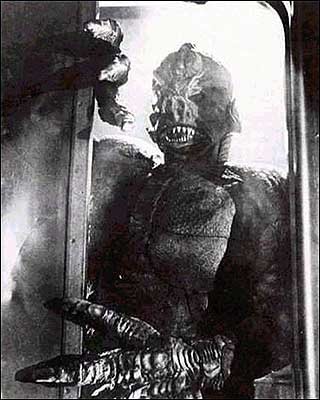
The second mission is now on their way back to Earth, with Carruthers under house arrest.  While one crewman does believe that Carruthers’s story could be true, the others are convinced that Carruthers is a murderer.  What they don’t know is that the monster from Carruthers’s story is not only real but that it also snuck onto their ship during lift-off.  Tall and scaly with huge claws and a permanently angry face, the Monster — It, for lack of a more formal name — is lurking in the lower levels of the ship and hunting for food.

To state what is probably already obvious, It! is not a film that worries much about being scientifically accurate.  While it does explain how living on the surface of Mars caused It to develop into the predator that it is, this is also a science fiction film from 1958.  It’s a film where, instead of going to the Moon, the first manned spaceflight is to Mars.  It’s also a film where there’s no weightlessness in space, the two women on the ship serve everyone coffee, and a nuclear reactor is casually unshielded at one point in an attempt to destroy It.  Bullets are fired on the spaceship.  Grenades are tossed.  Airlocks are rather casually opened.

Fortunately, none of that matters.  Clocking in at a mere 69 minutes, It! is a surprisingly suspenseful horror film, one that makes good use of its claustrophobic locations (a lot of the action takes place in an air duct) and which features a surprisingly convincing and, at times, even scary monster.  It may be a man in a rubber suit but that doesn’t make it any less shocking when its claw bursts out of an an open hatch and starts trying to grab everything nearby.  The cast of It! are all convincing in their roles.  Watching them, you really do believe that they are a crew who have seen a lot together and it makes the subsequent deaths all the more effective,

It! was a troubled production,  The monster was played by veteran stuntman Ray Corrigan, who reportedly showed up drunk a few times and also managed to damage the monster suit.  Many members of the cast were not happy about being cast in a B-movie.  (Fortunately, their resentment probably helped their performances as the similarly resentful crew of the second mission to Mars.)  Marshall Thompson, who played Carruthers, was one of the few cast members who enjoyed making It! and, perhaps not surprisingly, he also gives the best performance in the film.

Troubled production or not, It! was not only a box office success but, along with Mario Bava’s Planet of the Vampires, it was later cited as one of the inspiration for Alien.  At its best, It! has the same sort of claustrophobic feel as Alien.  The scene where one of the crewman is found in an air duct brings to mind the fate of Tom Skerritt’s character in Alien.

It! is still a very effective work of sci-fi horror.  Remember, another name for Mars is …. DEATH!

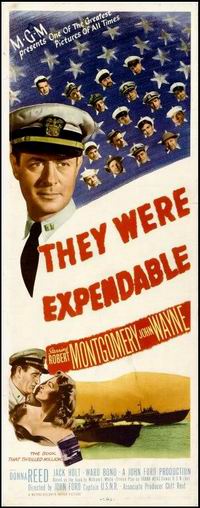
They Were Expendable (1945, directed by John Ford)


In December of 1941, Lt. John Brickley (Robert Montgomery) commands a squadron of Navy PT boats, based in the Philippines.  Brickley is convinced that the small and agile PT Boats could be used in combat but his superior officers disagree, even after viewing a demonstration of what they can do.  Brickley’s second-in-command, Rusty (John Wayne), is frustrated and feels that he will never see combat.  That changes when the Japanese attack Pearl Harbor and then turn their attention to the Philippines.  Brickley gets his chance to show what the PT boats can do but both he and his men must also deal with the terrible risks that come with combat.  Brickley and his men have been set up to fight a losing battle, only hoping to slow down the inevitable Japanese onslaught, because both they and their boats are considered to be expendable.  The hot-headed Rusty learns humility when he’s sidelined by blood poisoning and he also falls in love with a nurse, Sandy (Donna Reed).  However, the war doesn’t care about love or any other plans that its participants may have.  With the invasion of the Philippines inevitable, it just becomes a question of who will be sent with MacArthur to Australia and who will remain behind.

One of John Ford’s best films, They Were Expendable is a tribute to the U.S. Navy and also a realistic look at the realities of combat.  The movie features Ford’s trademark sentimentality and moments of humors but it also doesn’t deny that most of the characters who are left behind at the end of the movie will not survive the Japanese invasion.  Even “Dad’ Knowland (Russell Simpson), the fatherly owner of a local shipyard who does repair work on the PT boats, knows that he’s expendable.  He resolves to meet his fate with a rifle in hand and a jug of whiskey at his feet.  Rusty, who starts out thirty for combat, comes to learn the truth about war.  Ford was one of the many Hollywood directors who was recruited to film documentaries during World War II and he brings a documentarian’s touch to the scenes of combat.

Robert Montgomery had previously volunteered in France and the United Kingdom, fighting the Axis Powers before America officially entered the war.  After the war began, he entered the Navy and he was a lieutenant commander when he appeared in They Were Expendable.  Montgomery brought a hardened authenticity to the role of Brickley.  (Montgomery also reportedly directed a few scenes when Ford was sidelined with a broken leg.)  John Wayne is equally good in the role of the hot-headed Rusty, who learns the truth about combat and what it means to be expendable.  The cast is full of familiar faces, many of whom were members of the John Ford stock company.  Keep an eye out for Ward Bond, Cameron Mitchell, Leon Ames, Jack Holt, and Donald Curtis.

They Were Expendable is one of the best of the World War II movies.  It’s a worthy film for Memorial Day and any other day.

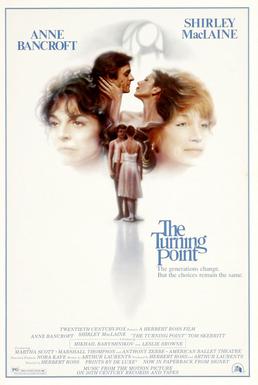
Cleaning Out The DVR, Again #28: The Turning Point (dir by Herbert Ross)


(Lisa is currently in the process of trying to clean out her DVR by watching and reviewing all 40 of the movies that she recorded from the start of March to the end of June.  She’s trying to get it all done by July 11th!  Will she make it!?  Keep visiting the site to find out!)

The 28th film on my DVR was the 1977 film The Turning Point.  I recorded it off Indieplex on June 3rd.

I guess I should start this review by admitting that I really have no excuse.  As someone who grew up dreaming of being a prima ballerina and who unknowingly caused her mother to spend an incalculable amount of money of dance classes, dance outfits, dance shoes, dance trips, and all the medical bills that go along with having a klutzy daughter who is obsessed with ballet and as someone who continues to love to dance today, I really have no excuse for not having seen The Turning Point before last night.  Along with The Red Shoes and my beloved Black Swan, The Turning Point is one of three ballet movies to have been nominated for best picture.  It’s a film that, as a result of its box office success, established many of the clichés that continue to show up in dance movies to this day.

Seriously, how had I not seen it before?

And make no mistake about it — The Turning Point is a dance movie.  Don’t get me wrong.  There’s a plot.  Actually, there’s several plots and it’s not incorrect to describe The Turning Point as being something of a soap opera.  But ultimately, all the plots are just window dressing.  Director Herbert Ross started his career as a choreographer with the American Ballet Theater and the characters in The Turning Point are fictionalized portraits of people that he actually knew.  Ross’s love for both ballet and the dancers comes through every frame of The Turning Point and the film’s best moments are when the melodrama takes a backseat to the performances onstage.

But I guess we actually should talk about the melodrama.  Okay, here goes:

Many years ago, DeeDee (Shirley MacClaine) and Emma (Anne Bancroft) both belonged to the same New York ballet company.  DeeDee was the star of the company and was set to play the lead in Anna Karenina when another dancer with the company, Wayne (Tom Skerritt), got her pregnant.  DeeDee not only dropped out of the company but she married Wayne and moved back to his home state of Oklahoma.  (The film suggests, in an oddly regressive moment, that Wayne only slept with DeeDee in order to prove that, despite being a male dancer, he wasn’t gay.)  DeeDee and Wayne opened a dance studio in Oklahoma City while Emma got the lead in Anna Karenina and went on to become a prima ballerina.

18 years later, Wayne and DeeDee’s daughter, Emilia (Leslie Browne), is invited to join the company.  Because Emilia is shy and somewhat naive, DeeDee accompanies her to New York while Wayne stays behind in Oklahoma with their younger children.

Once in New York, DeeDee starts to wonder if she made the right decision when gave up ballet for domesticity.  She run into an old friend, conductor Joe Rosenberg (Anthony Zerbe, not playing a villain for once) and has an affair with him.  Meanwhile, Emma is having an affair with a married man named Carter (Marshall Thompson) and is struggling to accept that she’s getting older and will soon have to retire.  Just as DeeDee regrets giving up dancing, Emma regrets never having children.

Meanwhile, Emilia slowly starts to come into her own and blossom as a dancer.  She even ends up having an affair with the self-centered and womanizing Yuri (Mikhail Baryshnikov), one of the stars of the company.  Emilia and Emma start to grow close, with Emma treating Emilia like her own daughter.  DeeDee finds herself growing jealous of both her daughter and her former best friend.

Needless to say, it all leads to Emma throwing a drink in DeeDee’s face and the two of them having a cat fight on the streets of New York…

The Turning Point is no Black Swan or Red Shoes.  Leslie Browne (who was playing a character based on herself) was a great dancer but not much of an actress so you never care about her the way that you do Natalie Portman in Black Swan.  The dancers are amazing in both films but Darren Aronofsky literally put the audience in Portman’s ballet slippers while Herbert Ross keeps the audience at a distance, allowing them to watch and appreciate the dancers’s passion but not necessarily to experience it with them.

But, with all that in mind, I still enjoyed The Turning Point.  What can I say?  I love dance movies!  Both Shirley MacClaine and Anne Bancroft give excellent performances.  Bancroft apparently had no dance experience before shooting The Turning Point (and it’s hard not to notice that, whenever Emma is performing, the camera focuses on those moving around her as opposed to Emma herself) but she still does a good job of poignantly capturing Emma’s fear of getting older and her joy when she realizes that Emilia looks up to her.  MacClaine, meanwhile, has an amazing scene where she watches her screen daughter perform and, in just a matter of seconds, we watch as every emotion — pride, envy, regret, and finally happiness — flashes across her face.

And, of course, there’s that cat fight.  It’s a silly scene, to be honest.  But seriously, if there was any actress who could convincingly throw a drink in someone else’s face, it was Anne Bancroft.

The Turning Point was nominated for 11 Oscars and it ended up setting a somewhat dubious record when it managed to win exactly zero.  (This perhaps shouldn’t be surprising when you consider its competition included Annie Hall and the first Star Wars.)

Well — no matter!

Though the film may not be perfect, I liked it!

The Turning Point

Lisa Marie Reviews The Oscar Nominees: Battleground (dir by William Wellman)


I love February.

Why?  Well, first off, we all know that February is the most romantic month of the year.  February is Valentine’s Day, romantic movies, flowers, lingerie, and chocolate.  February is also the month when, in a lead up to the Oscars, TCM devotes a good deal of its programming to showing Oscar nominees of the past.

As I’ve mentioned in the past, one of my dreams is to watch and review every single film that has ever been nominated for best picture. Now, realistically, I’ll never be able to accomplish this goal because the 1929 Best Picture nominee The Patriot is currently a lost film.  But, even if it does mean that I’ll only be able to see 510 out of the 511 nominated films, it’s still a dream that I’m pursuing and, with the help of TCM and the month of February, it’s a dream that’ll come true.

Take, for instance, Battleground.  This 1949 Best Picture nominee (it lost All The King’s Men) recently aired on TCM.  I’m not exactly a fan of war films but, since it was a best picture nominee, I still made sure to DVR and watch it.

Set during the final days of World War II, Battleground follows one platoon of soldiers as they fight and attempt to survive the Battle of the Bulge.  The platoon is made up of the type of characters that we usually expect to find in a WWII film but, fortunately, they’re played by an ensemble of likable actors who all bring their familiar characters to life.  There’s Jim Layton (Marshall Thompson), the newest member of the platoon who nobody wants to run the risk of getting close to.  There’s Holley (Van Johnson), the cheerful soldier who is unexpectedly thrust into a position of leadership that he might not be right for.  Roderiques (Ricardo Montalban) is from Los Angeles and is amazed by the sight of snow.  “Pops” Stazak (George Murphy) is the type of older soldier who you would totally expect to be nicknamed “Pops.”  Bettis (Richard Jaeckel) is scared of combat.  Kippton (Douglas Fowley) spends nearly the entire film looking for his lost teeth.  And finally, of course, there’s the hard-boiled but warm-hearted Sgt. Kinnie (James Whitmore).

In some ways, Battleground is a very conventional film and it’s easy to wonder how it ended up getting nominated for best film of the year.  (Among the eligible films that were not nominated: The Bicycle Thief, Champion, The Fountainhead,  On The Town, Sands of Iwo Jima, She Wore A Yellow Ribbon, They Live By Night, and White Heat.)  However, the film’s nomination makes a bit more sense when you consider that it was released just four years after the end of World War II.  It was a film that appealed both to the veterans who were able to relate to the film’s story and to the patriotic spirit of a country that had just defeated the greatest evil of the 20th Century.

Battleground did not exactly make me a fan of war movies but it’s still a well-made and effective film. As opposed to a lot of other war films, Battleground never makes war look like fun.  For the most part, the emphasis is less on strategy and combat and more on the soldiers who are simply trying to survive from day-to-day.  The end result is a film that serves as a moving tribute to the soldiers who fought in World War II.