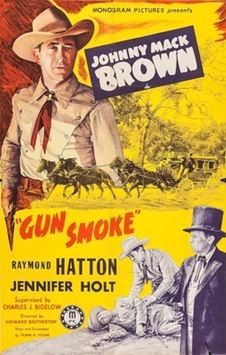
Gun Smoke (1945, directed by Howard Bretherton)


On the frontier, a stagecoach has been overturned and both the passenger and the driver have been killed by outlaws.  The passenger was Hinkley, an archeologist.  Who would want to kill a harmless archeologist?  That’s what Marshals Nevada Jack McKenzie (Johnny Mack Brown) and Sandy Hopkins (Raymond Hatton) set out to discover.  While Nevada Jack asks questions in the nearby town, Sandy disguises himself as a medicine man.

It all links back to an old Indian site that is said to be full of gold relics.  Jane (Jennifer Holt), the daughter of Hinkley’s partner, reveals that the only other person who knows the location of the site is an old Indian named Shag (Dimas Sotello).  Jack and Sandy have to try to track down Shag before he’s found the gang that killed Hinkley.

Yes, it’s another Johnny Mack Brown western.  Despite the title, this has nothing to do with the television series that featured James Arness and Amanda Blake.  Gun Smoke is still a solid western, featuring a determined performance from Johnny Mack Brown and some memorable villains from the usual poverty row western stock company.  Once again, Frank Ellis shows up as a henchman, though the identity of the main villain is actually a little more interesting than was typical for these films.  Johnny Mack Brown is a little more serious than usual, throwing punches with authority.  For fans of B-westerns, Gun Smoke is an above average entry in Johnny Mack Brown’s seemingly endless filmography.

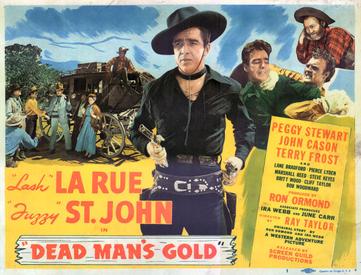
Dead Man’s Gold (1948, directed by Ray Taylor)


Jim Thornton (Britt Wood) has discovered a gold mine so he writes to his old friends, Lash LaRue (Lash La Rue) and Fuzzy (Al St. John), asking them to come help him guard it.  When Lash and Fuzzy arrive, Jim is nowhere to be found.  With the help of Jim’s niece (Peggy Stewart), they discover that Jim’s been murdered.  It doesn’t take a genius to realize that the murder was carried out by Conway (Jason Cason) and his men and that’s a good thing because a genius is something you will never find in a Lash La Rue western.  However, Lash suspects that Conway was following someone else’s orders.  He and Fuzzy set up a trap to reveal the true identity of the mastermind.

Lash dresses in all black and often uses a whip instead of a gun but this is still a standard B-western.  Historically, it’s important because it was the first movie that La Rue made with producer Ron Ormond.  Ormond later went from producing Lash La Rue films to directing them and Lash’s career never really recovered.  (Ormond, whose non-Lash LaRue films included Mesa of Lost Women and If Footmen Tire You, What Will Horses Do?, was never much of a director.)  Fortunately, Dead Man’s Gold was directed by the dependable Ray Taylor, who keeps the action moving and crafts an adequate if not exactly memorable western.

There is one cool scene in Dead Man’s Gold, in which Lash uses his whip to knock a shot glass out of a bad guy’s hand.  Let’s see The Lone Ranger do that!

Challenge of the Range (1949, directed by Ray Nazarro)


On the frontier, someone is raiding the homes of ranchers like Jim (Henry Hall) and Judy Barton (Paula Raymond).  The Homeowners Association summons Steve Roper (Charles Starrett) to bring a stop to the raids.  Everyone suspects that Cal Matson (Steve Darrell) and his son, Rob (Billy Halop), are behind  the raids but Steve, as the Durango Kid, discovers that a third party is trying to set everyone at war with each other for his own benefit.

The entry in the Durango Kid series was Charles Starrett’s 103rd western.  It’s not a particularly distinguished entry, relying heavily on stock footage.  I did find the idea of the film’s bad guy trying to manipulate the Bartons and the Matsons into destroying each other to be interesting but the movie doesn’t do much with it and the identity of main villain will be obvious to anyone who watches the film.  There is one good scene where Steve disarms three bad guys and then makes them walk all the way back to town without their boots on.  Steve doesn’t mess around.

Smiley Burnette provides the comic relief and a few songs.  This time, Smiley’s a dime store writer researching his next book.  Musically, he is accompanied by The Sunshine Boys.  103 movies in and Smiley still hasn’t figure out that Steve and Durango are one of a kind.

The Rough Tough West (1952, directed by Ray Nazarro)


Steve Holden (Charles Starrett) is hired by an old friend, Jack Mahoney (played by Jock Mahoney), to serve as the sheriff of a frontier town.  Steve soon discovers that his old friend has been corrupted by power and is plotting to cheat the locals out of their land and the gold that the land holds.  Despite their friendship, Steve knows that Jack has to be stopped and made to see the errors of his way.  It’s a good thing that Steve is secretly the Durango Kid and that his old sidekick, Smiley Burnette, is the town’s police chief.  But even if Jack Mahoney does eventually see the error of his ways, will it be soon enough to stop his out-of-control henchmen?

This was one of the last of the Durango Kid films and it’s heavy on stock footage and Smiley Burnette musical numbers.  It has all of the usual horse chases and gunfights but making the villain an old friend of the Durango Kid adds a little more emotional weight to this entry than some of the other Durango Kid films.  As always, Charles Starrett is a strong western hero and Smiley Burnette’s antics are nowhere nearly as annoying as the antics of some of the other western sidekicks who were populating matinee movie screens in 1952.  Western fans should enjoy this fast-paced and undemanding film.

This is not the first time that Jock Mahoney played a friend of the Durango Kid who is named Jack Mahoney, though I think the Jack Mahoney who appeared in Pecos River, Junction City, Smokey Canyon, The Hawk of Wild River, and The Kid From Broken Gun was meant to be a different character than the one who appeared in The Rough, Tough West.  If Smiley Burnette could have a rotating cast of musicians who followed him from town-to-town, then the Durango Kid could very well have known multiple Jack Mahoneys.


Bonanza Town (1951, directed by Fred F. Sears)


The frontier community of Bonanza Town has been taken over by the corrupt businessman, Krag Boseman (Myron Healey).  No one can stand up to Krag because the local judge (Luther Crockett) is under Boseman’s control.  The judge’s son (Ted Jordan) writes to the Durango Kid and asks him to come to Bonanza Town and lead a group of vigilantes to overthrow Boseman.

The Durango Kid, whose real name is Steve Ramsay (Charles Starrett) somehow receives the letter and heads into town.  As Steve, he gets a job working for Boseman and looks for evidence that Boseman is actually being bankrolled by a notorious outlaw named Henry Hardison (played by the film’s director, Fred Sears).  As the masked Durango Kid, he defuses the vigilante’s violent plan and, with the help of Smiley Burnette, he investigates what Boseman has on the judge.

Charles Starrett played the Durango Kid in 131 films.  In fact, he appeared in so many movies that the majority of Bonanza Town is made up of flashbacks from 1947’s West of Dodge City.  Despite all of the flashbacks, Bonanza Town is one of Starrett’s better films, featuring an interesting story and good performances from both Fred Sears and Luther Crockett.  Sears shows some imagination with his staging of the many gunfights and, as always, Starrett is convincing riding a horse and carrying a gun.

Bonanza Town is a fairly serious film and Smiley Burnette’s trademark comedic relief feels out of place but the kids in 1951 probably enjoyed it.  While everyone else is shooting guns and committing murder, Smiley is running his barber shop and turning a potato into a musical instrument.  While the Durango Kid dispenses frontier justice, Smiley sings a song and leaves his customers bald.  They were a good team.