The TSL Horror Grindhouse: The Fifth Floor (dir by Howard Avedis)


In 1977’s The Fifth Floor, Dianne Hull plays Kelly McIntyre.

Kelly is a college student by day and a disco dancer by night!  Unfortunately, after someone spikes her drink at the discotheque and she suffers an overdose, she becomes a full-time patient at a mental asylum.  Neither the head doctor (Mel Ferrer) nor the head nurse (Julia Adams, who once swam with The Creature From The Black Lagoon)  believes her claim that her drink was spiked.  Judged to be suicidal and delusional, Kelly is sent to the Fifth Floor!

While her boyfriend (John David Carson) tries to convince the authorities that she’s not insane, Kelly adjusts to life on the Fifth Floor.  She befriend Cathy (Patti D’Arbanville).  She encourages her fellow patients to dance and enjoy themselves.  She tries to escape on multiple occasions.  She draws the unwanted attention of a male orderly named Carl (Bo Hopkins, giving a wonderfully sinister performance).  A sadist equipped with down-home country charm, Carl has got all of his co-workers convinced that he’s a great guy.  The patients, though, know that Carl is a petty authoritarian who enjoys showing off his power.  (“I’m just doing my job,” is the excuse whenever he’s challenged.)  Carl takes an obsessive interest in Kelly and soon, Kelly is not only trying to get her life back but also trying to escape from Carl’s cruel intentions.

Most film directories list The Fifth Floor as being a horror film and certainly, there are elements of the horror genre to be found in the film.  The smooth-talking and nonchalantly cruel Carl is certainly a horrific character and Kelly’s attempts to escape from the asylum capture the very primal fear of not having any control over one’s life.  That said, The Fifth Floor owes greater debt to One Flew Over The Cuckoo’s Nest than to the typical slasher film.  Kelly is a rebel who brings the patients in the ward together.  Much as in Cuckoo’s Nest, the nurses and the orderlies use the threat of electro-shock treatment to keep the patients under control.

It’s not a bad film, though it definitely has its slow spots and I do wish the film had embraced its own sordidness with a bit more style.  I’m a history nerd so I appreciated the fact that The Fifth Floor was so obviously a product of its time.  Any film that features the heroine showing off her disco moves before being taken to a mental hospital is going to hold my interest.  That said, the most interesting thing about the film are some of the familiar faces in the cast.  For instance, Earl Boen — who played so many authority figures over the course of his career and appeared as a psychiatrist in the early Terminator films — plays a patient who wears a NASA jacket.  The always intimidating Anthony James plays the most violent patient.  Michael Berryman and Tracey Walter appear as background patients.

And then you’ve got Robert Englund, cast here as Benny.  Benny is the most gentle of the patients, a prankster who befriends Kelly.  It’s always so interesting to see the type of roles that Englund played before he was cast as Freddy Krueger in A Nightmare On Elm Street.  In this film, Englund is so goofy and friendly that you actually find yourself worrying about something happening to him.  Englund’s role is small but his amiable nerdiness definitely makes an impression.

The Fifth Floor opens and ends with a title card telling us that the film is based on a true story.  Sure, it was.

Embracing the Melodrama Part II #43: The Stepmother (dir by Howard Avedis)


stepmotherJust looking at the poster for the 1972 film The Stepmother, I bet you think it’s a pretty scandalous and sordid film.  I mean, there’s a picture of a woman wearing a black bra and there’s a tagline that reads, “She forced her husband’s son to commit the ultimate sin!”

CIP_Logo

Well, perhaps not surprisingly considering that this is a Crown International film, The Stepmother‘s poster and tagline have very little do with the actual film.  Yes, the film does feature a stepmother and, during the final 20 or so minutes of the film, her stepson does finally show up and she does end up sleeping with him.  It’s consensual.  There’s no forcing involved.  And, as far as the ultimate sin part is concerned — well, her husband has been doing a lot worse.

The film itself is actually about the husband.  Frank Delgado (Alejandro Rey) is a wealthy architect who is also insanely jealous of his new wife, Margo (Katherine Justice).  Whenever he suspects that Margo is cheating on him, he ends up killing someone.  And, as a matter of fact, even when he doesn’t think Margo is cheating on him, he ends up killing someone.  Frank, of course, has to find a way to cover up all of his various murders.  It doesn’t help that Inspector Darnezi (John Anderson) is constantly snooping around.  And then, once he discovers that his stepson actually has slept with Margo (as opposed to all the people he killed just because he assumed they had slept with Margo), Frank is forced to decide whether or not to kill his own son.

The Stepmother is available in about a dozen Mill Creek boxsets and it’s fun in a 1972 sort of way.  Frank and all of his friends are decadent rich people so you could argue that the film is meant to be a portrait of the immorality of the 1%.  (That would actually be a pretty stupid argument but it’s one that you could make if you’re trying to impress someone who hasn’t read this review.)  Director Howard Avedis tries to liven up the plot by including a lot of artsy touches that don’t really add up to much but which are still fun to watch.  Occasionally, he’ll toss in a freeze frame for no particular reason.  As well, Frank has a habit of hallucinating.  He continually sees his first victim running across the beach in slow motion.  Make a drinking game out of it.  Every time it’s obvious that The Stepmother was trying to fool people into thinking it was a European art film, take a drink.

To be honest, the most interesting thing about The Stepmother is that it is the only Crown International film to have received an Oscar nomination!  That’s right!  The Stepmother was nominated for Best Original Song.  The name of the song was Strange Are The Ways Of Love.  You can listen to it below if you want.  Feel free to dance.

Anyway, that’s The Stepmother for you.  It’s not my favorite Crown International film but, as a historical oddity, it’s still worth watching.

http://www.youtube.com/watch?v=lKO-U5J4Vrs

Back to School #14: The Teacher (dir by Howard Avedis)


3df3d

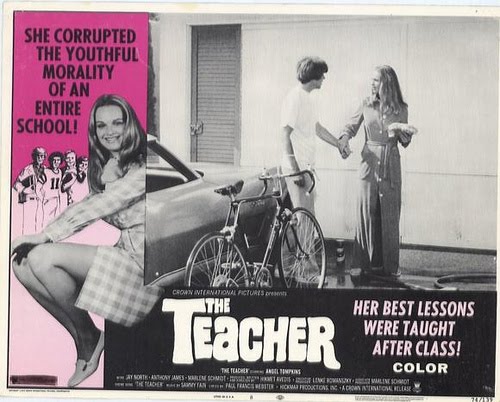
“She Corrupted The Youthful Morality of an Entire School!” the tagline for the 1974 film The Teacher screams out.

Uhmmm, no.

In fact, that’s probably one of the most deceptive taglines in the history of film advertising.  However, we shouldn’t be surprised that it was used.  Like The Young Graduates, The Teacher was produced by Crown International Pictures.  Crown International was all about getting people to buy tickets and they probably figured that more people would pay to see a movie about a teacher corrupting “an entire school” than they would for a film about a 28 year-old teacher having an affair with one (and only one) 18 year-old who has recently graduated high school.

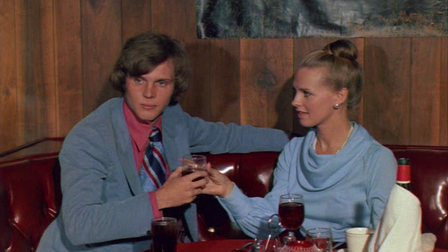
The relationship is between Diane (Angel Tompkins) and Sean (Jay North).  Diane lives next door to Sean’s family.  She’s married to a man who spends most of his time on the road, racing motorcycles and only occasionally calling his wife.  Diane is a teacher but we only briefly see her standing outside of the local high school.  While Sean admits that he has always had a crush on her and, at the start of the movie, even spies on her while she’s sunbathing, it’s never made clear whether or not Sean was ever actually in any of her classes.  In fact, the only thing controversial about their eventual relationship is that there’s a 10 year age difference between them.  But that really doesn’t seem to bother anyone, with the exception of two old women who happen to see Diane and Sean out on a date.

Teacher and Not A Student

Teacher and Not A Student

That, of course, doesn’t mean that Diane doesn’t have anything to teach Sean.  As the film’s theme song tells us, “Every boy needs a teacher, to help show him the way…”

But here’s the thing.  Considering how tawdry one would naturally expect a film like The Teacher to be, it’s actually treats Diane and Sean’s relationship with a lot of sensitivity.  Tompkins and North have a lot of chemistry together and both of them give natural and believable performances.  In many ways, this film is a sincere attempt to explore an unlikely relationship.  I’ve always felt that in almost every 70s exploitation film, there’s an art film waiting to break out.  That’s certainly the case with The Teacher.

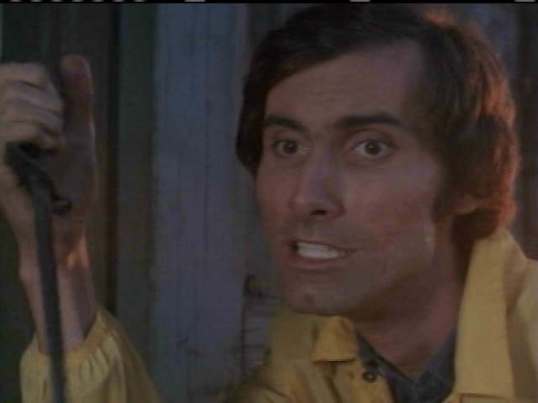
However, The Teacher isn’t just about Diane “teaching” Sean.  It’s also about a guy named Ralph, who also happens to be obsessed with Diane.  (When, at the start of the film, Sean is spying on Diane, little does he suspect that Ralph is spying on him.)  We know Ralph is a bit off because he’s always talking to himself, he drives a hearse, and he’s played by Anthony James.  You may not recognize his name but if you’re a fan of 70s and 80s exploitation cinema, you know who Anthony James is.  He’s one of those very intense, very creepy-looking character actors who would always show up playing psychos and evil henchmen.

Anthony James

Anthony James

Ralph is not only obsessed with Diane but he also blames Sean for the death of his younger brother.  It seems that Sean and Ralph’s brother were spying on Diane when, somehow, Ralph’s brother ended up falling to his death.  (If you get the feeling that literally every male in this film appears to spend the majority of his time watching Diane — well, you’re right.)  Ralph wants vengeance and, in his defense, Sean never really does seem to be that upset about the death of his best friend.

Because this film was made in the 70s, it all leads to surprisingly somber ending that will probably inspire you to reconsider any belief you may have in a benevolent God.

I have to admit that, out of all the Crown International films that I’ve recently watched, The Teacher was a favorite of mine.  Watching the film — with its constantly shifting tone and it’s mix of arthouse pretension and grindhouse melodrama — is an odd experience that epitomizes everything that I love about old exploitation films.

Thank you, Crown International, for always being you.

CIP_Logo