Retro Television Review: The Chadwick Family (dir by David Lowell Rich)


Welcome to Retro Television Reviews, a feature where we review some of our favorite and least favorite shows of the past!  On Sundays, I will be reviewing the made-for-television movies that used to be a primetime mainstay.  Today’s film is 1974’s The Chadwick Family!  It  can be viewed on YouTube.
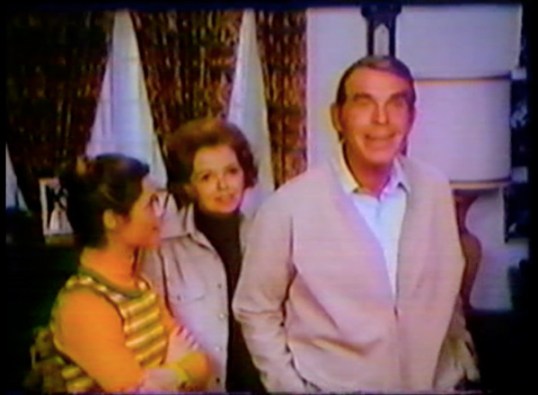
Who are the Chadwicks?

They’re a family living in San Francisco.  They claim to be an average middle class family but, as has apparently been typical of television since its very first broadcast day, they live in a way that can only be explained by having a good deal of wealth.

Consider this: Patriarch Ned Chadwick (Fred MacMurray) is a prominent newspaper columnist who writes so well that a mere column from him can settle a potential labor strike.  A national magazine has noticed the power of Ned’s words and they’ve offered him a job.  They want to turn him into a national figure.  The only catch is that he and his wife (Kathleen Maguire) would have to leave their beloved San Francisco and move to Chicago.  There’s no ocean in Chicago, as Ned puts it.  Sure, it would mean more money but who needs money when you’re a fabulously wealthy couple pretending to be middle class?

Moving would also mean leaving behind their children, all of whom have dramas of their own to deal with.  Tim (Stephen Nathan) is a college student, struggling to make the grade.  Lisa (Jane Actman) is engaged to Lee (Frank Michael Liu) and, for some reason, decides that it would be a good idea to tell her future mother-in-law that her desire for a long engagement is “bad chop suey.”  (Lee’s family is Chinese.)  Eileen (Lara Parker) is pregnant and her husband worries this will sabotage their support for “zero population growth.”  And Joan (Darleen Carr) is having to deal with the fact that her charismatic and fun-loving husband, Duffy (a young Barry Bostwick), is seriously ill and might even die before he can finish teaching Ned how to play the bagpipes.  Like all middle class people, Duffy owns his own airplane.

This is one of those movies that was obviously meant to serve as a pilot for a weekly television series and it’s easy to imagine Ned handing out wisdom to his kids on a weekly basis as they tried to navigate their way through the 70s.  Fred MacMurray gives off a nice grandfatherly vibe as Ned, so much so that it’s hard to believe that he’s the same actor who brought to life memorable heels in Double Indemnity, The Caine Mutiny, and The Apartment.  Unfortunately, the rest of the cast is not as memorable as MacMurray, largely because their roles are underwritten and their characters never feel like more than caricatures.  Barry Bostwick acts up a storm as Duffy but the fact that he’s listed as being a “special guest star” in the opening credits pretty much gives away his fate from the start.  As for Lisa, I usually like any character who shares my name but how much sympathy can you have for someone dumb enough to use a phrase like “bad chop suey” while speaking to her Chinese future in-laws.  Indeed, it was kind of weird how everyone in the family seemed to be totally comfortable with making jokes about Lee being Chinese and speaking with an accent.  One has to wonder how Lee felt about that.

Anyway, as far as I know, The Chadwick Family has no further adventures but their sole outing will live forever thanks to YouTube.
Cleaning Out The DVR, Again #11: Cavalcade (dir by Frank Lloyd)


Cavalcade_film_poster

So, I’ve been cleaning out the DVR for the past week.  Fortunately, I’m going to be off work for this upcoming week, which should give me a lot of extra film-watching time.  That’s a good thing because I’ve got 36 movies that I’ve recorded on the DVR since Thursday and, over the past seven days, I’ve only watched 13 of them!  That’s 23 movies to go and I hope to be finished by the end of the next week.

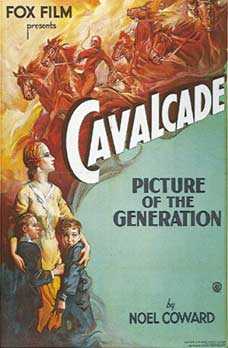
The 11th film that I found on my DVR was the 1933 film, Cavalcade.  I recorded it off of FXM on April 3rd.

The main reason that I recorded Cavalcade was because it was the 6th film to win the Oscar for Best Picture.  Now, I have to admit that I wasn’t expecting much from Cavalcade.  It’s a film that many Oscar historians tend to list as being one of the lesser best picture winners.  Cavalcade is often unfavorably compared to the films that it beat — movies like I Am A Fugitive From A Chain Gang, A Farewell To Arms, Little Women, and The Private Life of Henry VIII.  Cavalcade was the first British to ever win the Best Picture and its victory is often cited as the beginning of the Academy’s love affair with British productions.

And really, Cavalcade couldn’t be more British if it tried.  Based on a play by Noel Coward, Cavalcade follows two families through several decades in British history.  One family is wealthy and is anchored by a patriarch who is knighted in the Boer War.  The other family is lower middle class, anchored by a patriarch who starts out as a butler but who eventually manages to open up his own pub.  Through the eyes of these two families, we view what, in the 1930s, was recent British history.

For modern viewers, it may be helpful to watch Cavalcade while consulting Wikipedia.  For instance, the film starts with the two father figures preparing to leave to fight in the Boer War and I’m sorry to admit that I really wasn’t totally sure what that was.  I had to look it up in order to discover that it was a war that the British fought in South Africa.

But you know what?  That’s not really a complaint.  I may not have known what the Boer War was before I started the film but that had changed by the time that I finished watching Cavalcade.  Several times, I’ve mentioned on this blog how much I love history but watching Cavalcade made me realize that I still have more to learn.  Even more importantly, it encouragds me to learn.  That’s always a good thing.

Certain other historical events were more familiar.  As soon as I saw the title card announcing that the date was 1914, I knew that I would soon be seeing a World War I montage.  And, as terrible as World War I was (though, naturally, the film refers to it as being “the Great War,” and, for a few moments, I considered the fact that there was a time when nobody thought there would ever be a second world war), I was actually kind of happy for the montage because it got the characters out of the drawing room and out of the pub.  Cavalcade is a very stagey film.  Though there are a few attempts to open up the action, you’re always very aware that you’re essentially watching a filmed play.

Of course, the film’s best historic moment comes when a recently married couple goes on their honeymoon.  We see them standing on the deck of a cruise ship, talking about how much they love each other and how wonderful life will be.  They then step to the side and we see the name of the ship: RMS Titanic.

In many ways, those dismissive Oscar historians are correct about Cavalcade.  It’s stagey and it’s old-fashioned and some of the performances are better than others.  But, dammit, I liked Cavalcade.  As the upper class couple, Diana Wynyward and Clive Brook made for a likable couple and they got to exchange some sweet-natured dialogue at the beginning and the end of the film.   Add to that, it was a film about history and I love history.

Cavalcade is hardly a perfect film and it probably didn’t deserve to win best picture.  But it’s still better than its reputation suggests.

Embracing the Melodrama Part II #21: Emergency Hospital (dir by Lee Sholem)


Emergency Hospital

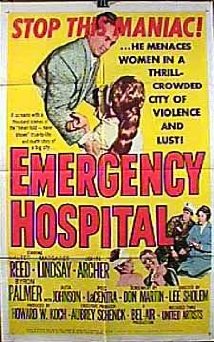
Right now, on Netflix, you can find Emergency Hospital, a low-budget film from 1956.  Emergency Hospital, which probably was made to be the second feature on a double bill, covers the course of one night at a hospital.  Patients come in.  Crimes are investigated.  Two doctors — one a man and one a woman and since this film was made in the 50s, that leads to all sorts of confusion — deal with all of the patients.  The film manages to stuff a lot of incidents into just 61 minutes of running time.

If you look at the poster above, you’ll see that it implores us to “STOP THE MANIAC!  He menaces women in a thrill-crowded city of violent and lust!”  I’m not really sure which of the film’s many subplots that is meant to refer to.  At one point, the son of a police detective is brought in after crashing his car.  He briefly attempts to hold a nurse hostage with a scalpel but, in the end, he doesn’t turn out to be much of a maniac.

In fact, if there’s anything that really distinguishes Emergency Hospital is just how low-key it is.  For the most part, the film emphasizes the fact that everyone at the hospital is focused on doing her or his job.  The patients all come in with their own individual melodramas but, for the most part, the doctors and the police all react calmly and rationally.  It’s interesting to compare Emergency Hospital to something like Magnificent Obsession.  Whereas Magnificent Obsession truly embraces the melodrama, Emergency Hospital invites the melodrama to pull up a chair and then tells it to calm down.

Perhaps because it was such a low-budget and obscure film, Emergency Hospital gets away with taking a look at and talking about issues that you normally wouldn’t expect to be so openly explored by a film made in the 50s.  And, interestingly enough for a film made in a culturally reserved time, the doctors and nurses at Emergency Hospital take a rather open-minded and nonjudgmental approach to their patients.  An anxious mother comes in with her bruised baby and is confronted about being an abusive parent.  A teenage girl comes in after being raped and the doctors try to convince her father (who thinks his daughter’s reputation will be ruined) to call the police.

Now, make no mistake about it: Emergency Hospital is not a secret masterpiece.  It’s an extremely low-budget movie that looks like an extremely low-budget movie.  But, taking all that into consideration, it’s still a lot better than your typical 61 minute second feature.

Emergency Hospital can currently be watched on Netflix.

Embracing the Melodrama Part II #12: Jezebel (dir by William Wyler)


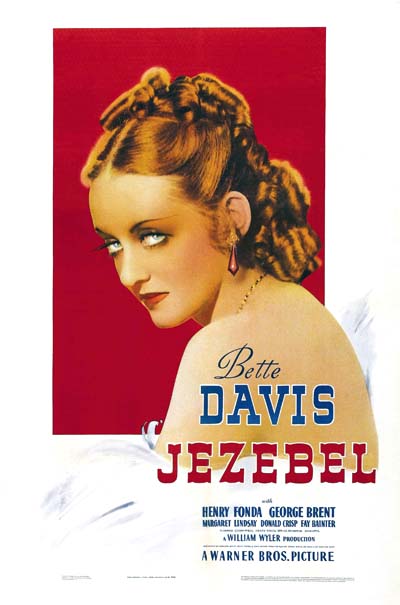
Jesebel_movieposterWe started out this day by taking a look at Bette Davis in Of Human Bondage so it seems only appropriate that today’s final entry in Embracing the Melodrama should be another film in which Bette Davis plays a potentially unlikable character who is redeemed by being the most interesting person in the film.

The 1938 best picture nominee Jezebel stars Bette Davis as Julie Marsden, a strong-willed Southern belle who lives in pre-Civil War New Orleans.  Julie is looking forward to an upcoming ball but is frustrated when her fiancée, boring old Pres (Henry Fonda), says that he has to work and declines to go shopping for a dress with her.  Impulsively, Julie does exactly what I would do.  She buys the most flamboyant red dress that she can find.

Back in the old South, unmarried women were expected to wear white to formal balls, the better to let everyone know that they were pure and innocent and waiting for the right man.  When Julie shows up in her red gown, it’s a scandal and, upon seeing the looks of shock and disdain on everyone’s faces, Julie wants to leave the ball.  However, Pres insists that Julie dance with him and he continues to dance with her, even after the orchestra attempts to stop playing music.

And then he leaves her.  At first, Julie insists to all who will listen that Pres is going to return to her but it soon becomes obvious that Pres has abandoned both Julie and Southern society.  Julie locks herself away in her house and becomes a recluse.

Until, a year later, Pres returns.  At first, Julie is overjoyed to see that Pres is back and she’s prepared to finally humble herself if that means winning back his love.  But then she discovers that the only reason that he’s returned to New Orleans is to warn people about the dangers of Yellow Fever.

Oh, and he’s also married.

To a yankee.

For the most part, Jezebel is a showcase for another fierce and determined Bette Davis performance.  It’s easy to be judgmental of a character like Julie Marsden but honestly, who doesn’t wish that they could be just as outspoken and determined?  It helps, of course, that the film surrounds Julie with a collection of boring and self-righteous characters, the type of people who you love to see scandalized.  Henry Fonda gives one of his more boring performances in the role of Pres while Margaret Lindsay, in the role of Pres’s Northern wife, is so saintly that she reminds you of the extremely religious girl in high school who would get offended whenever you came to school wearing a short skirt.  In a society as rigid, moralistic, and judgmental as the one portrayed in Jezebel, it’s impossible not to cheer for someone like Julie Marsden.

Add to that, I totally would have worn that red dress too!  In a world that insisted that all women had to act a certain way or look a certain way and think a certain way, Julie went her own way and, regardless of what boring old Pres may have thought, there’s a lesson there for us all.

When watching Jezebel, it helps to know a little about film history.  Bette Davis very much wanted to play Scarlett O’Hara in Gone With The Wind and was reportedly very disappointed when the role went to Vivien Leigh.  Depending on the source, Jezebel is often described as either being Davis’s audition for the role of Scarlett or as being a consolation gift for losing out on the role.  Either way, Jezebel is as close as we will ever get to seeing Bette Davis play Scarlett.  Judging from the film, Davis would not have been an ideal Scarlett.  (Whereas Gone With The Wind works because Leigh’s Scarlett grows stronger over the course of the film, Davis would have started the film as strong and had nowhere left to go with the character.)  However, Davis was a perfect Julie Marsden.