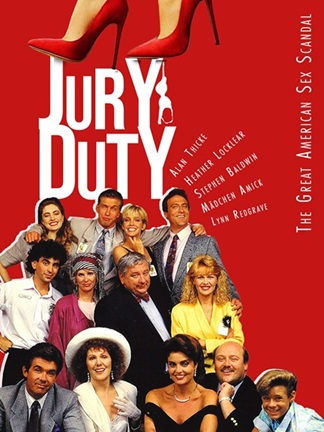
Meek-looking accountant Sanford Lagelfost (Bronson Pinchot) is on trial for embezzlement. It’s supposed to be a simple, up-and-shut case but when the beautiful star witness (Tracy Scoggins) testifies that Sanford is an amazing lover, it becomes a tabloid sensation and the jurors are sequestered in a hotel, where they have to deal with their own restlessness and several distractions, the majority of whom are also played by Bronson Pinchot. Pinchot plays a total of four characters but it’s not like he’s Peter Sellers or even Eddie Murphy. He looks and sounds like Bronson Pinchot in every role.
The jurors are played by a bunch of a familiar television actors. Alan Thicke plays a yuppie named Phil and Lynn Redgrave plays a hippie named Abby and they end up getting married. Stephen Baldwin is the waiter who falls for Heather Locklear, an actress who is a former call girl who is being threatened by her pimp. Madchen Amick is the spoiled rich girl. Television mainstays Mark Blankfield, Ilene Graf, William G. Schilling, Danny Pintauro, and Bill Kirchenbauer are all present and accounted for. Adding to the overall sitcom feel of the movie is the presence of Reginald VelJohnson as the judge. No one in the cast tries very hard, though I do think a case can be made that Madchen Amick was the most beautiful woman on television in 1990.
With the film failing to achieve either a consistent tone or a single laugh, the best thing that I can say about Jury Duty is that it didn’t feature Pauly Shore. Instead it featured Alan Thicke driving a BMW with a license plate that read, “BMW4Phil.” It’s hard to believe that this film was directed by Michael Schultz, who was responsible for movies like Car Wash, Cooley High, and Greased Lightning in the 70s and Berry Gordy’s The Last Dragon in the 80s.
Welcome to Retro Television Reviews, a feature where we review some of our favorite and least favorite shows of the past! On Tuesdays, I will be reviewing the original Fantasy Island, which ran on ABC from 1977 to 1984. Unfortunately, the show has been removed from most streaming sites. Fortunately, I’ve got nearly every episode on my DVR.
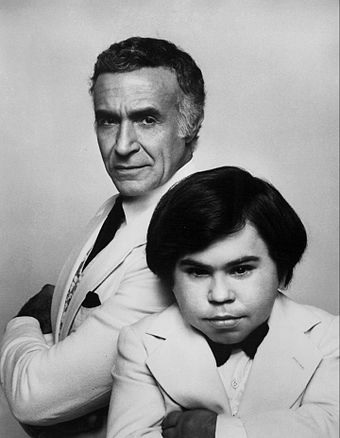
The Island just hasn’t been the same without Tattoo.
Episode 7.12 “The High Cost Of Loving/To Fly With Eagles”
(Dir by Jerome Courtland, originally aired on January 21st, 1984)
Craig Bradshaw (Doug McClure) is an aging pilot and daredevil who comes to the Island because he wants to compete in one final competition before he gets too old to keep going up in the air. His girlfriend (Christine Belford) doesn’t want him to keep risking his life. In the end, Craig finally comes to peace with the idea of getting older and he also gets engaged.
This fantasy felt pretty familiar. A lot of people have come to the Island over the years with the hope of winning one final competition. Actually, that’s probably one of the more realistic recurring fantasies that this show employs. Who wouldn’t want one last chance to win? If I went to Fantasy Island, I’d probably want to return to my high school years and compete in another speech and debate or drama competition. As for this specific fantasy, it’s always difficult for me to take Doug McClure seriously and this episode was no different.
As for the other fantasy …. yeesh! Lynn Redgrave plays Kristen Robbins, a former advertising exec who was fired when she refused her boss’s sexual advances. Instead of suing the guy, Kristen comes to Fantasy Island and tells Mr. Roarke that her fantasy is to fall in love and get married and start a family because that means she will never be sexually harassed again. (For a 40-something veteran of the advertising world, Kristen is incredibly naive.)
Kristen meets Paul Horner (Alex Cord) and it’s love at first sight. Paul is actually on the Island to interview Kristen for a job with his firm but instead, they have a night of passion. The next morning, Paul tells Kristen that, before they had sex, he recommended her for a job in which she would be working with him in Hawaii!
Kristen asks Roarke to change her fantasy. She now wants to get that job and work in Hawaii. Roarke reluctantly agrees. Kristen does get the job but the company decides that Kristen will be their sole representative in Hawaii and Paul will remain in New York. Kristen asks Mr. Roarke to change her fantasy once again. She doesn’t want the job, she just wants Paul. (Keep in mind that she’s known for Paul for one day.) Paul overhears and pretends to be a cad so that Kristen will take the job.
Now convinced that Paul is a compulsive womanizer, Kristen tells Roarke to change her fantasy back to taking the job. Roarke tells Kristen she needs to make up her own damn mind and then tells her that Paul was only pretending to be a womanizing jerk. In the end, Kristen decides to take the job and marry Paul. Paul decides to continue working in New York. As they leave the Island, they assure Mr. Roarke that they’ll make it work.
Yeah, good luck with that.
This fantasy irked me. Kristen lost her job because she refuses to sleep with her boss. I would rather have seen her get a revenge fantasy than a love fantasy. At the very least, Roarke could have introduced her to a good lawyer. Instead, we got a fantasy in which the main theme was that women are irresponsible and can’t make up their own mind.
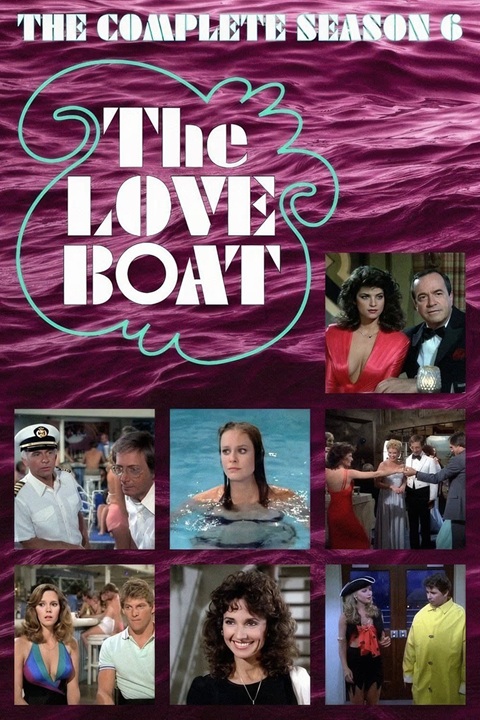
Welcome to Retro Television Reviews, a feature where we review some of our favorite and least favorite shows of the past! On Wednesdays, I will be reviewing the original Love Boat, which aired on ABC from 1977 to 1986! The series can be streamed on Paramount Plus!
It’s time so set sail for adventure, your mind on a new romance….
Episode 6.3 “The Anniversary Gift/Honey Bee Mine/Bewigged, Bothered and Bewildered”
(Dir by Ted Lange, originally aired on October 16th, 1982)
Oh my God, what did Julie do to her hair!? I mean, I understand that it was the 80s and everything but Julie’s short, spiky look in this episode is not a good decision. No wonder she’s so worried that she’s going to lose her boyfriend (Richard Bergman) to her old college friend, Honey Bee Harknest (Randi Oakes, taking a break from appearing on CHiPs to do TheLoveBoat). Honey Bee has always stolen Julie’s boyfriends so, for this cruise, Julie lies and says that she’s dating Gopher. Normally, Gopher would be happy about this but he’s already got a girlfriend to whom he’s trying to stay loyal.
(I’m going to guess that we’ll never see Julie’s boyfriend or Gopher’s girlfriend again after this episode.)
In other cruise news, Lynn Redgrave and Robert Mandan are taking a vacation to celebrate 20 years of wedded bliss. Mandan is looking forward to traveling. Redgrave wants to have another child. You’ve probably already guessed where this storyline is heading. Lynn Redgrave and Robert Mandan made for a surprisingly believable couple. Redgrave was, of course, an Oscar nominee while Mandan was the best of the celebrity skaters to appear on the Roller Disco episode of CHiPs.
(There’s our second CHiPs reference of the review! Woo hoo!)
Finally, Phyllis Diller plays an old classmate of Captain Stubing’s. When Diller compliments Stubing on still looking young, Stubing starts to worry about how she’ll react when he removes his captain’s cap and reveals that he’s bald. So, he starts wearing a toupee. Oh, Captain Stubing! To be honest, I do like episodes that allow Stubing to be emotionally vulnerable. Gavin MacLeod always did a good job of suggesting the insecurity that lay underneath the commanding presence and that’s certainly the case with this episode. That said, Stubing could take a lesson from Sgt. Getraer, who still manages to run things on CHiPs despite his thinning hair.
(Boom! Three references to CHiPs in one review of The Love Boat. That’s got to be a record.)
This was a pleasant cruise and it was directed by Isaac himself, Ted Lange! Lange keeps the action moving and, as a director, he obviously knew how to get good performances out of his castmates. Julia’s terrible hairstyle aside, this was a good trip on TheLoveBoat.
Welcome to Retro Television Reviews, a feature where we review some of our favorite and least favorite shows of the past! On Tuesdays, I will be reviewing the original Fantasy Island, which ran on ABC from 1977 to 1984. Unfortunately, the show has been removed from most streaming sites. Fortunately, I’ve got nearly every episode on my DVR.
This week, Fantasy Island goes country.
Episode 6.5 “Everybody Goes to Gilley’s/Face of Fire”
(Dir by Jerome Courtland, originally aired on November 20th, 1982)
Mickey Gilley is a country-western singer who comes to Fantasy Island because he wants to finally become a star after years of struggling. Tattoo, who is a huge country music fan, puts on a cowboy hat and decides that he’ll be Gilley’s “exclusive manager.” Not so fast, Mr. Roarke says. Apparently, there’s a country-western bar on the other side of the Island and the owner, Mr. Sherwood (Dennis Cole), has a fantasy of finally having a successful bar. Roarke arranges for Gilley and Sherwood to become partners. Gilley is a star whenever he performs in Sherwood’s bar. In the end, Sherwood and Gilley leave the Island together with Sherwood as Gilley’s new manager.
I’m not a huge country music fan so I have to admit that, until I watched this episode, I had no idea who Mickey Gilley was. (In fact, in my first draft of this review, I repeatedly called him “Dennis Gilley,” so that tells you how much I know about county-western singers.) Gilley actually was a country music star, one who did spend several years toiling away in small clubs before he finally found success. This role was autobiographical for him. It’s a bit odd that he plays himself but maybe he was a big deal in 1982. As I said, country music is not my area of expertise and 1982 is a bit before my time. What I can say is that, on the show, Gilley was portrayed in a way that kind of made him seem like a jerk. I mean, the nonstop complaining and all the demands! “I’m not here for romance,” he tells Roarke at one point. Don’t tell Mr. Roarke how to do his job, Gilley!
The other storyline was a take on Jane Eyre. Jean Harrigan (Lynn Redgrave) is from Nevada, despite being totally English. She needs a million dollars. A mysterious rich guy (David Hedison) offers it to her if she can survive a weekend at his home. His crazy wife is locked away in a bedroom. She ends up catching on fire towards the end of the episode, freeing things up for Jean and the rich guy. What’s interesting is that the rich guy says that he originally met Jean when his car broke down in the Nevada desert and Jean gave him a ride. What’s interesting about this is that, when the legendary Howard Hughes died, a man named Melvin Dummar claimed that he had once given Hughes a ride after coming across him stranded in the Nevada desert and, in return, Hughes left him a good deal of his fortune. Dummar even produced a will in support of his claim. The courts ruled the will to have been a forgery and Dummar never received his money, though there still are people out there who defend “the Dummar will” and claims that he was telling the truth about meeting Hughes. Fortunately, Jean does get her money and a chance to spend some time with the totally charming and handsome David Hedison.
Perhaps not surprisingly, I preferred the gothic story to the country music story. I appreciated that Tattoo got to do something this episode. The scene where he declares himself to be Gilley’s manager felt like a throwback to the show’s earlier seasons. This journey to the Island was a mixed bag for me, though overall it was a pleasant trip.
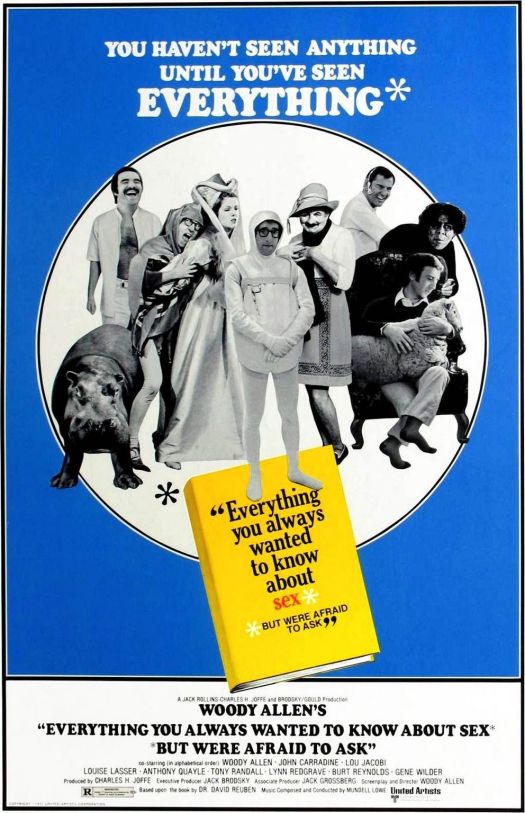
Say what you will about Woody Allen (and I’m sure some of you will), but from 1969 to 1977 he wrote, directed, and starred in some of the laugh-out-loud funniest movies ever made (after that, things got a bit pretentious, and his output has been hit-or-miss far as I’m concerned). Allen’s inventive mind took Dr. David Reuben’s best-selling sex manual EVERYTHING YOU ALWAYS WANTED TO KNOW ABOUT SEX (*but were afraid to ask) and turned it into a hilarious anthology that skewers not only societal mores and morals, but every segment parodies a different film genre.
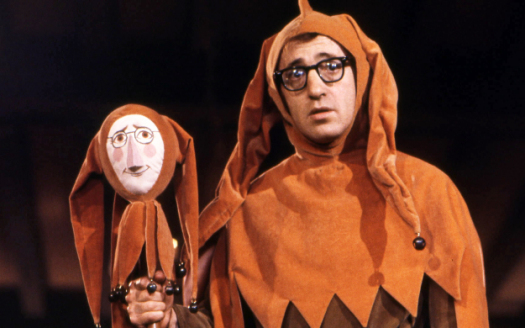
Some are better than others, but each has something funny to offer. The first, “Do Aphrodisiacs Work?”, finds Woody as a medieval court jester whose lousy Bob Hope one-liners bomb with the King (Anthony Quayle). The randy jester is dying to enter the Queen’s (Lynn Redgrave) “royal chambers”, but…
Every Saturday, I get together with my friends in the Late Night Movie Gang and we watch a movie. I’m usually the one who picks the movie. I usually try to pick something fun and kinda silly. For instance, every Christmas, we watch Santa Claus Conquers The Martians. Last week, we watched Tobor The Great. And this week, I selected a 51-minute program from 1978. The name of that program?
Disco Beaver From Outer Space.
Now, I have to admit that this was one of the rare instances where I didn’t actually bother to watch the entire movie before selecting it. I did watch the first five minutes on YouTube. It featured someone in a beaver costume walking around New York City and eating stuff while disco music played in the background. That was all I needed to see.
An alien beaver eating New York!? I thought, Disco music!?How could this possibly go wrong!?
Add to that, the movie only had 51 minute run time. Even if it’s terrible, I thought, at least it won’t be long!
However, once the film started, I discovered that 51 minutes can be a very long time indeed. Unfortunately, it turned out that the beaver wasn’t actually in much of the film. He showed up at the start of the movie and then he popped up in the middle and finally, he showed up again at the end. That the beaver was cute and came with his own disco song made it all the more regretful that he wasn’t in more of the film.
Anyway, it turned out that the film itself was a collection of vaguely connected sketches. The idea was that a husband and wife were looking for something to watch and , as a result, they kept changing the channel. One channel featured a country western singer. Another channel was showing Masterpiece Theater. And then there was this movie about a vampire called Dragula.
The joke about Dragula was that he was gay and … well, that was pretty much it. Dragula was gay and everyone he bit turned gay and eventually Lynn Redgrave showed up as Dr. Vanessa Van Helsing and she managed to destroy Dragula. If you think this sounds homophobic … well, it was. When the humor wasn’t homophobic, it was misogynistic. I’ve always been proud of the fact that I’m not easily offended and I’ve never been the type to need a safe space but I have to admit that I spent the majority of Disco Beaver cringing. Of course, the problem wasn’t that the humor was politically incorrect. The problem was that the majority of it just wasn’t that funny.
Disco Beaver was produced, for HBO, by National Lampoon. In fact, HBO was only 6 years old when it broadcast Diso Beaver so I’m going to assume that this may have been one of the first original programs ever specifically made for the network. Perhaps that explains why the entire production has a sort of “look how naughty we can be on cable!” feel to it. “We just dropped the F bomb! Here’s a whole skit about breasts! And now, here’s a skit about how to spot a homosexual. We’re so daring!”
From the minute that Disco Beaver started, I felt as if I could literally hear the coke being cut backstage. How many lines of cocaine were snorted over the course of the making of Disco Beaver? Remember that scene at the end of Scarface where Al Pacino had a mountain of white powder on his desk? I imagine that’s what the Disco Beaver production office looked like.
Anyway, we survived Disco Beaver and, at the end of it, we swore that we would never speak of it again. And I learned a very valuable lesson! Always watch the entire movie!
(For those following at home, Lisa is attempting to clean out her DVR by watching and reviewing 38 films by this Friday. Will she make it? Keep following the site to find out!)
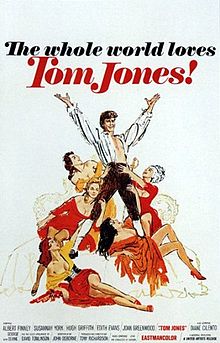
Oh, how I wanted to love Tom Jones!
No! Not that Tom Jones.
I’m talking about Tom Jones, the British film from 1963. Based on a novel by Henry Fielding, Tom Jones was a huge box office success and it was one of the few comedies to ever win the Oscar for best picture. Whenever you watch a documentary about the British invasion of the early 60s, chances are that you’ll see at least a clip or two from Tom Jones. The film (or perhaps I should say the film’s box office success) is a part of 60s pop history, right up there with The Beatles on The Ed Sullivan Show and Sean Connery shooting that guy in cold blood in Dr. No.
Up until last night, I had heard about Tom Jones but I had never seen it.
And I really wanted to love it.
The film takes place in 18th century England and it tells the story of young Tom Jones (Albert Finney). It starts with a lengthy sequence that plays out like a silent film, complete with title cards. Upright Squire Allworthy (George Devine) comes home and discovers that a baby has been left in his bed. He assumes that the child was born to two of his servants and declares that he will raise Tom Jones to be a good and worthy man.
Two decades later, Tom Jones has grown up and now he’s being played by Albert Finney (who, it must be said, was quite a handsome man when he was young). Because Tom is good-looking and kind-hearted, every woman in England lusts after him. But Tom is in love with innocent Sophie Western (Susannah York). However, Sophie is a member of the upper class and Tom is a “bastard,” at a time when that actually means something.
Indeed, Sophie’s aunt and uncle (played by Edith Evans and Hugh Griffith) demand that Sophie have nothing to do with Tom Jones. They decide that she will marry Blifil (David Warner, young but already typecast as a villain). Through clever lies and manipulations, Blifil convinces Squire Allworthy that Tom has turned bad and must therefore be exiled from his home. Does Blifil want to get rid of Tom just so he can marry Sophie or is it possible that there’s more to Blifil’s scheming?
Before we get the answer to that question, we spend a while following the exiled Tom as he wanders around England and attempts to prove himself worthy of Sophie. Along the way, Tom serves briefly in the army, gets into numerous fights, and has several affairs. One of those affairs is with Mrs. Walters (Joyce Redman), who he briefly thinks might be his mother. Eventually, Tom ends up as the lover to the decadent Lady Bellaston (Joan Greenwood). Through Blifil’s scheming, he also ends up framed for attempted murder and facing the gallows…
And, as melodramatic as that may all sound, Tom Jones is definitely a comedy. It doesn’t take itself seriously and there’s hardly a single scene that isn’t played for laughs. Director Tony Richardson goes out of his way to make sure that you never forget that you’re watching a movie. There are freeze frames. There’s plenty of characters around to supply sarcastic commentary. There’s even a few cases of fourth wall breaking.
As I watched Tom Jones, it was hard for me not to compare it to Stanley Kubrick’s Barry Lyndon. After all, both films take place during the same period of time and both deal with a young man making his way through European society. I would even argue that, in its way, Barry Lyndon is far more satirical than Tom Jones. The main difference between the two films is that Barry Lyndon is all about subtext whereas everything that happens in Tom Jones happens right on the surface.
As I said, I really wanted to like Tom Jones but, seen today, the entire film seems to be trying a little bit too hard. Tony Richardson’s direction is so manic that it gets a bit exhausting after a while. That said, I can understand why the film was such a success when it was first released. I’m sure in 1963 — after having to deal with decades of pompous costume dramas — viewers probably found Tom Jones to be a breath of fresh air. Not only was it a British film released at a time when all things British were in style but it was also a film that, by the standards of 1963, dealt frankly with sex. In short, Tom Jones is definitely a film of its time. If it doesn’t hold up as well today, that’s because it wasn’t made for 2016. It was made for 1963.
And obviously, if the judgment of the Academy is to be trusted, Tom Jones was the perfect film for 1963. That said, I would have given best picture to another British film, From Russia With Love.
 Meek-looking accountant Sanford Lagelfost (Bronson Pinchot) is on trial for embezzlement. It’s supposed to be a simple, up-and-shut case but when the beautiful star witness (Tracy Scoggins) testifies that Sanford is an amazing lover, it becomes a tabloid sensation and the jurors are sequestered in a hotel, where they have to deal with their own restlessness and several distractions, the majority of whom are also played by Bronson Pinchot. Pinchot plays a total of four characters but it’s not like he’s Peter Sellers or even Eddie Murphy. He looks and sounds like Bronson Pinchot in every role.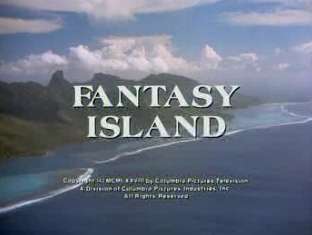



 Through the Shattered Lens