4 Shots From 4 Films is just what it says it is, 4 shots from 4 of our favorite films. As opposed to the reviews and recaps that we usually post, 4 Shots From 4 Films is all about letting the visuals do the talking.
This October, I am going to be using our 4 Shots From 4 Films feature to pay tribute to some of my favorite horror directors, in alphabetical order! That’s right, we’re going from Argento to Zombie in one month!
Today’s director is the underrated Italian filmmaker, Luigi Cozzi!
4 Shots From 4 Luigi Cozzi Films
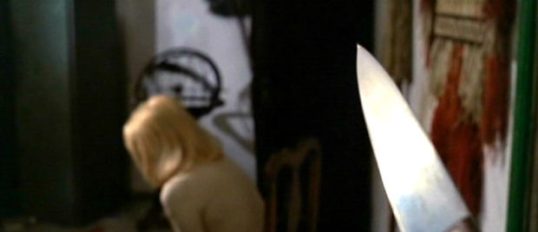
The Killer Must Kill Again (1975, dir by Luigi Cozzi, DP: Riccardo Pallottini)
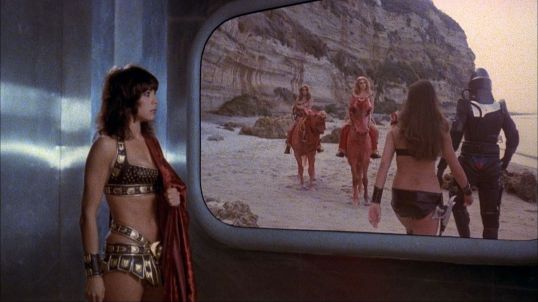
Starcrash (1978, dir by Luigi Cozzi, DP: Paul Beeson and Roberto D’Ettorre Piazzoli)
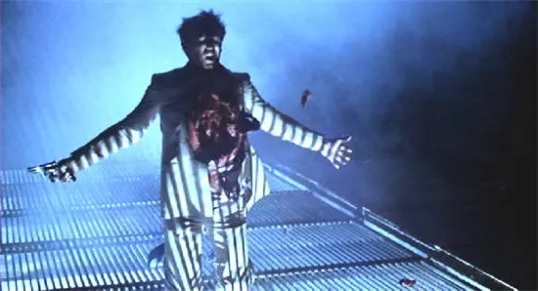
Contamination (1980, dir by Luigi Cozzi, DP: Giuseppe Pinori)
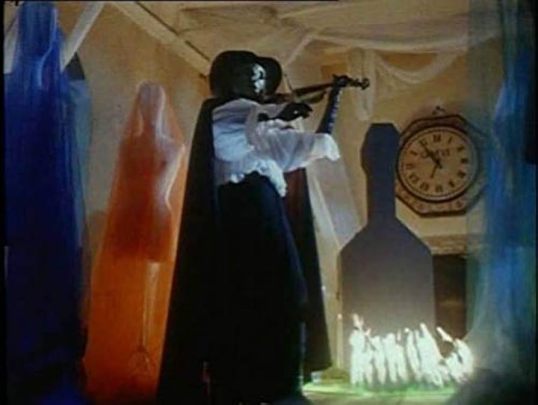
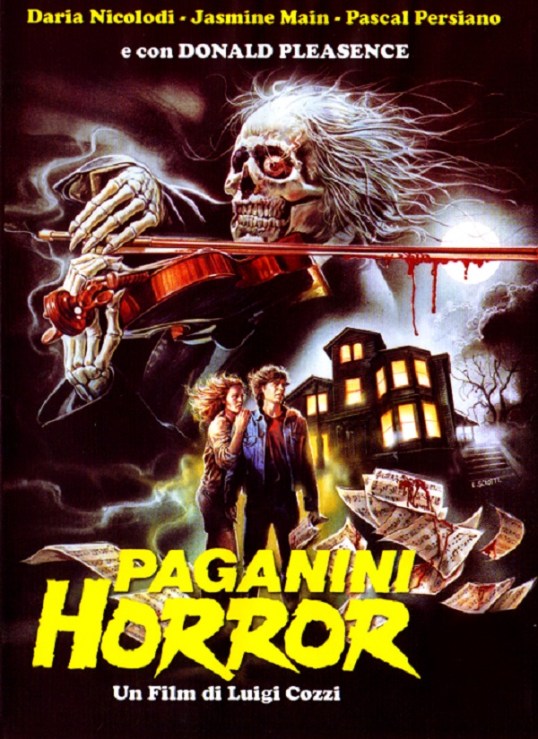
Paganini Horror (1989, dir by Luigi Cozzi, DP: Franco Lecca)
So, it seems appropriate to share a scene that I love from my favorite Star Wars film, Starcrash!
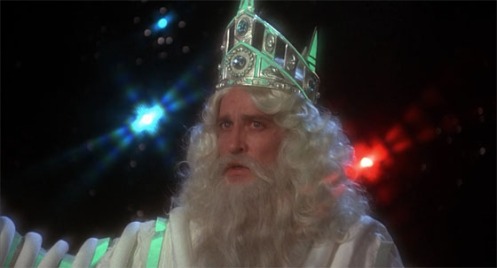
Okay, technically, Starcrash is not part of the Star Wars franchise. This 1978, Luigi Cozzi-directed film is usually considered to be one of the more blatant rip-offs of Star Wars. But you know what? I love Starcrash. I’ve seen Star Wars and I’ve seen Starcrash and Starcrash is a lot more fun. Not only does Starcrash feature Marjoe Gortner, David Hasselhoff, Joe Spinell, and Caroline Munro but it also features the one and only Christopher Plummer as the emperor of the universe.
In the scene, Hasselhoff and Munro inform Plummer that they only 45 seconds before a planet explodes. Plummer, however, has the perfect solution and his delivery of the line “HALT …. the flow of time!” is one of the many things that makes Starcrash one of the greatest films ever made.
Yes, this 1989 Italian horror film does deal with the legend that violinist and composer Niccolò Paganini sold his soul the devil in return for his talent.
And yes, it does feature Paganini coming back to life and murdering people.
Listen, there’s a lot of critical things that you can say about this film but you have to love the idea of a slasher film that feature an actual historical figure coming to life and doing the slashing. I mean, this is no ordinary, masked murderer! No, this is a murderer whose compositions are still played in concert to this day!
Paganini Horror was written by Daria Nicolodi (who also co-starred) and directed by Luigi Cozzi, two Italian horror figures who — fairly or not — will always be associated with Dario Argento. Nicolodi co-starred in several of Argento’s films and was his longtime girlfriend. She’s the mother of Asia Argento. She also provided Dario Argento with the story that would eventually become Suspiria. Argento and Nicolodi had a notably bad breakup and, though they continue to occasionally work together, it’s rare that you ever read an interview with Nicolodi where she doesn’t have something negative to say about Argento and his later films. Luigi Cozzi, meanwhile, is often considered to be a protégé of Argento’s. Argento produced several of Cozzi’s films and Cozzi has directed multiple documentaries about Argento. For several years, Cozzi was also the co-owner and manager of Argento’s movie memorabilia store, Profondo Rosso.
Considering Nicolodi and Cozzi’s well-documented relationships with him, it’s interesting that Paganini Horror features a character who appears to be, at the very least, slightly based on Dario Argento. Mark Singer (Pietro Genuardi) is an arrogant director of bloody horror films who is hired to shoot a music video for a band. The band, which is in desperate need of a hit, is recording a song that is based on a never before recorded (or heard) composition by Paganini himself. The band’s drummer, Daniel (Pascal Persiano), purchased the composition from a mysterious man named Mr. Pickett (Donald Pleasence). We later see Mr. Pickett standing on the roof of a church, grinning maniacally as he throws away Daniel’s money. Hmmm….I wonder what that’s all about.
Though Pleasence isn’t in much of the film, his performance is definitely one of the highlights of Paganini Horror. That he’s playing an evil character is obvious from the minute he shows but Pleasence seems to be having so much fun with the role that you can’t help but like him. There’s something especially charming about the way he smiles while throwing away that money.
The other highpoint of the movie is Paganini himself. As played by Roberto Giannini, Paganani wanders about wearing a mask and a black coat. He carries a violin that has a very sharp blade sticking out of the bottom of it. Yes, it’s totally ludicrous but that’s kind of the point of it. Paganini was known for two things: 1) being a great musician and 2) the rumors that he sold his soul to the devil. Paganini Horror may emphasize the rumors about the devil but it doesn’t let us forget that Paganini was a damn good violinist….
Anyway, Paganini Horror is a frequently incoherent film, where characters don’t act logically and the rules of Paganini’s curse seems to change from scene to scene. Once you get passed the novelty of Paganini being the murderer, this really is a standard slasher film, albeit one that’s a bit more graphic than its American and British counterparts. That said, I don’t think that it’s quite the disaster that Luigi Cozzi has described it as being. (Cozzi has consistently cited it as one of his least favorite of the films that he’s directed.) Donald Pleasence appears to have had a blast playing his role and there are a few memorable shots of Venice. (Of course, it’s pretty much impossible to find an unmemorable shot of Venice.) The scenes of the band pretending to perform are also enjoyably silly. Paganini Horror may not be great but it’s certainly not boring. If you appreciate Italian horror, you get it.
I watched Paganini Horror on Tubi. It was an enjoyable 90 minutes. I have no regrets.
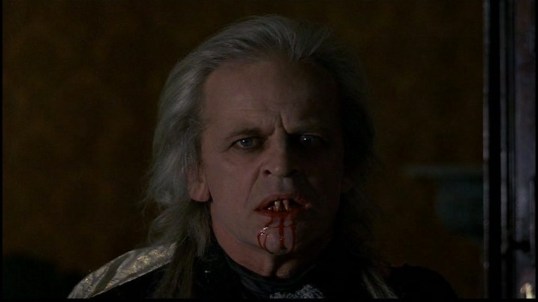
This Italian production from 1988 was originally envisioned as being a semi-official sequel to Werner Herzog’s Nosferatu, which was itself a remake of F.W. Murnau’s silent classic. The idea was that Klaus Kinski would reprise his role and this time, his feral version of Dracula would haunt Venice. Kinski agreed, initially, to reprise his role. However, after arriving on the set, Kinski lived up to his infamous reputation for being difficult. He announced that he would, under no circumstances, don the famous make-up that he wore in Nosferatu. And while Kinski was undoubtedly a good actor who was capable of giving performances that kept him employed despite reportedly being insane, Nosferatu without the makeup is not really Nosferatu. He’s just another vampire.
Still, Kinski was a big enough star that he got his way about the makeup. He also attempted to get his way during the first day of filming, when he refused to take any direction from director Mario Ciaino. When Ciaino attempted to figure out why Kinski was being so difficult, Kinski declared that he had been promised, by producer Augusto Caminito, that he would be allowed to direct the film. This led to Mario Ciaino quitting during the first day of production. Producer Caminito took over as a director, though apparently Kinski did end up directing several of his own scenes. Reportedly, other scenes were directed by Luigi Cozzi.
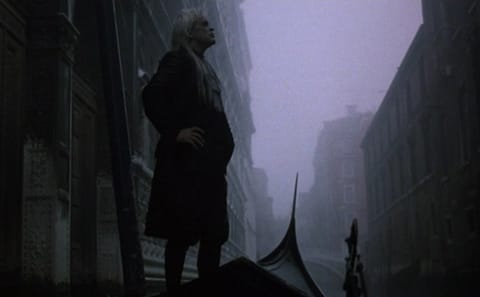
However, Kinski didn’t stop with getting the director replaced. He also demanded that nearly the entire cast be replaced as well. Kinski, in fact, was such a terror on the set that it was common for members of the crew to refuse to work with him, which perhaps explains why Kinski seems to spend so much of this film wandering around Venice by himself.
As for the film itself — well, yes, it’s exactly as big of a mess as it sounds like it would be. Kinski plays a vampire who may or may not be Dracula. Actually, very few of the traditional vampire rules seem to apply to him. He wanders around in the daylight. He looks at his reflection in a mirror. He does, however, drink a lot of blood so I guess some things never change. Because he refused to wear the vampire makeup or shave his head, Kinski spends the entire film looking like the aging lead singer of a 70s prog rock band. At the same time, it must be said that Kinski actually does give a fairly good performance. He’s a vampire who is desperate to find someone pure of heart who can end his ennui-stricken life. Kinski’s screen presence is undeniably powerful and he looks appropriately miserable.
Christopher Plummer has the Van Helsing role and Donald Pleasence plays a priest who always seems to be somewhat nervous. (In other words, a typical role for Donald Pleasence.) Plummer is in Venice because, back in the 18th century, it was the last place that Kinski’s vampire was seen. This leads to several confusing flashbacks, all of which are somewhat randomly sprinkled throughout the film.
There’s not really any story beyond Kinski walking around with a stricken-look on his face but, oddly, the film kind of works. Despite all of the directors who worked on it, the film is often visually stunning. I think it’s the power of Venice. No other city has quite the same atmosphere as Venice and it turns out to be the perfect location for a film about an ennui-stricken vampire.
(I know that when I visited Venice the summer after I graduated high school, I often found myself thinking about vampires. That’s just the type of city it is.)
Anyway, the film will be best appreciated by Italian horror enthusiasts and Kinski completists. Others will probably be bored out of their mind. If you just want to see a good horror film set in Venice, I recommend Don’t Look Now.
For the record, I fully realize and understand that I have shared this trailer like a thousand times on this site. I make no apologies! I love this trailer and, even more importantly, I love this film! It’s perhaps the greatest Italian Star Wars rip-off of all time. Directed by Luigi Cozzi and starring Caroline Munro, David Hasselhoff, Joe Spinell, Marjoe Gortner, and Christopher Plummer, Starcrash is a movie everyone must see! I was even Stella Starr for Halloween in 2014. Unfortunately, no one knew who I was (apparently, not everyone loves Italian exploitation films that I do) but I still got a lot of candy.
2. The Deadly Spawn (1983)
When a meteor crashes to Earth, it unleashes … well, watch the trailer. I’ve been meaning to review this movie for a while but somehow, I keep getting distracted by Lifetime. The Deadly Spawn is a lot of fun. It’s good nature more than makes up for its low budget.
3. Starship Invasions (1977)
This is the trailer for Starship Invasions, which Christopher Lee regularly described as being the worst film he ever made.
4. Contamination (1980)
This one was directed by Luigi Cozzi, who also directed Starcrash. It’s also known as Alien Contamination. Here’s my review!
5. Alien 2: On Earth (1980)
Oh my God! A previously unknown Alien sequel!? Not quite. This Italian sci-fi film may have been released as Alien 2 but it actually had nothing to do with the original Alien. That said, Alien 2 is still considerably better than Alien Covenant.
6. I Come In Peace (1990)
“…and you go in pieces!”
Hah! You tell him! I’ve never seen this film but I love that line.
4 Shots From 4 Films is just what it says it is, 4 shots from 4 of our favorite films. As opposed to the reviews and recaps that we usually post, 4 Shots From 4 Films lets the visuals do the talking.
Happy World UFO Day!
4 Shots From 4 Films
The Eyes Behind The Stars (1978, dir by Mario Gariazzo)
4 Shots From 4 Films is just what it says it is, 4 shots from 4 of our favorite films. As opposed to the reviews and recaps that we usually post, 4 Shots From 4 Films is all about letting the visuals do the talking.
Today is Daria Nicolodi’s birthday!
Daria Nicolodi has been called the “unsung hero of Italian horror” and it’s an apt description. Along with starring in several of the films that Dario Argento directed during the first half of his legendary career, Nicolodi also was responsible for the story of and co-wrote the script for Suspiria. (Nicolodi has always said that Suspiria was based on a true story involving one of her ancestors.) Argento’s decision to give the lead role in Suspiria to Jessica Harper, instead of Nicolodi, is often cited as the beginning of the end of their relationship.
(It’s also a shame — actually, a more accurate description would be to say that it’s a goddamn crime — that Nicolodi apparently will not have even as much as a cameo in the upcoming Suspiria remake.)
Nicolodi also appeared in films directed by Mario Bava, Luigi Cozzi, Michele Soavi, and several other distinguished Italian directors. In Scarlet Diva, she was directed by her daughter, Asia Argento.
This edition for 4 Shots From 4 Films is dedicated to Daria Nicolodi!
(Lisa recently discovered that she only has about 8 hours of space left on her DVR! It turns out that she’s been recording movies from July and she just hasn’t gotten around to watching and reviewing them yet. So, once again, Lisa is cleaning out her DVR! She is going to try to watch and review 52 movies by the end of Tuesday, December 6th! Will she make it? Keep checking the site to find out!)
On November 10th, I recorded 1985’s The Adventures of Hercules off of the Encore Family channel.
Let’s see if I can explain exactly what this film is about. Bear with me because this is going to be a strange one. For that matter, you might also want to bare with me because The Adventures of Hercules is all about displaying the physique of body builder Lou Ferrigno. Ferrigno plays the legendary Greek demigod Hercules. Or I should say that he provides Hercules’s body and occasionally a facial expression or two. Since The Legend of Hercules was an Italian film, the entire cast is obviously and frequently awkwardly dubbed. That includes Ferrigno. Though Hercules doesn’t say much, when he does speak, he does so in a voice that really doesn’t go with his body, his personality, or anything that seems to be happening on screen.
Anyway, I guess I should try to explain the plot. I should mention that The Legend of Hercules is a sequel to another Hercules film. I haven’t seen the first Hercules film. Maybe the Legend of Hercules would have made more sense if I had, though I somehow doubt it.
Basically, bad things are happening on Earth. Why? Well, it appears that four of the Gods have gotten together and stolen Zeus’s 7 Mighty Thunderbolts. They’ve hidden the Thunderbolts across the planet, entrusting them with various monsters. As a result of Zeus no longer having his thunderbolts, the Moon is now on the verge of colliding with Earth and human sacrifices are also being committed to a monster that looks a lot like the ID Monster from Forbidden Planet.
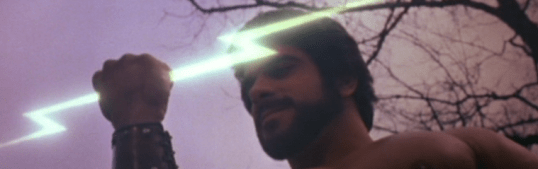
What does a Mighty Thunderbolt look like? Here you go.
Two sisters, Urania (Milly Carlucci) and Glaucia (Sonia Vivani), appeal to Zeus for help but, of course, Zeus is powerless without his thunderbolts. However, he can still sends his son Hercules (Lou Ferrigno) to Earth. Working with the sisters, Hercules goes on a quest for the thunderbolts. This basically amounts to a series of scenes in which Hercules battles various people in rubber suits. Whenever Hercules throws a punch, he’s filmed so that appears that he’s punching the camera. Whenever Hercules’s fist makes contact, there’s a flash of red. Whenever anyone is knocked off their feet by Hercules, they flip around in slow motion. This happens every ten minutes or so.
Now, I don’t want to spoil the movie but I simply have to tell you about this. There is a scene, towards the end of the film, in which Hercules literally grabs hold of the Moon and prevents it from crashing into the Earth.
Anyway, the plot makes no sense and that’s a huge part of this film’s enthusiastic, if frequently inept, charm. As directed by the famed Italian director, Luigi Cozzi, The Adventures of Hercules has this cobbled together feeling to it that is undeniably likable. Much as with Cozzi’s best-known film, Starcrash, The Adventures of Hercules is a film that wins you over by pure determination. Cozzi set out to make a mythological epic and he wasn’t going to let something like a complete lack of budget stop him.
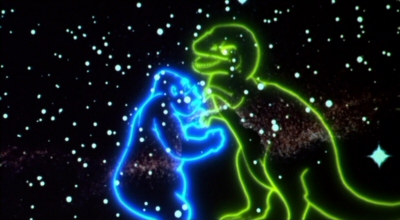
How strange an experience is The Adventures of Hercules? Check out some of these randomly assembled screen shots:
The other fun thing about The Adventures of Hercules is that, since this was a Luigi Cozzi film, the cast is full of Italian exploitation vets, the majority of whom were best known for appearing in far less family-friendly fare.
Here’s just a few of the performers you’ll find in The Adventures of Hercules:
Sonia Vivani, who plays Glaucia, also played the doomed sculptor in Umberto Lenzi’s infamous Nightmare City.
William Berger, who plays the villainous King Minos, appeared in several classic Spaghetti westerns, including Sabata. Sadly, his promising career was cut short when he was framed for drug possession and spent several years in an Italian prison. When he was finally freed, he ended up doing movies like The Adventures of Hercules.
Zeus was played by Claudio Cassinelli, an acclaimed actor who appeared in several giallo films. He also co-starred in 1978’s infamous Mountain of the Cannibal God.
The evil High Priest was played by Venantino Venantini whose credits include everything from The Agony and the Ecstasy to Lucio Fulci’s City of the Living Dead to Umberto Lenzi’s Cannibal Ferox.
Aphrodite is played by Margit Newton, who somewhat infamously starred in what is generally considered to be the worst zombie film of all time, Hell of the Living Dead.
Serena Grandi played Euryale (a.k.a. Medusa). Grandi is probably most remembered for his grotesque death scene in Antropophagus. She was also the star of one of my personal guilty pleasures, Lamberto Bava’s Delirium.
And finally, the mad scientist Dedalos was played by Eva Robbins, who achieved immortality by playing the Girl on the Beach in Dario Argento’s Tenebrae.
The Adventures of Hercules might not be “technically” a good film but it’s definitely (and rather compulsively) watchable.
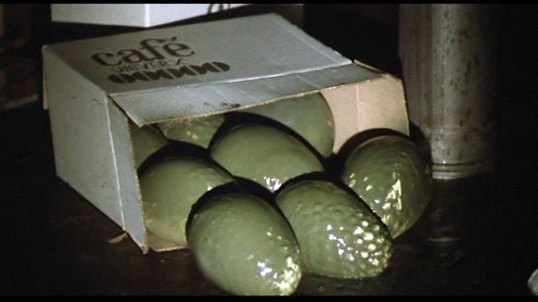
See those green things in the picture above? You’re probably looking at them and you’re thinking to yourself, “Those are the biggest avocados that I’ve ever seen!”
Well, they’re not avocados.
No, instead they are green eggs from Mars. They may look harmless but if they start glowing, pulsating, and making an eerie womping noise, you might want to get away from them. When those eggs explodes, they spray out a green goo. Any living creatures that is so much as even splashed by this goo will then explode in a mass of blood and guts. It’s messy. I would not want to clean up after anyone is sprayed with green goo.
Those eggs are at the center of this week’s daily sci-fi grindhouse, the 1980 Italian film, Contamination. How much you enjoy Contamination will largely depend on how much you like old school Italian exploitation films in general. If you’re the type who rolls your eyes at bad dubbing and who demands that a film follow some sort of narrative logic, you are not the ideal audience for this movie. However, if you’re like me and you enjoy the pure shamelessness of Italian exploitation, you’ll probably have an easier time enjoying Contamination.
It won’t come as a surprise to any student of Italian or grindhouse cinema to learn that Contamination was ripped off from several films that were popular in the late 70s. The eggs are largely lifted from Alien and, whenever the goo-sprayed bodies explode, it’s reminiscent of that ugly little thing bursting out of John Hurt’s chest. The second half of the film feels like a secondhand James Bond film, complete with a sinister conspiracy, a mysterious mastermind who earlier faked his own death, and a femme fatale. The conspiracy is headquartered on a coffee plantation in South America. It’s not difficult to imagine Baron Samedi or some other villain from Live and Let Die showing up and laughing before throwing an exploding egg at someone.
Contamination opens with a seemingly deserted ship floating into New York harbor. Fans of Italian cinema will immediately think about the opening of Lucio Fulci’s Zombi 2. Just as Zombi 2 opened with the New York City police investigating an abandoned boat and getting attacked by a zombie, Contamination features the New York City police investigating an abandoned boat and getting sprayed with green goo. The only cop who doesn’t explode, a tough New Yawker named Tony (Marino Mase), works with Col. Stella Holmes (Louise Marleau) to figure out why those eggs were on that boat.
Helping them out is an alcoholic former astronaut named Commander Ian Hubbard (Ian McCulloch). Somewhat appropriately, McCulloch was also in Zombi 2. (And let’s not forget about his role in Zomie Holocaust…) I once read an interview with McCulloch (in Jay Slater’s overview of Italian zombie cinema, Eaten Alive) in which he said that he didn’t feel he did a very good job in Contamination but I think he’s being too hard on himself. Is the very British and slightly uptight Ian McCulloch miscast as a cynical, alcoholic, American astronaut who can’t even walk to his front door without stumbling over discarded beer cans? Sure, he is. But he’s so miscast that it actually becomes rather fascinating to watch him in the role. He may be miscast but you can tell he’s really trying and he’s just so damn likable that you almost feel like it would be a disservice to him not to watch the film.
Anyway, Stella, Tony, and Hubbard have to discover out why the green eggs are on Earth and they eventually do figure out what’s going on. I’ve watched the film multiple times and I have to admit that I’m still not sure what they figured out. It’s a confusing movie and I doubt that there’s really any way that it could have ever made any sort of coherent sense but then again, that’s part of the film’s charm.
So, here’s what does work about Contamination. The exploding green eggs are both scary and wonderfully ludicrous. Ian McCulloch is a lot of fun as drunk Commander Hubbard. Goblin provides an excellent and propulsive score. And finally, there’s an alien monster who simply has to be seen to be believed. To his credit, director Luigi Cozzi realized that the monster looked cheap and he uses all sorts of creative editing and employed an arsenal of jump cuts to try to keep you from noticing. Much as with McCulloch’s performance, you can’t help but appreciate Cozzi’s effort.
As I said before, you’re enjoyment of Contamination will probably be determined by how much you enjoy Italian exploitation films in general. If you’re not familiar with the Italian grindhouse, Contamination is not the film to use for an introduction. However, if you are already a fan, you might appreciate Contamination.
Contamination is in the public domain and, as such, very easy to track down.
For some of our readers, this will probably be the most challenging episode of television that I’m going to post this Halloween season.
But first, what is Door Into Darkness?
In 1973, after he had directed his highly successful Three Animals Trilogy, Dario Argento produced a television series called Door Into Darkness. Each episode of Door Into Darkness told a different story of horror and suspense. Argento would appear at the beginning of each episode and introduce the story.
Of the four episodes of Door Into Darkness that were produced, most critics agree that the first one was the best. Titled Neighbors, it was also the directorial debut of Argento’s long-time assistant, Luigi Cozzi.
Neighbors tells the story of a newlywed couple who, along with their newborn baby, move into a seaside villa. (Along the way, they also manage to run their car into a ditch, effectively leaving them stranded at their new home.) When they arrive at the villa, they discover that the power hasn’t been turned on yet so they decide to hang out in the apartment upstairs. Once up there, they come across the dead body of their neighbor’s wife. When the neighbor arrives back home, the couple have to try to survive in the darkness while he looks for a place to hide the body of his dead wife.
Neighbors is an effectively suspenseful story that makes good use of both our inherent fear of the dark and the fact that we can never be quite sure of what our neighbors are doing.
I’m happy to say that a user in Italy has downloaded all four episodes of Door Into Darkness to YouTube and, hence, we can now share Neighbors on this site.
However, that’s where the challenge comes in.
The episode below is in Italian.
It has not been poorly dubbed into English and there are no subtitles. Personally, that’s not an issue for me. The plot of Neighbors is effectively simple and easy to follow and Italian suspense has always been a visual genre. Add to that, I love Italy. I’m a fourth Italian. I could listen to people speak Italian for days without understanding a word with it. I just love the sound of the language.
With all that in mind, here is Door Into Darkness…







 Through the Shattered Lens