Horror Film Review: X: The Man With X-Ray Eyes (dir by Roger Corman)


X: The Man With The X-Ray Eyes (1963, dir by Roger Corman, DP: Floyd Crosby)

Eyes.  They’re one of the most important parts of our body but they’re also frightening easy to damage. Unlike the heart or the liver or the brain, they don’t have a protective covering of skin and bone.  They sit exposed and  are easily injured.  They can be ripped out of one’s head, which is a scary thought.  As well, they tend to grow weaker over time.  I love my multi-colored eyes and I think they’re one of my best features but I still spend a lot of time wishing that they weren’t quite as vulnerable as they are.  I often say that I’m blind without my contacts or my glasses.  That’s not quite true, of course.  I can see enough to get by if I forget to put in my contacts but I still have to do a lot of squinting, enough so that most people can take one look at me and say, “You forgot to put in your contacts, didn’t you?”  In my case, my eyesight has definitely gotten even worse over the past few years.  I’ve been told that’s normal but it still freaks me out.  I worry about waking up one day and not being able to see anything at all.

Director Lucio Fulci, a diabetic who was slowly going blind during the final years of his life, was infamous for including scenes of eyes being either pierced or gouged out in his films.  The New York Ripper even featured one scene where an eye was slit in half with a razor blade.  (This occurred in a close-up, no less!)  In Joe D’Amato’s Beyond the Darkness, there’s a scene where a mad taxidermist replaces the eyes of his dead fiancée with glass and for me, that’s one of most disturbing elements of the film.  Horror directors understand the vulnerability of the eyes and the sadness when life is extinguished from those eyes.  Eyes are said to be the windows to soul and when those eyes are lifeless, it’s a reminder that a living soul is a fleeting thing.

Perhaps that’s why 1963’s X: The Man With The X-Ray Eyes is such an effective work of art.  Directed by Roger Corman, the film tells the story of Dr. James Xavier (Ray Milland), a doctor who has developed eye drops that, when taken, allow one to have x-ray vision.  Dr. Xavier claims that the eye drops will allow doctors to more easily diagnose their patients and certainly, he has a point there.  His friend, Dr. Sam Brant (Harold J. Stone), points out that the eyes are directly connected to the brain and that using experimental eye drops on them could potentially drive a person mad.  Dr. Xavier proves Dr. Brant’s point by losing his tempter and accidentally pushing him out of a window.

Ah, x-ray vision.  It all starts out fun.  Dr. Xavier is performing miracle surgeries and seeing what everyone looks like naked.  (The swinging jazz party scene is a classic example of how 60s B-movies teased audiences while never quite showing everything.) But once he’s forced to go on the run from the police, Xavier finds himself making a living as a carnival psychic while still trying to refine his eyedrops.  Xavier’s sleazy manager (Don Rickles) tries to turn Xavier into a faith healer but, with Xavier’s x-ray vision growing more erratic and more intense, Xavier ends up running off to Vegas with a former colleague, Dr. Diane Fairfax (Diana Van der Vils).

And again, it’s all fun and games as Xavier uses his powers to cheat at cards.  But then the megalomania kicks in and, after Xavier basically announces that he’s cheating, he finds himself being chased through the desert by a police helicopter and freaking out as more and more of the universe is revealed to him.  Much like a Lovecraftian protagonist who has been driven mad by the sight of the Great Old Ones, Xavier finds himself overwhelmed by the center of the universe.  At a tent revival, a preacher shouts, “If thine eye offends thee, pluck it out!”

The film’s final image is a shocking one and it stays with you.  (There were rumors that the film originally ended with Xavier shouting, “I can still see!” but Corman himself said that never happened.)  Even without that final image, this would be one of Corman’s best films, a surprisingly intelligent and rather sad story about a man who, in trying to see what is usually hidden, was driven mad by what he discovered.  Ray Milland was well-cast as Dr. Xavier and watching him go from being a somewhat stiff but good-hearted scientist to a raving madman at a revival is quite an experience, a testament to the vulnerability that all humans share.  In the name of science, Xavier goes from being a respected researcher to being chased through the desert by a helicopter.  The man who wanted to be able to see everything finds himself wishing to be forever blinded.  Sometimes, the film suggests, it’s best not to be able to see everything around us.  Sometime, the mysteries of the universe should remain mysteries and the rest of us should respect our own vulnerabilities.
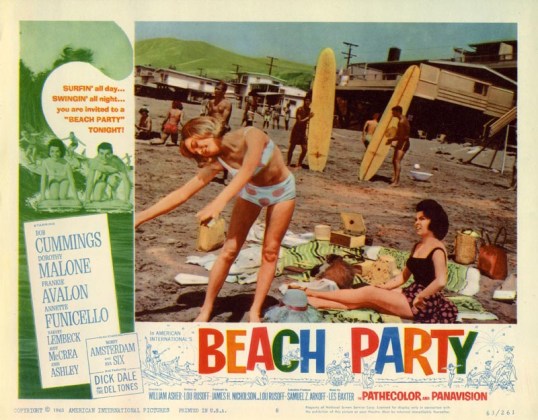
Life Is A Beach #1: Beach Party (dir by William Asher)


Beach-Party-Lobby-Card8

It seems a little bit strange that today was, for many people, the first day of Spring Break.

First off, it was cold and rainy today and, whenever I found myself glancing out a window and being confronted by the gray weather, it was very hard for me to imagine having any fun on a beach.

Secondly, for reasons that I never quite understood, the University of North Texas’s Spring Break was always a week after everyone else’s.  As a result, I’ve been conditioned to think of Spring Break as starting during the third week of March.

I always looked forward to Spring Break, despite the fact that we always got out a week late.  In fact, it was kind of nice to know that, when my friends and I got down to that year’s beach, the most obnoxious of the alcoholic frat boys would already be back in Oklahoma.  I’ve always loved the beach, which is odd because I’m scared of drowning.  Fortunately, you don’t have to swim to look good in a bikini.

Now, of course, I’m an adult and I don’t get a Spring Break.  But that doesn’t mean that I can’t relive the fun of it all by spending the next few days watching and reviewing beach movies!

For instance, earlier today, I discovered that the 1963 film Beach Party was available on Netflix.   I watched the first 40 minutes during my lunch and then, as the day progressed, I watched the rest of it in bits and pieces until finally, nearly 8 hours after starting the film, I finished it.  Needless to say, this is absolutely the worst way to watch a film like Beach Party.  Beach Party was designed to be a film to be enjoyed but not thought about.  It’s the cinematic equivalent of fast food.  Watching Beach Party in increments of 2 or 3 minutes at a time is a bit like buying a Wendy’s bacon cheeseburger and not eating it until the next day.

(Or so I assume.  I would never do that because, seriously, Wendy’s makes the best bacon cheeseburgers!)

It feels kind of silly to try to describe the plot of something like Beach Party but here goes: Frankie (Frankie Avalon) and Delores (Annette Funicello) are two teenagers in love.  Or, at the very least, Delores is in love.  Frankie, however, has a hard time saying it.  Frankie and Delores are planning on spending the weekend at a beach house where, Frankie tells her, it will be just like they’re married.  Though it’s never explicitly stated (like many films from the early 60s, Beach Party is all about the euphemisms), Frankie is obviously expecting that he and Delores will finally be having sex in that beach house.  However, Delores had the same idea so she invited all of their friends to stay at the beach house as well, specifically to keep her from giving in during a moment of weakness.

Meanwhile, Prof. Robert Sutwell (Robert Cummings) is also hanging out on the beach.  He’s an anthropologist who has a rather prominent beard.  He’s studying the sex lives of teenagers.  Since they’re adults, Robert and his assistant Marianne (Dorothy Malone) are actually allowed to say the word “sex.”

Speaking of which, that’s one thing that nobody on the beach seems to be doing.  Robert is too obsessed with his work, Marianne is too frustrated with his lack of interest, Frankie is too busy surfing and singing, and Delores says she’s not interesting in “being a woman” until she’s married.  There’s constant flirting going on, of course but, for the most part, these teenagers make the spring breakers from From Justin To Kelly look wild.  (One can only guess what would happen if any of them ever ran into the spring breakers from Spring Breakers….)

That said, I do think that I did spot Frankie and his friends passing around a joint during one scene.  According to some comments at the imdb, it was probably meant to be a cigarette that Frankie was sharing with his friends Ken (John Ashley) and Deadhead (Jody McCrea) but it sure looked like a joint to me.  Plus, Frankie was listening to beatnik poetry at the time and we all know those crazy kids loved the poetry and loved the marijuana.

Oh!  And did I mention that there’s a motorcycle gang in this film?  Because there so totally is.  The Rat Pack is led by a guy named Erich Von Zipper (Harvey Lembeck) and they pretty much show up whenever the film starts to run out of ideas…

Now, it may sound like I’m being pretty critical of Beach Party but actually, I thought it was fun in a time capsule sort of way.  This is one of those films that is so obviously a product of the time in which it was made that watching it is a bit like getting to take a ride in a time machine.  Everything about this film — from the dialogue to the cultural attitudes to the clean-cut teenagers to the music to the bizarrely modest bikinis — practically screams 1963.  As a secret history nerd, I loved the part of Beach Party.

Add to that, Vincent Price has a cameo!  That’s always fun.

Anyway, Beach Party is currently available to be watched on Netflix and Hulu.  If you can’t get to the beach this year, you can always watch Frankie Avalon getting high in Beach Party.

http://www.youtube.com/watch?v=nkhGmZPJIHY