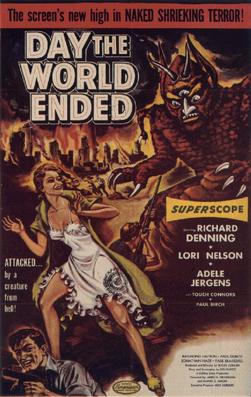
Horror Film Review: Day The World Ended (dir by Roger Corman)


“You finally did it!  You blew it up! …. Goddamn you to Hell!”

That’s right.  Just as how the original Planet of the Apes showed us what the world would look like centuries after a nuclear war, 1957’s Day The World Ended shows us what things would be like in  the weeks afterwards.  And guess what?  It wouldn’t be a lot of fun.

Day The World Ended starts with the bombs dropping and mushroom clouds forming in all of their fearsome glory.  (Oppenheimer may have hated his greatest achievement but aesthetically, the atomic bomb is still an impressive invention.)  Jim Maddison (Paul Birch) and his daughter, Louise (Lori Nelson), manage to survive by camping out in a steel bunker that Maddison built especially for the moment.  As a former Navy commander, Maddison understood that the world was on the verge of nuclear war and he also understood that only those with discipline would survive.  He’s filled with bomb shelter with supplies and he’s told Louise that only the two of them can use the shelter.  Anyone else is out of luck.

Unfortunately, people keep showing up at the shelter and asking to come in.  And while Maddison is prepared to leave them outside with the fallout and the mutants that have started to roam the desert, Louise just can’t stand the thought of leaving anyone to die.  Reluctantly, Maddison starts to allow people to join him and his daughter.  Some of them, like geologist Rick (Richard Denning), are a good addition to the group,  Rick is actually an expert in uranium mining and a potential husband for Louise.  (Louise has a fiancé but he’s missing.  She keeps his picture by her bed.  The picture, of course, is actually a photo of director Roger Corman.)  Unfortunately, not everyone is as likable and well-intentioned as Rick.  Lowlife hood Tony (Mike Connors) and his girlfriend, Ruby (Adele Jergens) show up and continue to act as if they’ve got the police after them even though the police were probably atomized with the rest of civilization.  And finally, there’s a man (Jonathan Haze) who is transforming into a mutant and who develops a strange mental connection to Louise.

No one said the end of the world would be easy!

Day The World Ended was Corman’s fourth film as a director and it was also his first film in the horror genre.  (It’s actually a mix of science fiction and horror but whatever.)  The film was enough of a box office success that it inspired Corman to do more films in the genre.  Seen today, it’s obviously an early directorial effort.  It lacks the humor that distinguished Corman’s later films.  In fact, the film is actually a little bit boring.  Watching a film like this really drives home just how important Vincent Price and his energy were to Corman’s later films.  This film doesn’t have an actor like Vincent Price or Boris Karloff or even Dick Miller, someone who could energize a film just through the power of their own eccentricities.  Instead, Mike Connors, Paul Birch, and Richard Denning all give dull performances as the survivors.  This is a historically important film because, without its box office success, Corman probably would have stuck with doing B-westerns and gangster films.  Filmgoers should be happy that audiences in the 50s were drawn in by the film’s title and their own paranoia about nuclear war.  It’s a film that one appreciates as a piece of history, even if it doesn’t quite stand up to the test of time.
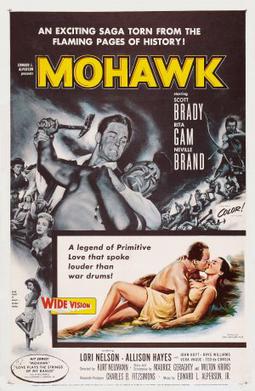
Mohawk (1956, directed by Kurt Neumann)


In the late 18th century, Boston socialite Cynthia Stanhope (Lori Nelson) travels to Fort Alden in upstate New York to visit her fiancé, a painter named Jonathan Adams (Scott Brady), who has been commissioned to paint the local scenery.  As soon as Cynthia and her mother arrive, they are shocked to discover that not only Jonathan has been painting pictures of the members of the Native local tribes but that he is also now flirting with a barmaid named Greta.  Greta is played by Allison Hayes so who can blame him?  Cynthia wants to return to their normal upper class life in Boston but Adams has fallen for the untamed wilderness of the frontier.

When Onida (Rita Gam), the daughter of Iroquois chief Kowanen (Ted de Corsia) is captured during a raid on the fort, Adams is assigned to escort her back to her tribe.  Leaving behind Cynthia and Greta, Adams falls in love with Onida over the course of the journey.  When he meets the Iroquois, he earns the respect of her father and the entire tribe when he agrees to paint the chief’s portrait.

Meanwhile, a haughty settler named Butler (John Hoyt) is trying to play the army and the Iroquois against each other, feeding both of them false information in an attempt to spark a war.  Butler is hoping that a war will lead to both sides wiping each other out so that he can once again have the valley to himself.  When it turns out that his words might not be enough to spark a war, Butler resorts to murder.  When Kowanen’s son is killed, the Iroquois prepare for war while Adams is framed for the crime and finds himself tied to a stake.

Mohawk is a standard B-western, with a plot that is largely lifted from John Ford’s Drums Along The Mohawk.  Unfortunately, Adams is about as sympathetic hero as you would expect someone manipulating three different women to be and, when it comes to depicting the Iroquois, Mohawk resorts to too many clichés.  This is one of those westerns where the Native characters speak broken English, even when they are just talking to each other.

Mohawk does have three things to recommend it.  Number one, John Hoyt was a master at playing haughty villains and Butler is easy to root against.  You will look forward to seeing him get his comeuppance.  Number two, Allison Hayes was a force of nature and that’s true even in this film, where she’s not given nearly enough to do.  Number three, one of Iroquois braves is played by Neville Brand.  A highly decorated World War II veteran, Brand built a long career playing tough guys.  In Mohawk, it only takes one look at Neville Brand to know that this isn’t someone you want to mess with.  Anyone watching would want to stay on Neville Brand’s good side.

Otherwise, Mohawk is forgettable.  Two years after it was released, Mohawk’s director Kurt Neumann, would be responsible for the much more memorable The Fly.

Halloween Havoc!: REVENGE OF THE CREATURE (Universal-International 1955)


gary loggins's avatarcracked rear viewer

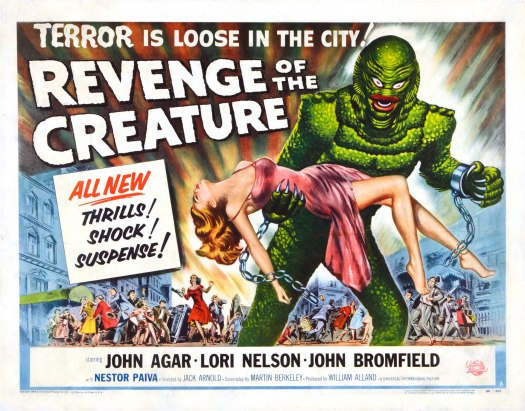
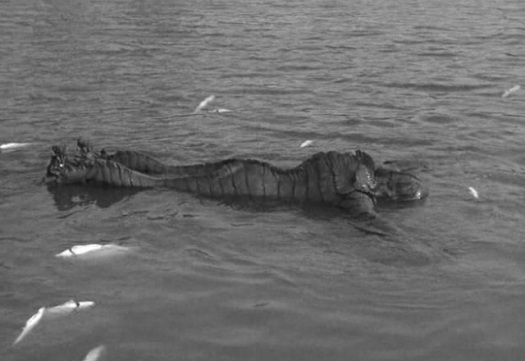
The Gill-Man  made his second appearance in REVENGE OF THE CREATURE, a good-not-great sequel that finds The Creature out of his element and in the modern (well, 1955) world. In fact, The Creature is the most sympathetic character in the film, as he’s hunted, ripped from his home, chained up, tortured, and treated like a freak-show attraction. The humans, with the exception of heroine Lori Nelson, are your basic 50’s sci-fi hammerheads who fear what they don’t understand and try to force The Gill-Man to their will.

Old friend Captain Lucas is once again heading down the Amazon to the Black Lagoon, in his new boat The Rita II. Joe Hayes and George Johnson of Florida’s Ocean Harbor Oceanarium are out to capture The Creature and use him as a theme park attraction. Underwater dynamite charges stun The Gill-Man into a coma, and he’s trussed up and transported stateside. Professor…

View original post 454 more words

Western Noir: James Stewart in BEND OF THE RIVER (Universal-International 1952)


gary loggins's avatarcracked rear viewer

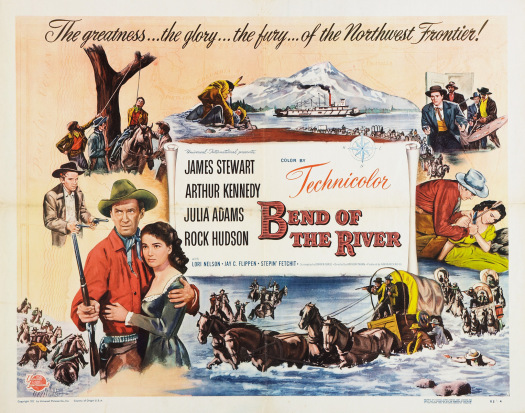
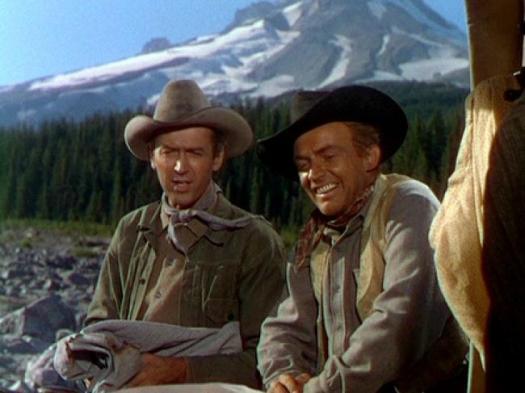
BEND OF THE RIVER, the second of the James Stewart/Anthony Mann Westerns, isn’t quite as good as the first, WINCHESTER ’73 . That’s not to say it isn’t a good film; it’s just hard to top that bona fide sagebrush classic. Stewart continues his post-war, harder edged characterizations as a man determined to change his ways, and is supported by a strong cast that includes a villainous turn by the underrated Arthur Kennedy .

Jimmy plays Glyn McLyntock, an ex-outlaw now riding as trail boss for a group of farmers heading to Oregon to begin a new life. He encounters Kennedy as Emerson Cole, a horse thief about to be hanged, and enlists his help on the trail west. Both men know each other’s reputations; they were both once raiders along the Missouri/Kansas border. The wagons are attacked at night by Shoshone, an arrow piercing young Laura Baile, daughter of…

View original post 580 more words

Horror On The Lens: Revenge of the Creature (dir by Jack Arnold)


For today’s horror on the lens, we present to you 1956’s Revenge of the Creature!

Revenge of the Creature was the first sequel to The Creature From The Black Lagoon.  It turns out that the Gil-Man didn’t actually die at the end of the last film.  Instead, he’s alive, he’s been captured, and he’s now being displayed in an aquarium.

Now, I’m going to be honest: Revenge of the Creature is not as a good as The Creature From The Black Lagoon.  But it’s still kind of fun in a silly 1950s monster movie sort of way.  And, if you keep your eyes open, you might spot a very young Clint Eastwood, playing a lab technician and sporting a truly impressive head of hair.

Enjoy!