Late Night Retro Television Review: Friday the 13th: The Series 2.16 “Scarlet Cinema”


Welcome to Late Night Retro Television Reviews, a new feature where we review some of our favorite and least favorite shows of the past! On Fridays, I will be reviewing Friday the 13th: The Series, a show which ran in syndication from 1987 to 1990. The show can be found on YouTube!

This week, a nerdy film students takes his love of a 1940s horror film too far!

Episode 2.16 “Scarlet Cinema”

(Dir by David Winning, originally aired on February 20th, 1989)

Darius Pogue (Jonathan Wise) is a nerdy film student who is obsessed with The Wolf Man.  When Darius steals an old antique movie camera, he discovers that, by looking through the camera’s view finder, he can bring The Wolf Man to life and send him to kill anyone who annoys him.  Darius kills a snooty antique store manager.  He kills a bully.  He kills his professor.  He even sends the wolf after Ryan and a girl that Darius likes.

However, as much as Darius enjoys sending the Wolf Man after people, he wants to be the Wolf Man himself.  After allowing the Wolf Man to scratch him, Darius shoots him with silver bullets.  Transforming into a werewolf himself, Darius goes after Ryan, Micki, and Jack.  Unfortunately, Darius didn’t consider that film stock is full of silver nitrate.  Live by the film, die by the film….

This episode was a case where the premise was pretty interesting but the execution didn’t quite work.  The episode mixes in archival footage from The Wolf Man with scenes of Darius’s victims meeting their fate.  So, for example, one sees Lon Chaney Jr. turning into the Wolf Man and then the viewer sees The Wolf Man killing one of Darius’s classmates.  The problem is that the Friday the 13th werewolf makeup doesn’t really look much like the Wolf Man makeup.  Regardless of how darkly lit each scene is, it’s pretty obvious that the Wolf Man from the film is not the same Wolf Man that is doing Darius’s bidding.  It not only negates the whole idea behind the cursed antique but it’s also pretty distracting for those of us just trying to watch the show.  And, again, it’s a shame because the idea behind this episode was actually pretty clever.

Myself, I’ve always liked the original Wolf Man.  Eventually, Larry Talbot got a bit too whiny for his own good and it’s pretty much impossible to buy the idea of the hulking, very American Lon Chaney, Jr. as the son of the sophisticated and very British Claude Rains.  But, even with all that in mind, The Wolf Man holds up as a classic American horror film, full of atmosphere and featuring a pretty impressive monster.  Friday the 13th deserves some credit for making Darius a Wolf Man fan because The Wolf Man, with its portrait of a man being driven mad by a curse that he cannot control, fits in perfectly with the main idea behind Friday the 13th.  Darius, like most of the villains on this show, isn’t really evil until he starts using the camera.  Each times he picks up the camera, his actions become progressively worse.  Just as Larry Talbott was cursed by the werewolf, Darius is cursed by the camera.  Much like a drug addict, Darius falls in love with the camera and he just can’t stop using it.  His addiction changes his personality as it becomes all-consuming,.  Eventually, it drives him to become the Wolf Man himself.

The episode ends with another cursed antique safely hidden away and Darius joining Larry Talbot in the cold embrace of death.  There was a lot of potential to this episode so it’s a shame that it didn’t quite work.
Horror Film Review: The Alligator People (dir by Roy Del Ruth)


You know what the worst bayou is?

Bayouself.

Thank you!  I’ll be here all night and don’t forget to tip your server!

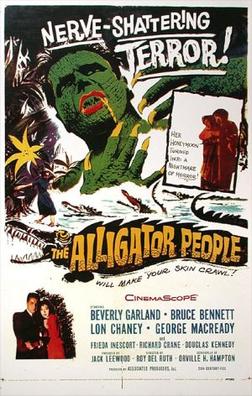
Anyway, the 1959 film, The Alligator People, largely takes place in the bayous of Louisiana.  Nurse Jane Marvin (Beverly Garland) is suffering from amnesia so she allows two psychiatrist to give her a dose of truth serum and then, when she’s in a hypnotized state, she proceeds to remember her former life as Joyce Webster.

Joyce married a handsome and seemingly perfect man named Paul Webster (Richard Crane) but, right when they were about to go on their honeymoon, he received a telegram that disturbed him.  After he made a phone call, he vanished from Joyce’s life.  Joyce did some research of her own and discovered that Paul’s former home was the Cypresses Plantation in the small town of Bayou Landing, Louisiana.

When Joyce travels down to Bayou Landing, she discovers that there’s really not much there, other than a bunch of hungry alligators.  She meets the owner of the plantation, Lavinia Hawthorne (Frieda Inescort).  She also meets the handyman, Manon (Lon Chaney, Jr.), a one-handed brute who spends most of his day shooting at alligators.  And, eventually, Joyce comes across her husband but Paul is no longer the man that she remembers.

Paul’s skin is scaly and he only comes out at night.  It turns out that Paul was, long ago, injected with a serum that would allow him to grow back a missing limb.  The serum worked as far as the limb was concerned but an unfortunate side effect is that Paul is now turning into an alligator!  Dr. Mark Sinclair (George Macready), the man who came up with the serum in the first place, is hopeful that he can reverse the process but, to do so, he’s going to need a lot of radioactive material.

Complicating things is that Manon has decided that he wants Joyce for himself and he’s certainly not going to compete with some alligator man for her attention.  Of course, Joyce despises Manon from the first moment she sees him but Manon’s not that smart.  Can Paul be cured before Manon destroys everything?

The Alligator People is one of those 1950s B-movies that is probably better-known for its name than anything else.  That said, when taken on its own terms, it’s an entertaining watch.  It was one of the final films to be directed by Roy Del Ruth, who had previously been one of Hollywood’s top directors of musicals and comedies.  There’s not much music or deliberate comedy to be found in The Alligator People but Del Ruth does manage to capture the humid stillness of the bayous.  As always, Beverly Garland gives a strong performance as a determined woman who isn’t going to be told what to do and Richard Crane is about as convincing as one can be while turning into an alligator.

As for Lon Chaney, Jr, he plays Manon as being a total monster and he gives a convincing performance, even if it is hard not to mourn the loss of the shadings that he brought to his monster roles while he was with Universal.  Manon is a rough and determinedly unintelligent character, one who exists only to destroy.  Significantly, he’s not one of the Alligator People.  Instead, he’s just a man who doesn’t care about anyone but himself.

The Alligator People is an effective B-movie, full of a bayou atmosphere.

Horror Scenes I Love: Lon Chaney, Jr. in The Wolf Man


Ah, Lon Chaney, Jr.

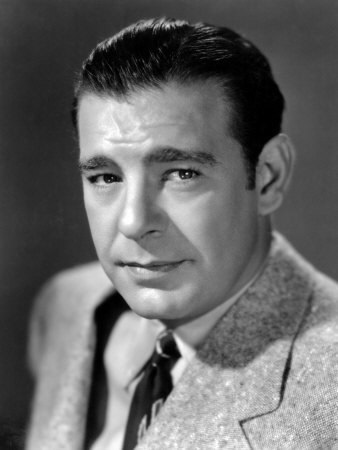
He was the son of a famous man and, like many sons of famous men, he often struggled to escape his father’s shadow.  While he would never be mistaken for a man of a thousand faces, Lon Chaney, Jr. did make a name for himself as Larry Talbot, the unfortunate man who found himself cursed to turn into the Wolf Man whenever the man was full.  Chaney spent the majority of his career appearing in horror films and, later, westerns.  Not only did he play The Wolf Man but he was also one of the many actors to take a shot at playing both Frankenstein’s Monster and Dracula.  Later, he would appear in a series of low budget horror films that, quality-wise, were often a far cry from his best-known films.  That said, he was also a favorite of producer/director Stanley Kramer, who cast him in both High Noon and The Defiant Ones and who once said that Chaney was one of the finest character actors in Hollywood.

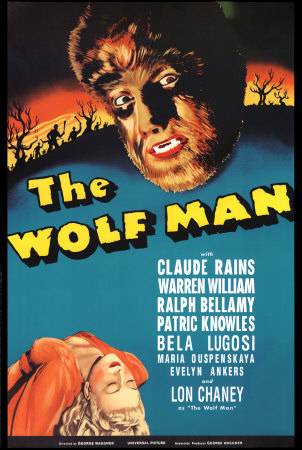
In today’s scene that I love, Larry Talbot learns the facts about being a werewolf.  From 1941’s The Wolf Man, here is Lon Chaney, Jr in his signature role.

Horror Scenes That I Love: Lon Chaney Transforms Into The Wolfman


Today’s horror scene that I love comes from 1941’s The Wolf Man.  Watch as poor Larry Talbot transforms, for the first time, into The Wolf Man!  I’ll be the first to admit that, in the past, I’ve been pretty critical of Larry as a character and Lon Chaney, Jr.’s performance in the role.  But, in this scene, Chaney does an excellent job of capturing Larry’s helplessness as the curse takes effect for the first time.

Badlands of Dakota (1941, directed by Alfred E. Green)


This B-western takes place in the legendry frontier town of Deadwood.  It’s a town that’s patrolled by General George Custer (Addison Richards) and which is home to Wild Bill Hickok (Richard Dix) and Calamity Jane (Frances Farmer).  When outlaw Jack McCall (Lon Chaney, Jr.) and his gang start disguising themselves as Sioux and start robbing stagecoaches, young homesteader Jim Holliday (Robert Stack) is appointed town marshal.  Unfortunately, Jim’s older brother, Bob (Broderick Crawford), has gotten involved with McCall and his gang.  Bob has also never forgiven Jim for marrying Anne (Ann Rutherford), the woman that Bob loved.  Jim struggles to get the town to take him seriously.  When Jim tries to put out a fire that’s threatening to burn down several businesses, the citizens laugh at him and shoot a hole in the water hose.  No one said that the people of Deadwood were smart.  Ann wants to leave town but McCall and his gang are growing more brazen in their attacks and when one of Jim’ mentors is murdered, Jim has no choice but to get justice and revenge.  Meanwhile, the real Sioux grow tired of being blamed every time a stagecoach is robbed and they launch their own attack on the town.

Though the plot may be predictable, Badlands of Dakota is memorable for the cast that was assembled to bring its familiar story to life.  Along with those already mentioned, the cast also includes Andy Devine as a saloon owner, Hugh Hubert as the town drunk, Fuzzy Knight as the town’s stagecoach driver, and the folk band, The Jesters, as the town’s entertainment.  They all do their part to bring the town of Deadwood to life.  Frances Farmer steals the film with her tough and unsentimental portrayal of Calamity Jane and Lon Chaney, Jr. is an effectively hard-edged villain.  This was one of Robert Stack’s first films and he’s appropriately stiff and upright as Jim.  Jim is the only honest man in Deadwood, which also means that Jim is fairly boring when compared to everyone else around him.  It’s also difficult to accept him as being Broderick Crawford’s younger brother, though Crawford does a good job of portraying the personal betrayal that Bob feels when he discovers that Jim has married Anne.

Not surprisingly, Badlands of Dakota plays havoc with history.  This is especially true when it comes to Addison Richards’s sober and reasonable portrayal of a middle-aged General Custer.  (The real-life General Custer died when he was only 36 and could reportedly be slightly erratic.  Not to mention, Custer died the same year that Deadwood was founded so it’s doubtful that he ever visited the city, much less had a personal friendship with Wild Bill Hickok and Calamity Jane.)  Still, there’s a lot here to entertain fans of B-westerns.  Along with all of the familiar faces in the cast, there’s also a sequence with an out-of-control stage coach that makes good use of rear projection and the film’s final gun battle is exciting and well-directed.  It’s a quick 76 minutes, full of all the action and bad history that a western fan could hope for.

Frontier Marshal (1939, directed by Allan Dwan)


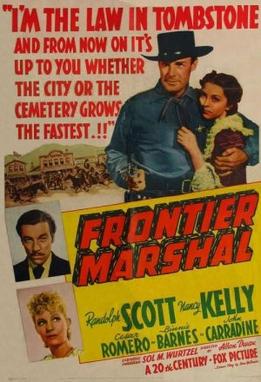
When Wyatt Earp (Randolph Scott) arrives in the town of Tombstone, he takes the law in his own hands by preventing a local outlaw named Indian Charlie (Charles Stevens) from destroying the saloon owned by Ben Carter (John Carradine).  For his trouble, Earp is beaten up by Carter’s men.  Earp, however, does get a  job as the town’s new marshal.

After some initial weariness, Wyatt befriends an alcoholic dentist and gunfighter named Doc Holliday (Cesar Romero).  While Earp keeps the peace in Tombstone, Doc is torn between two women, dancehall girl Jerry (Binnie Barnes) and his ex-girlfriend, Sarah (Nancy Kelly).

With Carter and his man planning on robbing a payroll train and also kidnapping frontier performer, Eddie Foy (played by the real Foy’s son, Eddie Foy, Jr.), it is only a matter of time before Earp takes on Carter at the legendary O.K. Corral.

Frontier Marshal was only the second sound film to be made about Wyatt Earp’s time in Tombstone and it was the first to use Earp’s name.  (In the first film version of the story, also called Frontier Marshal, Earp’s name was changed to Michael Wyatt.)  This was because Wyatt’s widow was offended by some of the material that was included in the biography that served as the basis for Frontier Marshal and threatened to sue anyone who wanted to make a movie out of it.  In order to get her permission to make the film, 20th Century Fox agreed that no reference would be made to Wyatt’s marriage in the film.  Mrs. Earp ended up suing anyways.  20th Century Fox settled.

As for the film, it’s in no way historically accurate and it pales in comparison to My Darling Clementine, Gunfight at the O.K. Corral, Tombstone, and the Star Trek episode where Kirk, Spock, and McCoy thought they were in the old west.  It is, however, better than The Gunfighters episode of Dr. Who.  Randolph Scott is convincing as an upright and law-abiding Wyatt Earp, quite a contrast to the real Wyatt.  The movie though is stolen by Cesar Romero, who plays Doc Holliday as being pathologically self-destructive.  Cesar Romero is not necessarily the first name that comes to mind when you think of a great western actor but he’s very convincing here.  John Carradine is a perfect villain and keep an eye out for Lon Chaney, Jr. as one of his henchmen.  Unfortunately, the final gunfight feels rushed and, for all the build up, it isn’t as exciting as it should be.  Frontier Marshal will mostly be of interest to those curious to see how Doc Holliday, Wyatt Earp, Tombstone and the Gunfight at the O.K. Corral were portrayed in films before they became a sacrosanct part of the mythology of the Old West.

Frontier Marshal was later remade, as My Darling Clementine, by John Ford.  Ward Bond, who played Morgan Earp in Ford’s film, plays the original town marshal in Frontier Marshal.  Charles Stevens, who plays Indian Charlie in Frontier Marshal, was often falsely described by the Hollywood publicity mill as being the real-life grandson of Geronimo.  He also appeared in My Darling Clementine, once again playing the role of Indian Charlie.  It was one of the nearly 200 films he made before he died in 1964.

Horror on the Lens: Bride of the Gorilla (dir by Curt Siodmak)


In the 1951 film, Bride of the Gorilla, Raymond Burr plays a plantation manager who commits a murder.  Unfortunately, for him, the murder is observed by a witch who promptly puts a curse of Burr.  Now, every time the sun goes down, Burr transforms into a gorilla and goes wild in the jungle.

Basically, it’s kind of like The Wolf Man, just with a less sympathetic protagonist and a gorilla instead of a werewolf. Just in case we missed the similarities, Lon Chaney, Jr. plays the film’s nominal hero, a police commissioner who suspects that something weird might be happening with Burr.  Apparently, the plan was originally for Chaney to play the gorilla and for Burr to play the policeman but, because Chaney was dealing with a serious alcohol problem at the time, the roles were reversed.

Also in the cast, playing the role of Dina, is Barbara Payton, the tragic actress who is best known for being at the center of a love triangle involving actors Tom Neal and Franchot Tone.  In 195000, Neal attacked Tone and beat him so severely that Tone spent 18 hours in a coma.  Tone was notably shaky onscreen for the rest of his film career while Neal spent a few years in prison.  After the incident between Tone and Neal, Payton could only get roles in B-movies like this one.  Tragically, she would pass away, in 1967, of heart and live failure.  She was only 39 years old.

Horror Scenes I Love: Larry Talbot Discovers His Fate in The Wolf Man


Today’s horror scene that I love comes from 1941’s The Wolf Man.

In this scene, poor, unfortunate Larry Talbot (Lon Chaney, Jr) visits a gypsy camp and learns that sad truth of his fate from Maleva (Maria Ouspenskaya).  I love this scene not only for the iconic dialogue but also for George Waggner’s atmospheric direction and Maria Ouspenskaya’s performance.  Even Lon Chaney, Jr. gives it his all in this scene.  Larry Talbot may have been a dumb lug but he was our dumb lug!

Horror Film Review: Son of Dracula (dir by Robert Siodmak)


son_of_dracula_movie_poster

Did you know that Count Dracula had a son?

Well, maybe he did or maybe he didn’t.  It all depends on how you interpret the 1943 film, Son of Dracula.  In Son of Dracula, Lon Chaney, Jr. plays a vampire named Count Alucard.  I get the feeling that it’s supposed to be a shocking moment when it’s pointed out that Alucard is Dracula spelled backwards but, since the movie is called Son of Dracula, I would think that most people would have already figured out the connection.

That said, when Alucard reveals that his true name is Dracula, he seems to be suggesting that he is the original Count Dracula.  And yet the name of the film is Son of Dracula.  At one point, two characters speculate that Alucard is a descendant of the original, just to be corrected by his bride.  “He is Dracula!” she announces.  Then again, she could just be bragging.  If you’re going to marry a Dracula, wouldn’t you rather marry the original than a descendant?

If he is the original Dracula, you do have to wonder why he’s still alive.  Since the film is a part of the Universal Dracula series, you have to wonder how he managed to survive being both staked by Van Helsing and having his body cremated by his daughter in Dracula’s Daughter.  You also can’t help but notice that Alucard doesn’t bear much of a resemblance to Bela Lugosi. nor does he have a European accent.  Instead, Alucard looks a lot like Lon Chaney, Jr.  Chaney does not make for the most convincing vampire.  As an actor, Chaney tended to project a certain “likable but dumb lug” quality that worked well for The Wolf Man and as Lenny in Of Mice and Men but it doesn’t quite work when he’s cast as a suave, Hungarian vampire.

Anyway, Son of Dracula finds Count Alucard in New Orleans at the turn of the century.  He has specifically moved to the Deep South so that he can be with Katherine Caldwell (Louise Allbritton), a young woman who is obsessed with the occult.  Katherine secretly marries Alucard.  When her former boyfriend, Frank (Robert Paige), finds out about the marriage he decides that the best way to handle way things would be to get drunk and shoot the count.  Unfortunately, since the Count is a vampire, the bullet passes through him and kills Katherine instead.

Or does it!?

Probably the most interesting thing about Son of Dracula is that it presents Alucard as being manipulated by a mortal.  Usually, Dracula is the one doing the manipulating but in Son of Dracula, it’s suggested that a clever mortal can manipulate the undead jut as easily.  GO KATHERINE!

Anyway, Son of Dracula is okay.  It has some steamy deep south atmosphere and it’s fun in a campy, Universal sort of way.  It has some historical significance because it was apparently the first film to actually feature a vampire transforming into a bat onscreen.  For the most part, though, it’s a film that will best be appreciated by Universal horror completists.

That said, I kind of like the fact that nobody in the film could figure out that Alucard is Dracula spelled backwards.  That was cute.