Horror On The Lens: The Phantom of the Opera (dir by Rupert Julian)


Today’s horror movie on the Shattered Lens is both a classic of silent era and one of the most influential horror films ever made.  It’s one that I previously shared in 2013, 2015, 2016, 2108, 2019, 2020, 2021, and 2022 but it’s such a classic that I feel that it is worth sharing a second (or fifth or even a sixth or perhaps an ninth) time.

First released in 1925, The Phantom of the Opera is today best known for both Lon Chaney’s theatrical but empathetic performance as the Phantom and the iconic scene where Mary Philbin unmasks him. However, the film is also a perfect example of early screen spectacle. The Phantom of the Opera was released during that period of time, between Birth of the Nation and the introduction of sound, when audiences expected films to provide a visual feast and Phantom of the Opera certainly accomplishes that. Indeed, after watching this film and reading Gaston Leroux’s original novel, it’s obvious that the musical was inspired more by the opulence of this film than by the book.

This film is also historically significant in that it was one of the first films to be massively reworked as the result of a poor test screening. The film’s ending was originally faithful to the end of the novel. However, audiences demanded something a little more dramatic and that’s what they got.

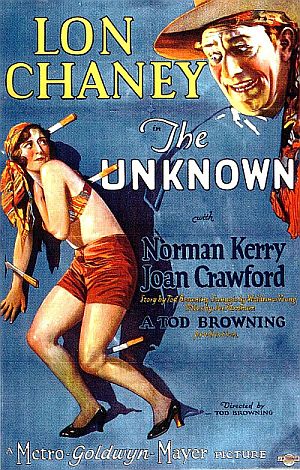
Horror on the Lens: The Unknown (dir by Tod Browning)


First released in 1927, The Unknown tells the story of circus performer Alonzo the Armless (Lon Chaney, Sr.).  As you might guess from his name, everyone thinks that Alonzo is armless.  Of course, he’s not.  He’s just a contortionist who pretends to have no arms.  People thinking that he has no arms gives him the perfect alibi whenever he has to strangle someone.

However, Alonzo has fallen in love with Nanon (Joan Crawford), his beautiful circus assistant.  Unfortunately, Malabar the Mighty (Norman Kerry) is also in love with her and there’s no way that Alonzo could allow her to get too close because then she might discover that he not only has arms but that his hand has an unusual deformity that would identify Alonzo as the man who strangled Nanon’s father.

Alonzo’s solution?  Maybe he could just get someone to amputate his arms for real!  But will that be enough for him to win Nanon away from Malbar?  Or will he pursue an even more macabre plan to get Malabar out of the picture?

The Unknown was, for years, considered to be a lost film.  In 1968, a 49-minute print of the film was found in France.  That’s the version that I’m sharing here.  Reportedly, several early scenes were missing but those scenes were not important to the overall story.  Even in truncucated form, The Unknown is a wonderfully surreal and atmospheric film and it’s widely considered to be the best of Tod Browning and Lon Chaney’s collaborations.  Since this film was made in the age before CGI, whenever Alonzo hides his arms, Chaney was having to do the same thing.  This is one of Chaney’s best performances.  Alonzo is both frightening and rather sad in his way.  Having won the role over Greta Garbo, Joan Crawford was 18 when she played Nanon.

Enjoy!

4 Oscar Snubs From the 1920s


The Oscars started out as an afterthought.

When Louis B. Mayer first proposed setting up what would become the Academy of Motion Picture Arts and Sciences in 1927, he wasn’t really that interested in giving out awards. Instead, he saw the Academy as an organization that would mediate labor disputes between the studios and the unions. He also felt that the Academy could basically be used to improve the film industry’s image, which had taken a hit from the rape trial of Fatty Arbuckle, the overdose of Wallace Reid, and the murder of William Desmond Taylor. When he and the other 35 founders of the Academy met to draw up the organization’s charter, the idea of giving out awards was mentioned only in passing. A committee would be set up to give out yearly awards to honor the best that Hollywood had to offer.

The first Academy Awards ceremony was held in a hotel ballroom in 1928. It occurred at the end of a private dinner and the awards were handed out in 15 minutes. The 2nd ceremony was the first to be broadcast on the radio. It was only when the Academy got around to the third ceremony that the Oscars started to transform into the spectacle that we know today. It was only then that people started to really pay attention to what was and was not nominated for Best Picture.  And, as people started to pay attention, they also started to notice and talk about which films and performers were snubbed by the Academy.

Today, for Oscar Sunday, we’re taking a a decade-by-decade look at some notable Oscar snubs. We will start with those first three ceremonies.

1927 — 1928: The General Receives Zero Nominations

For the very first Oscar ceremony, two Best Picture awards were handed out.  Wings won the Oscar for Best Production.  Sunrise, meanwhile, won the Oscar for Unique and Artistic Production.  Today, Sunrise is better remembered than Wings.  Personally, I like both films.  Thought it’s nearly a hundred years old, Sunrise remains visually stunning.  Wings, meanwhile, features some thrilling aerial footage and a performance from the wonderful Clara Bow.

That said, it’s still a bit unfortunate that Buster Keaton’s The General received not a single nomination, despite being eligible for the Oscars.  Today, The General is recognized as being a comedic masterpiece.  However, when it was initially released, it struggled at the box office and many in Hollywood resented Keaton’s independent streak.  As a result, The General became one of the first films to be snubbed by the Academy.
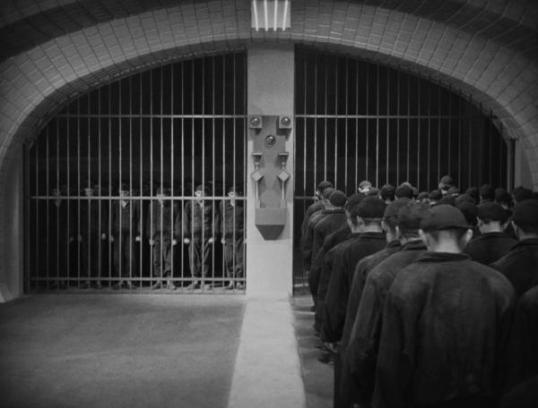
Metropolis (1927, dir by Fritz Lang, DP: Karl Freund and Gunther Rittau)

1927 — 1928: The Academy Ignores Metropolis

The very first Best Actor winner was Emil Jannings.  Jannings was German and struggled with English but, during the Silent Era, that wasn’t a problem.  However, the coming of sound petty much ended Jannings’s Hollywood career.  He returned to Germany, where he remained a star.  He would go on to star in several Nazi propaganda films and was reportedly one of Hitler’s favorite actors.  When the war came to an end, Jannings took to carrying his Oscar statuette around with him in the hopes that it would win him favor with the Allies and allow him to avoid having to go through the denazification process.  It didn’t work and Jannings retired from acting.  He died in Austria in 1950.

Personally, I think it would have been nice if the first Oscars hadn’t honored someone who would later star in Nazi propaganda films.  And the Academy had the option to do just that, as Fritz Lang’s Metropolis was released in the United States in 1927.  Metropolis was not only one of the first great science fiction films but Lang was one of the many German directors who would come to Hollywood after the Nazis came to power,  Honoring Metropolis would have allowed the Academy to honor someone who refused to compromise with the Ministry of Propaganda.  Unfortunately, neither Metropolis nor Lang were nominated.

1927 — 1928 and 1928 — 1929: Lon Chaney Is Not Nominated For Best Actor

Poor Lon Chaney.  Widely considered to be one of the best actors of the silent era, Lon Chaney, Sr. was never nominated for an Oscar.  London After Midnight is a lost film and West of Zanzibar is only partially complete but, speaking as a horror fan, I would have loved it if the Academy could have nominated him for either one of those films.  If nothing else, it would have opened the door for the horror genre.

1929 — 1930: The Cocoanuts Is Ignored

Imagine how different Oscar history would have been if the Academy had early on started a tradition of honoring comedy?  The Marx Brothers were not fans of their first released film but audiences loved The Cocoanuts.  Unfortunately, the Academy was not quite ready to embrace comedy and, as such, this became the first (but not the last) Marx Brothers film to be snubbed.

Agree?  Disagree?  Do you have an Oscar snub that you think is even worse than the 4 listed here?  Let us know in the comments!

Up next: The 1930s brings a depression and a lot more snubs!
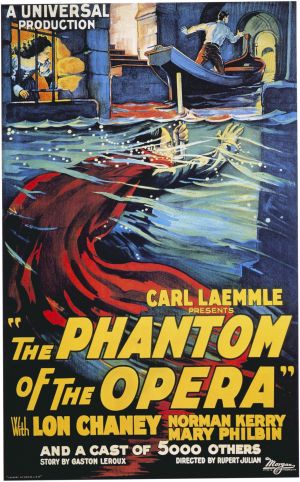
Horror On The Lens: The Phantom of the Opera (dir by Rupert Julian)


Today’s horror movie on the Shattered Lens is both a classic of silent era and one of the most influential horror films ever made.  It’s one that I previously shared in 2013, 2015, 2016, 2108, 2019, 2020, and 2021 but it’s such a classic that I feel that it is worth sharing a second (or fifth or even a sixth or perhaps an eighth) time.

First released in 1925, The Phantom of the Opera is today best known for both Lon Chaney’s theatrical but empathetic performance as the Phantom and the iconic scene where Mary Philbin unmasks him. However, the film is also a perfect example of early screen spectacle. The Phantom of the Opera was released during that period of time, between Birth of the Nation and the introduction of sound, when audiences expected films to provide a visual feast and Phantom of the Opera certainly accomplishes that. Indeed, after watching this film and reading Gaston Leroux’s original novel, it’s obvious that the musical was inspired more by the opulence of this film than by the book.

This film is also historically significant in that it was one of the first films to be massively reworked as the result of a poor test screening. The film’s ending was originally faithful to the end of the novel. However, audiences demanded something a little more dramatic and that’s what they got.

Horror On The Lens: The Phantom of the Opera (dir by Rupert Julian)


Today’s horror movie on the Shattered Lens is both a classic of silent era and one of the most influential horror films ever made.  It’s one that I previously shared in 2013, 2015, 2016, 2108, 2019, and 2020 but it’s such a classic that I feel that it is worth sharing a second (or fifth or even a sixth or perhaps a seventh) time.

First released in 1925, The Phantom of the Opera is today best known for both Lon Chaney’s theatrical but empathetic performance as the Phantom and the iconic scene where Mary Philbin unmasks him. However, the film is also a perfect example of early screen spectacle. The Phantom of the Opera was released during that period of time, between Birth of the Nation and the introduction of sound, when audiences expected films to provide a visual feast and Phantom of the Opera certainly accomplishes that. Indeed, after watching this film and reading Gaston Leroux’s original novel, it’s obvious that the musical was inspired more by the opulence of this film than by the book.

This film is also historically significant in that it was one of the first films to be massively reworked as the result of a poor test screening. The film’s ending was originally faithful to the end of the novel. However, audiences demanded something a little more dramatic and that’s what they got.


Horror On The Lens: The Phantom of the Opera (dir by Rupert Julian)


Today’s horror movie on the Shattered Lens is both a classic of silent era and one of the most influential horror films ever made.  It’s one that I previously shared in 2013, 2015, 2016, 2108, and 2019 but it’s such a classic that I feel that it is worth sharing a second (or fifth or even a sixth) time.

First released in 1925, The Phantom of the Opera is today best known for both Lon Chaney’s theatrical but empathetic performance as the Phantom and the iconic scene where Mary Philbin unmasks him. However, the film is also a perfect example of early screen spectacle. The Phantom of the Opera was released during that period of time, between Birth of the Nation and the introduction of sound, when audiences expected films to provide a visual feast and Phantom of the Opera certainly accomplishes that. Indeed, after watching this film and reading Gaston Leroux’s original novel, it’s obvious that the musical was inspired more by the opulence of this film than by the book.

This film is also historically significant in that it was one of the first films to be massively reworked as the result of a poor test screening. The film’s ending was originally faithful to the end of the novel. However, audiences demanded something a little more dramatic and that’s what they got.

Scenes That I Love: Lon Chaney Gets Unmasked in Phantom of the Opera


I know I’ve probably shared this scene in the past but I’m going to share it again because today is Lon Chaney’s birthday!  137 years ago, today, one of the greatest actors of all time was born in Colorado Springs, Colorado.  He was the man of a thousand faces and he brought a lot of life to silent cinema.

This scene is from the 1925 version of Phantom of the Opera!  That’s Lon as the phantom and Mary Philbin as Christine.  In honor of the anniversary of Lon Chaney’s birth, we invited you to enjoy a scene that I love…..

This scene, incidentally, was originally planned to be shot in color.  Unfortunately, the lights that were (back then) necessary to film in color were too hot and they caused Chaney’s makeup to melt.   So, those plans were scrapped and then scene was shot in black-and-white but, personally, I find the black-and-white to be more effective.  I’ve seen a colorized version of this film and it just wasn’t as effective.


Horror On The Lens: The Phantom of the Opera (dir by Rupert Julian)


Today’s horror movie on the Shattered Lens is both a classic of silent era and one of the most influential horror films ever made.  It’s one that I previously shared in 2013, 2015, 2016, and 2108 but it’s such a classic that I feel that it is worth sharing a second (or fifth) time.

First released in 1925, The Phantom of the Opera is today best known for both Lon Chaney’s theatrical but empathetic performance as the Phantom and the iconic scene where Mary Philbin unmasks him. However, the film is also a perfect example of early screen spectacle. The Phantom of the Opera was released during that period of time, between Birth of the Nation and the introduction of sound, when audiences expected films to provide a visual feast and Phantom of the Opera certainly accomplishes that. Indeed, after watching this film and reading Gaston Leroux’s original novel, it’s obvious that the musical was inspired more by the opulence of this film than by the book.

This film is also historically significant in that it was one of the first films to be massively reworked as the result of a poor test screening. The film’s ending was originally faithful to the end of the novel. However, audiences demanded something a little more dramatic and that’s what they got.

Horror on the Lens: The Phantom of the Opera (dir by Rupert Julian)


Today’s horror movie on the Shattered Lens is both a classic of silent era and one of the most influential horror films ever made.  It’s one that I previously shared in 2013, 2015, and 2106 but it’s such a classic that I feel that it is worth sharing a second (or fourth) time.

First released in 1925, The Phantom of the Opera is today best known for both Lon Chaney’s theatrical but empathetic performance as the Phantom and the iconic scene where Mary Philbin unmasks him. However, the film is also a perfect example of early screen spectacle. The Phantom of the Opera was released during that period of time, between Birth of the Nation and the introduction of sound, when audiences expected films to provide a visual feast and Phantom of the Opera certainly accomplishes that. Indeed, after watching this film and reading Gaston Leroux’s original novel, it’s obvious that the musical was inspired more by the opulence of this film than by the book.

This film is also historically significant in that it was one of the first films to be massively reworked as the result of a poor test screening. The film’s ending was originally faithful to the end of the novel. However, audiences demanded something a little more dramatic and that’s what they got.

Horror on the Lens: Indestructible Man (dir by Jack Pollexfen)


Today’s horror on the lens is the surprisingly brutal 1956 B-movie, Indestructible Man!

I reviewed this movie back in 2013.  It was definitely made on a low-budget and it features one of the most sexist endings in cinematic history and yet it’s also occasionally effective.  The film’s biggest strength is that the Indestructible Man is played by Lon Chaney, Jr.  Though Chaney was clearly dealing with his personal demons at the time this film was made, his surly manner and ravaged face make him very effective in the role of Charles “Butcher” Benson.

Enjoy!