Pony Post (1940, directed by Ray Taylor)


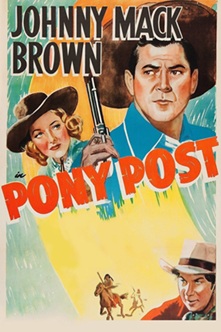
In the days of the Old West, Griff Atkins (Stanley Blystone) manages a Pony Express station but, because of his gambling debts, he actually encourages the Indians and the outlaw Richard brothers (John Rockwell and Ray Teal) to attack the Pony Express riders and steal their horses.  Major Goodwin (Tom Chatterton) tries to put a stop to all this by firing Griff and putting Cal Sheridan (Johnny Mack Brown) in charge.  Griff and the Richard brothers continue their outlaw ways and eventually, the head of one of the relay stations is killed in one of their raids.  While the dead man’s daughter, Norma (Nell O’Day), investigates the murder, Cal works to bring peace the line and falls in love with Goodwin’s daughter, Alice (Dorothy Short).  Meanwhile, aspiring Pony Express rider Shorty (Fuzzy Knight) tries to invent a trampoline system that will help him to mount a horse.

No matter how bad things get in the west, you can always count on Johnny Mack Brown to bring some order and to get it done in less than an hour.  Johnny Mack Brown was always a good hero and that’s the case here.  Eventually this film has all of the horse riding and tough fighting that fans of the genre expect from these westerns but, for a short movie (it only runs for 59 minutes), it still seems to take a while for it to really get going.  The first half of the movie is more about Fuzzy Knight singing songs and trying to become a rider than it is about anything else.  I usually enjoy Fuzzy’s antics but, like the B-western themselves, they are definitely an acquired taste for most viewers.

Everyman’s Law (1936, directed by Albert Ray)


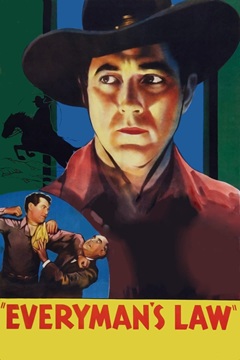
Corrupt Sheriff Chris Bradley (Homer Murphy) sends letters to three outlaws, asking them to come to his town and to work for him.  Sheriff Bradley wants to use them to kick some homesteaders off their land.  What Sheriff Bradly didn’t count on was one of the outlaws being an undercover Texas Ranger!  Johnny Mack Brown plays Johnny, a.k.a. The Dog Town Kid.

The Kid takes a liking to homesteader Marian Henley (Beth Marion) and her infant son.  When the Kid and the other two outlaws don’t move out the homesteaders to the sheriff’s liking, Bradley hires fearsome outlaw Lobo Joe (Roger Gray).

This is a pretty typical Poverty Row western.  After you see enough of these, you realize that every plot is going to be about a corrupt sheriff and a businessman teaming up to try to steal the land away from the settlers.  What makes these film work (or not) is the quality of the stars and Johnny Mack Brown was one of the best, someone who seemed authentic when he was riding a horse or shooting a gun but who was also a good enough actor to bring some life to the familiar plots.  As usual, with this film, Johnny Mack Brown is better than his material.

Everyman’s Law is best-known for the scenes of Brown and the other two outlaws having to babysit Marian’s baby.  The “comedic” scene where the baby puts the barrel of Johnny’s six-shooter in his mouth probably had the audience rolling in 1936 but today, it would undoubtedly get the film banned.

Branded A Coward (1935, directed by Sam Newfield)


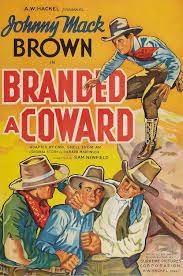
When Johnny Hume was just a young boy, he witnessed his entire family being killed by a group of bandits led by the mysterious Cat.  Johnny grows up to be a trick-shot artist but, despite his skill with a gun, he can’t stand to point it at anyone or to be near any sort of gunfights.  When a fight breaks out in a saloon, he hides behind a bar and is labeled a coward.

Still, Johnny and his sidekick (Syd Saylor) somehow find the strength to run off a bunch of stagecoach robbers and save passenger Ethel Carson (Billie Seward).  Johnny is offered a chance to become the new town marshal.  Johnny, despite his fear of gunfights, accepts after he hears that the Cat is back in business.  Johnny wants revenge but the Cat turns out to be not who he was expecting.

Branded A Coward may be a zero-budget Poverty Row western but it’s actually has an interesting story and a good (if not entirely unexpected) twist towards the end.  Johnny Mack Brown was one of the better actors amongst the cowboys who starred in the westerns put out by PRC and directed by Sam Newfield.  Brown does a good job portraying Johnny’s fear and also his determination to get justice for his family.  Johnny proves he’s no coward but at what cost?

The plot here is a little darker than most of the westerns that were coming out at this time.  Every Poverty Row western featured a comic relief sidekick but this might be the only to feature the sidekick getting killed.  In the role of Oscar, Syd Saylor leaned very heavily on his fake stuttering shtick, to the extent that it actually got offensive.  I wasn’t sorry to see his character go.  Johnny Mack Brown didn’t need any help to get justice.

Lawless Empire (1945, directed by Vernon Keays)


For years, outlaws have controlled the frontier town of Dusty Gulch but now their power is threatened by the homesteaders who are moving into the area.  Led by the crusading Rev. Tex Harding, the homesteaders are being progress and reform to the frontier.

Duke (Ethan Laidlaw) and his gang have launched a campaign of intimidation against the new arrivals.  Luckily, the Durango Kid (Charles Starrett) rides into town to protect the homesteaders.  Duke’s boss, businessman Blaze Howard (John Calvert), decides that the town needs a sheriff to go after the Kid.  Blaze offers the job to newcomer Steve Ranson, not realizing that Steve is not only the Durango Kid but also the brother of the former sheriff, who was murdered by Blaze’s men.

Lawless Empire is one of the few Durango Kid films not to feature Smiley Burnette as Durango’s sidekick.  Instead, Durango rides into town with Bob Wills and his Texas Playboys and, while Willis does perform a song or two, there’s still considerable less singing than in the films that featured Burnette.  The role of comic relief is provided by Dub Taylor in the role of Cannonball.  Cannonball gets a job sweeping up Blaze’s saloon and he feeds whatever information he learns back to Durango.  When Blaze figures out what’s going on, he deliberately supplies Cannonball with bad information but it doesn’t make any difference.  The Durango Kid is always one step ahead of the bad guys.

Lawless Empire is a little more serious than the other Durango Kid films.  Steve is not only trying to clean up the town but he’s also seeking to avenge his brother so there’s not as much room for as much comedy as usual.  Lawless Empire does have all of the usual gunfights and horse chases and the film gets off to an exciting start with Durango making his first appearance with his gun already drawn so that he can disarm Duke and his men.  Even without Smiley around to help him out, Durango brings law to a lawless empire.


The Fifth Annual Academy Awards: 1918


Over on Through the Shattered Lens Presents the Oscars, we are continuing to reimagine Oscar history, one year at a time! Today, we take a look at the year 1918. World War I ended, the Spanish Flu wiped out 5% of the world’s population, and the Academy embraced Tarzan of the Apes!

Lisa Marie Bowman's avatarThrough the Shattered Lens Presents The Oscars

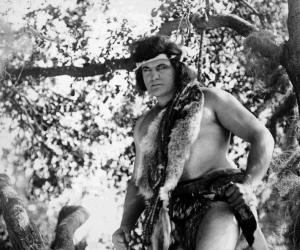
A scene from Tarzan of The Apes A scene from Tarzan of The Apes

1918 was a year of dominated by war and pestilence.  As the world seemed to be intent on destroying itself, both the Academy and American filmgoers embraced escapism.

Overseas, the Great War continued to drag on.  With no end to the fighting in sight, there were fears that the American public would turn against the war and their elected leaders would withdraw American soldiers from the fighting.  The British government, realizing the potential of film as a propaganda tool, contacted director D.W. Griffith and offered to help him make a film.  The end result was Hearts of the World, an epic war film that starred Lillian Gish as a French girl who struggles to survive and find true love as the Germans raid her village.

Though Gish would later say that Griffith was displeased with the pro-war tone of Hearts Of The World

View original post 1,357 more words