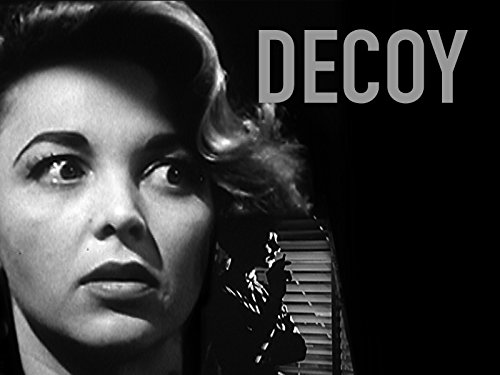
Welcome to Retro Television Reviews, a feature where we review some of our favorite and least favorite shows of the past! On Thursdays, I will be reviewing Decoy, which aired in Syndication in 1957 and 1958. The show can be viewed on Tubi!
Casey goes undercover at nightclub.
Episode 1.12 “Queen of Diamonds”
(Dir by Teddy Sills, originally aired on December 30th, 1957)
Casey is working undercover, pretending to be a photographer named Judy. She’s been working at a run-down nightclub for two months, trying to find evidence that the club’s owner, Frank (James Mitchell), was responsible for a payroll theft. Frank has an alibi but Casey is able to get her man when she convinces Frank’s second-in-command, Chi Chi (Al Lewis), to turn on him. Chi Chi is in love with Frank’s girlfriend, Georgia (Kay Medford).
This was not a bad episode. Casey got to wear a pretty dress and Beverly Garland got to show off her acting skills as she flirted with Frank and worked to turn Chi Chi against him. Interestingly enough, this episode ended on something of a melancholy note. Casey managed to send Frank to jail and Chi Chi and Georgia left for France together but the night club closed and blind pianist Alex (Richard Ward), the only truly decent person in this episode, ended up out of a job. In the end, Casey looked almost as if she was about to cry. It’s not easy, working undercover.
That Richard Burton is today best-remembered for his tumultuous marriages to Elizabeth Taylor and for his performances in several less-than-worthy films is unfortunate as Burton was also one of the most highly regarded staged actors of his generation. In fact, late in his life, Burton often expressed regret that he had ever left the stage for films to begin with.
In 1964, Burton played Hamlet on Broadway, in a production that was directed by John Gielgud. (Gielgud also provided the voice of the Ghost.) This is a video-recording of both that production and Burton’s acclaimed performance. Burton brings an intense and almost divine madness to the role. Watching, one can see why Burton would have preferred to have been remembered for this instead of for playing Mark Antony.
By most accounts, Che Guevara epitomized the excesses and the hypocrisies of the extreme Left. He spoke of the class struggle while remaining an elitist himself. He oversaw thousands of executions and advocated for authoritarian rule. In his writings, he frequently revealed himself to be a racist and a misogynist. By arguing that the Russians should be allowed to bring nuclear missiles to Cuba, he brought the world to the brink of destruction. However, he also died relatively young and he looked good on a t-shirt. Decades after he was executed by the Bolivian Army in 1967 (or was it the CIA?), he remains an icon for college students and champagne socialists everywhere.
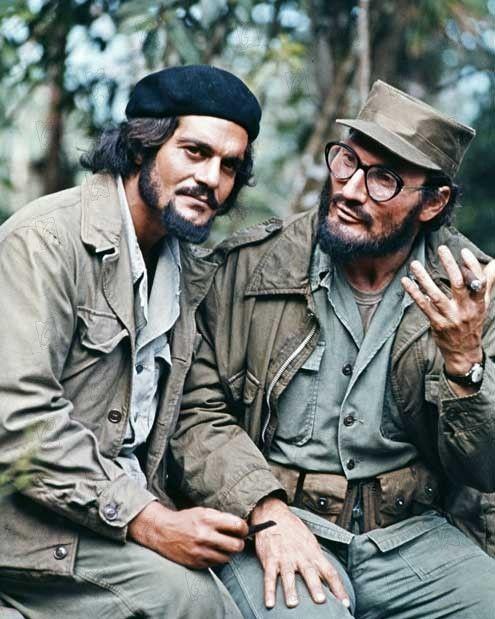
The film about Che! was released in 1969, two years after his death. Starring the Egyptian actor Omar Sharif as Che Guevara, Che! opens with Guevara already a martyr and then quickly gives way to flashbacks. Various actors pretending to be Cuban appear and speak directly to the audience, debating Che Guevara’s legacy. Some describe him as being a violent thug who killed anyone who displeased him. Others describe him as a visionary doctor who sacrificed his comfortable existence for the people. It’s a rather conventional opening and one that hints that Che! is going to try to have it both ways as far as Che’s legacy is concerned. But it’s still effective enough. A montage of soldiers and rebels creates the proper feeling of a society on the verge of collapse.
And then Jack Palance shows up.
Palance first appears creeping his way through the Cuban jungle with a group of soldiers behind him. Palance is chomping on a cigar and he wears the intense look of a man on a mission. My initial reaction was that Palance was playing one of the CIA agents who sent to Cuba to try to assassinate Fidel Castro or to set up the Bay of Pigs invasion. I kept waiting for him to look at the camera and launch into a monologue about why, for the safety of America, he had been dispatched the topple Cuba’s communist government. Imagine my shock when Omar Sharif called Palance, “Fidel.”
Yes, that’s right. Jack Palance plays Fidel Castro! As miscast as the suave Omar Sharif is as Che Guevara, nothing can prepare one for seeing Jack Palance playing Fidel Castro. Needless to say, there is nothing remotely Cuban or even Spanish about Jack Palance. He delivers his lines in his trademark terse Jack Palance voice, without even bothering to try any sort of accent. (And, needless to say, both he and Sharif speak English through the entire film.) Anyone who has ever seen a picture of a young Fidel Castro knows that, while he shared a family resemblance with Justin Trudeau, he looked nothing like Jack Palance. Eventually, Palance puts on a fake beard that makes him look even less like Castro. When one of our narrators mentions that Castro was a great speaker, the film cuts to a scene of Palance spitting out communist slogans with a noted lack of enthusiasm. When Castro takes control of Cuba, Palance looks slightly amused with himself. When Che accused Castro of selling out the revolution, Palance looks bored. It’s a remarkably bad piece of casting. Seeing Palance as Castro feels like seeing John Wayne as Genghis Khan. Thank goodness Hollywood never tried anything that silly, right? Anyway….
As for the rest of the film, it hits all the expected notes. The film was made in the very political year of 1969, a time when the New Left was ascendant and many considered Che Guevara to be a hero. However, since this was a studio production, Che! tries to appeal to both college radicals and their parents by taking a “both sides” approach to Che Guevara. Here’s Che teaching an illiterate farmer how to read. Here’s Che overseeing a bunch of dissidents being executed. Here’s Che getting angry at Castro for not being properly enthusiastic about housing Russian nuclear missiles. Here’s Che talking about a moral revolution. Here’s Che trying to start an unwanted war in Bolivia. Here’s Che talking to Sid Haig — hey, Sid Haig’s in this film!
Like so many mainstream political films of the 60s and today, Che! tries to be political without actually taking any firm positions. One is tempted to say that is the film’s downfall. Of course, the film’s real downfall is casting Jack Palance as Fidel Castro.
Most of us are a little bit scared of the elderly.
Oh, we try to deny it. We talk about how they’re “real characters” or we attempts to convince ourselves that their eccentricities are actually signs of an incurable zest of life. We tell ourselves that old people remind us of the value of carpe diem but, ultimately, they creep most of us out because, when we look at them, we see our own future. Regardless of what we do today or tomorrow, we’re all going to eventually become old. Perhaps that’s why there’s a whole industry devoted to keeping old people out of sight and out of mind.
Today’s entry in the Daily Grindhouse, the obscure 1974 film Homebodies, is effective precisely because it understands that unpleasant truth.
Directed by Larry Yust, Homebodies tells the story of Mattie (Paula Trueman). Mattie is one of seven elderly retirees who are the sole residents of a condemned apartment building. All around them, buildings are being torn down and replaced with new apartments. When an uncaring social worker (Linda Marsh) shows up and informs them that they’re going to be forcefully relocated to an assisted living facility, Mattie take matters into her own hands. She realizes that every time there’s an accident on a construction site, work stops for a few days. Hence, if there are enough accidents, work will be stopped indefinitely. Mattie and her fellow residents (some reluctantly and some not) are soon murdering anyone they view as a threat. While this is effective initially, things get complicated once Mattie starts to view some of her fellow residents with the same contempt that she previously reserved for construction workers.
Homebodies is one of those odd and dark films that could have only been made in the 70s. When the film begins, one would be excused for expecting to see a heart-warming comedy about a bunch of plucky seniors outsmarting the forces of progress and real estate. After all, the elderly residents of the condemned building are all appropriately quirky and, as played by Paula Trueman, Mattie doesn’t seem like she’d be out-of-place as one of the prankers on Betty White’s Off Their Rockers. Linda Marsh’s social worker and Kenneth Tobey’s construction foreman both seem like the type of authority figures who one would expect to see humiliated in a mawkish 1970s comedy film.
Instead, Homebodies turns out to be an effectively creepy and dark little film. When the elderly residents of the apartment building fight back, they do so with a surprising brutality that’s all the more effective because of the harmless exteriors of Mattie and her fellow residents. Paula Trueman makes Mattie into a truly fascinating and frightening monster. When a few of her fellow residents start to question Mattie’s methods, you truly do fear for them because Mattie has truly proven herself to be capable of just about anything. While Trueman dominates the film, the entire cast is excellent. As a classic film lover, I was happy to see that one of the residents was played by Ian Wolfe, a character actor who will be recognizable to anyone who has ever watched TCM.
(Remember the old man who gave the lecture at the observatory in Rebel Without A Cause? Him.)
I first saw Homebodies on YouTube and I was going to share it below but, apparently, the video has been pulled from the site. That’s a shame because it’s a film that definitely deserves to be seen, if for no other reason than to appreciate the performances from a cast of underrated character actors who, sadly, are no longer with us. Unfortunately, the best I can offer is this Spanish-language trailer for the film.

 Through the Shattered Lens