Favorite Son (1988, directed by Jeff Bleckner)


During a reception on the steps of U.S. Capitol, an assassin kills Contra leader Col. Martinez (Geno Silva) and seriously wounds Sen. Terry Fallon (Harry Hamlin), an up-and-coming politician from Texas.  An eager media catapults Fallon to national stardom and the beleagued President (James Whitmore), who is facing a tough reelection bid, is pressured to replace the current vice president (Mitchell Ryan) with Fallon.

The FBI only assigns two of their agents to investigate the assassination, a sure sign that someone wants the investigation to just go away.  Nick Mancuso (Robert Loggia) is a crusty, hard-drinking veteran agent whose career is nearly at an end.  David Ross (Lance Guest) is his young and idealistic partner.  When Mancuso and Ross discover that Martinez was injected with the HIV virus just two days before the assassination, it becomes obvious that there is a bigger conspiracy afoot.  It all links back to Sally Crain (Linda Kozlowski), who is Fallon’s legislative aide and also his lover.  (Fallon has a wife but she’s locked away in a hospital.)  Sally has an interest in bondage, as Ross soon finds out.

Favorite Son was originally aired as a 3-night, 4 and a half-hour miniseries.  It was later reedited and, with a running time of less than two hours, released theatrically overseas as Target: Favorite Son.  As a miniseries, Favorite Son is an exciting conspiracy-themed film that is full of scheming, plotting, interesting performances, and pungent dialogue.  Target: Favorite Son, on the other hand, is disjointed and, unless you know the original’s plot, almost impossible to follow.  If you’re going to watch Favorite Son, make sure you see the original miniseries.  My mom taped it off of NBC when it originally aired.  That was the only way that I was able to originally see the film the way that it meant to be seen.  The entire miniseries has also been uploaded, in three parts, to YouTube.

Hopefully, the original miniseries will get an official release someday because it’s pretty damn entertaining.  Harry Hamlin isn’t really dynamic enough for the role of Fallon but otherwise, the movie is perfectly cast.  Robert Loggia is so perfect for the role of Nick Mancuso that it almost seems as if the character was written for him.  (Loggia did later star in a one-season drama called Mancuso, FBI.)  Linda Kozlowski seems to be destined to be forever known as Crocodile Dundee’s wife but her performance as Sally shows that she was a better actress than she was given credit for.  The supporting cast also features good performances from Jason Alexander, Ronny Cox, Tony Goldwyn, John Mahoney, Kenneth McMillian, Richard Bradford, and Jon Cypher.

Favorite Son may be over 30 years old but it’s still relevant today.  In the third part, John Mahoney gives a speech about how American voters are often willfully ignorant when it comes to what’s going on behind the scenes in Washington and it’s a killer moment.  Melodramatic as Favorite Son may be, with its portrayal of political chicanery and an exploitative national media, it’s still got something to say that’s worth hearing.
 

Backstreet Justice (1994, directed by Chris McIntyre)


“These straight-to-video, schlocky films I was getting were giving me an ulcer, basically because I was the only one on the set that cared about anything… Between that and my biological clock, I decided to give it all away.”

— Linda Kozlowksi, on why she retired from acting

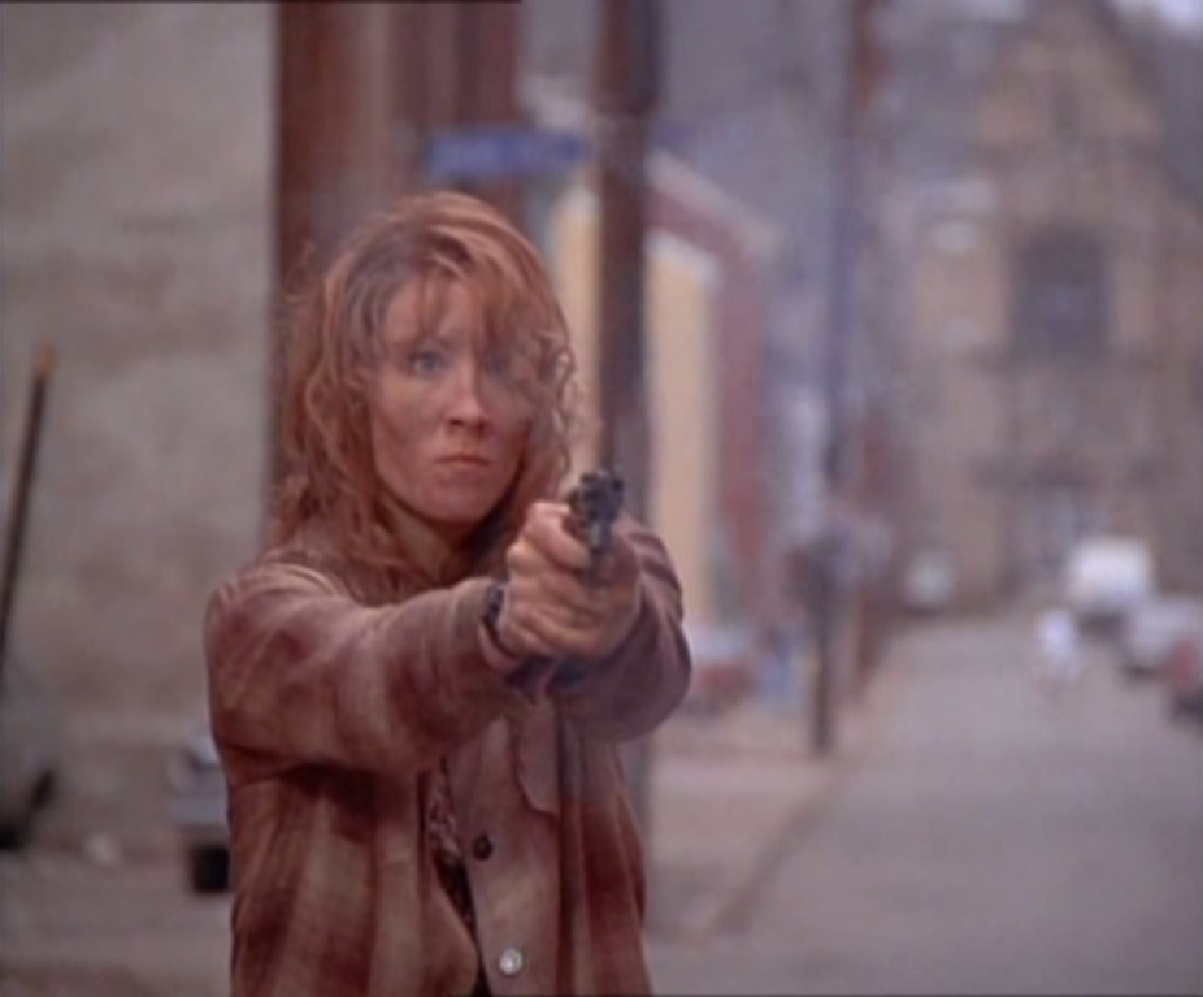
When Linda Kozlowski talked about the “shlocky films” that soured her on acting, Backstreet Justice was probably high on the list.  Kozlowski may have found fame co-starring with her then-husband Paul Hogan in the Crocodile Dundee films but, in Backstreet Justice, there’s neither an Australian nor a sense of humor to be found.

Kozlowski plays Keri Finnegan, a tough and streetwise private investigator in Philadelphia.  Her late father was a policeman who was accused of corruption while her mentor (Hector Elizondo) is the district attorney.  Most of the cops hate Keri, especially Captain Giarusso (Paul Sorvino).  The one exception is her lover, Nick Donovan (John Shea).

The residents of Philadelphia’s worst neighborhood have hired Keri to protect them.  For the past two years, a murderer has lurked among them.  With the police showing no interest in solving the crimes, the neighborhood turns to Keri.  Keri’s investigation leads her to believe that the murders are being carried out be corrupt cops but Keri isn’t prepared for just how far up the corruption goes.

For a straight-to-video film, Backstreet Justice has a surprisingly good cast, with Paul Sorvino, Hector Elizondo, John Shea, Tammy Grimes, and Viveca Lindfors all appearing in supporting roles.  Linda Kozlowski holds her own opposite her better-known co-stars and is believable in the film’s many action scenes.  The movie has a good sense of urban squalor and captures the desperation of people living in a dying neighborhood.  The main problem with the film is that the central mystery is never that interesting and the solution is one that most people will see coming from miles away.  For all the violence and scenes of people chasing each other, Backstreet Justice is still a boring movie.

With the exception of one surprisingly explicit sex scene, Backstreet Justice could easily pass for a made-for-TV film or a pilot for a Keri Finnegan television series.  Instead, it was just another straight-to-video thriller and another reason for the talented Linda Kozlowski to leave acting behind.  Her final film appearance was in 2001’s Crocodile Dundee in Los Angeles.

Horror Film Review: Village of the Damned (dir by John Carpenter)


At the risk of getting in trouble with at least a few people around the TSL offices, I am going to say something right now.  It may be controversial.  It may be shocking.  It may even make you question your belief in whatever it is that you believe in.

Ready?

Here we go:

I do not think that the 1995 version of Village of the Damned is that bad.

Now, please notice that I didn’t say that I thought it was that great, either.  However, when you listen to some people talk about this movie (which, admittedly, doesn’t seem to happen a lot), they make it sound as if Village of the Damned is one of the worst films ever made.  It is usually cited as being a waste of director John Carpenter’s abilities and Carpenter himself has said that he’s indifferent to the film.  Carpenter has gone as far as to call the film a “contractual assignment.”

Of course, one reason why people dislike the 1995 Village of the Damned is because it’s a remake of an acknowledged classic.  Even worse, it’s an unnecessary remake.  I would not disagree with that opinion.  The 1960 Village of the Damned holds up remarkably well, featuring George Sanders at his best and a lot of creepy little children.  (If anything, the fact that the original is in black-and-white makes the children look even creepier in the original.)  Having recently watched both versions of Village of the Damned, I can say that the remake doesn’t really improve on the original.

And yet, I would still argue that John Carpenter’s Village of the Damned is an underrated and crudely effective little movie.

The film tells the story of the town of Midwich, California.  (The original film took place in the UK and Midwich doesn’t really sound like the name of a town you’d find in California.  Incidentally, my favorite town in California is a place named Drytown, specifically because the town bar advertises itself as being “the only wet place in Drytown.”)  Midwich is a nice, little town.  Everyone is friendly.  Everyone knows everyone else.  Carpenter spends a while establishing Midwich as being the idealized coastal town.  But then, one day, the skies turn dark and everyone in Midwich loses consciousness.  Unfortunately, that doesn’t work out well for some people.  Frank McGowan (Michael Pare), for instance, is driving when the blackout occurs and he ends up dying when his truck goes off the road.  Another unfortunate fellow was manning the grill at the church picnic and, when he passed out, he ended up burning to death.

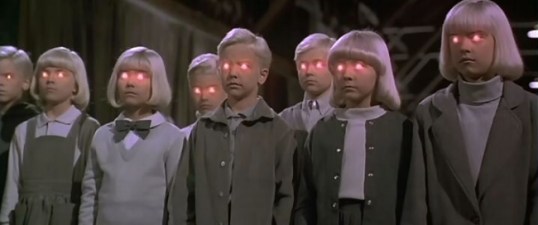
When everyone does wake up, it’s discovered that ten women are now pregnant.  One of them, Kate (Linda Kozlowski), is the widow of Frank.  Another, a teenage girl named Melanie (Meredith Salenger), is a virgin.  Nine months later, all of the babies are born on the same night, though Melanie’s is stillborn.  The 9 babies eventually become 9 very creepy children.  They have pale skin, white hair, glowing eyes, and no emotions.  Soon the government, led by Dr. Verner (Kristie Alley), invades the town so that they can investigate and experiment on the children.  You know that once the government shows up and takes over, everyone’s screwed.

And, while all of this is going on, the once friendly and vibrant town of Midwich becomes a far different place.  We watch as the citizens of the town die, one after another.  Melanie finds herself ostracized and abandoned.  The local reverend (Mark Hamill) goes insane and ends up perched on a hill with a rifle.  The town doctor (Christopher Reeve) loses his wife when she walks into the ocean.

And the children continue to coldly and unemotionally kill anyone who displeases them.  One man is forced to shoot himself.  In perhaps the film’s most disturbing scene, a scientist is forced to dissect herself.

Admittedly, some of the actors do a better than others.  Meredith Salenger gives the best performance while Mark Hamill definitely gives the worst.  At first, Kirstie Alley seems miscast but she actually gives one of the better performances in the film.  As the nominal hero, Christopher Reeve is boring but then again, many small town doctors are.  Of course, nearly everyone in the movie is dead by the time the end credits roll.

It’s a seriously dark movie and, when taken on its own terms, it’s definitely effective.  Carpenter does such a good job of establishing Midwich as a place where anyone would want to live that it does carry an impact to see the town suddenly isolate from the world and the once happy citizens resorting to suicide just to escape the town’s children.  In the end, John Carpenter’s Village of the Damned does capture the anguish of feeling as if there’s no escape from the present nor hope for the future.

Village of the Damned is crudely effective but effective nonetheless.