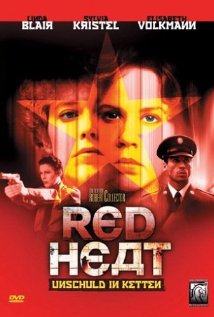
At the height of the cold war, college student Christine Carlson (Linda Blair, of course) travels to West Germany to marry her fiancée, Lt. Mike Grainger (William Ostrander). Mike has spent the last few years in West Berlin but, with his time in the army coming to an end, that means that he will be able to return to the United States with Christine. The only problem is that Mike doesn’t want to do that. Instead, Mike has decided to spend a few more years in the army and to put the marriage off for a while.
Christine is so upset that she goes for a walk to clear her head. Unfortunately, while walking around West Berlin, she witnesses a defector being abducted by the Stasi. For unclear reasons, the Stasi decided to kidnap Christine as well. Soon, Christine is in East Berlin, where she’s forced to falsely confess to being a CIA agent. Christine is sentenced to three years in prison and finally, after 20 minutes of build-up, Red Heat settles into being a typical Women In Prison film.
All of the usual WIP tropes are present. Sylvia Kristel plays Sofia, the lesbian gang leader who immediately targets Christine. The political prisoners (like Christine) are preyed upon by the common criminals, some of whom work with crooked guards to maintain order in the prison. There’s the usual collection of fights, shower scenes, and suicides, all mixed with scenes of Mike trying to get a group together to sneak across the border and rescue his fiancée. The only thing that really distinguished Red Heat from every other WIP film ever made is that it takes place in a communist-controlled prison so, in between fighting off Sofia and her crew, Christine has to watch propaganda films.
Linda Blair appeared in a lot of films like this and, by the time she made Red Heat, she was clearly getting bored with the genre. Both Blair and Kristel go through the motions and supply the obligatory nudity but neither one of them really seems to be that into the movie, with Sylvia Kristel especially appearing to be bored. Both Blair and Kristel were better in other films and, despite the uniqueness of the cold war angle, Red Heat is never as strange or as memorable as Blair’s best WIP film, Chained Heat. Red Heat is ultimately for Blair and Kristel completists only.
(In a perfect world, Red Heat would have been made in the 70s with Pam Grier in Blair’s role, Glynn Turman as Mike, Barbara Steele as Sofia, and Sid Haig as one of the guards. Now that would have been something to see!)
Today is not only Jim Jarmusch’s birthday. It’s also Linda Blair’s!
Now, of course, the first film that probably comes to mind when you hear the name “Linda Blair” is The Exorcist and that makes sense. After all, it’s probably the best film in which Blair ever appeared. Blair even received an Oscar nomination for playing the demonically possessed Regan MacNeil and for convincingly vomiting all over Jason Miller and Max von Sydow. If not for the fact that Mercedes McCambridge provided the voice of the demon, Blair probably would have won that Oscar as well. Instead, the Oscar went to Tatum O’Neal.
Blair’s gone on to have an active career, though none of her subsequent films ever proven to be as popular with critics or audiences as The Exorcist. In fact, the majority of her films have been received rather dismissively by the critics. Of course, Blair’s subsequent films haven’t exactly been in the type of genres that are usually embraced by the critics. Instead, Linda Blair appeared in several women-in-prison films. She also appeared in several vigilante films, including Savage Streets. She did several low-budget horror movies, like the classic Hell Night. Blair also appeared in two bad-but-kind-of-fun sequels, Airport 1975 and Exorcist II: The Heretic.(Airport 1975 features Linda Blair as the most perky seriously ill person ever. Exorcist II, of course, featured Blair trying to keep a street face.)
And here’s the thing — the movies may have occasionally been bad but Linda Blair always kicked ass. In fact, she often literally did just that. At her best, Blair was the type of exploitation heroine who would kick the bad guy in the balls and then taunt him for crying about it afterwards. And good for her!
Now admittedly, today’s scene of the day does not feature Linda Blair kicking anyone or exacting violent revenge on the patriarchy. But no matter. The 1979 film Roller Boogie is a lot of fun, precisely because it’s a mix of disco, roller skating, and the mob. Linda Blair and Jim Bray have to protect their favorite skating rink from the mafia. They also have to win the annual Boogie contest. Needless to say, that’s a lot to deal with but if anyone can handle it, it’s Linda Blair.
“It’s love on wheels!” the posters proclaimed, presumably because Skatetown U.S.A. was already using, “It’s the greatest story that ever rolled.” Roller Boogie is a thoroughly silly movie and, not surprisingly, it’s also a very 70s movie. Every single moment of the film screams out, “1979!” You know how Saturday Night Feverused the disco scene as the backdrop for a rather melancholy story about a young person struggling to grow up and become a better person? Well, Roller Boogie‘s not like that at all but it does feature a lot of disco and a lot of skating and how can you go wrong with that?
Anyway, here is today’s scene that I love. Here are Linda Blair and Jim Bray competing for the top prize in Roller Boogie!
I don’t know her name. It was a brief relationship I had when I was making stained glass for a while. I was going to a stained glass class in Pasadena, and I met this guy and his girlfriend. I was completely turned on to his girlfriend, but she was just not interested. So I had a lot of sexual angst, and I went home and wrote a song about it. Then about four months later I stopped going to the class and lost contact with them. The only thing I remember is his name was Gary, so I changed the name, because ‘Gary’ didn’t sing very well. But the whole thing is absolutely what I was feeling. He was getting it and I wasn’t, and it was really tearing me up. And sexual angst is an amazing motivator to write a song. Actually, Oprah’s people tried to find her, and they got as far back as finding the stained glass guy. I couldn’t remember his name, but I said it was late ’70s; they found him, and he had died two years earlier, and they’d thrown all his papers out a year after that. So we missed finding out who she was by a year.
As the old saying goes, “When not even Oprah can find you…”
Today, this song is probably best remembered for its prominent use in Boogie Nights and for one frequently misheard lyric. Many people still continue to believe that Springfield sings, “I wish I was Jessie’s girl,” instead of “I wish I had Jessie’s girl.”
This simple video was directed by Rick Springfield himself. The song was Springfield’s second top 20 hit, the first being the now-forgotten Speak To The Sky. At the time that this song and video came out, Springfield was better known for appearing on General Hospital. Though he had started out as a singer, when Springfield’s musical career temporarily stalled, he followed the advice of his then-girlfriend, Linda Blair (yes, that Linda Blair), and pursued an acting career.
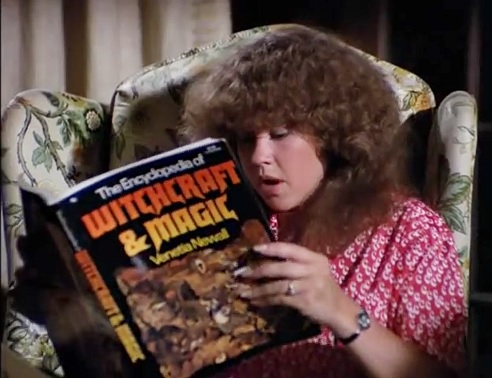
Like many Italian horror films, Witchery is a film that is known by many names.
When it was originally released in Italy, it was called La Casa 4 and it was sold as being a sequel to Sam Raimi’s Evil Dead films. (In Italy, Evil Dead was called La Casa.) In countries where Umberto Lenzi’s Ghosthouse was a hit, this film was entitled Ghosthouse 2. (Adding to the confusion, Ghosthouse was called La Casa 3 in Italy, even though it had nothing to do with the Evil Dead films.) In countries where neither Ghosthouse nor La Casa were hits, this film was sometimes called Witchcraft and sometimes called Witchery. For the purposes of this review, I’m going with Witchery, just because Witchcraft is kind of a bland title.
Anyway, the main lesson to be learned from Witchery is that David Hasselhoff will never be anyone other than David Hasselhoff. In this film, he plays a character named Gary but, from the minute you see him and he starts talking, it’s impossible to think of him as being anyone other than David Hasselhoff. You spend the film thinking, “Uh-oh, David Hasselhoff’s getting sexually frustrated. Uh-oh, that witch is coming for David Hasselhoff. Did they just throw David Hasselhoff through a window?”
David Hasselhoff and his friend Leslie (Leslie Cumming) are in Massachusetts, staying at an abandoned hotel. It’s rumored that, living nearby, there’s a reculsive actress, known as the Woman in Black (Hildegard Knef), who decades ago made some sort of deal with the devil or a witch or something like that and the hotel is now some sort of portal to Hell. Leslie is determined to discover whether the rumors are true but all David Hasselhoff cares about is the fact that Leslie is still a virgin. “It’s not normal,” he tells her, with a look in his eye that suggests that he’s willing to help her out. Somehow, Leslie manages to resist Hasselhoff.
Before Hasselhoff can continue to make his case, both he and Leslie have to hide in the hotel because a group of people show up. It turns out that the Brooks family is interested in buying the hotel so that they can renovate it and hopefully make some money! Now, they’ve arrived and they’re looking to inspect the property. There’s Jane (Linda Blair), who is pregnant. There’s Jane’s obnoxious stepmother, Rose (Annie Ross), who won’t stop complaining. There’s two real estate agents, Linda (Catherine Hickland) and Jerry (Rick Farnsworth). And then there’s a little kid who has a Sesame Street cassette player with him. Have you ever wanted to hear a demonic chant come out of a bulky box decorated with Big Bird and Oscar the Grouch? Well, this is the film for you!
Anyway, the Brooks family ends up getting stranded at the hotel for a night, which gives the Woman In Black several chances to pop up and send people to Hell. It turns out that the hotel is crawling with all sorts of demonic creatures and not even David Hasselhoff can scare them off. One person gets their lips sewn together and is hung in a fireplace. Someone else gets crucified upside down. Someone else gets impaled on a marlin. Because she’s played by Linda Blair, Jane gets possessed….
It’s a real mess of a film and not one that ever makes much sense. You keep wondering just what exactly the Woman In Black is hoping to accomplish but then you realize that the film itself has no idea so you stop worrying about it. Witchery may not be a good film but it’s such a strange film that it’s a little bit hard to resist. I mean, how many other films combine demonic chants with Big Bird? How many other films feature David Hasselhoff playing himself and getting into a fight with Linda Blair? Watching the film, you get the feeling that everyone involved just kinda made it up as they went along.
I’m not exactly recommending Witchery but it is one of those films that’s weird enough to justify viewing it at least once.
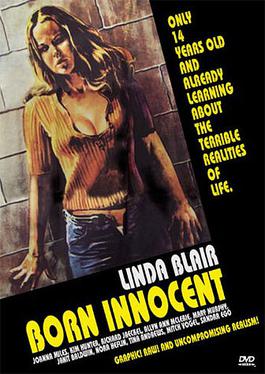
Fatal Bond is another Australian exploitation flick starring Linda Blair.
In this one, Linda plays a hairdresser named Leonie. When a drifter named Joe (Jerome Ehlers) crashes a birthday party that Leonie’s attending, it’s lust at first sight. Even though Joe is a violent womanizer who steals milk and headbutts anyone who looks at him crossly, Leonie still takes him home with her. Soon, Joe is crashing in Leonie’s bedroom and Leonie is providing Joe with an alibi whenever the police come looking for him. (Joe says that he has a lot of parking tickets.) When one of Joe’s one night stands turns up dead, Leonie starts to suspect that Joe might be responsible.
Like Dead Sleep, Fatal Bond features Linda Blair as an American who lives in Australia and who has bad taste in men. While Linda Blair has never been a great actress, she’s almost always brings grit, determination, and a will to survive to her roles. Unfortunately, none of that is on display in Fatal Bond, where she’s such a pushover that she lets Joe take over her life. There’s not really much to the whole serial killer storyline either, especially not when the murderer’s identity will be obvious to anyone watching. There’s also another subplot in the movie about Joe searching for his brother, who has gone missing. Fatal Bond doesn’t know if it’s a Linda Blair thriller or a standard Australian crime film.
Don’t be fooled by the sexy cover art. I love a good Linda Blair movie but Fatal Bond was just boring. If you do see the film, keep an eye out for Joe Bugner, the former heavyweight boxer who once fought Muhammad Ali. Bugner has a small role as a lowlife criminal in Fatal Bond. His partner-in-crime is Mel’s younger brother, Donal Gibson, stepping into a role that was originally earmarked for Russell Crowe.
Yuppie lawyer Ted (adult film actor Randy Spears, credited here as Gregory Patrick) is shocked when he sees a painting of a man who looks just like him. He is told that the portrait was painted in 1964 and that the man in the painting is the late husband of the artist, Arlene (porn legend Georgina Spelvin, credited here at Ruth Raymond). Arlene goes on to reveal that Ted is actually her long-lost son and then she invites him and his wife, Evie (Linda Blair, credited here as Linda Blair), to come out to her mansion. What Ted doesn’t realize is that Arlene believes that he is actually her husband reincarnated and she is planning on doing away with Evie so that she can have her son all to herself and do what it is she wants to do with him. Yes, this film goes there.
Chuck Vincent was one of the leading directors of the Golden Age of Porn. Unlike most other adult film directors, his movies were popular with not only the public but also with critics. (His best-known film, Roommates, received a rave in the New York Times.) In the 80s, Vincent tried to make the move into mainstream film, mostly directing sex comedies and dopey thrillers. Most of his mainstream films featured adult performers in dramatic roles, which made them very popular on late night cable.
Bad Blood feels like a combination of Fatal Attraction and Misery. There’s even a scene where Arlene ties up her son in bed and then breaks his toes to keep him from leaving. (Bad Blood, though, came out a year before Rob Reiner’s film so the resemblance is probably a coincidence.) Spelvin, who was widely regarded as being the best actress to ever regularly appear in pornographic movies, gives a great, demented performance as Arlene and Linda Blair is also good as Evie. Chuck Vincent was a good director, even when he was doing schlocky straight-to-video stuff like this. Perhaps because of his background in adult films, Vincent never hesitated about taking his films to the places where other directors would be scared to tread. Sadly, Vincent died in 1991 and most of his movies have fallen into obscurity.
Maggie Healey (Linda Blair) is an American nurse in Australia. Freshly separated from her drug addict boyfriend, Maggie gets a job working at a mental hospital. Dr. Jonathan Heckett (Tony Bonner) is experimenting with “dead sleep therapy,” where the patients are kept drugged at night. Maggie notices that the patients keep dying and that Dr. Heckett doesn’t care so she teams up with an annoying activist to investigate what dead sleep therapy is actually about.
This was on TCM at 3 a.m. last night, airing right after Dreamscape. Dead Sleep might be disguised as a horror film but there’s nothing scary about it. When the patients are in dead sleep, they don’t even have nightmares, which is a huge missed opportunity. The movie is so sloppily put together that it doesn’t even reveal why Dr. Heckett is putting his patients in dead sleep, other than he’s just evil. Linda Blair delivers her lines as if she is reading them off a cue card and the entire movie look like it was filmed at a community college. The only amusing thing about the movie was that all of the male patients got to wear hospital gowns when they went under deep sleep while all the female patients slept topless. Normally I wouldn’t complain but it was so blatant what the filmmakers were doing that it was hard not to laugh when the movie tried to pivot to being a serious drama. A film starring Linda Blair has no right to be this boring.
It’s pledge initiation night at Generic University! Four students are hoping to join the Alpha Sigma Rho fraternity and its sister sorority. Denise (Suki Goodwin) is English and never goes anywhere without a supply of quaaludes and a flask of Jack Daniels. Seth (Vincent Van Patten) is the blonde jock, who wants to spend the entire night hooking up with Denise, despite the fact that Denise keeps calling him, “Wes.” Jeff (Peter Barton) is the sensitive rich kid who fears that the only reason he’s getting into the fraternity is because of his family’s money. And Marti (Linda Blair) is the girl from a poor family who works on cars during her spare time. In order to pass the initiation, they have to spend the night in deserted Garth Manor.
However, they won’t be alone in Garth Manor. The president of the fraternity, Peter (Kevin Brophy), is planning on spending the entire night playing pranks on them. Helping him will be his girlfriend, May West (Jenny Nuemann) and his nerdy best friend, Scott (Jimmy Sturtevant). Unfortunately, what Peter did not realize was that the four pledges are all smart enough to know that he’s going to be trying to scare them. As a result, they just ignore his best efforts to make things creepy.
Of course, what none of them know is that the legend of Garth Mansion is actually true. As Peter explains at the beginning of the film, it has long been rumored that Mr. Garth murdered his entire family, except for his horribly deformed son Andrew. They say that Andrew still lives in the mansion, waiting for a chance to attack and kill all trespassers…
And that’s pretty much exactly what happens!
But you know what? For a relatively straight forward slasher film from 1981, Hell Night is not a bad film at all. In fact, with its relative lack of gore, nudity, and painfully stupid victims, it can probably be argued that Hell Night is a slasher film for people who don’t like slashers. Hell Night emphasizes atmosphere over easy shocks and actually devotes some time to characterization. Even if the majority of the characters are familiar horror film types, you still care about them. Even poor Denise, who has the thankless role of being the sexually independent girl who you know is doomed from the minute she first appears on screen, gets a few good lines.
(Plus, the film opens with a costume party so, of course, all of the outfits are to die for!)
One of the things that really made Hell Night effective is that the characters are not idiots. They don’t just stand around waiting to be picked off. At first, they just assume that any and all strangeness is a result of Peter trying to scare them. When it becomes obvious that Andrew Garth is alive, one of them manages to escape the manor and goes straight to the cops. And how do the cops react? They tell him that they’re tired of dealing with drunk frat boys and order him to go home, adding to the hopelessness of the situation.
(But, honestly, if some random guy told you that a deformed monster was trying to kill him, would you believe him?)
Hell Night is full of scary atmosphere, clever lines, and good acting. As far as early 80s slasher movies go, it’s one of better examples of the genre.
The Exorcist is one of the greatest horror films of all time and a personal favorite of mine. But what about Exorcist II: The Heretic? Well, it would be a bit of an understatement to say that The Heretic has not quite received the amount of critical acclaim as the first film. Since it was first released in 1977, The Heretic has been widely considered to be one of the worst sequels of all time. It’s a film that is often cited as evidence as to why not all successful films need a follow-up.
Myself, I have sat through The Heretic twice. And yes, it is a pretty bad film but I have to admit that I enjoyed it each time that I saw it. It’s not a scary film at all. It’s not a successful horror film. But, as an unintentional comedy, it’s hilarious.
The Heretic opens four years after the end of The Exorcist. Father Merrin (Max von Sydow) is dead, having had a heart attack during the first film while performing an exorcism on Regan MacNeil (Linda Blair). In the years since, some in the Vatican have cast doubt on whether or not Merrin actually performed exorcisms. It turns out that, contrary to everything that we saw in the first film, Father Merrin was actually something of a rebel. His teachings are controversial. For instance, he was convinced that everyone has latent psychic powers and that the demon Pazuzu possesses those who have the potential to be the strongest psychics. Why? Because those people have the ability to lead humanity into a shared global consciousness and…
Well, it gets a little bit complicated. That’s one of the big differences between The Exorcist and Heretic. The Exorcist kept things relatively simple. The Heretic drags in a lot of metaphysical argle bargle.
The deceased Father Merrin has been brought up on charges of heresy. The Cardinal (Paul Henreid, many, many years after Casablanca), assigns Father Lamont (Richard Burton) to investigate the circumstances surrounding Father Merrin’s final exorcism.
The presence of Richard Burton is what elevates Heretic from merely being bad to being so bad that it’s good. As written, Father Lamont is supposed to be something of a naive idealist, someone who never met Father Merrin but who has been intrigued by his writings. Reportedly, several youthful actors turned down the role and eventually, production decided to make Lamont an older man and they ended up casting Richard Burton. Speaking in a shaky rasp and staring at the camera with bloodshot eyes, Burton appears to be at the height of his famous self-loathing in this film. Burton is so miscast as an idealistic priest that the film becomes fascinating to watch. Occasionally, the film tries to make us suspect that Lamont himself may be possessed but with Burton snarling his way through the role, how could anyone tell the difference?
Lamont tracks Regan down in New York. Regan doesn’t remember a thing about the exorcism and appears to be an overly happy teenage actress. (A good deal of the movie is devoted to her rehearsing a big dance number.) She is under the care of psychiatrist Gene Tuskin (Louise Fletcher). Tuskin has a device called the Synchronizer. When two people are hooked up to it, they can literally see into each other’s minds. They can share the same memories. They can … wait a minute. What the Hell? The Synchronizer essentially appears to be little more than a blinking light but it can actually allow you to enter into someone else’s mind? Doesn’t that seem like that should be a big deal?
Well, it’s not. Everyone pretty much just shrugs and accepts it…
Through the use of the Synchronizer, Reagan, Lamont, and Tuskin get to watch a lot of scenes from the first Exoricst. It also allows Father Lamont to have visions of Africa and another exorcism, this one involving a young boy named Kokumo.
This leads to one of my favorite parts of the film; Richard Burton wandering around a dusty African market and randomly telling people, “I am looking for Kokumo.” It turns out that Kukomo has grown up to be a doctor and he’s now played by James Earl Jones, who appears to be amused by his dialogue. Also showing up in the film’s Africa scenes is Ned Beatty. Beatty plays a pilot who flies Lamont to Kokumo’s village. “Have you come here before?” Beatty asks. “Once … on the wings of a demon,” Lamont replies.
Well, okay then…
The first Exorcist worked largely because William Friedkin directed it as if he was making a documentary. John Boorman takes the exact opposite approach here, trying to turn a cheap sequel into a metaphysical meditation on good, evil, and nature. It’s amazingly pretentious and it would actually be rather annoying if not for the fact that Burton doesn’t make the slightest bit of effort to come across as being in any way emotionally or intellectually invested in his over-the-top dialogue. When you combine Burton’s overwhelming cynicism with Linda Blair’s nearly insane perkiness, Louise Fletcher’s genial confusion, and James Earl Jones’s cheerful humor, the end result is something that simply has to be seen to be believed.
So, yes, The Heretic is as bad as you’ve heard. But that doesn’t mean you shouldn’t watch it.
Today’s horror on the lens is a 1978 made-for-TV movie that was directed by Wes Craven. Originally entitled Stranger In Our House, it was retitled Summer of Fear when it was released into theaters in Europe. Personally, I think Summer of Fear is a better title. It has a fun R.L. Stine feel to it.
As for the film itself, it tells the story of what happens when the recently orphaned Julia (Lee Purcell) moves in with her cousins in California. At first, Julia fits right in with her new family but, slowly and surely, her cousin Rachel (Linda Blair) comes to suspect that Julia might be a witch. And hey, who can’t relate to that? Seriously, everyone has that one cousin…
And, it’s actually pretty good. Working within the confines of what could and could not be shown on TV in the late 70s, Craven managed to make an effective little thriller.