Made-For-TV Horror: Good Against Evil (dir by Paul Wendkos)


The 1977 made-for-TV movie Good Against Evil opens with a woman giving birth in a hospital.  Her baby daughter is forcefully taken from her and given to her father, the sinister Mr. Rimmin (Richard Lynch).

Two decades later, Jessica Gordon (Elyssa Davalos) has grown up and is working at a boutique in San Francisco.  When her car is rear-ended by a free-spirited, van-driven single guy named Andy Stuart (Dack Rambo), it’s love at first sight.  Jessica and Andy are so caught up in their whirlwind romance that they don’t even notice that there’s a schlubby guy following them everywhere that they go and that strangers are giving them dirty looks.  Someone does not want Jessica and Andy to end up together.

How could anyone object to two young people falling in love, you may ask.  Well, it turns out that Jessica is meant to be a bride of Satan and the plan is for her to eventually give birth to the Antichrist.  Everyone in Jessica’s life works for Mr. Rimmin …. or, at least, everyone but Andy.  Andy suddenly showing up and falling in love with Jessica throws a big old monkey wrench into Rimmin’s carefully crafted scheme.  Mr. Rimmin reacts by sending an army of adorable cats to harass Andy.

This might sound like it has the makings for a good made-for-TV horror film and, in fairness to Good Against Evil, the first 50 minutes or so are pretty well-done.  The movie does a good job of building up and maintaining an atmosphere of paranoia and I enjoyed watching all of the people attempting to discreetly keep an eye on Andy and Jessica whenever they went out.  When Mr. Rimmin finally abducted Jessica and took her back to his mansion, I was prepared to see Andy risk his life to rescue her….

That didn’t happen, though.  Instead, Andy got involved with the case of a little girl who was possessed.  (Again, in all fairness, he got involved because he read a news story about the girl drawing a pentagram while in a coma and he assumed that meant she was a victim of the same cult that abducted Jessica.)  Andy meets the girl’s mother (played by Kim Cattrall) and then helps an exorcist (Dan O’Herlihy) perform an exorcism.  The movie ends with Jessica, still in the clutches of Mr. Rimmin.

Good Against Evil was apparently a pilot for a television series that wasn’t picked up.  I assume the plan was that Andy would have a weekly supernatural adventure while trying to recuse Jessica from Mr. Rimmin.  The idea had some potential.  As always, Richard Lynch is a wonderfully sinister villain.  But the pilot shoots itself in the foot by getting distracted with the whole exorcism storyline.  It’s wonderful to see the great Dan O’Herlihy as a priest but the exorcism storyline really does come out of nowhere and the exorcism scene itself so blatantly copies The Exorcist that they really should have given William Peter Blatty an onscreen credit.  Sadly, because this was a pilot, the movie ends with the main storyline unresolved.  The joke is on us for caring about two people in love.

Good Against Evil is one of those films that can be found in a dozen Mill Creek box sets.  Ultimately, it’s as forgettable as its generic name.
Retro Television Review: St. Elsewhere 2.7 “Entrapment”


Welcome to Retro Television Reviews, a feature where we review some of our favorite and least favorite shows of the past! On Fridays, I will be reviewing St. Elsewhere, a medical show which ran on NBC from 1982 to 1988.  The show can be found on Hulu and, for purchase, on Prime!

This week, Peter’s in trouble …. again!

Episode 2.7 “Entrapment”

(Dir by Mark Tinker, originally aired on December 7th, 1983)

Oh, that Peter White!  Always in trouble for something!

This week, a woman comes into the Emergency Room with her baby and begs for some Seconal, just to help her get some sleep.  Peter says that Seconal might be too powerful a drug but he’s moved by the woman’s pleas.  Finally, he gives her the drugs.  The next morning, Dr. Craig and Dr. Westphall get a call.  The woman was an undercover cop and now, Dr. White — a recovering drug addict himself — is under investigation.

Both Dr. Craig and Dr. Auschlander think that the solution is to just kick Peter out of the hospital.  Westphall disagrees, saying that Peter has come a long way since he completed rehab.  Westphall promises Peter that he and Auschlander will support him when his hearing comes up.

As for Dr. Craig, he finally found out that his secret admirer was Kathy Martin.  This led to Ellen Craig (played by Bonnie Bartlett, William Daniels’s real-life wife) heading down to the morgue and politely telling Kathy to stay away from her man before then mentioning that, if politeness hadn’t worked, she was prepared to beat Kathy up.  I love Ellen.  She’s one of the best characters on the show.

Meanwhile, Irish kid Eddie Carson (Eric Stoltz), who was admitted to the hospital last week, is upset because he’s going to have a big ugly scar on his face.  He’ll probably be even more upset when he discovers that a rival Irish teenager (a protestant, naturally) planted a bomb in his family’s restaurant and blew up his parents.

This was an okay episode.  The highlight was definitely Ellen confronting Kathy Martin.  As for the other storylines, Eddie Carson’s story felt a bit contrived while Peter White’s story was just getting started.  I assume the hearing will be next week.  It’s interesting to see Peter as the victim for once.  Usually, it’s his own stupidity that screws things up for him.  This week, he really was unfairly targeted.

We’ll see what happens next week.

Late Night Retro Television Review: Highway to Heaven 2.23 “Children’s Children”


Welcome to Late Night Retro Television Reviews, a feature where we review some of our favorite and least favorite shows of the past!  On Thursdays, I will be reviewing Highway to Heaven, which aired on NBC from 1984 to 1989.  The entire show is currently streaming on Freevee and several other services!

This week, Jonathan and Mark find themselves in a Douglas Sirk-style melodrama.

Episode 2.23 “Children’s Children”

(Dir by Victor French, originally aired on April 30th, 1986)

When I watched this episode, I saw that the script was credited to David Thoreau and I immediately assumed that it had to be a pseudonym for the actual writer.  Fortunately, for once, I actually did some research and I discovered that the writer’s name actually was David Thoreau.  He wrote a few scripts that were produced in the 80s and 90s and, in fact, this was the first of seven scripts that he wrote for Highway to Heaven.  He’s also credited as writing the screenplay for the classic beach volleyball film, Side Out.

As for this episode, it finds Mark and Jonathan working at a home for unwed mothers.  Just the term “home for unwed mothers” brings to mind the 50s melodramas of Douglas Sirk and I found myself thinking about just how old-fashioned Highway to Heaven must have seemed even in the 80s.  I did a google search and I discovered that homes from unwed mothers do still exist, though they’re now called “maternity homes.”

The manager of the home for unwed mothers is Joyce Blair (Bibi Besch), who finds herself being hounded by a reporter named Dan Rivers (Robert Lipton).  Dan is determined to take Joyce down and, to do so, he brings up a past incident in which Joyce was arrested.  Dan twists the facts to make Joyce look like a criminal and soon, Joyce finds that she might not be able to keep the home open.  Why is Dan doing this?  Like most reporters on Highway to Heaven, he’s just plain evil.  But when one of the girls at the home suggests that Dan might be the father of her child, Dan learns what it’s like to be falsely accused.

Meanwhile, evil businessman Jack Brent (James T. Callahan) hopes for a chance to foreclose on the home so that he can bulldoze it and replace it with condominiums.  (Bad guys in the 80s always wanted to build condos.)  But how will he react when he discovers that his teenage son (Scott Coffey) is going to be a father and that the girl he impregnated in currently living at the home?

This episode is the type of episode that most people think of when they dismiss Highway to Heaven as just being an old-fashioned and slightly preachy melodrama.  There’s not a single subtle moment or particularly nuanced moment to be found in this particular episode.  It’s note quite as heavy-handed as that episode where Mark begged the President to talk to the Russians and reduce amount of nuclear missiles but it’s close.

Horror Film Review: Tormented (dir by Bert I. Gordon)


“Tom Stewart killed me!” shouts the spirit of Vi Mason (Juli Reding).

Technically, it’s debatable whether or not Tom Stewart (Richard Carlson) actually killed Vi.  As is seen during the opening moments of 1960’s Tormented, Vi actually slipped and was clinging onto the lighthouse’s balcony for dear life before she fell to her death on the rocks below.  Tom didn’t push her and he didn’t force her to fall.  However, Tom did refuse to pull her up.  After she fell, he ran into the ocean and thought he had dragged back to safety.  But then it turned out that he was just dragging around a bunch of seaweed.

To a certain extent, Tom is glad to be done with Vi.  Vi was his ex-girlfriend and she was determined to keep Tom from marrying the rich and innocent, Meg (Lugene Sanders).  Meg’s father (Harry Fleer) already hates Tom because he’s not only a pianist but he’s also a jazz pianist!  Still, Meg loves Tom and, in a somewhat disturbing way, Meg’s little sister, Sandy (Susan Gordon), seems to be kind of obsessed with Tom as well.  “Why can’t I get married!?” Sandy demands.  BECAUSE YOU’RE LIKE TEN, YOU LITTLE BRAT!

Still, it’s not helping Tom that he keeps hearing Vi’s voice and seeing her ghost.  Everyone in the village think that Tom is acting strangely but they dismiss it as pre-wedding jitters.  (And, of course, his future father-in-law just assumes that Tom is being weird because he’s one of those jazz pianists.)   If it wasn’t bad enough that Tom is having to deal with Vi’s ghost, he’s also got a hepcat blackmailer named Nick (Joe Turkel).  Nick was hired to take Vi out to the island where Tom lives.  When Vi doesn’t return to pay him, Nick goes to Tom for the money.  When Nick overhears that Tom is about to marry a rich woman, Nick decides that he needs even more money.

Joe Turkel was one of the great character actors.  A favorite of Stanley Kubrick’s, he appeared in Paths of Glory and later played Lloyd the Bartender in The Shining,  Turkel also played Eldon Tyrrell in Blade Runner, in which he made the mistake of talking down to Rutger Hauer’s Roy.  In the role of Nick, Tukel is the best thing to be found in Tormented.  Turkel delivers all of his dialogue with a wonderfully insolent attitude.  He’s the type of character who, in the style of Robert Mitchum in Cape Fear, refers to everyone he meets as “Dad.”  He’s a lowlife and criminal but he’s got the spirit of Kerouac and Cassady in him and it doesn’t take him long to see straight through Tom.

Tormented was directed by Bert I. Gordon, who was best-known for his movies about giant monsters.  There aren’t any monsters in Tormented but there is a really shrill ghost and a truly unlikable protagonist.  There’s a lot flaws to be found in this film but Joe Turkel makes up for a lot of them.  And the scene where Vi’s ghost objects to Tom’s wedding is a lot creepier than it really has any right to be.  This is probably the best film that Bert I. Gordon ever directed, which does not necessarily mean its a good film.  Bert I. Gordon was still Bert I. Gordon.  But Tormented is definitely entertaining.

Lisa Cleans Out Her DVR: Hemingway’s Adventures Of A Young Man (dir by Martin Ritt)


(Lisa is currently in the process of cleaning out her DVR!  It’s going to take a while.  She recorded this 1962 literary adaptation off of FXM on January 30th!)

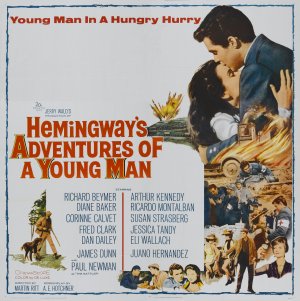
Hemingway’s Adventures Of A Young Man is one of those films that you just know was made specifically to win Oscars.  It’s a big prestige production, complete with a historical setting, an epic scope and big, all-star cast.  That most of those stars appear in relatively small roles was undoubtedly meant to evidence of the film’s importance.

“Look!” the film seems to shout at times, “This is such an important film that even Paul Newman was willing to stop by for a day’s work!”

The film is based on ten short stories by Ernest Hemingway and, loosely, A Farewell to Arms.  The stories all dealt with the early life of Nick Adams, who was a literary stand-in for Hemingway.  Since the Nick Adams stories were autobiographical (and, for that matter, so was A Farewell to Arms), the film can also be viewed as biopic.  Richard Beymer (who, a year earlier, had starred in West Side Story and who is currently playing Ben Horne on Twin Peaks) may be playing Nick Adams but the film leaves little doubt that he was actually meant to be playing Ernest Hemingway.

The film opens with Nick hunting with his father, Dr. Harold Adams (Arthur Kennedy).  He is present when his father travels to an Indian camp and helps to deliver a baby.  He respects his father but Nick wants to see the world and the film follows him as he explores America, working odd jobs and meeting colorful characters along the way.  Paul Newman shows up as a punch-drunk boxer and proceeds to overact to such an extent that he reminded me of Eric Roberts appearing in a Lifetime film.  Nick meets rich men, poor men, and everything in between.  He works as a journalist.  He works as a porter.  Eventually, when World War I breaks out, Nick enlists in the Italian army and the film turns into the 100th adaptation of A Farewell to Arms.

And really, I think it would have been an enjoyable film if it had been directed by someone like Otto Preminger, George Stevens, or maybe even Elia Kazan.  These are directors who would have embraced both the pulpy potential of the Nick Adams stories and the soapy melodrama of the war scenes.  A showman like Preminger would have had no fear of going totally and completely over the top and that’s the approach that this material needed.  Instead, Hemingway’s Adventures Of A Young Man was directed, in a painfully earnest style, by Martin Ritt.  Ritt tries to imitate Hemingway’s famously understated style with his understated direction but, cinematically, it’s just not very interesting.  Ritt portrays everything very seriously and very literally and, in the end, his direction is more than a little dull.

Sadly, the same can be said for Richard Beymer’s performance in the lead role.  Beymer comes across as being the nice guy who everyone says you should marry because he’ll be able to get a good and stable job and he’ll probably never go to jail.  Two months ago, when I watched and reviewed Twin Peaks, I really loved Beymer’s performance as Ben Horne.  He just seemed to be having so much fun being bad.  Unfortunately, in Hemingway’s Adventures Of A Young Man, he never seemed to be having any fun at all.  No wonder he temporarily put his film career on hold so that he could fully devote himself to working as a civil rights activist.

In the end, this is a movie that’s a lot more fun to look at than to actually watch.  Visually, the film is frequently quite pretty in an early 1960s prestige movie so sort of way.  And there are some good performances.  Eli Wallach, Ricardo Montalban, Susan Strasberg, Arthur Kennedy — there’s a whole host of performers doing memorable supporting work.  Unfortunately, even with all that in mind, this well-intentioned film largely falls flat.