The Unominated #21: Southern Comfort (dir by Walter Hill)


Though the Academy of Motion Picture Arts and Sciences claim that the Oscars honor the best of the year, we all know that there are always worthy films and performances that end up getting overlooked.  Sometimes, it’s because the competition too fierce.  Sometimes, it’s because the film itself was too controversial.  Often, it’s just a case of a film’s quality not being fully recognized until years after its initial released.  This series of reviews takes a look at the films and performances that should have been nominated but were, for whatever reason, overlooked.  These are the Unnominated.

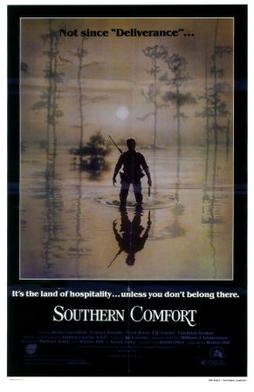
1981’s Southern Comfort takes place in 1973.  While America tries to wind down its presence in Vietnam, a squad of nine National Guardsmen take part in war games in the Louisiana bayous.  The squad is led by the ineffectual Sgt. Crawford Poole (Peter Coyote) while other members include the trigger-happy Lonnie Reece (Fred Ward), the weed-smoking Tyrone Cribbs (T.K. Carter), the cowardly Private Simms (Franklyn Seales), and the tightly-wound Coach Bowden (Alan Autry).  Poole may be in charge but most of the members of the squad seem to look up to the laid-back and friendly Private Spencer (Keith Carradine).  The newest member of the squad is Charles Hardin (Powers Boothe), a sober-minded transfer from Texas who doesn’t seem to get along with anyone but Spencer.

With the exception of Poole and Hardin, no one takes the weekend maneuvers seriously until they find themselves lost in the bayou and it becomes obvious that Poole has no idea what he’s doing.  When they come across some canoes that belong to some Cajun trappers, they decide to “borrow” them.  When the trappers protest, Reece fires his weapon at them.  Reece’s gun is loaded with blanks but the trappers don’t know that.  They fire back, killing Poole.

The national guardsmen now find themselves lost and being stalked by the trappers, a largely unseen force that always seems to attack out of nowhere.  The men have no idea where they are.  The trappers, on the other hand, have lived in the swamps their entire lives.  The guardsmen bicker and argue over the best way to respond.  Some want to fight back and some just want to get back to civilization.  One-by-one, the men are picked off until only two remain.

Though the film is a somewhat heavy-handed metaphor for the Vietnam War, Southern Comfort is still a deeply affecting and suspenseful mix of horror and action.  Director Walter Hill keeps the action moving at a quick pace and the film, which was shot on location and featured scenes shot during an actual Cajun celebration, perfectly captures the languid yet ominous atmosphere of the bayous.  As soon as the men see those canoes unattended, we know that they’re going to steal them and that they are making the biggest mistake of their lives.  Keith Carradine and Powers Boothe both give powerful performances in the lead roles and the members of the supporting cast — especially Alan Autry and Fred Ward — make a strong impression as well.  I especially liked the performance of Brion James, who has a small role as a one-armed Cajun who is more crafty than he looks.

Being a mix of horror and action, it’s probably not a shock that Southern Comfort was ignored by the Academy.  At the very least, I would have found room for Ry Cooder’s original score and Andrew Laszlo’s haunting cinematography.
Previous Entries In The Unnominated:

  1. Auto Focus 
  2. Star 80
  3. Monty Python and The Holy Grail
  4. Johnny Got His Gun
  5. Saint Jack
  6. Office Space
  7. Play Misty For Me
  8. The Long Riders
  9. Mean Streets
  10. The Long Goodbye
  11. The General
  12. Tombstone
  13. Heat
  14. Kansas City Bomber
  15. Touch of Evil
  16. The Mortal Storm
  17. Honky Tonk Man
  18. Two-Lane Blacktop
  19. The Terminator
  20. The Ninth Configuration

The TSL’s Grindhouse: The Final Terror (dir by Andrew Davis)


“Marco!?”

“Melanie!?”

“Margaret!?”

“Dennis!?”

“Eggar!?”

“Windy!?”

If you watch the 1983’s The Final Terror, be prepared to frequently hear the names of the film’s characters.  For a slasher film about a bunch of campers wandering through the forest, The Final Terror has a surprisingly large cast and they all spend a good deal of time walking around and yelling out each other’s names.  Somehow, people keep getting lost even though they know that there’s a killer out there and they all really should be sticking together.

Interestingly enough, for a slasher film, there aren’t that many deaths.  The majority of the cast survives.  Even the most obnoxious of the campers, the one who seems like an obvious victim, manages to make it through to the finale.  I guess we should be happy that most of them survived and this was apparently their final terror.  The majority of the campers were teenagers and if you’re having your surviving your final terror when you’re not even old enough to drink yet …. well, consider yourself lucky.

The Final Terror is set up like an entry in the Friday the 13th franchise but it’s never anywhere close to being as sleazy as those films.  Whether that’s a good or a bad thing depends on what you, as a viewer, want in terms of a wilderness slasher film.  If you want lots of sex, blood, and people making stupid decisions, The Final Terror will probably bore you to death, despite the fact that it includes all three.  If you want a relatively realistic film about being lost in the wilderness while being stalked by an unseen killer, you’ll probably appreciate The Final Terror.  This film was directed Andrew Davis, who went on to direct several big budget Hollywood action films.  Before he became an action director, though, he worked as an assistant to cinematographer Haskell Wexler on the semi-documentary Medium Cool.  Davis brings that realistic style to The Final Terror.  Even though the film does feature some familiar faces, it’s easy to believe that you’re just watching a bunch of campers trying to survive for the weekend.

As for the cast, Rachel Ward plays one of the leaders of the campers.  Joe Pantoliano makes an early appearance as the creepy Eggar.  Daryl Hannah plays Windy.  Mark Metcalf plays another camper named Mike.  The entire ensemble actually does a pretty good job.  As I said, you really do believe that the majority of the cast are delinquent teenagers who have been sent on a camping trip.  When they work together to keep someone from bleeding to death, it almost feels like an educational film.  “Because the campers worked together,” you can imagine a narrator saying, “they might survive The Final Terror.”

The Final Terror is not bad, though I have to admit that I like my 80s slashers to be a little bit more sordid.  But for what it is — an attempt to take a realistic approach to a genre that is regularly held in dismissive disdain — The Final Terror works surprisingly well.  As captured by Andrew Davis, the wilderness is both beautiful and terrifying.  You’ll never catch me camping!

A Movie A Day #217: Wyatt Earp (1994, directed by Lawrence Kasdan)


Once upon a time, there were two movies about the legendary Western lawman (or outlaw, depending on who is telling the story) Wyatt Earp.  One came out in 1993 and the other came out in 1994.

The 1993 movie was called Tombstone.  That is the one that starred Kurt Russell was Wyatt, with Sam Elliott and Bill Paxton in the roles of his brothers and Val Kilmer playing Doc Holliday.  Tombstone deals with the circumstances that led to the Gunfight at the O.K. Corral.  “I’m your huckleberry,” Doc Holliday says right before his gunfight with Michael Biehn’s Johnny Ringo.  Tombstone is the movie that everyone remembers.

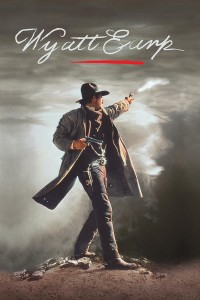
The 1994 movies was called Wyatt Earp.  This was a big budget extravaganza that was directed by Lawrence Kasdan and starred Kevin Costner as Wyatt.  Dennis Quaid played Doc Holliday and supporting roles were played by almost everyone who was an active SAG member in 1994.  If they were not in Tombstone, they were probably in Wyatt Earp.  Gene Hackman, Michael Madsen, Tom Sizemore, Jeff Fahey, Mark Harmon, Annabeth Gish, Gene Hackman, Bill Pullman, Isabella Rossellini, JoBeth Williams, Mare Winningham, and many others all appeared as supporting characters in the (very) long story of Wyatt Earp’s life.

Of course, Wyatt Earp features the famous Gunfight at the O.K. Corral but it also deals with every other chapter of Earp’s life, including his multiple marriages, his career as a buffalo hunter, and his time as a gold prospector.  With a three-hour running time, there is little about Wyatt Earp’s life that is not included.  Unfortunately, with the exception of his time in Tomstone, Wyatt Earp’s life was not that interesting.  Neither was Kevin Costner’s performance.  Costner tried to channel Gary Cooper in his performance but Cooper would have known better than to have starred in a slowly paced, three-hour movie.  The film is so centered around Costner and his all-American persona that, with the exception of Dennis Quaid, the impressive cast is wasted in glorified cameos.  Wyatt Earp the movie tries to be an elegy for the old west but neither Wyatt Earp as a character nor Kevin Costner’s performance was strong enough to carry such heavy symbolism.  A good western should never be boring and that is a rule that Wyatt Earp breaks from the minute that Costner delivers his first line.

Costner was originally cast in Tombstone, just to leave the project so he could produce his own Wyatt Earp film.  As a big, Oscar-winnng star, Costner went as far as to try to have production of Tombstone canceled.  Ironically, Tombstone turned out to be the film that everyone remember while Wyatt Earp is the film that most people want to forget.

Film Review: Diary of a Hitman (dir by Roy London)


Diary of a Hitman

I’ve been on a mission to see as many obscure and forgotten films as possible, which is why, last night — via Movieplex OnDemand —  I ended up watching a 1991 film called Diary of a Hitman.

In Diary of a Hitman, Forest Whitaker plays Dekker, a professional killer.  Despite the film’s title, Dekker does not keep a diary.  What he does do is talk.  A lot.  The film is framed by scenes of him telling his story to somebody on the phone.  (I was never quite sure who he was supposed to be talking to.)  Over the course of the film, he talks to a psychiatrist.  He talks to his agent (Seymour Cassel).  He talks to a dominatrix.  He talks to a corrupt police officer (James Belushi).  He talks to a born-again Christian (Lewis Smith) who hires Dekker to kill his wife and a baby that he may or may not be the father of.  Eventually, he ends up talking to Jain (Sherilyn Fenn), the woman that he’s been hired to kill.  He even has a very brief conversation with Jain’s sister, Kiki (who is played, in a shrill cameo appearance, by Sharon Stone).

With all of the constant talking, it’s not surprising to discover that Diary of a Hitman was based on a stage play.  That’s especially obvious during the film’s second act, which almost entirely takes place inside of Jain’s apartment and basically consists of Fenn and Whitaker delivering dramatic monologues about life and death.  Director Roy London was an acting teacher (among his students were Sharon Stone and Sherilyn Fenn) and it’s perhaps not surprising that he never found a way to make such obviously stage-bound material feel cinematic.  Instead, London directed the film as if he was filming an acting exercise.  Just consider the scene where Kiki drops by the apartment unannounced.  While watching this scene, I kept having flashbacks to high school theater.  I could literally hear one of my old teachers saying, “Okay, for this scene, your motivation is to get her to leave the apartment and your motivation is to stay in the apartment no matter what.  And…go!”

That said, Diary of a Hitman is not a total waste of time.  Playing the agoraphobic Jain, Sherilyn Fenn (who can be seen playing a far more villainous character in this year’s Raze) gives a sympathetic performance, even managing to redeem a potentially distasteful scene where she attempts to seduce Decker.  (I’ve included that scene at the bottom of the review, mostly because — along with Sharon Stone’s cameo — it’s the only scene from Diary Of A Hitman that’s currently available on YouTube.)

And then there’s Forest Whitaker.  It’s hard to say whether Whitaker gives a good performance here or not, largely because the character of Decker makes little sense to begin with and he’s required to have a massive change of heart that seems to come out of nowhere.  (Whitaker has made a credible killer in several other films, just not this one.)  However, what Whitaker lacks in credibility, he makes up for in eccentricity.  In the role of Decker, Forest Whitaker gives one of the oddest performances that I’ve ever seen.  Delivering the majority of his dialogue in an occasionally incomprehensible rasp and flashing a wide smile at the most inappropriate of moments, Forest Whitaker is a force of misdirected nature in this film.  Again, it’s hard to say whether Whitaker actually gives a good performance here but he does make Diary of a Hitman worth seeing.