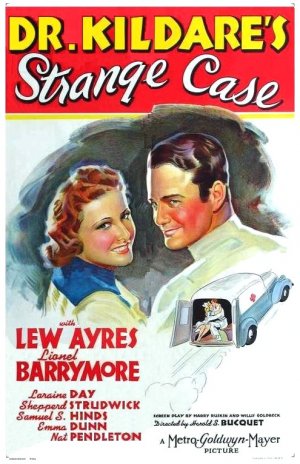
Continuing my effort to watch 38 films in 10 days (and, as of today, I only have 6 days left!), I spent part of last night watching the 1948 film Johnny Belinda.
Johnny Belinda takes place in Canada, on Cape Breton Island. The residents of the island are a hearty, no-nonsense group of people. They work hard, they don’t play hard because they never play, they farm, and they don’t have much use for outsiders. When a new doctor, Robert Richardson (Lew Ayres), arrives on the island, he has to work hard to earn their trust.
Dr. Richardson is fascinated by Belinda McDonald (Jane Wyman), a young woman who is deaf and mute. Belinda lives on a farm with her father (Charles Bickford) and her aunt (Agnes Moorehead). Everyone in the community assumes that Belinda is a simple-minded and, because her mother died giving birth to her, she is resented by her father. Only Dr. Richardson believes that Belinda is in any way intelligent and, over her father’s objections, he teaches Belinda sign language.
Dr. Richardson’s secretary, Stella (Jan Sterling), falls in love with him and grows angry when it becomes apparent that he’s more interested in taking care of Belinda than pursuing an adulterous romance with Stella. Meanwhile, Stella’s husband, a viscous alcoholic named Locky (Stephen McNally), gets drunk and rapes Belinda. 9 months later, when Belinda gives birth to a boy that she names Johnny, everyone assumes that Dr. Richardson is the father. Soon, both Richardson and the McDonald family are being shunned by the judgmental community.
Locky, meanwhile, is determined to keep anyone from finding out about his crime, to the extent that he’s willing to commit murder. Both Locky and Stella are determined to take Johnny away from Belinda and it all eventually leads to further tragedy and, somewhat inevitably, a dramatic murder trial.
Much like Random Harvest, Johnny Belinda is another film that I could imagine being remade for Lifetime. It’s a well-made melodrama that appeals to all of the emotions and features a cast of talented actors doing good work playing characters that are probably just a bit too familiar. In fact, there’s really not a single moment of Johnny Belinda that will take you by surprise but, despite that, the film still works. Jane Wyman does such a good job playing the silent Belinda that it makes the entire movie worth watching. (It’s interesting to contrast Wyman’s innocent, vulnerable, and sympathetic performance here with her far more severe work in The Yearling.) Reportedly, Wyman devoted so much time and effort to her performance that it was cited as a reason for her divorce from future President Ronald Reagan. For Johnny Belinda, Wyman lost the chance to be first lady but she did win an Oscar.
(And, for the record, Wyman voted for Reagan in 1980 and 1984, saying that it wasn’t often that you got to vote for your ex-husband.)
Johnny Belinda was nominated for best picture of the year and, with 10 nominations, it was the most nominated film of 1947. Though it won an Osar for Wyman, it lost best picture to Laurence Olivier’s Hamlet.
Those were some of the most terrifying words I’ve ever heard growing up. It’s all because of one scene from the tv mini-series which adapted Stephen King’s vampire novel, Salem’s Lot. It was a scene in the novel that terrified me as a young boy reading King for the first time.
I’ve always been gifted (or I sometimes say cursed) with having a very overactive imagination. This is why horror has always been such a fascinating genre for me. Even where the horror is all up in one’s face with it’s gore and messy aftermath my mind’s eye would make things worst or just constantly play it on repeat in my head days after the film has ended. It’s even worst when the horror comes across less through gore and more through atmosphere and built-up dread moving towards a jump-scare or something more insidious.
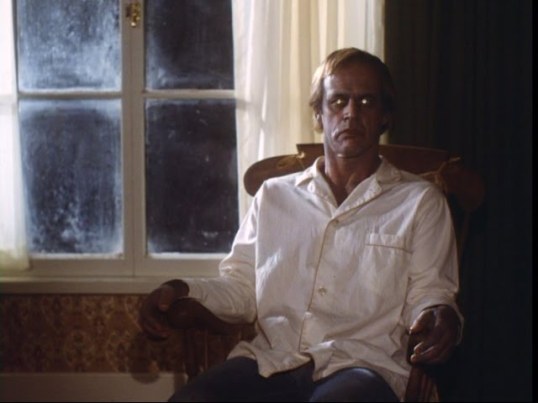
This particular scene is my second favorite from the Salem’s Lot mini-series. The first one I had posted a couple years back which just barely lags behind this one for third. What made this scene so effective despite it’s tv-style production was Tobe Hooper’s direction. Despite working with the censorship inherent in broadcast tv, Hooper was able to create a palpable sense of dread as the old English teacher Matt Burke senses a presence up in one of his house’s rooms. It was the same room where one of his former students had passed away in his sleep.
As the audience we already have an idea who or what is in that second floor room. Matt Burke has an idea as well, but his morbid curiosity wins out as he decides to investigate. Yet, despite such a lack in judgement he does come armed with a crucifix in hand. The way the scene builds and builds as Burke climbs the stairs and hesitating before opening the door to the room was almost too much to bear.
The reveal of his former student, Mike Ryerson, back in the room sitting in the rocking chair as one of the undead only increases the horror of the scene. His snake-like mannerisms was a new take on the vampire behavior. It’s not the usual silk and lace bloodsucker we grew up watching. This was a vampire that behaved like a predator beguiling it’s next prey. From the way Ryerson (played by Geoffrey Lewis) hissed his words and undulated his body as he stood to face his former teacher was disturbing at the very least.
Just writing about it and seeing the scene for the umpteenth time still gives me the shakes.
The 1960s was apparently a bad time for talented old school Hollywood filmmakers getting sucked into making big budget, excessively lengthy films. Joseph L. Mankiewicz spent most of his career making movies like All About Eve and then, in 1963, he ended up directing Cleopatra. Elia Kazan went from A Face In The Crowd to The Arrangement. John Huston went from Treasure of the Sierra Madre and The African Queen to directing not only The Bible but Reflections in a Golden Eye as well.
And then there’s Edward Dmytryk. Dmytryk may not be as highly regarded by modern critics as Mankiewicz and Huston but he still directed some of the best film noirs of the 1940s. His 1947 film Crossfire was nominated for best picture and probably should have won. In 1952, he directed one of the first true crime procedural films, The Sniper. His 1954 best picture nominee, The Caine Mutiny, featured one of Humphrey Bogart’s best and most unusual performances.
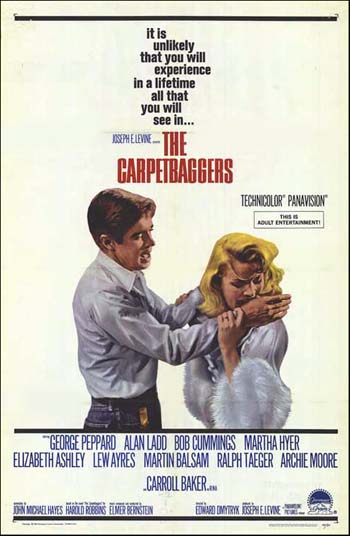
And yet, in 1964, he somehow found himself directing The Carpetbaggers.
The Carpetbaggers tells the story of Jonas Cord (George Peppard). Jonas is the son of the fabulously wealthy Jonas Cord, Sr. (Leif Erickson). At the start of the film, father and son do not get along. Senior resents that Junior is more interested in piloting airplanes than in learning the family business. Junior is angry that Senior has married Jonas’s ex-girlfriend, actress Rina Marlowe (Carroll Baker). In fact, as far as Jonas, Jr. is concerned, Nevada Smith (Alan Ladd) is more of a father to him than his actual father.
Nevada Smith is Jonas, Sr.’s best friend and occasional business partner. He’s a former cowboy who, we are told in a lengthy bit of exposition, is legendary for tracking down and killing the three men who killed his parents. (As we listen to Jonas, Jr. tell the entire lengthy story, we find ourselves thinking, “Okay, so why not make a movie out of that story?” Well, they did. Two years after the release of The Carpetbaggers, Steve McQueen starred in Nevada Smith.) Nevada’s also a film star whose career is in deep decline.
Speaking of deep decline, Jonas, Sr. ends up having a heart attack and dramatically dropping dead before he can get a chance to disinherit his son. Jonas, Jr. inherits the Cord fortune and the Cord business and proceed to spend the next two and a half hours abusing everyone who gets close to him. He even mistreats his loving and neurotic wife, Monica (Elizabeth Ashley, giving the only really memorable performance in the entire film).
Yes, there’s really no reason to have any sympathy at all for Jonas Cord, Jr. but the film insists that we should because he’s the main character and he’s played by the top-billed star. We’re also told that he’s a brilliant aviation engineer and I guess we’re supposed to admire him for being good at what does. We also discover that Jonas believes that his mother was insane and that she passed down her insanity to him. He fears that he’ll pass the crazy gene to any of children that he might have so that’s why he pushes everyone away. Just in case we don’t understand how big a deal this is to him, the camera zooms in for a closeup whenever Jonas is reminded of his mother.
(In the 60s, all mental instability was represented via zoom lens.)
However, Jonas isn’t just into airplanes! He also buys a movie studio, specifically because Rina Marlowe is under contract. Soon, Jonas is directing movies his way. Jonas also finds himself falling in love with another actress (Martha Hyer) so, of course, he starts treating her badly in an effort to push her away.
What can be done to save the tortured soul of Jonas Cord? Maybe he just need to get beaten up by Nevada Smith…
The Carpetbaggers was based on a novel by Harold Robbins. The novel was apparently quite a scandal when it was originally published. People read it and they wondered, “Who was based on who?” Well, if you’ve ever seen The Aviator, it’s not that difficult to figure out. Jonas Cord, eccentric movie mogul and obsessive pilot, was obviously meant to be Howard Hughes. Rina Marlowe was meant to be Jean Harlow, a fact that can be guessed just by looking at the last names. And I’m guessing that Nevada Smith was probably based on former President Warren G. Harding because … well, why not?
I suppose that, by the standards of 1964, the film version of The Carpetbaggers would have been considered risqué. For a modern audience, the main appeal of something like The Carpetbaggers is to see what was once considered to be shocking. The film is overlong, George Peppard doesn’t exactly figure out how to make Jonas into the compelling rogue that he needs to be, the clothes and the sets are a lot more interesting than any of the dialogue (but not interesting enough to carry a nearly 3 hour movie), and the film’s pacing is so off that some scenes seem to go on forever while others are way too short. But, as a cultural and historical artifact, The Carpetbaggers does hold some interest.
The Carpetbaggers was made at a time when Hollywood felt it was under attack from both television and European cinema. With a film like The Carpetbaggers, the studios were saying, “See!? Television will never be able to make a film this long and big! And those Europeans aren’t the only ones who can make a movie about sex!” Of course, as so often happened during this time, the studios failed to take into account that size and length don’t always equal quality (and ain’t that the truth?). As for the sex — well, we hear a lot more than we actually see. The Carpetbaggers is one of those films where everyone talks about sex, largely because showing sex wasn’t really an option. (And it should be noted that most of the sex talk is delivered in the language of euphemism.) As a result, The Carpetbaggers feels incredibly tame by today’s standards. As a result, your main reaction to The Carpetbaggers will probably be to marvel at what was considered daring and shocking 50 years ago.
(And before we get too cocky and quick to dismiss those who came before us, let’s consider how our current films will look to movie audiences five decades from now…)
As far as biopics of Howard Hughes are concerned, The Carpetbaggers in no Aviator. However, it is an occasionally interesting historical artifact.
In case you hadn’t heard, U.S. Sen. Barbara Boxer has recently announced that she’s retiring in 2016. For the first time in decades, there’s going to be an open senate seat in California. There’s been a lot of speculation about who might run for the seat and, for the most part, it’s all been the usual political suspects. The state’s attorney general is running. A few congresspeople might run. Token billionaire Tom Steyer is thinking of getting into the race.
What disappoints me is that, as of right now, it doesn’t look like any celebrities are planning on running. You know what would have made the Golden Globes perfect? If George Clooney had announced his candidacy while accepting his Cecil B. DeMille award. (At the very least, it might have given Amal something to smile about, as opposed to just sitting there with a condescending smirk on her face. Seriously, what’s up with that?) But even beyond George Clooney, there’s all sorts of celebrities who could run. Charlie Sheen lives in California, after all. Jeff Bridges might not be able to run in Montana but what about California?
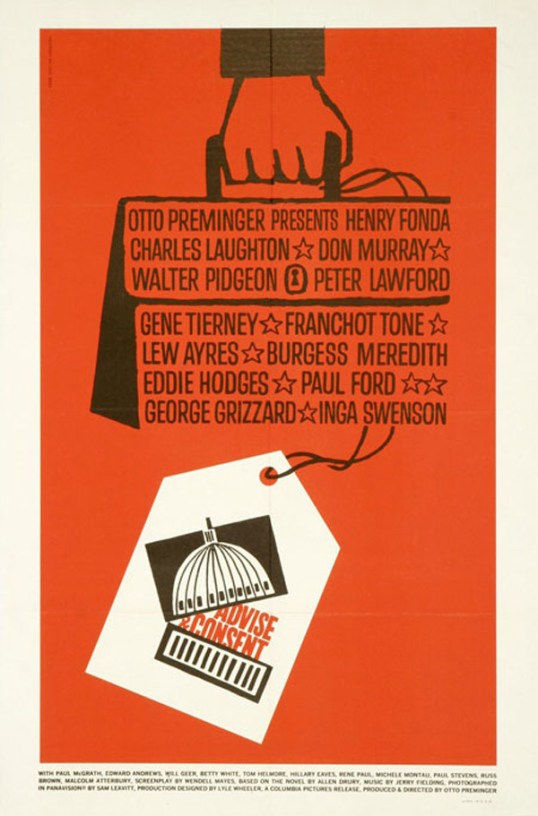
I was discussing this with a friend of mine who suggested that Betty White should run because who could vote against Betty White? Speaking for myself, I could easily vote against Betty White but I do think there would be something appropriate about Betty White serving in the U.S. Senate. After all, in 1962, she played a senator in Otto Preminger’s political epic, Advice & Consent.
White played Sen. Bessie Adams of Kansas and was only given a few minutes of screen time. She’s one of many performers to show up in Advise & Consent‘s version of the U.S. Senate.
For instance, Walter Pidgeon plays Sen. Bob Munson, who is the Senate majority leader and, as a result, the closest thing that this sprawling film has to a central character. His job is to make sure the President’s agenda is pushed through Congress.
And then there’s Peter Lawford, as Sen. Lafe Smith, who always has a different girl leaving his hotel room. When Advise & Consent was made, Lawford was President Kennedy’s brother-in-law. Interestingly enough, one of Kennedy’s former girlfriends — actress Gene Tierney — shows up in the film as well, playing Bob Munson’s lover.
George Grizzard plays Sen. Fred Van Ackerman, who is about as evil as you would expect someone named Fred Van Ackerman to be. Grizzard gives one of the better performances in the film, which just goes to prove that it’s more fun to play an evil character than a good one.
Don Murray is Sen. Brigham Anderson, a senator who is being blackmailed by Van Ackerman’s lackeys. Despite being happily married to Mabel (Inga Swenson), Anderson is leading a secret life as a gay man. The scene where Anderson steps into a gay bar may seem incredibly tame today but it was reportedly very controversial back in 1962.
And finally, there’s Sen. Seabright Cooley. You may be able to guess, just from his overly prosaic name, that Cooley is meant to be a southerner. That, of course, means that he wears a white suit, is constantly fanning himself, and speaks in lengthy metaphors. Sen. Cooley is played by Charles Laughton, who overacts to such a degree that I’m surprised that there was any oxygen left over for anyone else.
All of these senators have been tasked with deciding whether or not Robert Leffingwell (Henry Fonda) will be the next secretary of state. Fonda, not surprisingly, is the epitome of urbane liberalness in the role of Leffingwell. However, Leffingwell has a secret. Back in the 1930s, Leffingwell was a communist. When Sen. Cooley introduces a witness (Burgess Meredith) who can confirm this fact, Leffingwell offers to withdraw as the nominee. However, the President (Franchot Tone) refuses to allow Leffingwell to do so. Instead, with the help of Van Ackerman, he tries to pressure Anderson into supporting Leffingwell’s nomination.
This, of course, leads to melodrama and tragedy.
As far as literary adaptations directed by Otto Preminger are concerned, Advise & Consent is better than Hurry Sundown while being nowhere to close to being as good as Anatomy of a Murder. It’s a film that is occasionally entertaining, often draggy, and, if just because of all the different acting styles to be found in the cast, always interesting to watch.
And, for what it’s worth, Betty White makes for a convincing senator. So, perhaps the people of California should watch Advise & Consent before voting for Tom Steyer…
The first sequel to The Omen was 1978’s Damien: Omen II. Damien: Omen II is an odd film, one that is not very good but yet remains very watchable.
Damien: Omen II takes place 7 years after the end of the original Omen. Antichrist Damien Thorn (now played by Jonathan Scott-Taylor) is now 12 years old. He lives with his uncle Richard (William Holden) and Richard’s 2nd wife, Ann (Lee Grant). His best friend is his cousin Mark (Lucas Donat). In fact, the only problem that Damien has is that his great-aunt Marion (Sylvia Sidney) can’t stand him and views him as a bad influence. Fortunately, as usually seems to happen whenever someone puts an obstacle in Damien’s life, there’s always either a black dog or a black crow around to help out.
Damien and Mark are cadets at a local military academy where Damien deals with a bully by glaring at him until he falls to the ground, grabbing at his head. In history class, Damien shocks his teacher by revealing that he knows the date of every battle ever fought. Damien’s new commander, Sgt. Neff (Lance Henriksen), pulls Damien to the side and tells him to stop showing off and to quietly bide his time.
Meanwhile, Richard is busy running Thorn Industries. One of his executives, Paul Buhler (Robert Foxworth), wants to expand Thorn’s operations into agriculture but his plans are opposed by Richard’s executive vice president, Bill Atherton (Lew Ayres), who considers Paul to be unethical. However, during an ice hockey game, Bill falls through the ice and, despite the efforts of everyone to break through the ice and save him, ends up floating away. Paul is promoted and pursues his plans to make money off of world famine. In between all of this, Paul finds the time to speak to Damien and tell him that he has a great future ahead of him.
Along with Thorn Industries, Richard also owns the Thorn Museum in Chicago. The museum’s curator is Dr. Charles Warren (Nicholas Pryor) who was a friend of the archeologist Karl Bugenhagen (Leo McKern) who, in the first film, revealed that not only was Damien the antichrist but that the only way to kill him was by stabbing him with the Seven Daggers of Meggido. Dr. Warren is also friends with Joan Hart (Elizabeth Shepherd), a reporter who both knows the truth behind Bugenhagen’s death and who has also seen an ancient cave painting that reveals that the Antichrist looks exactly like a 12 year-old Damien Thorn.
Much as in the first film, just about everyone who comes into contact with Damien ends up getting killed in some odd and grotesque way. Crows peck out eyes. Trucks run over heads. One unfortunate victim is crushed between two trains. Another is chopped in half by an elevator cable. At times, Damien: Omen II feels less like a sequel to The Omen and more like a forerunner to Final Destination.
Damien: Omen II is one of those films that I like despite myself. It’s bad but it’s bad in a way that only a film from the 1970s could be and, as such, it has some definite historical value. The script is full of red herrings, the acting is inconsistent, and the film can never seem to make up its mind whether Damien is pure evil or if he’s conflicted about his role as Antichrist. As I watched the film, I wondered why the devil could so easily kill some people but not others.
And yet, Damien: Omen II is so ludicrous and silly that it’s undeniably watchable. If the first film was distinguished by Gregory Peck’s defiant underplaying, the second film is distinguished by the way that William Holden delivers every line through manfully clenched teeth. Everyone else in the cast follows Holden’s lead and everyone goes so far over-the-top that even the most mundane of scenes become oddly fascinating.
For me, the film is defined by poor Lew Ayres floating underneath that sheet of ice while everyone else tries to rescue him. On the one hand, it’s absolutely horrific to watch. I’m terrified of drowning and, whenever the camera focused on Ayres desperately pounding on the ice above him, I could barely bring myself to look at the screen. But, at the same time, we also had William Holden screaming, “OH GOD!” and Nicholas Pryror enthusiastically chopping at the ice with a big axe and dozens of extras awkwardly skating across the ice. Somehow, the scene ended up being both horrifying and humorous. It should not have worked but somehow, it did.
And that’s pretty much the perfect description of Damien: Omen II. It shouldn’t work but, in its own way, it does.
Stephen King’s novels and short stories were mined relentlessly during the late 70’s and through the 80’s and the early 90’s. For the most part the film and tv adaptations of his work were adequate and passable. Some were downright awful and made one wonder if King was just trying to cash as many of his work for licensing paychecks or if he really thought the studios who purchased the rights would actually do a good job adapting them. One such studio which seemed to have done a very good job adapting one of King’s greatest works, Salem’s Lot, was Warner Brothers who adapted the classic vampire novel to become a mini-series for CBS.
I never saw the mini-series when it first aired in 1979, but I did see it a few years later when it re-aired on TV and then many more times on VHS and then on DVD. Tobe Hooper directed the hell out of this mini-series and turned what was a very complex modern retelling of Bram Stoker’s Dracula into a 3-hour mini-series that was both gothic and downright terrifying despite the restraints of TV.
While the mini-series does seem dated now it still retains that creepiness, foreboding atmosphere and scares which made Hooper’s Salem’s Lot one of the better King adaptations. The scene which will always stick with me and still gives me the chills whenever I watch it is when Danny Glick’s younger brother visits him in the hospital. This scene is just downright scary whether watching it as a 9 year-old or one in their 30’s.