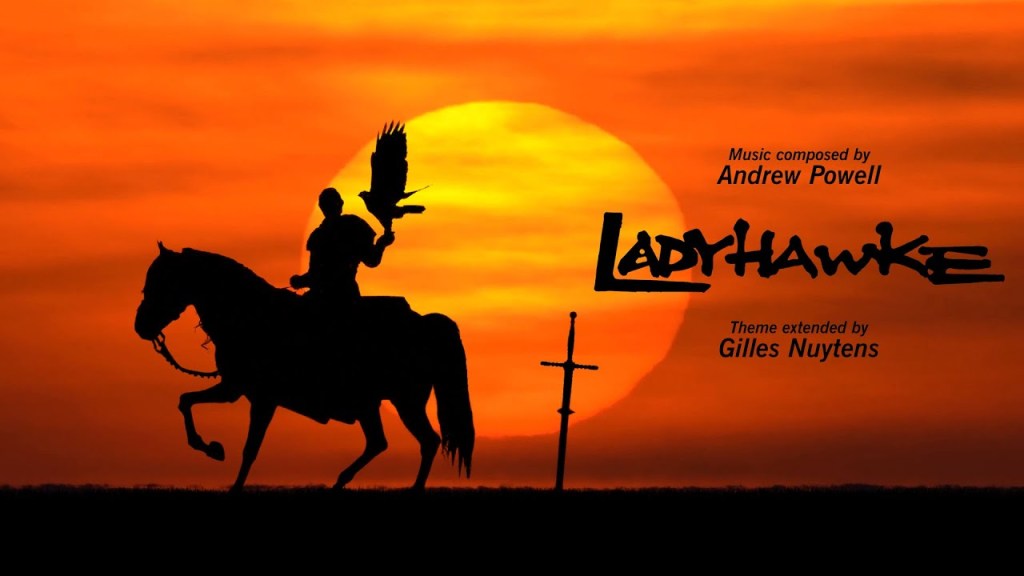
I love Richard Donner’s Ladyhawke . In the following scene, our hero Navarre (Rutger Hauer) has stormed a church, looking to reach the wicked Bishop (played by Wargames‘ John Wood). It’s in an effort to force the Bishop to break the curse that turns Navarre into a wolf by night and his love, Isabeau (Michelle Pfeiffer) into a Hawk by day. He’s reached the Bishop, but believes that Isabeau is surely gone, having asked a old friend to take her life should Navarre fail. I chose this part partially because I love the look on Navarre’s face on hearing Isabeau’s voice. He looks at her almost as if he’s seen her for the first time. He’s just so entranced, but then he quickly remembers what he needs to do, and his voice booms through the church. I wish this video wasn’t cut as short as it is.
The 1968 film, The Shoes of The Fisherman, opens in a snowy Siberian labor camp. For the past twenty years, this camp has been the home of Kiril Pavlovich Lakota (Anthony Quinn), the Ukrainian archbishop of Liviv. Kiril is unexpectedly released by Russia’s new leader, Piotr Ilyich Kamenev (a very British Laurence Olivier). After explaining to Kiril that Russia and China are on the verge of nuclear war due to a famine that has been instigated by U.S. sanctions, Kamenev tells Kiril that he is being released on the condition that he tell no one about the conditions at the Russian labor camp. Kiril starts to protest just for Father Telemond (Oskar Werner), the Vatican’s representative, to say that the conditions have already been agreed to.
In Rome, Kiril meets the Pope (John Gielgud), who makes the humble Kiril a cardinal, over Kiril’s objections that he just a “simple man.” Later, when the aged Pope suddenly dies, Kiril is unexpectedly elected, as a compromise candidate, to succeed him. Still humble and considering himself to be a simple man with a simple mission, Kiril suddenly finds himself as one of the most revered and powerful men on the planet. With Father Telemond as his secretary, Kiril tries to make the Vatican responsive to the needs of the people and sets out to bring peace between the Russians and the Chinese. That turns out to be easier said than done, especially when Telemond himself is eventually accused of heresy for his progressive views.
(And yes, Telemond is a Jesuit….)
The Shoes of the Fisherman is a type of film that should be familiar to anyone who has any knowledge of the Hollywood studios in the 60s. It’s the type of big and self-serious film that was meant to tell audiences, “You won’t find anything this opulent and important on television!” The cast is designed to appeal to everyone. Anthony Quinn and Laurence Olivier are there for the older viewers (especially the older viewers who made up the majority of the Oscar voters in 1968) while, for the younger voters, there’s handsome Oskar Werner as a Jesuit who interpretation of the Gospels is so radical that even Pope Francis would probably tell him to step back a little. For the older, anti-communist viewers, there are scenes that portray the harsh conditions at a Siberian labor camp. The commies put Kiril in prison so he must be one of the good guys. And for the younger, more liberal viewers, there was the suggestion that the threat of World War III was largely due to the actions of the American government. And, just in case there was still anyone who thought that television was preferable to a prestige picture, TV star David Janssen shows up as a cynical reporter whose wife (played by Barbara Jefford) is a doctor who Kiril helps to get some medicine for one of her dying patients. Director Michael Anderson includes enough sudden zoom shots to let younger viewers know that he’s with them while still directing in a stately enough manner to appeal to the older viewers.
The end result is a film that is big and grand but also rather slow. The film gets bogged down in subplots that don’t really add much to the overall story. We spend way too much time with the reporter and his wife. Anthony Quinn does a good enough job as Kiril, giving a rather subdued performance by Quinn standards. (A scene where Kiril recites a Jewish prayer for a dying man is wonderfully acted by Quinn, who seems to truly be emotionally invested in the film’s message of togetherness.) Laurence Olivier is not at all convincing as a Russian but still, he has the stately bearing of a man used to being in power. Like many of the studio productions of the late 60s, The Shoes of The Fisherman tries a bit too hard to strike a balance between old school Hollywood and the counterculture and the film ultimately feels rather wishy-washy as a result. It’s a noble film with good intentions but it’s not particularly memorable.
Since Sunday is a day of rest for a lot of people, I present #SundayShorts, a weekly mini review of a movie I’ve recently watched. This week I got carried aways so it’s #SundayNotSoShorts!
We meet petty thief Gaston “The Mouse” Gaston (Matthew Broderick) as he’s finding a way to escape from the horrific dungeons of the medieval city of Aquila. Being the only person to ever escape the prison, the evil Bishop of Aquila (John Wood) orders his soldiers to find Gaston and kill him. When it appears that he’s about to be recaptured and killed, Captain Etienne Navarre (Rutger Hauer) appears and rescues him. Navarre, who’s accompanied by a hawk, forces Gaston to go with him where they seek lodging in the barn of a local farmer. That night while Gaston is out gathering wood, the duplicitous farmer attempts to kill him, but he is saved again, this time by a large black wolf. Freaked out by this seemingly random event, Gaston runs back to the barn and finds a young lady named Isabeau (Michelle Pfeiffer), but no sign of Captain Navarre. Isabeau isn’t surprised about the events that Gaston describes to her. As a matter of fact, he sees the wolf join Isabeau in the yard as she’s taking a leisurely stroll that evening. The next morning, Navarre has returned and tells Gaston that he needs his help to complete his plan to kill the Bishop. Not wanting to get involved, Gaston escapes that night and is immediately captured again by the Bishop’s soldiers. Saving Gaston a second time doesn’t go well for Navarre, when both he and the hawk are shot with arrows by the soldiers prior to dispensing of them. An injured Navarre forces Gaston to take his horse and deliver the injured hawk to a monk named Imperius (Leo McKern) who resides in a ruined castle in the area. At the castle that night, Gaston sees Isabeau with an arrow in her shoulder. Imperius tells him of a satanic curse that has been placed on husband and wife, Navarre and Isabeau, by the evil Bishop because she spurned his advances. The curse dooms them to always being together, yet eternally apart. Thus, by day Isabeau is a hawk, and by night Navarre is a wolf. After learning this, Gaston is now ready to help Navarre in his plan. Is there any way to reverse the curse, or is vengeance against the Bishop the best thing that can be hoped for? You’ll just have to watch and see!
LADYHAWKE is a film that checks quite a few boxes. It has some good action scenes. Rutger Hauer makes for a strong hero who can handle his fists and his swords in numerous fight scenes, and he looks damn awesome astride his beautiful horse! It also has some good comedy, which is mostly provided by Matthew Broderick. His petty thief has a running commentary where he talks to God anytime that he’s alone and needing help. He has this way of making promises, while also hedging his bets, so he doesn’t box himself in with promises that he has no chance to keep. I recognized myself in those conversations. The film has an air of magic and romance. Rutger Hauer and Michelle Pfeiffer are a beautiful couple. The idea that they are lovers caught up in a curse, but who still love and care for each other every day is hard to resist. This desire to see them break that curse is what gives me a real rooting interest in the outcome. The film is a story of redemption for the monk Imperius whose drunken betrayal helped put the two lovers in this position. And it’s a story of good trying to triumph over evil, with evil being vividly portrayed in the character of the Bishop. Leo McKern and John Wood embody the characters of Imperius and the Bishop perfectly. Director Richard Donner handles all of these different facets in a fun and entertaining way. I think LADYHAWKE still holds up well as a nice piece of 80’s entertainment!
Five Fast Facts:
Spike II, the hawk featured in this movie, worked in the Universal Bird Show until 2000, when she was transfered to the National Audubon society and became an Audubon Ambassador until she died in May 2007.
If you needed proof that celebrities aren’t like the rest of us, three of the castles used for this movie were owned by Italian movie director Luchino Visconti and his family.
Producer and director Richard Donner originally cast Kurt Russell as Navarre. When Russell dropped out a few days before principal photography began, the part was handed to Rutger Hauer.
When Matthew Broderick’s character Gaston is escaping the dungeon at the beginning of the film, you can hear someone say ‘cut’ just before Phillipe says, “It’s not unlike escaping Mother’s womb.”
As enjoyable as the film is, LADYHAWKE was a disappointment at the box office. It grossed a little over $18 million on a budget of $20 million, ranking 48th in the North American box office for 1985.
The late Gene Wilder was well loved by filmgoers for his work with Mel Brooks, his movies alongside Richard Pryor, and his iconic role as Willie Wonka. Wilder had co-written the screenplay for Brooks’ YOUNG FRANKENSTEIN, and now branched out on his own as writer/director/star of 1975’s THE ADVENTURE OF SHERLOCK HOLMES’ SMARTER BROTHER.
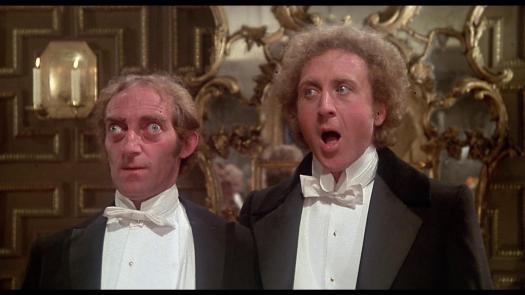
The zany tale, set in 1891, finds Sherlock’s jealous brother Sigerson (Wilder, who derisively calls his more famous sibling “Sheer-Luck”) assigned to the case of music hall singer Jenny Hill (Madeline Kahn) who’s being blackmailed by opera singer Eduardo Gambetti (the enormously funny Dom DeLuise ). Assisting Sigerson is his own Watson, the pop-eyed Sgt. Orville Stacker (Marty Feldman), blessed with “a photographic sense of hearing” that he can only access by whacking himself upside the head. The plot thickens as Sigerson learns Jenny’s a practiced liar (who only trusts men when she’s sexually aroused), she’s…
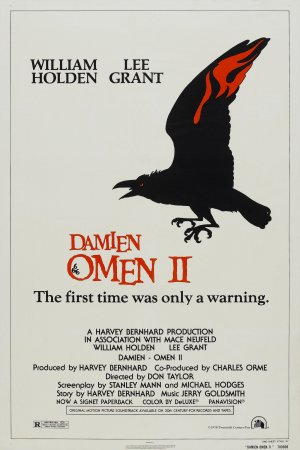
The first sequel to The Omen was 1978’s Damien: Omen II. Damien: Omen II is an odd film, one that is not very good but yet remains very watchable.
Damien: Omen II takes place 7 years after the end of the original Omen. Antichrist Damien Thorn (now played by Jonathan Scott-Taylor) is now 12 years old. He lives with his uncle Richard (William Holden) and Richard’s 2nd wife, Ann (Lee Grant). His best friend is his cousin Mark (Lucas Donat). In fact, the only problem that Damien has is that his great-aunt Marion (Sylvia Sidney) can’t stand him and views him as a bad influence. Fortunately, as usually seems to happen whenever someone puts an obstacle in Damien’s life, there’s always either a black dog or a black crow around to help out.
Damien and Mark are cadets at a local military academy where Damien deals with a bully by glaring at him until he falls to the ground, grabbing at his head. In history class, Damien shocks his teacher by revealing that he knows the date of every battle ever fought. Damien’s new commander, Sgt. Neff (Lance Henriksen), pulls Damien to the side and tells him to stop showing off and to quietly bide his time.
Meanwhile, Richard is busy running Thorn Industries. One of his executives, Paul Buhler (Robert Foxworth), wants to expand Thorn’s operations into agriculture but his plans are opposed by Richard’s executive vice president, Bill Atherton (Lew Ayres), who considers Paul to be unethical. However, during an ice hockey game, Bill falls through the ice and, despite the efforts of everyone to break through the ice and save him, ends up floating away. Paul is promoted and pursues his plans to make money off of world famine. In between all of this, Paul finds the time to speak to Damien and tell him that he has a great future ahead of him.
Along with Thorn Industries, Richard also owns the Thorn Museum in Chicago. The museum’s curator is Dr. Charles Warren (Nicholas Pryor) who was a friend of the archeologist Karl Bugenhagen (Leo McKern) who, in the first film, revealed that not only was Damien the antichrist but that the only way to kill him was by stabbing him with the Seven Daggers of Meggido. Dr. Warren is also friends with Joan Hart (Elizabeth Shepherd), a reporter who both knows the truth behind Bugenhagen’s death and who has also seen an ancient cave painting that reveals that the Antichrist looks exactly like a 12 year-old Damien Thorn.
Much as in the first film, just about everyone who comes into contact with Damien ends up getting killed in some odd and grotesque way. Crows peck out eyes. Trucks run over heads. One unfortunate victim is crushed between two trains. Another is chopped in half by an elevator cable. At times, Damien: Omen II feels less like a sequel to The Omen and more like a forerunner to Final Destination.
Damien: Omen II is one of those films that I like despite myself. It’s bad but it’s bad in a way that only a film from the 1970s could be and, as such, it has some definite historical value. The script is full of red herrings, the acting is inconsistent, and the film can never seem to make up its mind whether Damien is pure evil or if he’s conflicted about his role as Antichrist. As I watched the film, I wondered why the devil could so easily kill some people but not others.
And yet, Damien: Omen II is so ludicrous and silly that it’s undeniably watchable. If the first film was distinguished by Gregory Peck’s defiant underplaying, the second film is distinguished by the way that William Holden delivers every line through manfully clenched teeth. Everyone else in the cast follows Holden’s lead and everyone goes so far over-the-top that even the most mundane of scenes become oddly fascinating.
For me, the film is defined by poor Lew Ayres floating underneath that sheet of ice while everyone else tries to rescue him. On the one hand, it’s absolutely horrific to watch. I’m terrified of drowning and, whenever the camera focused on Ayres desperately pounding on the ice above him, I could barely bring myself to look at the screen. But, at the same time, we also had William Holden screaming, “OH GOD!” and Nicholas Pryror enthusiastically chopping at the ice with a big axe and dozens of extras awkwardly skating across the ice. Somehow, the scene ended up being both horrifying and humorous. It should not have worked but somehow, it did.
And that’s pretty much the perfect description of Damien: Omen II. It shouldn’t work but, in its own way, it does.
A few days ago, Arleigh shared the theme song from 1976’s The Omen as Monday’s horror song of the day. As I sat there and listened to Jerry Goldsmith’s award-winning hymn to Satan, it occurred to me that I happen to have all five of the Omen films sitting in my movie collection. Seeing as how this is Halloween and how the world seems to be getting closer to ending with each passing day, I decided that this would be the perfect time to rewatch the entire franchise and consider whether or not The Omen films are truly as scary as a lot of people seem to think.
So, that’s what I did.
How did things turn out?
Well, in the long history of sequels and remakes, The Omen franchise is one of the more uneven collections. This is one of those franchises where things tend to get less impressive with each subsequent entry. However, 38 years after its initial release, the first Omen remains effective and, in its way, genuinely scary.
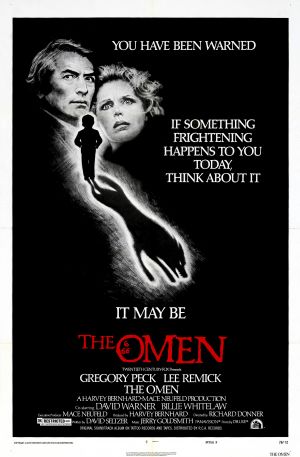
If you’re a horror fan, you probably know the general plot of The Omen regardless of whether you’ve actually watched it or not. It’s one of those films that has been so frequently imitated that it’s almost possible to watch it by osmosis.
The film opens in Rome with diplomat Robert Thorn (Gregory Peck) being rushed to the hospital where his wife, Kathy (Lee Remick), has just given birth. A priest (Martin Benson) tells him that his son died shortly after being born but that he can always just go home with an orphaned newborn that he just happens to have handy. Robert agrees and decides not to tell his wife the truth about the child. Robert and Kathy raise the boy and they name him Damien. Four years later, the politically ambitious Robert is named as Ambassador to the Court of St. James.
The Thorns move to London and soon, odd things start to happen. Damien (now played by Harvey Spencer Stephens) is a quiet boy with a piercing stare who throws a fit whenever he’s taken inside of a church. When Kathy takes Damien to the zoo, they’re attacked by angry baboons. A large Rottweiler mysteriously appears on the grounds of the Ambassador’s estate. A mysterious and sinister nanny (Billie Whitelaw) shows up and explains that she’s been sent by an “agency.” A crazed priest (Patrick Troughton) starts to stalk the Ambassador, demanding a chance to speak with him and insisting that Damien’s mother was actually a jackal.
Even more mysteriously, people start dying in the strangest of ways. A young woman (Holly Palance) smiles as she shouts, “Damien, it’s all for you!” and then hangs herself, thoroughly ruining Damien’s fifth birthday party. A freak lightning storm leads to a man being impaled by a weather vane. Another person who suspects that there might be something wrong with Damien ends up losing his head in a graphic sequence that — even in this age of Hostel and Saw — is difficult to watch.
The Ambassador is contact by Keith Jennings (David Warner), a nervous photographer who fears that Damien may be planning on killing him. Soon, Thorn and Jennings are flying to Italy and to the Middle East and discovering evidence that five year-old Damien might very well be the Antichrist. Speaking of Damien, he and that nanny have been left alone with poor, victimized Kathy.
(“Oh, leave her alone,” I muttered as Damien attempted to kill Kathy for the hundredth time…)
As I watched The Omen, I tried to figure out why this film has held up so well. It certainly wasn’t due to the performance of Gregory Peck who, quite frankly, seemed to mostly be going through the motions. David Warner, on the other hand, gave such a good performance that it was almost difficult to watch. (Don’t get attached to any character who appears in an Omen film.) Some of the film’s effectiveness was undoubtedly due to Jerry Goldsmith’s intense score. Anything’s scary when you’ve got a hundred voice shouting “Ave Satani” at you.
But, ultimately, I think the reason why The Omen still works is because the film generates such a palpable sense of doom. This is one of those films that leaves you convinced that anyone can die at any minute and, considering that happens to be true in both this movie and in real life, that makes the horror of The Omen feel very real. By the time the film ends, you’re left with little doubt that nobody in the film had the least bit of power or control over his or her own destiny. Instead, they were all just pawns in a game that they had no hope of ever winning or understanding. Is there anything scarier than feeling powerless?
All I know is that, having rewatched The Omen, I will never look at a plane of glass the same way again.


 Through the Shattered Lens