14 Days of Paranoia #4: The Believers (dir by John Schlesinger)


When it comes to unfortunate and dumb ways to die, getting electrocuted while standing in a puddle of spilled milk would seem to rank fairly high on the list.  Unfortunately, it’s exactly what happens to the wife of Cal Jamison (Martin Sheen) during the first few minutes of 1987’s The Believers.

Traumatized by his wife’s death (and probably also by all of the people asking, “Wait a minute, she was standing in milk?”), Cal relocates from Minneapolis to New York City.  Accompanying him is his young son, Chris (Harley Cross).  Upon arriving in New York, Cal starts a tentative new relationship with artist Jessica Halliday (Helen Shaver) and he also gets a job working a psychologist for the NYPD.

And several members of the NYPD are going to need a good psychologist because they are investigating a series of brutal and ritualistic murders.  All of the victims are children around Chris’s age and the murders are so grisly that even a hardened cop like Lt. Sean McTaggart (Robert Loggia) finds himself traumatized.  When Detective Tom Lopez (Jimmy Smits, in one of his first roles) discovers one of the bodies, he has an apparent mental breakdown and starts to rant and rave about an all-powerful cult that Tom claims is committing the murders.

After Tom commits suicide, his ravings are dismissed as being the product of a mentally ill man.  However, Cal is not so sure and starts to investigate on his own.  What he discovers is a cult made up of a motely mix of wannabe gangsters and members of high society.  While his friends and lovers either die or lose their minds around him, Cal discovers that the cult is actually closer to both him and his son than he ever realized.

An odd film, The Believers.  On the one hand, there’s plenty of creepy scenes, including one in which Jessica gets a truly disturbing skin condition.  The scenes in which Cal discovers that his friends have lost their minds as a result of the Cult are frequently sad and difficult to watch.  Robert Loggia has scene that brought tears to my eyes.  The mix of street witchery and upper class power lust is nicely handled and, as always, Harris Yulin makes for an effective villain.  The Believers creates an ominous atmosphere of paranoia, one in which you really do come to feel that no one in the film is quite who they say they are.

And yet, it’s obvious that director John Schlesinger — whose previous films included Darling and the Oscar-winning Midnight Cowboy — had more on his mind than just making an effective Omen-style horror film.  He also tries to deal with Cal coming to terms with the death of his wife and Chris coming to terms with the idea of Cal dating someone new and all of those scenes of straight-forward domestic drama feel out-of-place in what should have been an energetic and grisly B-movie.  In those ploddingly earnest scenes, Schlesinger seems to be trying almost too hard to remind us that he’s not really a horror filmmaker and they just feel out of place.

If there was ever a movie that called for the unapologetic and wickedly sardonic directorial vision of David Cronenberg, it was The Believers.  As it is, The Believers is an intriguing but frustratingly uneven mix of paranoia, witchcraft, and domestic melodrama.

14 Days of Paranoia:
  1. Fast Money (1996)
  2. Deep Throat II (1974)
  3. The Passover Plot (1976)

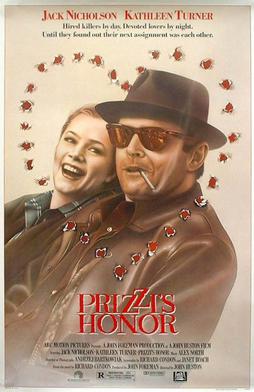
Lisa Reviews An Oscar Nominee: Prizzi’s Honor (dir by John Huston)


First released in 1985, Prizzi’s Honor tells the story of Charley Partanna (Jack Nicholson), a blue collar guy who lives in Brooklyn and who is a hard-working hit man for the Prizzi crime family.  Charley is the son of Angelo (John Randolph), who is the right-hand man to the family’s elderly but still ruthless Don (William Hickey).  In the past, Charley came close to marrying the Don’s daughter, Maerose Prizzi (Anjelica Huston), and he is almost as much a member of the family as the Don’s two sons, Eduardo (Robert Loggia) and Dominic (Lee Richardson).

While attending a family wedding, Charley meets and is immediately infatuated with a woman named Irene Walker (Kathleen Turner).  Later, when Charley is sent to California to kill a man who robbed one of the family’s Vegas casinos, he is shocked to discover that the man is Irene’s husband.  Irene swears that she didn’t have anything to do with the casino theft and, after a whirlwind courtship, Charley and Irene get married in Mexico.  What Charley doesn’t know (but eventually discovers) is that Irene is herself a professional killer.  While Charley and Irene try to balance work and love, Maerose conspires to turn the family against Irene and win Charley back.

Directed by the legendary John Huston, Prizzi’s Honor is pitch black comedy about two hard-working people who kill for a living.  (The film’s big set piece is an extended sequence in which Charley and Irene’s attempt to pull a job together goes wrong in every way and they end up arguing about their relationship while dragging dead bodies from one room to another.)  Though Prizzi’s Honor was released long before the series premiered on HBO, the film feels almost like a companion piece to The Sopranos, full of mobsters who are not as clever as they think they are and who struggle to uphold the old ways in an increasingly complicated world.  Particularly when compared to the gangster who populate a film like The Godfather, the Prizzis are defined by their pettiness.  If Don Corleone epitomized wisdom and honor, Don Prizzi epitomizes someone who holds onto power solely for power’s sake.

Prizzi’s Honor is one of those films that probably seemed a bit more revolutionary when it was first released than it does today.  At this point, we’ve seen so many films about hired killers who have quirky conversations while carrying out their work that the mix of violence and dark humor can feel almost like a cliché.  As well, there are certain parts of the film, like the opening wedding sequence, that feel as if they go on for just a few minutes too long, as if John Huston himself was not always comfortable with the balance between the dark drama and the comedy of mob manners.  That said, Jack Nicholson, Kathleen Turner (who gives a performance worthy of the great femme fatales of film noir), Anjelica Huston, John Randolph, and especially William Hickey all give strong enough performances to hold the audience’s attention and the film’s finale cuts to the point in such a way that it leaves you reconsidering everything that you’ve previously seen.  Prizzi’s Honor has its flaws but Nicholson and Turner have such chemistry that the film’s ending sticks with you.

Prizzi’s Honor was nominated for 8 Oscars, including Best Picture, Best Director, Best Actor, and Best Supporting Actor for William Hickey.  (Oddly, Kathleen Turner was not nominated for playing Irene.)  In the end, it only won one Oscar that year, for supporting actress Anjelica Huston.  The Oscars that year were dominated by a far more convention love story, Out of Africa.

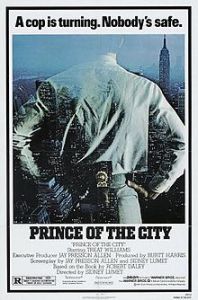
A Movie A Day #30: Prince of the City (1981, directed by Sidney Lumet)


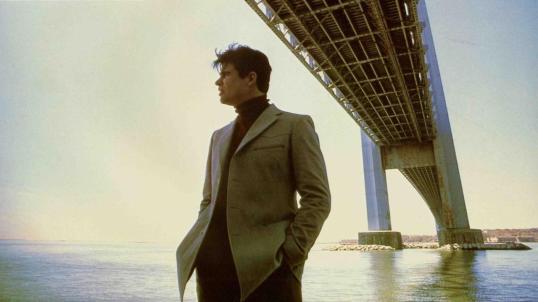
220px-prince_of_the_city_foldedIn 1970s New York City, Danny Ciello (Treat Williams) is a self-described “prince of the city.”  A narcotics detective, Ciello is the youngest member of the Special Investigations Unit.  Because of their constant success, the SIU is given wide latitude by their superiors at the police department.  The SIU puts mobsters and drug dealers behind bars.  They get results.  If they sometimes cut corners or skim a little money for themselves, who cares?
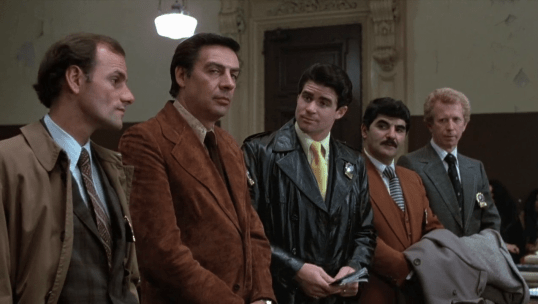
It turns out that a lot of people care.  When a federal prosecutor, Rick Cappalino (Norman Parker), first approaches Ciello and asks him if he knows anything about police corruption, Ciello refuses to speak to him.  As Ciello puts it, “I sleep with my wife but I live with my partners.”  But Ciello already has doubts.  His drug addict brother calls him out on his hypocrisy. Ciello spends one harrowing night with one of his informants, a pathetic addict who Ciello keeps supplied with heroin in return for information.  Ciello finally agrees to help the investigation but with one condition: he will not testify against anyone in the SIU.  Before accepting Ciello’s help, Cappalino asks him one question.  Has Ciello ever done anything illegal while a cop?  Ciello says that he has only broken the law three times and each time, it was a minor infraction.

For the next two years, Ciello wears a wire nearly every day and helps to build cases against other cops, some of which are more corrupt than others.  It turns out that being an informant is not as easy as it looks.  Along with getting burned by malfunctioning wires and having to deal with incompetent backup, Ciello struggles with his own guilt.  When Cappalino is assigned to another case, Ciello finds himself working with two prosecutors (Bob Balaban and James Tolkan) who are less sympathetic to him and his desire to protect the SIU.  When evidence comes to light that Ciello may have lied about the extent of his own corruption, Ciello may become the investigation’s newest target.

prince-of-the-city

Prince of the City is one of the best of Sidney Lumet’s many films but it is not as well-known as 12 Angry Men, Dog Day Afternoon, Network, Serpico, The Verdict, or even The Wiz.  Why is it such an underrated film?  As good as it is, Prince of the City is not always an easy movie to watch.  It’s nearly three hours long and almost every minute is spent with Danny Ciello, who is not always likable and often seems to be on the verge of having a nervous breakdown.  Treat Williams gives an intense and powerful performance but he is such a raw nerve that sometimes it is a relief when Lumet cuts away to Jerry Orbach (as one of Ciello’s partners) telling off a district attorney or to a meeting where a group of prosecutors debate where a group of prosecutors debate whether or not to charge Ciello with perjury.

Prince of the City may be about the police but there’s very little of the typical cop movie clichés.  The most exciting scenes in the movie are the ones, like that scene with all the prosecutors arguing, where the characters debate what “corruption” actually means.  Throughout Prince of the City, Lumet contrasts the moral ambiguity of otherwise effective cops with the self-righteous certitude of the federal prosecutors.  Unlike Lumet’s other films about police corruption (Serpico, Q&A), Prince of the City doesn’t come down firmly on either side.

(Though the names have been changed, Prince of the City was based on a true story.  Ciello’s biggest ally among the investigators, Rick Cappalino, was based on a young federal prosecutor named Rudy Giuliani.)

Prince of the City is dominated by Treat Williams but the entire cast is full of great New York character actors.  It would not surprise me if Jerry Orbach’s performance here was in the back of someone’s mind when he was cast as Law & Order‘s Lenny Briscoe.  Keep an eye out for familiar actors like Lance Henriksen, Lane Smith, Lee Richardson, Carmine Caridi, and Cynthia Nixon, all appearing in small roles.

Prince of the City is a very long movie but it needs to be.  Much as David Simon would later do with The Wire, Lumet uses this police story as a way to present a sprawling portrait of New York City.  In fact, if Prince of the City were made today, it probably would be a David Simon-penned miniseries for HBO.

image-w1280