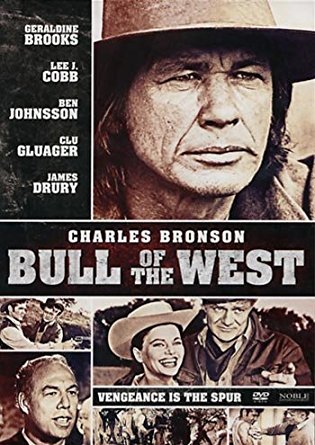
A Movie A Day #143: The Bull of the West (1972, directed by Jerry Hopper and Paul Stanley)


Welcome to the American frontier.  The time is the 1880s and men and women everywhere are heading out west in search of their fortune.  While stowing away on a train, veteran cowboy Johnny Wade (Brian Keith) meets the naive Steve Hill (Gary Clarke) and becomes a mentor to the younger man.  Johnny teaches Steve how to shoot a gun and, when they get off the train at Medicine Bow, Wyoming, they get jobs working on the ranch of Georgia Price (Geraldine Brooks).  When Georgia and Johnny plot to overgraze the land, Steve must decide whether he’s with them or with a rival rancher, Judge Garth (Lee J. Cobb).

At the same time, Ben Justin (Charles Bronson) has arrived in town with his son, Will (Robert Random), and his new wife (Lois Nettleton).  Ben is determined to start his own ranch but, because of his taciturn and stubborn personality, he alienates the Cattleman’s Association, which led by Judge Garth and Bear Suchette (George Kennedy).  Will wants to help his father but Ben keeps pushing him away.  It’s up to Judge Garth’s foreman, the Virginian (James Drury), to bring the family together.

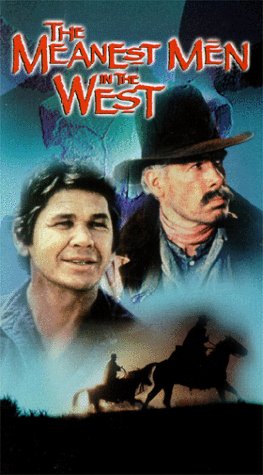
Just like The Meanest Men In The West, The Bull of the West was created by editing together footage from two unrelated episodes of The Virginian.  It works better for the Bull of the West because the two episodes had similar themes and the footage mixes together less awkwardly than it did in The Meanest Men In The West.  But Bull of the West is still just a TV show edited into a movie.  The main reason to see it is because of all the familiar western faces in the cast.  Along with Bronson, Keith, Cobb, and Kennedy, keep an eye out for Ben Johnson, DeForest Kelley, and Clu Gulager.

A Movie A Day #142: The Meanest Men In The West (1978, directed by Sam Fuller and Charles S. Dubin)


The Meanest Men In The West may “star” Charles Bronson and Lee Marvin and Sam Fuller may be credited as being one of the film’s two directors but don’t make the same mistake that I made.  Don’t get too excited.

There was once a TV western called The Virginian.  Starring James Drury as a ranch foreman, The Virginian ran for nine seasons on NBC.  A 1962 episode, which was written and directed by Sam Fuller, featured Lee Marvin as a sadistic outlaw who kidnapped The Virginian’s employer, a judge played by Lee J. Cobb.  Five years later, another episode features Charles Bronson as a less sadistic outlaw who kidnapped the Judge’s daughter.

The Meanest Men In The West mixes scenes from those two episode with western stock footage, a bank robbery that originally appeared in The Return of Frank James, an intrusive voice-over, and an almost incoherent prologue, all in order to tell an entirely new story.  Now, Charles Bronson and Lee Marvin are brothers and rivals.  After Marvin snitches on Bronson’s plan to rob a bank, Bronson blames his former friend, The Virginian.  In order to get the Virginian to come to his hideout, Bronson kidnaps Cobb’s daughter.  The Virginian manages to convince Bronson that he didn’t betray him, just to arrive back at the ranch and discover that Cobb has been kidnapped.  Meanwhile, Bronson and his gang set off after Marvin and his gang.  It ends with Charles Bronson, in 1967, shooting at Lee Marvin, who is still in 1962.

The Meanest Men In The West is so clumsily edited that the same shot of Charles Bronson holding a gun is spliced into a dozen different scenes.  Filmed on different film stocks, the Bronson scenes and the Marvin scenes look nothing alike and, since the two episodes were filmed five years apart, James Drury literally ages backwards over the course of the film.

The Meanest Men In The West is for Charles Bronson and Lee Marvin completists only.  I think Bronson and Marvin are two of the coolest individuals who ever existed and even I had a hard time making it through this one.  If you do watch it, keep an eye out for a young Charles Grodin, thoroughly miscast as a tough outlaw.

Lisa Marie Reviews An Oscar Winner For Labor Day: On The Waterfront (dir by Elia Kazan)


On-the-Waterfront

I like On The Waterfront.

Nowadays, that can be a dangerous thing to admit.  On The Waterfront won the Oscar for Best Picture of 1954 and Marlon Brando’s lead performance as boxer-turned-dockworker Terry Malloy is still regularly cited as one of the best of all time.  The scene where he tells his brother (played by Rod Steiger) that he “could have been a contender” is so iconic that other films still continue to either parody or pay homage to it.  On The Waterfront is one of those films that regularly shows up on TCM and on lists of the greatest films ever made.

And yet, despite all that, it’s become fashionable to criticize On The Waterfront or to cite it as an unworthy Oscar winner.  Certain film bloggers wear their disdain for On The Waterfront like a badge of honor.  Ask them and they’ll spend hours telling you exactly why they dislike On The Waterfront and, not surprisingly, it all gets tedious pretty quickly.

Like all tedious things, the answer ultimately comes down to politics.  In the early 50s, as the House UnAmerican Affairs Committee conducted its search for communists in Hollywood, hundreds of actors, writers, and directors were called before the committee.  They were asked if they were currently or ever had been a member of the Communist Party.  It was demanded that they name names.  Refusing to take part was career suicide and yet, many witnesses did just that.  They refused to testify, apologize, or name names.

And then there was the case of Elia Kazan.  When he was called in front of HUAC, he not only testified about his communist past but he named names as well.  Many of his past associates felt that Kazan had betrayed them in order to protect his own career.  On The Waterfront was Kazan’s answer to his critics.

In On The Waterfront, Terry Malloy’s dilemma is whether or not to voluntarily testify before a commission that is investigating union corruption on the waterfront.  Encouraging him to testify is the crusading priest, Father Barry (Karl Malden), and Edie (Eva Marie Saint), the saintly girl who Terry loves.  Discouraging Terry from testifying is literally every one else on the waterfront, including Terry’s brother, Charlie (Rod Steiger).  Charlie is the right-hand man of gangster Johnny Friendly (a crudely intimidating Lee J. Cobb), who is the same man who earlier ordered Terry to throw a big fight.

At first, Terry is content to follow the waterfront of code of playing “D and D” (deaf and dumb) when it comes to union corruption.  However, when Johnny uses Terry to lure Edie’s brother into an ambush, Terry is forced to reconsider his previous apathy.  As Terry gets closer and closer to deciding to testify, Johnny order Charlie to kill his brother…

The issue that many contemporary critics have with On The Waterfront is that they view it as being essentially a “pro-snitch” film.  It’s easy to see that Elia Kazan viewed himself as being the damaged but noble Terry Malloy while Johnny Friendly was meant to be a stand-in for Hollywood communism.  They see the film as being both anti-union and Kazan’s attempt to defend naming names.

And maybe they’re right.

But, ultimately, that doesn’t make the film any less effective.  Judging On The Waterfront solely by its backstory ignores just how well-made, well-acted, well-photographed, well-directed, and well-written this film truly is.  Elia Kazan may (or may not) have been a lousy human being but, watching this film, you can’t deny his skill as a director.  There’s a thrilling grittiness to the film’s style that allows it to feel authentic even when it’s being totally heavy-handed.

And the performances hold up amazingly well.  Marlon Brando’s performance as Terry Malloy gets so much attention that it’s easy to forget that the entire cast is just as great.  Rod Steiger makes Charlie’s regret and guilt poignantly real.  Karl Malden, who gets stuck with the film’s more pedantic dialogue, is the perfect crusader.  Eva Marie Saint is beautiful and saintly.  And then you’ve got Lee J. Cobb, playing one of the great screen villains.

The motives behind On The Waterfront may not be the best.  But, occasionally, a great film does emerge from less than pure motives.  (Just as often, truly good intentions lead to truly bad cinema.)  Regardless of what one thinks of Elia Kazan, On The Waterfront is a great work of cinema and it’s on that basis that it should be judged.

On_the_Waterfront_poster

Embracing the Melodrama Part II #45: Double Indemnity (dir by Jack Smight)


di3vh6

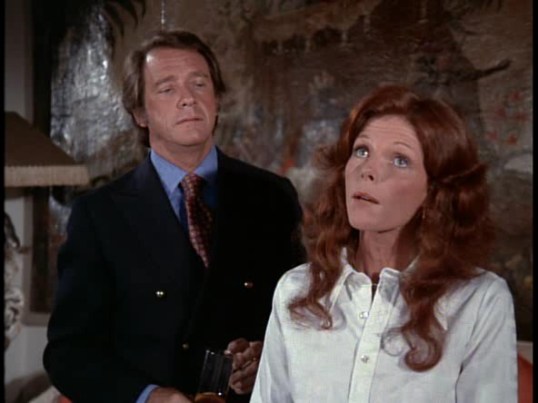
Nothing can make you appreciate a classic film more than by watching a really bad remake.  As proof, I would offer up the 1973 made-for-television version of the classic 1944 film Double Indemnity.  The original Double Indemnity is a classic example of film noir, one that remains intriguing and powerful over 70 years since it was first released.  The remake features the exact same plot as Double Indemnity and a few of the original’s scenes are recreated shot-by-shot but it just does not work.

Part of the problem is that the remake is in color.  In fact, since it was made in 1973 and for television, it’s in very bright and somewhat tacky color.  Bright and vibrant doesn’t work for film noir.  You need the shadows and the visual ambiguities that are unique to black-and-white.  If the original Double Indemnity was full of secrets and mysteries, the remake is all on the surface.  There are no secrets to be found in this remake.

That goes for the cast as well.  In the original, Fred MacMurray made Walter Neff into the epitome of the bored, post-war American male.  You watched him with a certain sick fascination, trying to figure out what was going on behind the blandly friendly facade.  In the remake, you know that Richard Crenna is a serpent from the minute he first appears.  If MacMurray’s Walter was motivated by ennui, Crenna’s Walter is just bad and therefore, far less interesting.  Meanwhile, in the role of Phyllis, Samantha Eggar has none of Barbara Stanwyck’s ferocious determination.  Instead, Eggar’s performance is curiously refined (which is another way to say boring).

Probably the most interesting thing about the remake of Double Indemnity is that the role of Keyes is played by Lee J. Cobb.  Cobb actually gives a pretty good performance and, unlike Crenna and Eggar, he’s actually entertaining to watch.  In the original film, Keyes was played by Edward G. Robinson and was roughly around the same age as Walter.  They were contemporaries and friends and that made the original’s ending all the more poignant.  In the remake, Cobb is quite a bit older than Crenna and, as a result, their relationship feels more paternalistic.  It’s almost as if Crenna is the prodigal son who has betrayed his father and who tells his story as a way of begging for forgiveness.

But that’s probably reading too much into the remake!  For the most part, the remake of Double Indemnity is bland and boring.  The best thing about it is that it’ll make you love the original even more.

As for how I ended up watching the remake of Double Indemnity, it was included as an extra on my DVD of the original.  Watching them back-to-back, as I did, really serves to make you appreciate Billy Wilder as a filmmaker.

12 Reasons To Love 12 Angry Men


Everyone already knows that the 1957 Best Picture nominee 12 Angry Men is a classic.  We all know the film’s story — a teenage boy is on trial for murdering his family.  11 jurors want to convict.  1 juror doesn’t.  Over the next few hours, that one juror tries to change 11 minds.  Some of the jurors are prejudiced, some of them are bored, and some of them just want to go home.  And, as the film reminds us, all 12 of them have a huge  responsibility.  You don’t need me to tell you that this is a great movie.  Therefore, consider this to be less of a review and more of an appreciation of one of the best movies ever made.

1) The film is the feature debut of director Sidney Lumet.  As any student of American film can tell you, Sidney Lumet was one of the most important directors in the history of cinema.  After beginning his career in television, Lumet made his film directing debut with 12 Angry Men and he was rewarded with a much deserved Oscar nomination for best director.

2) The film’s story is actually a lot more complex than you might think.  12 Angry Men is such an influential film and its story has been imitated so many times that it’s easy to forget that the film’s plot is a lot more nuanced than you might think.  Despite what many people seem to think, Juror Number 8 never argues that the defendant is innocent.  Instead, he argues that the state has not proven its case beyond a reasonable doubt and, as a result, the defendant cannot be convicted.  That’s an important lesson that is too often forgotten.

3) The movie celebrates the power of one person determined to do the right thing.  Again, that’s a lesson that remains very relevant today.

4) As Juror Number Eight, Henry Fonda makes human decency believable.

5) As the angry and bullying Juror Number Three, Lee J. Cobb is the perfect antagonist.

6) As Juror Number Ten, Ed Begley makes Cobb seem almost reasonable.  To be honest, the scene where Begley’s racist ranting causes all of the other jurors to stand up and turn their back on him feels a bit too theatrical.  But it’s still undeniably effective.  Alone among the jurors, Juror Number Ten is the only one without any hope of redemption.  It’s a bit of a thankless role but Begley does what he has to do to make the character believable.

7) E.G. Marshall makes the wealthy Juror Number Four into a worthy opponent of Fonda without crossing the line into prejudice like Cobb and Begley.  In many ways, Marshall’s role is almost as important as Fonda’s because Marshall’s performance reminds us that not all disagreements are the product of ignorance or anger.

8) As the Jury Foreman, Martin Balsam is the epitome of every ineffectual authority figure.

9) As Juror Number Seven, Jack Warden is hilariously sleazy.

10) As Juror Number Nine, Joseph Sweeney grows on you.  The first time I saw the film I thought that Sweeney went a bit overboard but, on more recent viewings, I’ve come to appreciate Sweeney’s performance.

11) As Juror Number Twelve, Robert Webber is hilariously shallow.  Juror Number Twelve is in advertising and Webber seems like he was right at home on Mad Men.

12)  Though they don’t get as much of a chance to make an impression, John Fiedler, Jack Klugman, Edward Binns, and George Voskovec all do good work as the other jurors.  If there’s ever been a film that proves the value of a great ensemble, it’s 12 Angry Men.

Scenes I Love: 12 Angry Men


With the recent passing of filmmaker Sidney Lumet I’ve gone through some of the films of his I’ve come to see as favorites of mine. One film which always came to the forefront whenever I spoke about Lumet as a filmmaker is his directorial film debut in 1957 with his adaptation of 12 Angry Men. Of all his films this is the one which I always go back to time and time again. Part of me is somewhat biased in regards to this film since I was part of a class reading of the original teleplay and played the role of Juror #3.

The scene in the film which I love the most has to be when Juror #8 (played with calm assurance by Henry Fonda) and Juror #3 (played with seething rage by Lee J. Cobb) finally get into it after a very long deliberation in trying to find a consensus on the guilt or innocence of the defendant in their case. I love how in this scene everything that’s right about the American jury system was being upheld by Juror #8. How the guilt or innocence of the defendant should come down to just the facts of the case and combing through all the testimony. How emotions and personal feelings and bias should never enter the equation. It is a person’s life in their hands and it is a responsibility too great to leave it to emotions to find the verdict.

This scene also shows the darker side of the American jury system in that there will be, at times, people chosen to preside as a juror in a case will come in with emotional baggage and a hidden agenda which clouds their decision making. They don’t look at the facts and testimony at hand but at what they believe to be true no matter what the facts may say otherwise. this is how the jury system becomes twisted and becomes part and parcel to the notion that justice is never truly blind but always colored by human frailties and prejudices.

Even 54 years since the films first premiered it still holds a powerful effect on me and those who sees it for the first time. It helps that you have a master filmmaker in Sidney Lumet guiding an exceptional cast of actors. One could come to the conclusion that the audience has the angel on one shoulder with Juror #8 and the devil on the other with Juror #3. All in all, a great scene that always stays with me long after the film has ended.