Intergalactic vampire Vlad Tepes (The Who’s Roger Daltrey) has come to Earth and is performing in Las Vegas under the name Jamie Blood. Though most vampires now drink synthetic blood, Vlad is a purist who prefers to drink straight from the veins of others. Vlad wants to unleash a horde of vampires on Earth. Trying to stop him is Vampirella (Talisa Soto), another intergalactic vampire who wears a revealing red bodysuit and little else.
Jim Wynorski says this is the only film that he regrets directing. Think about that. This is a film that even Jim Wynorski regrets! It’s easy to understand why. Talisa Soto is attractive and convincing in the action scenes but she’s still miscast of Vampirella, a character who was as known for her voluptuous figure as for her status as one of the first vampire super heroes. The movie has none of the subversive humor of the original Vampirella comic book and the special effects look cheap even by 1996 standards. With the exception of Roger Daltrey’s devilish portrayal of Vlad, Vampirella is an anemic take on a vampire legend.
Of course, in 1996, almost all comic book movies were as bad as Vampirella. While there were exceptions like the Batman movies, most comic book films were low-budget affairs that were made for nice audiences and which no one put much effort into. Comic books movies were not expected to be blockbusters or huge cultural events and most of them, like Vampirella, were released with very little fanfare. Things have certainly changed.
Welcome to Late Night Retro Television Reviews, a feature where we review some of our favorite and least favorite shows of the past! On Mondays, I will be reviewing CHiPs, which ran on NBC from 1977 to 1983. The entire show is currently streaming on Freevee!
This week, it’s helicopter time!
Episode 2.7 “High Flyer”
(Dir by Gordon Hessler, originally aired on November 4th, 1978)
Ponch in the air?
Not if Ponch has anything to say about it! All of the members of the Highway Patrol are apparently required to spend one day on helicopter patrol but Ponch is scared of heights. First, he pretends to have a cold. Then, he pretends to have an earache, just to discover that the helicopter has been grounded due to bad weather. Finally, the day comes when Ponch has no more excuses and the weather is clear. Ponch goes up in the air but, fortunately, being in the helicopter allows Ponch to spot the van that’s being driven by a bunch of car thieves that he and Baker have spent the entire episode chasing. To give credit where credit is due, the scene where the helicopter chases a thief in a stolen car is genuinely well-shot and exciting to watch. Fortunately, the thief managed to drive some place where no one else was around so the helicopter could then fly way too close to the ground and do a whole bunch of ludicrously dangerous stunts. I’m kind of surprised no one died to be honest.
While Ponch dealt with his fear of flying, Baker dealt with Kim (Cynthia Bain), the teenage daughter of his neighbor, Carol (Mary Louise Weller). After having a fight with her mother, Kim decided to just move into Baker’s apartment. Realizing that Kim had a bit of a crush, Ponch and Baker recruited Sindy Cahill — the only female member of the Highway Patrol who has spent the entire season demanding to be taken seriously — to pretend to be Baker’s girlfriend. Heart-broken, Kim returned home. That was a really terrible ending for what, until that point, had actually been a well-acted look at teen angst and first crushes. Weller, Bain, and Larry Wilcox were all giving sensitive performances so it’s a bit unfortunate that it was all just a set-up for another “Let’s-Demean-Cahill” moment.
So, this episode was not so great when it came to the human drama but it was redeemed by the helicopter action. When in doubt, toss in a helicopter.
It may seem odd to describe Coffy as being a love story.
After all, this is a film that is perhaps best known for a scene in which Pam Grier (as Nurse Coffin, a.k.a. Coffy) shoots her lying boyfriend in the balls. Coffy is often described as being the epitome of 70s grindhouse, a film in which Pam Grier takes on drug dealers, the Mafia, and a corrupt political establishment with a combination of shotguns and shanks. Coffy is perhaps Grier’s best-known films and it features one of her best performances. There’s nothing more empowering than watching Pam Grier take down some of the most corrupt, arrogant, and disgusting men to ever appear in a movie. It’s a violent and gritty film, one that opens with a drug dealer’s head literally exploding and never letting up afterwards. There are many different ways to describe Coffy but it’s rarely called a love story.
But here’s the thing. A film about love doesn’t necessarily have to center around romantic love. Coffy is about love but it’s not about any love that Coffy may have for her boyfriend, the duplicitous politician Howard Brunswick (Booker Bradshaw). Instead, the love at the center of this film is the love that Coffy has for her sister, who died from a heroin overdose. It’s her sister’s death that leads to Coffy first seeking revenge but that’s not the only love that motivates Coffy. There’s also the love that Coffy feels for her community. Throughout the film, we hear about how the black community is being destroyed by the drugs that are being pushed into their neighborhoods by white mafia dons like Arturo Vitronia (Allan Arbus, who was once married to the iconic photographer, Diane Arbus). It’s not a random thing that, for all of Coffy’s anger, she saves her most savage revenge for the members of her community who are working with the white mobsters, men like the pimp, King George (Robert DoQui), and her own boyfriend, Howard.
Throughout the film, Coffy says that she feels like she’s “in a dream” and Pam Grier gives an intelligent performance that suggests that, even after her mission is complete, Coffy will never be the same. She’s not a natural killer. She’s a nurse and it’s her job to save lives. But when she sets out to get revenge on those who killed her sister and who are destroying her community, Coffy shows no mercy. When she violently interrogates another victim of the drug trade, Coffy shows the junkie no sympathy because sympathy isn’t going to solve the problem. Coffy is determined and the reason why she succeeds is because none of her victims realize just how serious she is. Coffy uses her beauty to distract them and then, when they aren’t looking, she strikes. By the end of the film, she’s walking alone on the beach and the viewer is left to wonder what’s going on inside of her head. After all the people that Coffy has killed, can she ever go back to simply working the night shift at the ER? After you’ve seen life and death at its most extreme, can things ever go back to the way that they once were?
And listen, I’m generally a pacifist and I’m not a huge fan of real-life vigilante justice and I’ve signed many petitions against the death penalty but it’s impossible not to cheer for Coffy. Pam Grier gives such a committed performance that it’s impossible not to get sucked into her mission. (It helps, of course, that most of the people who she targets are legitimately terrible human beings.) The brilliance of Grier’s performance comes in the quiet moments. Yes, she’s convincing when she has to shoot a gun and she delivers vengeful one-liners with the best of them. But the film’s best moments are the ones were Grier thinks about how her life has become a dream of violent retribution and where she allows us to see the love for her sister and her community, the same love that is motivating all of the bloodshed.
Coffy is a rightfully celebrated film. For once, a cult film actually deserves its cult. It’s one of the best of the old grindhouse films and, in fact, to call it merely an exploitation film actually does a disservice to how effective a film Coffy actually is. It’s just a great film period.
The year is 1876 and the legendary Wild Bill Hickok (Jeff Bridges) sits in a saloon in Deadwood and thinks about his life (most of which is seen in high-resolution, black-and-white flashbacks). Hickok was a renowned lawman and a sure shot, a man whose exploits made him famous across the west. Thanks to his friend, Buffalo Bill Cody (Keith Carradine), he even appeared on the New York stage and reenacted some of his greatest gun battles. Now, Hickok is aging. He is 39 years old, an old man by the standards of his profession. Though men like Charlie Prince (John Hurt) and California Joe (James Gammon) continue to spread his legend, Hickok is going blind and spends most of his time in a haze of opium and regret.
Hickok only has one true friend in Deadwood, Calamity Jane (Ellen Barkin). He also has one true enemy, an aspiring gunslinger named Jack McCall (David Arquette). McCall approaches Hickok and announces that he is going to kill him because of the way that Hickok treated his mother (played, in flashback, by Diane Lane). Hickok does not do much to dissuade him.
Based on both a book and a play, Wild Bill is a talky and idiosyncratic Western from Walter Hill. Hill is less interested in Hickok as a gunfighter than Hickok as an early celebrity. There are gunfights but they only happen because, much like John Wayne in The Shootist, Hickok has become so famous that he cannot go anywhere without someone taking a shot at him. Almost the entire final half of Wild Bill is set in that saloon, with Hickok and a gallery of character actors talking about the past and wondering about the future.
At times, Wild Bill gets bogged down with all the dialogue and philosophizing. (To quote The Good, The Bad, and the Ugly: “When you have to shoot, shoot. Don’t talk.”) Luckily, the film is saved by an intriguing cast, led by Jeff Bridges. In many ways, his performance was Wild Bill feels like an audition for his later performance in True Grit. David Arquette is intensely weird as the jumpy Jack McCall and Ellen Barkin brings the film’s only underwritten role, Calamity Jane, to life. Smaller roles are played by everyone from Bruce Dern to James Remar to Marjoe Gortner.
United Artist made the mistake of trying to sell Wild Bill as being a straight western, which led to confused audiences and a resounding flop at the box office. Ironically, years after the release of Wild Bill, Walter Hill won an Emmy for directing the first episode of HBO’s Deadwood, an episode the featured Wild Bill cast member Keith Carradine in the role of Hickok.
 Intergalactic vampire Vlad Tepes (The Who’s Roger Daltrey) has come to Earth and is performing in Las Vegas under the name Jamie Blood. Though most vampires now drink synthetic blood, Vlad is a purist who prefers to drink straight from the veins of others. Vlad wants to unleash a horde of vampires on Earth. Trying to stop him is Vampirella (Talisa Soto), another intergalactic vampire who wears a revealing red bodysuit and little else.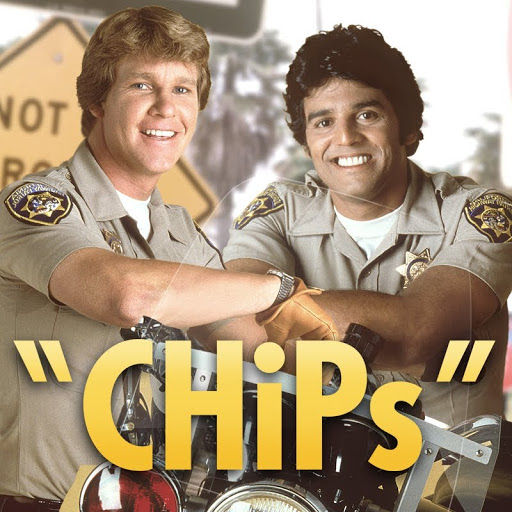

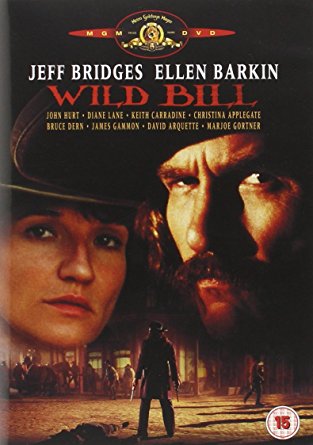 The year is 1876 and the legendary Wild Bill Hickok (Jeff Bridges) sits in a saloon in Deadwood and thinks about his life (most of which is seen in high-resolution, black-and-white flashbacks). Hickok was a renowned lawman and a sure shot, a man whose exploits made him famous across the west. Thanks to his friend, Buffalo Bill Cody (Keith Carradine), he even appeared on the New York stage and reenacted some of his greatest gun battles. Now, Hickok is aging. He is 39 years old, an old man by the standards of his profession. Though men like Charlie Prince (John Hurt) and California Joe (James Gammon) continue to spread his legend, Hickok is going blind and spends most of his time in a haze of opium and regret.
 Through the Shattered Lens