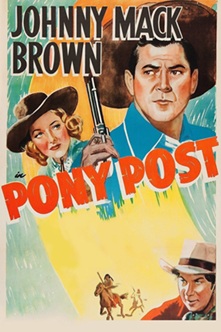
Pony Post (1940, directed by Ray Taylor)


In the days of the Old West, Griff Atkins (Stanley Blystone) manages a Pony Express station but, because of his gambling debts, he actually encourages the Indians and the outlaw Richard brothers (John Rockwell and Ray Teal) to attack the Pony Express riders and steal their horses.  Major Goodwin (Tom Chatterton) tries to put a stop to all this by firing Griff and putting Cal Sheridan (Johnny Mack Brown) in charge.  Griff and the Richard brothers continue their outlaw ways and eventually, the head of one of the relay stations is killed in one of their raids.  While the dead man’s daughter, Norma (Nell O’Day), investigates the murder, Cal works to bring peace the line and falls in love with Goodwin’s daughter, Alice (Dorothy Short).  Meanwhile, aspiring Pony Express rider Shorty (Fuzzy Knight) tries to invent a trampoline system that will help him to mount a horse.

No matter how bad things get in the west, you can always count on Johnny Mack Brown to bring some order and to get it done in less than an hour.  Johnny Mack Brown was always a good hero and that’s the case here.  Eventually this film has all of the horse riding and tough fighting that fans of the genre expect from these westerns but, for a short movie (it only runs for 59 minutes), it still seems to take a while for it to really get going.  The first half of the movie is more about Fuzzy Knight singing songs and trying to become a rider than it is about anything else.  I usually enjoy Fuzzy’s antics but, like the B-western themselves, they are definitely an acquired taste for most viewers.

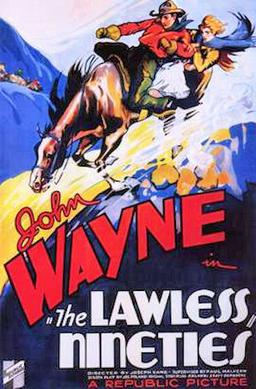
The Lawless Nineties (1936, directed by Joseph Kane)


The year is 1890 and Wyoming is on the verge of voting for statehood.  Newspaperman Major Carter (George “Gabby” Hayes) believes that it’s time for Wyoming to become a state and most of the locals agree with him.  Businessman Charles Plummer (Harry Woods) does not want Wyoming to become a state and he’s willing to send out his main henchman, Steele (Al Bridge), to intimidate the voters and to silence Carter.  Plummer has a profitable racket going and the last thing he wants is for the U.S. government to get involved in his activities.  It falls to two federal agents, John Tipton (John Wayne) and Bridger (Lane Chandler), to supervise the voting and protect the citizen.  When Major Carter is shot by a drunk anti-statehood activist, the mission to make Wyoming a part of the Union becomes personal.

The Lawless Nineties is typical of the B-movies that John Wayne made for Republic Pictures before John Ford resurrected his struggling career by casting him as The Ringo Kid in Stagecoach.  There are plenty of gunfights and horse chases and explosions as the bad guys try to keep the townspeople from voting and the federal agents set up their own sting operation to expose Plummer’s gang.  Wayne seems more relaxed here than he did in some of his other B-movies.  He was obviously getting more comfortable with being on camera and playing the hero.  Probably the most interesting thing about this film is that Gabby Hayes (credited as George Hayes, without his famous nickname) plays the renowned and intelligent Major Carter.  Hayes was just a year away from establishing himself as a perennial B-movie sidekick and supplier comedy relief.  He would soon be best-known for playing characters who had little in common with the intelligent and well-spoken Major Carter.  In The Lawless Nineties, Hayes gets a chance to play something other than the comedic relief and turns out to be petty good at it.

This is another one of those westerns that will be enjoyed by fans of the genre.  It’s nothing special but it does allow Wayne to show hints of his future stardom and it also gives Gabby Hayes a chance to show what he was actually capable of.

Gunning For Vengeance (1946, directed by Ray Nazarro)


Steve Landry (Charles Starrett) rides into another town and is once again named the new sheriff.  Luckily, Steve’s old friend Smiley Burnette is working as the town’s blacksmith.  Steve makes Smiley his deputy and then sets about trying to break up a gang of cattle rustlers.  When Steve learns that his jurisdiction does not extend beyond the city limits, he dons the disguise of his alter ego, The Durango Kid, to go after the outlaws.

Has Steve met his match in Belle (Phyllis Adair), the saloon owner who is the secret leader of the outlaws?  She notices that The Durango Kid’s boot tracks are the same as Steve’s boot tracks.  I’m surprised that no one has ever noticed that before.  Steve went through a lot of trouble to disguise himself as Durango but he never bothered to change his boots.

This entry in the Durango Kid series features a lot of Smiley Burnette so your enjoyment on the film will depend on how much tolerance you have for Smiley’s songs and his style of humor.  Each film featured Smiley being followed around by a different group of musicians.  In this one, Smiley is accompanied by The Trailsman.  When Smiley accidentally locks himself in a jail cell, the Trailsman stand on the other side of the bars and sing a song about how Smiley can’t get out of the cell.  Smiley does eventually get out but, later on, he’s knocked out cold during an attempted jail break.  Smiley’s not much of a help in this one.

This has all of the typical Durango Kid elements, including the stock footage of the stampeding cattle that appeared in nearly all of his films.  There’s another saloon fight and a gunfight towards the end.  Durango rides out of town alone, leaving Smiley behind, but we know they’ll soon be reunited in another adventure.

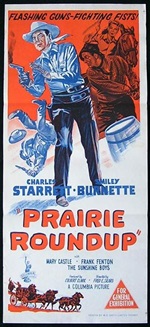
Prairie Roundup (1951, directed by Fred F. Sears)


Steve Carson (Charles Starrett) is wanted for murdering the Durango Kid!

I know that sounds confusing because Steve Carson is the Durango Kid.  The bandit that Carson shot was just disguised as the Durango Kid but actually, he was just a dim-witted outlaw who was set up by Buck Prescott (Frank Fenton), a rustler who was run out of Texas by Steve and who was trying to find a way to stop Steve from investigating his new scheme to cheat a bunch of ranchers in Santa Fe.

Steve is taken to jail but luckily, Smiley Burnette is around to help him break out.  Smiley and Steve head to Santa Fe, where they get jobs working as cowhands at the Eaton Ranch and work to expose Prescott and his gang as being responsible for a series of stampedes.  Smiley sings some songs and Steve resurrects the Durango Kid from the dead.

This was one of the later Durango Kid films.  The range war plot is one that showed up in many Durango Kid films but Prairie Roundup adds something new to the formula but having Steve framed for murdering himself.  Steve could prove his innocence by revealing that he’s actually the Durango Kid but Steve is determined to maintain his secret identity.  I’ve seen several Durango Kid films and I still don’t really understand why Steve felt he needed a secret identity in the first place.  But Prairie Roundup shows the extent to which he’ll go to keep it.

There’s plenty of fight and horse chases, more than enough to keep western fans happy.  Smiley Burnette gets to throw some punches along with singing all of his usual songs.  It’s also nice to see the lovely Mary Castle in the role of Toni Eaton, the daughter of one of the ranchers who has been targeted by Prescott.  Featuring less stock footage than usual, Prairie Roundup is a worthy entry in the Durango Kid series.

Idaho Kid (1936, directed by Robert F. Hill)


When the wife of rancher Clint Hollister (Earl Dwire) died in childbirth, Clint was so distraught that he rejected his son, Todd.  Todd was raised by a rival rancher, John Endicott (Lafe McKee).  Hollister resented Endicott for taking his son and a feud developed between the two families.  Hoping the end the feud, 15 year-old Todd ran away from home and made a new life for himself as a frontier scout named Idaho.

15 years later, Idaho (Rex Bell) returns home with his sidekick, a reformed outlaw known as The Kid (David Sharpe).  Neither Hollister nor Endicott recognize Idaho and, without revealing his identity, Idaho tries to stop their feud.  Hollister’s men want to keep the feud going and they manipulate Hollister into challenging his own son to a duel.

Idaho Kid is one of the better B-westerns that Rex Bell made between 1928 and 1936.  Though the film has its share of action scenes, Idaho Kid‘s intelligent script puts more emphasis on character development than most B-westerns, with Hollister especially being portrayed as a complex character as opposed to just a stock western villain.  Rex Bell always seemed authentic whenever he was riding a horse or shooting a gun.  Idaho Kid shows that he could also play more than just a standard western hero.

Though he was being pushed for stardom by Fox Film, Rex Bell voluntarily retired from the film industry in 1936 and instead pursued a career in politics.  He was the Lieutenant Governor of Nevada when he died of a heart attack in 1962.


Sagebrush Trail (1933, directed by Armand Schaefer)


Accused and convicted of a murder that he didn’t commit, John Brant (John Wayne) breaks out of prison in Maryland and, following the advice of Horace Greeley, he goes west.  After making a narrow escape from the authorities, he meets and befriends Joseph Conlan (Lane Chandler).  Conlan brings Brant into his gang, where Brant starts out as a cook but is soon being assigned to help rob stores and stagecoaches.  Despite his time in prison, Brant is no criminal and he secretly thwarts every robbery that the gang tries to pull off.  When the gang starts to suspect that Brant might be an undercover cop, Conlan is the only one willing to stand up for him and help him.  Conlan is also responsible for the murder that Brant was accused of committing.

John Wayne as a hardened escaped convict?  Maybe the older John Wayne could have pulled that off but, in 1933, Wayne was still too cheerful and easy going to be believable as someone who had spent the last few months doing hard time.  Fortunately, even early in his career, Wayne was convincing when riding a horse or shooting a gun and that’s probably all that the audience for these short programmers demanded.  There’s also an exciting scene where Wayne is forced to swim across a pond while his pursuers shoot at him.  As the criminal with a conscience, Lane Chandler steals the film.

Fans of westerns will want to keep an eye out for legendary stuntman Yakima Canutt, playing yet another outlaw gang leader.  Yakima Canutt started out his career risking his life as a rodeo rider and then went on to risk his life ever more as Hollywood’s most daring stunt performer.  When he got too old to continue doing stunt work, he became a second unit director, for John Ford and others.  He staged Ben-Hur‘s famous chariot race and was credited with making sure that not a single horse was hurt and not a single human was seriously injured during filming.  Yakima Canutt lived to be 90 years old, outliving most of the actors from whom he doubled as a stuntman.

Winds of the Wasteland (1936, directed by Mack V. Wright)


When the invention of the telegraph puts the Pony Express out of business, two veteran riders — John Blair (John Wayne) and Larry Adams (Lane Chandler) — decide to start their own stagecoach line.  The richest man in Buchanan City, “Honest” Cal Drake (Douglas Cosgrove), sells them the line to nearby Crescent City.  Though initially grateful, Blair and Larry soon discover that Crescent City is now a ghost town that serves as home to exactly two inhabitants.  Rather than give up, Blair and Larry set up their stagecoach and they suddenly get lucky as settlers start to find themselves in Crescent City.  Blair is even able to convince the local telegraph company to run the wire though Crescent City, which leads to an influx of even more people.  Now, Blair just needs to land the contract delivering mail for the area.  To do that, he’ll have to win a stagecoach race against Drake, who turns out to not be very honest at all.

Winds of the Wastelands is one of John Wayne’s better pre-Stagecoach programmers.  While it has the western action that most people would expect from a B-western, it also has a lot more comedy than some of Wayne’s other poverty row productions.  For instance, a skunk tries to turn the stagecoach into his home and, of course, shows up at a key moment during the big race.  When one of bad guys tries to convince Blair to take his donkey to Crescent City in the stagecoach, Blair asks if there are any other “jackasses” who want a ride while casting a look at Drake’s men.  The movie takes a more serious turn when Drake goes to extreme methods to try to stop Blair and, as a result, Larry is wounded in a gunfight.  Doc Forsythe (Sam Flint), the founder of Crescent City, has to rediscover his confidence to perform the operation that can save Larry’s life.  Fortunately, the doctor’s daughter (Phyllis Fraser) is there to both help him out and to fall in love with John Blair.

This 55-minute programmer featured John Wayne playing the type of character for which he best known, the level-headed westerner who wasn’t going to let anyone push him around but who still fought fair.  Watching this movie, it’s easy to see why, just three years later, John Ford used him in Stagecoach.