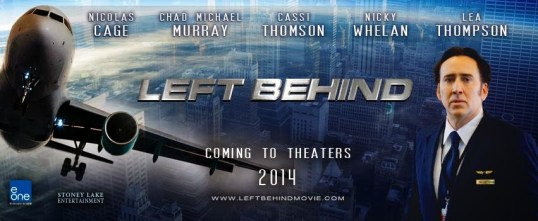
I have always felt that film critics and bloggers should be open and honest about their biases. Most critics, of course, claim that their reviews are solely based on the merits of what they’ve seen and that they leave their personal political or religious beliefs out of it. That, needless to say, is complete bullshit and I’ve never quite understood why some people are so terrified over the prospect of being revealed to be just as biased as everyone else in the world. The fact of the matter is that critics are supposed to be opinionated and readers have a right to know exactly where those opinions are coming from.
With that in mind, allow me to let you know my mindset before I attempt to review Left Behind.
First off, you should know that I come from a Catholic family. On my Dad’s side, I’m Irish. On my mom’s side, I’m Italian and Spanish. Put those three together and basically, you’ve got a big and fiercely Catholic heritage to deal with. Therefore, I have to admit that I really don’t know a whole lot about the whole Evangelical Protestant background from which Left Behind apparently sprung. (In fact, the only thing that I really knew about the Left Behind books is that, apparently, most of the book’s Catholics get left behind.) So, who knows? Maybe some of the issues that I had were just a case of me not being a member of the film’s target audience.
Secondly, you should know that I love being a contrarian. I love any excuse to express an opinion that goes against the majority because, quite frankly, I think that there’s way too much groupthink going on when it comes to film reviewing. Far too often, it seems that critics have already decided which films that they’re going to love and which films that they’re going to hate. I knew that the critics were going to hate Left Behind so I was really hoping that the film would somehow be good. That way, I could write a review defending it and, best of all, I could annoy a lot of people. After all, the only thing worse than organized religion would be organized hipster douchebags.
(I’m looking in your direction, A.V. Club commenters….)
On the other hand, another part of me hoped that the movie would be really, really bad. It’s been a while since I’ve seen a truly bad film and, in another few months, it’s going to be time for me to make out my list of the 16 worst films of 2014. And since I can only list films that I’ve actually seen, I need to step up my game and see more bad movies. I mean, A Million Ways To Die In The West and Transformers 4 are a good start but they can’t make up the entire list…
Fourth, I was really hoping that Nicolas Cage would somehow be responsible for redeeming Left Behind. I hoped that he would either give a brilliant performance or he would give a performance so weird that the film itself would become oddly watchable. A lot of this is because Cage was so good in Joe that it kind of breaks my heart to see him throwing away whatever critical respect he may have regained by appearing in Left Behind…
And finally, I’m on vacation! Why is that important? Because it meant that, when Jeff and I went to Left Behind, we saw it in a theater that we’ll never have to visit again. As such, we didn’t have to worry about running into anyone we knew. Yay! (The theater, incidentally, was nearly empty. Jeff and I were the youngest people there…)
So, with all that in mind, Left Behind was really, really bad.

Nicolas Cage plays Rayford Steele and let’s just start with a bit of praise. Rayford Steele is a great name! Anyway, Rayford Steele is a pilot who, one day, is flying an airplane and thinking about cheating on his wife (Lea Thompson), who just happens to be an Evangelical Christian! (How religious is Mrs. Rayford Steele? So religious that she apparently carries her bible with her everywhere.) Rayford has picked the flight attendant that he’s going to cheat with. He’s even got brand new U2 tickets that he’s going to use for enticement because, apparently, Left Behind takes place in the 20th Century.
And then suddenly — his copilot vanishes! Several passengers on the plane vanish! Children all over the world vanish! It’s the Rapture, a point that becomes clear as soon as Rayford takes a look at a vanished flight attendant’s date book and sees “BIBLE STUDY” written in all caps.
Even worse, apparently every flight controller in the world was a Christian because there’s nobody on the ground to help Rayford land his plane. Uh-oh!
Also on the plane (and unraptured) is a reporter named Buck Williams (Chad Michael Murray) and, let’s just be honest — Buck Williams is not as good a name as Rayford Steele. Shortly before boarding the plane, Buck met Rayford’s daughter, Chloe, (Cassi Thomson) and they bonded over their mutual atheism.
(Chloe might as well have been wearing a Neil deGrasse Tyson t-shirt.)
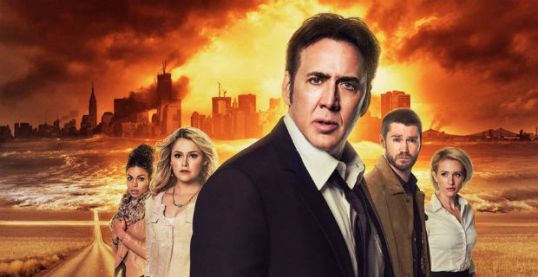
Of course, post-rapture, Chloe spends most of the day desperately searching for her mother and her younger brother. Riots are breaking out down on the ground. Airplanes are falling from the sky. Will Chloe survive?
(Ha, Chloe! Where’s your Neil deGrasse Tyson now!?)
One thing that I did find interesting is just how quickly society collapsed after the Rapture. It’s almost as if everyone in the world decided, “Now that the children are gone, let’s burn this place down!”
To be honest, it all felt a bit like a SyFy original film. SyFy films are almost always divided in half, with 50% of the film dealing with someone in either a plane or a boat while the other half of the film deals with that person’s son or daughter trying to lead a group of idiots to safety and hopefully avoid the monster. It’s tempting to think of what a SyFy version of Left Behind would look like. It would probably be a lot more fun than this one…
Anyway, the problem with Left Behind is that it’s just so boring. The film takes forever to get going and then, once everyone vanishes, the film tries to generate some suspense as to what happened but we already know it was the Rapture so why drag it out? The dialogue is flat, the performers do just enough to get by, and it’s obvious that the majority of the film’s budget was spent on Nicolas Cage. This, of course, is what I expected but I was hoping that Nicolas Cage would at least go crazy. Well, he doesn’t. In fact, he’s remarkable restrained and this film, if nothing else, proves that Cage can deliver even the worst dialogue with conviction and a straight face.
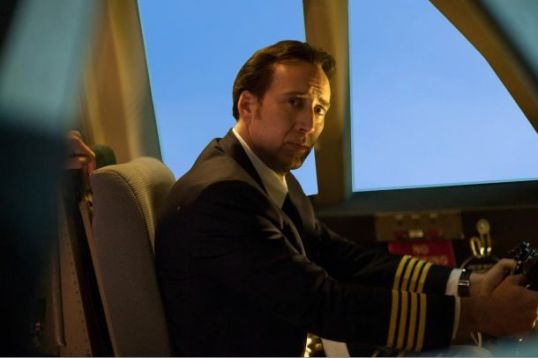
But we don’t want a restrained Cage in a film like Left Behind! We not only wanted him to go crazy, we needed him to go crazy! And he didn’t and, as a result, the film is even more disappointing than it would be otherwise.
Now, you may have noticed that I referred to Left Behind as being a “horror (?)” film in the title of this review. My argument there is that the film is obviously meant to scare nonbelievers. Indeed, this film was actually advertised with a pull quote from Satan. (“Please don’t take nonbelievers to this film.” — Satan.) Unfortunately, I think that Left Behind missed an opportunity. If the filmmakers had strictly focused on the horrific implications of being left behind — as opposed to trying to be both a sermon and a disaster movie, it probably would have been a lot more effective. Seriously, The Exorcist is probably the most effective religious film ever made.
Now, I do have to take issue with some of Left Behind‘s critics. Quite a few critics have made it a point to say, “Even if you agree with the film’s worldview, you’ll be annoyed by the bad acting and the bad directing…” Uhmmm …. no. Sorry, it doesn’t work like that. Usually, people will enjoy any film that supports their beliefs, regardless of how terrible it is. That goes for all people regardless of religion or ideology. We all enjoy having our beliefs confirmed.
But, yeah — Left Behind is pretty bad. Is it the worst film of the year?
Well, the year’s not over yet.
 Through the Shattered Lens