This October, I’m going to be doing something a little bit different with my contribution to 4 Shots From 4 Films. I’m going to be taking a little chronological tour of the history of horror cinema, moving from decade to decade.
Today, we complete the 1930s.
4 Shots From 4 Films
Dracula’s Daughter (1936, dir by Lambert Hillyer)
Revolt of the Zombies (1936, dir by Victor Halperin)
Sweeney Todd: The Demon Barber of Fleet Street (1936, dir by George King)
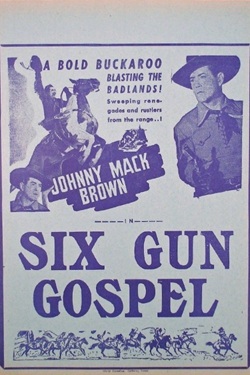
Marshals Nevada Jack McKenzie (Johnny Mack Brown) and Sandy Hopkins (Raymond Hatton) are sent to the frontier mining community of Goldville to determine who is responsible for hijacking all of the gold that should be coming out of the town. Not surprisingly, it’s all the work of another dastardly saloon owner (Kenneth MacDonald) who is planning on stealing all the gold, chasing off all the settlers, and then selling their land to the railroad company. While Sandy goes undercover as the town’s new preacher, Jack agrees to ride shotgun on a gold shipment, along with with Dan Baxter (Eddie Drew). Dan is in love with Jane Simms (Inna Gest), the daughter of honest miner Bill Simms (Kernan Cripps).
Johnny Mack Brown made a countless number of westerns for several different production companies but it seems like they always featured a crooked saloon owner and a plan to sell the land to a railroad company. Luckily, nobody watches these movies for the plots and that was probably true even when they were first released. People watch these movies for the nostalgia value of watching a movie where it’s good vs evil and good always triumphs without leaving any sort of lingering doubt about whether or not the heroes did the right thing. Johnny Mack Brown is as authentic on a horse and carrying a gun as he ever was and there’s a scene where he manages to get a gun despite being tied up that’s pretty cool. The appeal of Johnny Mack Brown was that he always seemed like he could do the things that he did in the movies in real life as well. Raymond Hatton provides comic relief, pretending to know the hymns being sung by his congregation and providing some songs of his own. There’s enough gun fights and horse chases to provide nostalgic happiness for fans of the genre and that’s the important thing.
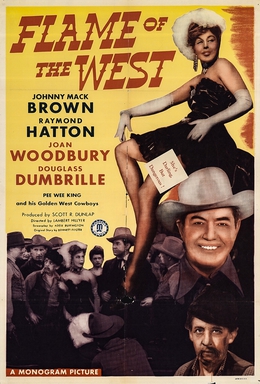
Marshal Tom Nightlander (Douglass Dumbrille) shows up in a lawless frontier town, tasked with bringing peace. He could sure use the help of Dr. John Poole (Johnny Mack Brown), a former gunslinger who has set his weapons aside and now works as the town doctor. Dr. Poole has sworn off guns but with corrupt businessman Wilson (Harry Woods) and his gang determined to keep their town lawless, Poole is soon forced to reconsider.
This B-western from Monogram is better than many of the other low-budget, poverty row westerns of the era. While the plot is another example of a corrupt businessman and his gang making life difficult for peaceful settlers, the characters in Flame of the West are a little more complex than usual. Brown stands out playing a character who, for once, doesn’t want to fight and believes that it’s better to talk than to shoot. Of course, this being a B-western, he soon sees the error of his ways. Dumbrille was usually cast as a villain so this film is a chance to see him in a likable and heroic role and he’s very convincing as a Wyatt Earp-style marshal.
Of course, even a serious B-western is still a B-western so songs and entertainment are provided by the gorgeous Joan Woodbury and Pee Wee King and his Golden West Cowboys. (Don’t worry, I had never heard of them before, either.) Joan Woodbury plays a saloon owner who wants to bring a higher class of entertainment to the frontier and she provides the film with enough sex appeal that 1945 audiences probably didn’t mind having to sit through the musical numbers before getting to the inevitable showdown between Johnny Mack Brown and Harry Woods.
Flame of the West is a good B-western that shows what dependable actors like Johnny Mack Brown and Douglass Dumbrille were capable of when given the opportunity.
4 Shots From 4 Films is just what it says it is, 4 shots from 4 of our favorite films. As opposed to the reviews and recaps that we usually post, 4 Shots From 4 Films lets the visuals do the talking.
It’s simply not the Halloween season without a little tribute to Bela Lugosi!
4 Shots From 4 Bela Lugosi Films
Island of Lost Souls (1932, dir by Erle C. Kenton)
The Black Cat (1934, dir by Edgar G. Ulmer)
The Invisible Ray (1936, dir by Lambert Hillyer)
The Return of the Vampire (1943, dir by Lew Landers)
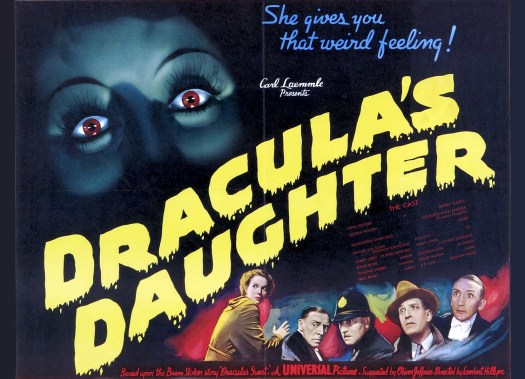
After the success of BRIDE OF FRANKENSTEIN , Universal decided it was time for a sequel to everybody’s favorite vampire, Dracula , with James Whale scheduled to direct. Whale opted out, putting DRACULA’S DAUGHTER in the hands of Lambert Hillyer , an old pro who dated back to silent William S. Hart Westerns, and was more comfortable with sagebrush sagas than Gothic horror. The result was an uneven film saved by Gloria Holden’s performance as the title character, Countess Marya Zaleska.
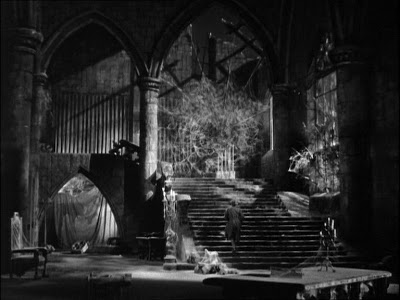
I’ll give Hillyer credit for some atmospheric scenes scattered throughout the movie. The opening scene at Carfax Abbey, cobwebbed as ever, picks up where DRACULA left off, with Edward Van Sloan’s Van Helsing (inexplicably renamed Von Helsing here) caught by constables shortly after staking the undead Count. The Countess burning the body of her vampiric father, hoping to free herself of her curse, is spooky, as is the return…
Well, Bram Stoker might disagree but, according to Universal Studios, he did. Her name was Countess Marya Zaleska and, as played by Gloria Holden, she is the title character in 1936’s Dracula’s Daughter! Like her father, the Countess was also a vampire. The film never gets into just how she became a vampire. Was she born a vampire or, far more disturbingly, was she once a mortal who turned into a vampire by her own father? The film doesn’t tell us but it does establish early on that she hates being one of the undead. Unlike her father, she struggles with her urge to drink blood. When she discovers that Dracula has been staked, she and her servant, Sandor (Irving Pichel), steal the body from the morgue and burn it. The Countess thinks that this will cure her of her urges.
Sadly, it does no such thing.
So, what’s a reluctant, 20th century vampire to do? Well, she can always go to a psychiatrist and hope that science can somehow break the curse. She ends up as a patient of Dr. Jeffrey Garth (Otto Kruger). By coincidence, Dr. Garth has another famous patient — Dr. Edward Von Helsing. (That’s right, they changed the “van” to a “von” in Dracula’s Daughter. Despite the name change, Edward van Sloan returns to play the veteran vampire hunter.)
Von Helsing in on trial, accused of murdering Dracula in the previous film. Oddly enough, nobody mentions Renfield who, seeing as how we’re told Dracula’s Daughter starts exactly where Dracula left off, would have been found dead in the crypt as well. Even stranger, no one steps forward to defend Von Helsing. Dr. Seward, Mina, Johnathan Harker? Forget about them. Not a single one is to be found while Von Helsing is accused of murder.
Bastards.
Fortunately, Von Helsing has a defense! Since Dracula was already dead and had been for 500 years, Von Helsing could not have killed him. Helping him out with this defense is Dr. Garth…
Meanwhile, the Countess tries to resist the urge to attack every woman that she sees. She pours her frustrations out into painting. One night, Sandor brings the Countess a new model, a beautiful young woman named Lil (Nan Grey). The Countess orders Lil to undress and then, after staring at her, gives into her urges and attacks…
If you’re thinking that there’s a subtext here, that’s because there is. (In fact, Universal’s tagline for the film was, “Save the women of London from Dracula’s Daughter!”) Perhaps even more so than in Dracula,Dracula’s Daughter uses vampirism as a metaphor for forbidden sex. When the Countess stares at Lil and, later, when she prepares to bite the neck of Dr. Garth’s fiancée, she is embodying the hysterical fears of a puritanical society. When she unsuccessfully seeks a cure for her vampirism, we’re reminded that, in the 1930s, psychiatry classified homosexuality as being a mental illness. When the Countess struggles with her urge to drink blood, she is a stand-in for everyone who has struggled with their sexuality.
Gloria Holden plays the Countess as being as much a victim as a victimizer. Whereas Bela Lugosi turned Dracula into the epitome of evil, Gloria Holden gives a performance that is full of ambiguity. In fact, she at times seems to be so tortured by her vampiric state that, when she finally fully embraces the fact that she’s a vampire, you have to cheer a little. At least she’s finally being honest with herself! At least she’s no longer making apologies or allowing society to punish her for being who she is. Was Countess Zaleska the first reluctant vampire in film history? I’m not sure but Holden’s performance undoubtedly set the bar by which all other self-loathing vampires should be judged.
Dracula’s Daughter holds up surprisingly well. It’s definitely one to look for during this Halloween season.
This October, I’m going to be doing something a little bit different with my contribution to 4 Shots From 4 Films. I’m going to be taking a little chronological tour of the history of horror cinema, moving from decade to decade.
Today, we complete the 1930s.
4 Shots From 4 Films
Dracula’s Daughter (1936, dir by Lambert Hillyer)
Revolt of the Zombies (1936, dir by Victor Halperin)
Sweeney Todd: The Demon Barber of Fleet Street (1936, dir by George King)





 Through the Shattered Lens