John Bourgignon (John Candy) is a man of many talents. He’s a limo driver. He’s a drummer. He is an occasional actor, having starred in Kung Fu U. for his friend, director Sal DiPasquale (Eugene Levy). John is also improbably engaged to Nancy Reece (Alley Mills), the daughter of Congressman and presidential candidate Ed Reese (Pat Hingle). As the wedding approaches, John deals with a number of things. He chauffeurs around a group of Spanish Beatles impersonators. He finds himself handcuffed to a fugitive (Ernie Hudson) who dies at an inopportune time. A cult leader (Richard Libertini) attempts to brainwash John into assassinating Ed, though the process might just turn John into a “schmuck.”
Going Berserk was John Candy’s first lead feature role and it was obviously designed to play to Candy’s popularity as one of the stars of SCTV. Going Berserk doesn’t gave a plot as much as it’s a collection of skits, some of which work better than others but all of which are held together by Candy’s comedic timing and amiable presence. Going Berserk is disjointed and wildly uneven but it’s also frequently funny and that is a testament to Candy’s talent. Even an overlong parody of The Blue Lagoon raises a smile because John Candy is just so committed to playing out the joke.
Going Berserk also features several familiar faces, like Richard Libertini, Pat Hingle, Ernie Hudson, Dixie Carter, Kurtwood Smith, Paul Dooley, and two of Candy’s SCTV co-stars, Eugene Levy and Joe Flaherty. I especially liked Levy’s performance as the sleazy director who blackmails his way into filming the wedding. Going Berserk was frequently stupid but, more often than not, it made me laugh.
Of the many films that have been made about people desperately trying to get the Hell out of New York City, Quick Change is one of the funniest. The appropriately-named Grimm (Bill Murray) works in the city planning office and has had all that he can take of New York’s crime and rudeness. His solution is to dress up like a clown and rob a bank. His girlfriend Phyllis (Geena Davis) and best friend Loomis (Randy Quaid) are already inside the bank, disguised as customers. When Grimm, who claims to be a “crying on the inside” type of clown, takes everyone in the bank hostage and forces them into the vault, Phyllis and Loomis grab as much of the money as they can. Talking on the phone to police chief Rotzinger (Jason Robards), Grimm makes a series of pointless demands. Each demand that is met leads to Grimm releasing a group of hostages. By removing his clown makeup, Grimm is able to join Phyllis and Loomis when they are “released.” Rotzinger, who has even managed to procure a monster truck, thinks that the robber is still in the bank while Grimm, Phyllis, and Logan head for the airport.
Of course, things don’t go as planned. What starts out as a energetic and good-natured Dog Day Afternoonparody quickly becomes an increasingly surreal journey through New York. The streets are in terrible condition. The signs that would have provided directions to the airport have been taken down by a road construction crew. (They explain that they’re only taking down the signs today and it will be a few days before they get around to putting them back up.) One of the few polite people they meet turns out to be a thief who steals four dollars from Grimm’s wallet but fails to notice that he’s got a million dollars taped around his waist. Stanley Tucci shows up as a mobster. Tony Shalhoub plays a well-meaning taxi driver who speaks his own indecipherable language. Grimm keeps running into rude cops who, despite being on the hunt for the bank robbers, are frequently too busy being rude to notice what’s happening in front of them.
Best of all, Grimm, Phyllis, and the increasingly addled Loomis board a bus being driven by the film’s greatest character. Played by Philip Bosco, the bus driver is a wonderful comedic creation. “That’s not exact change,” the driver says when Loomis attempts to pay him with a hundred dollar bill. “Behind the white line,” he says before starting the bus. When Loomis, who has a habit of running into things and appears to be suffering from a concussion, tries to sit down, the bus driver informs him that he’s not allowed to sit until he receives exact change. The driver has a schedule to keep and, to his credit, he largely manages to do so. Bosco plays him with such deadpan determination that it’s hard not to admire his dedication to following every single regulation to his job. As opposed to Grimm, the driver has learned to deal with living in New York by obsessively making every scheduled stop.
Quick Change struggles sometimes to balance its moments of humor and drama. Scenes of Loomis running like a cartoon character are mixed with scenes of Phyllis worrying that Grimm might actually be a hardened criminal and struggling with whether or not to tell him that she’s pregnant. This was Bill Murray’s first and only film as a director and sometimes, he does struggle to maintain a consistent tone. But, in the end, what’s important is that it’s a funny film. Bill Murray is one of those actors who can make you laugh just by existing and, as a director, he’s smart enough to give Jason Robards enough room to make Rotzinger into something more than just a standard comedic foil.
Quick Change is a comedic nightmare, one that made me laugh even as it also made me glad that I don’t have to drive in New York. I get lost just driving around the suburbs of Dallas. There’s no way I’d ever be able to find my way out of New York.
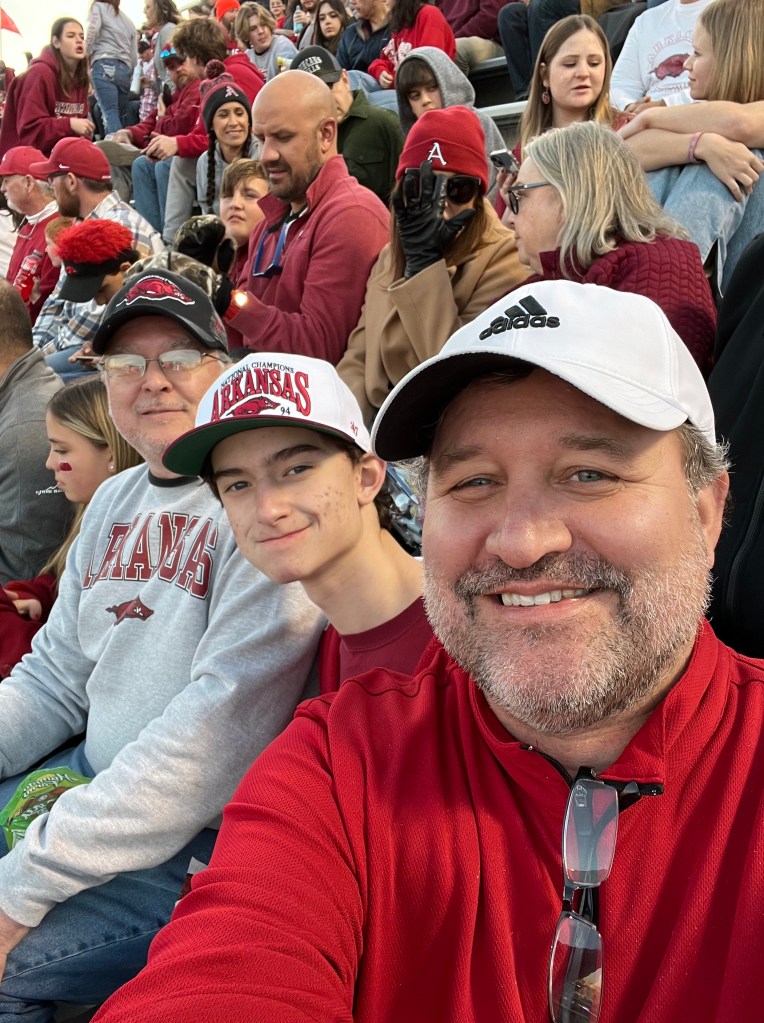
I don’t hear a lot about LAST OF THE DOGMEN, the 1995 modern day western starring Tom Berenger, Barbara Hershey and Kurtwood Smith. I love the movie, and I have for years. My buddy Chuck, his son Carter, and I recently drove up the hill to Fayetteville to watch the Arkansas Razorbacks play football. We had a great day! We ate at the Catfish Hole for lunch and then watched the Razorbacks beat Louisiana Tech 35-14. It was fun (See picture below for the happy crew). We had about a 3-hour drive home so we were talking about things we both love, like the Andy Griffith Show. Out of nowhere, Chuck said, “Do you want to know a movie I love? It’s called the LAST OF THE DOGMEN.” It was the last thing I was expecting to hear. I also love the movie. We talked about it and had a good time, but I made a mental note to watch it again soon. So here we are.
LAST OF THE DOGMEN opens with Sheriff Deegan (Kurtwood Smith) trying to find three escaped convicts in Northwest Montana. Deegan calls in the best tracker he knows, Lewis Gates (Tom Berenger), to go into the mountains to find the convicts. The two men have a history as Gates was married to the sheriff’s daughter, and the daughter died. The sheriff clearly doesn’t like Gates and blames him for his daughter’s death, but he knows he’s the man for the job. With Gates and his genius dog Zip right on their tails, the convicts are mysteriously killed by a group of men on horses who shoot them with arrows. Gates see the men riding off through a fog and is convinced they are Indians. He ends up seeking out the help of Native American historian Lillian Sloan (Barbara Hershey) to help him understand what he may have seen. He’s able to convince Lillian to ride into the mountains with him because he needs a translator if he actually finds anyone, and the two head off into the Oxbow. After a week of roughing it, they’re about to give up when they suddenly find themselves surrounded by the Indian dog soldiers. They’re taken as prisoners to the Indian camp, where the leader of the dog soldiers, Yellow Wolf, has a sick son. It seems he was shot by one of the escaped prisoners. Gates heads back to town to get penicillin for the son, which ultimately saves his life. Gates and Lillian spend some time getting to know and respect this isolated Cheyenne tribe. Meanwhile, Sheriff Deegan, unable to forgive Gates for the death of his daughter, gathers a group of men and they head into the Oxbow to find Gates. Will the Indians be able to have peace and live their lives like they did in the 19th century, or will they be discovered and forced to live out the fates of their ancestors? Well, if you haven’t seen it, just watch and enjoy!
As I said earlier, I’m a big fan of LAST OF THE DOGMEN. I was initially interested in the movie because I like Tom Berenger as a leading man. His SHOOT TO KILL with Sidney Poitier is a big time personal favorite. I also like him in PLATOON, SOMEONE TO WATCH OVER ME, BETRAYED, MAJOR LEAGUE, SHATTERED, SNIPER and THE SUBSTITUTE. He had been a big sex symbol earlier in his career. By the time of this film, he’s getting a little too old and heavy to be a sex symbol. In THE LAST OF THE DOGMEN, he’s actually very funny, and I really enjoy watching him have fun on screen. I’ll also go ahead and say that I’ve never been a huge fan of the actress Barbara Hershey, but she keeps showing up in movies I love. Outside of this, she’s also in HOOSIERS, and it’s one of my favorites. While there’s something about her I don’t really like, she is pretty good, and I do like her chemistry with Berenger. When they finally share a big smooch towards the end of the film, I liked it. And what can I say about Gates’ Australian cattle dog Zip? He’s an integral part of the story and saves Gates & Lillian’s asses on multiple occasions. At one point in the story, Lillian says “it’s disconcerting to know that the smartest member in our expedition is a dog!” It’s true!
I think the thing I like the most about the LAST OF THE DOGMEN is the idea that a group of Cheyenne Indians could be living out their lives the way they did a century ago. Something about that is romantic and magical to me, and it gave me an emotional interest in the film. Isn’t that why we really love movies? The best ones can reach into our souls and find something that’s valuable to us. I love the idea of Cheyenne Indians living out their heritage and protecting it at all costs. There’s something simple and meaningful about that. Director Tab Hunter really leans into this emotional truth. It’s the only film he would direct, and it seems to share the one message that meant the most to him. Most of us would give anything to have an opportunity to share with the world who we really are. Hunter got that opportunity and shared this movie. That’s pretty cool to me.
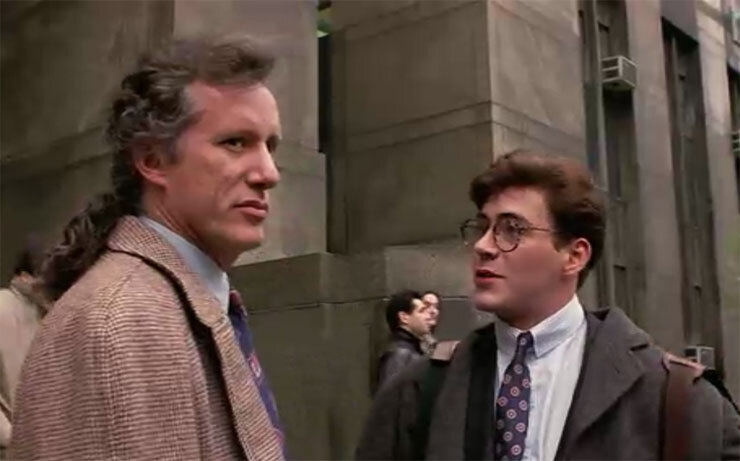
I’ve been going through my movies and re-watching some of my favorites. A movie that clearly falls into that category is TRUE BELIEVER starring James Woods and Robert Downey, Jr. I became a fan of James Woods around 1988 primarily based on the strength of two action films that he worked on around that time, those being BEST SELLER (1987) and COP (1988). I spent hours combing through the rental selections at our local Hastings Entertainment store and I remember both of these movies being in the “New Release” section at the same time. They’re both hard hitting, violent films, and Woods is especially good in both. Being an obsessive completist, I found myself searching out the prior work of the star for some more good movies. It was during this time that TRUE BELIEVER was released to the theaters in February of 1989. I enjoy courtroom dramas, and knowing the intensity that Woods brings to his films, I had no doubt I would like it.
The story revolves around Eddie Dodd (Woods), an attorney who used to fight for the cause of the little guy, but now mostly finds himself protecting drug dealers from the law. Enter Roger Baron (Downey Jr.), a recent law school graduate who idolizes Dodd, and is now disappointed to see his legal hero reduced to his current cynical state. When a Korean mother comes into the law offices one day and says her son, Shu Kai Kim, has spent 8 years in prison for a crime he didn’t commit, cynical Dodd doesn’t want to take the case. Young Baron shames him into it though, and soon the two men find themselves taking on the New York District Attorney himself Robert Reynard (Kurtwood Smith) as they try to prove Shu Kai Kim’s innocence and help him taste freedom once more!
Often when people ask me to name my favorite James Woods film, I’ll quickly answer TRUE BELIEVER even though there are many good films to choose from. There are a few reasons for that. First, even though the film is a serious legal thriller with many dark undertones, director Joseph Ruben has given his movie a dark sense of humor. Woods and Downey, Jr. are able to find the humorous elements inherent in their characters and that brings some fun to the otherwise serious proceedings. Second, I really enjoy the story of underdogs taking on the big, bad system. Shu Kai Kim is an underdog who maintains his innocence when all the evidence appears flawlessly stacked against him. Eddie Dodd, the once feared civil rights lawyer who is now a hopeless burnout, is an underdog who appears to be out of his league as he goes up against the most powerful attorney in New York. These underdog story lines give us something to really root for as the story plays out. And finally, the performances are phenomenal from top to bottom. James Woods, an actor known for his electric intensity, is at the top of his game and Kurtwood Smith is a great adversary. Robert Downey, Jr. brings a bright-eyed enthusiasm to the role that compliments the cynical Woods nicely. And Yuji Okumoto as Shu Kai Kim shows us quite a transformation from a man who goes from almost being dead inside as a result of his eight years in prison, to a man who allows a glimmer of hope to seep in for a second chance. I think Okumoto is great in the role. The story takes many twists and turns and I enjoy every moment as it plays out.
(Below, you will find spoilers for the final episode of The Dropout. I would recommend not reading this post until you’ve watched the episode.)
After all the drama and the deception, The Dropout ended the only way that it could, with Theranos in ruins, Sunny out of Elizabeth’s life, and Elizabeth still unable to comprehend why everyone got upset with her in the first place. While George Schultz tries to come to terms with his mistakes and Erika Cheung worries about whether or not she’s ruined her future career by coming out as a whistleblower, Elizabeth tries to do damage control by forcing Sunny out of Theranos and then going on television for a cringey interview that pretty much seals her fate. Both David Boies and Linda Tanner (Michaela Watkins, who became the unexpected heart of this episode) tell Elizabeth that it’s important that she come across as being contrite and sincerely “devastated” by Sunny’s actions. Elizabeth, however, can’t do it. As she explains to her mother, Elizabeth has been locking away her emotions for so long that she no longer knows how to express or even feel them.
The end of the episode finds Elizabeth finally pursuing the life that she would have led if she hadn’t dropped out of Stanford, started Theranos, and gotten involved with Sunny. She’s dating a younger man. She’s going to Burning Man. She owns a dog. She’s ditched the turtleneck. She’s let her hair down. She’s speaking in her real voice. She’s going by “Lizzie.” She’s reverted back to being the somewhat flakey child of privilege that she was at the start of the miniseries. Even while Linda Tanner confronts her with the number of lives that she and Theranos destroyed, Elizabeth doesn’t break her stride. Elizabeth has decided that she’s moved on, even if no one else can. It’s only when she’s alone that she briefly allow her composure to crack, just long enough to scream into the void.
Of course, the final title card informs us that it doesn’t matter how much Elizabeth wants to be Lizzie, the girl who goes to Burning Man with her boyfriend. Having been convicted of defrauding her investors, Elizabeth Holmes is currently awaiting her sentencing. She could end up spending the next twenty years in prison. And, just as Phyllis Gardner predicted in the previous episode, Elizabeth has made it difficult for other female entrepreneurs to find success in Silicon Valley.
As the episode came to a close, with Elizabeth walking through the now empty offices of Theranos with her dog and an increasingly agitated Linda, I found myself thinking about how those offices progressed through the series. Theranos went from a shabby office building in the worst part of town to being the epitome of Silicon Valley chic. In the early episodes, the cluttered Theranos offices and labs were disorganized but there was also a very sincere earnestness to them. Men like Ian Gibbons actually believed in what they were doing. By the fourth episode, Theranos transformed into a secretive place that was fueled by paranoia. With each subsequent episode, the offices became a bit less individualistic and bit more joyless. In the final episode, the offices were dark and deserted, as empty as Elizabeth and Sunny’s promises. Looking at those offices, it was hard not to mourn the lost idealism of those early days. Sunny may have never shared that idealism. The miniseries suggests that Elizabeth lost her idealism as soon as she finally started to get the positive publicity that she craved. But the people who were there at the beginning believed in Theranos and its stated mission. Even Elizabeth’s early investors were taking a chance because they thought she could make the world a better place. In the end, Elizabeth and Sunny betrayed all of them. As I said at the start of this review, The Dropout ended the only way that it could, with an empty office, a lot of broken hearts, and Elizabeth Holmes convinced that the world had somehow failed her. Viewers may never fully understand what was going on in Elizabeth Holmes’s mind but they’ll never forget her or the story of Theranos.
The Dropout was a good miniseries, probably the best that we’ll see this year. This is a miniseries that better be remembered come Emmy time. Amanda Seyfried seems to be a lock to at least get a nomination. Naveen Andrews deserves consideration as well. The supporting cast provides an embarrassment of riches. Sam Waterston, Dylan Minnette, Kurtwood Smith, Michaela Watkins, William H. Macy, the great Stephen Fry, Camryn Mi-Young Kim, Kate Burton, Anne Archer, and Laurie Metcalf, all of them are award-worthy. Give them the Emmy campaign that they deserve, Hulu!
Was she an idealist who got in over her head and ended up cutting corners with the best of intentions?
Was she a con artist who simply lied for the money?
Was she the abused and manipulated partner in a crime that masterminded by Sunny Balwani?
Or was she a sociopath who was simply incapable of feeling any empathy for the people that she manipulated and, in some cases, destroyed?
That’s the question that’s been at the heart of the first five episodes of The Dropout. It’s also a question that the show’s version of Elizabeth Holmes (played, brilliantly, by Amanda Seyfried) is struggling with. One gets the feeling that she herself doesn’t full understand what’s going on inside of her head. For the first half of the episode 5, Holmes is an almost sympathetic character. Still desperate for Sunny’s approval and seemingly convinced that Theranos can come up with some magic spell that will actually make the Edison work, Elizabeth comes across as being more self-delusional than malicious. For the first half of the episode, it’s like we’re watching the socially awkward but earnest Elizabeth who we first met at the beginning of the series. At her uncle’s funeral, she asks her mother if she ever had any hobbies when she was younger and her mom can only list several competitive activities that Elizabeth took part in. But, as becomes clear, Elizabeth never did anything just for fun or just for enjoyment. Instead, everything the she’s always done has been a part of an obsessive need to not only prove her own abilities but to also prove that she’s superior to other people.
Perhaps this strange mix of a grandiose self-image and gnawing insecurity is why she simply cannot bring herself to settle the lawsuit that’s been brought against her by Richard Fuisz (William H. Macy). Instead, with the help of her newest mentor, George Shultz (Sam Waterston), Elizabeth brings in David Boies (Kurtwood Smith). Boies is one of the leading lawyers in the United States. Before getting involved with Theranos, Boies tried to put Al Gore in the White House. After his involvement with Theranos, Boies tried to keep Harvey Weinstein out of jail. Boies failed on both accounts but he was far more successful when it came to battling Fuisz’s lawsuit. One of the key scenes in the episode comes when Schultz mentions that he and Boies are on different sides politically but that they’re willing to come together to protect Theranos. It doesn’t matter that Schultz is a Republican and Boies is a Democrat. What matters is that they’re both a member of the elite and Theranos, with its prestigious board of directors, is now a part of the elite as well. Richard Fuisz, with his terrible haircut and his excitable manner, is far too gauche to be allowed to defeat Theranos.
Indeed, Elizabeth spends most of this episode worrying about the lawsuit and also what might happen if Ian Gibbons (Stephen Fry) is called to testify. Gibbons’s name is on all of Theranos’s patents, along with Elizabeth’s. Gibbons is perhaps the one person who can testify that Elizabeth had nothing to do with designing any of Theranos’s equipment. When we first see Theranos’s legal team pressuring Ian to sign a statement saying that, as an alcoholic, he can’t testify, we’re left to wonder whether the team is working at the direction of Sunny, Boies, or Elizabeth. When Ian points out that signing such a statement will end his career, no one seems to care. Ian Gibbons goes home, plays with his dogs, listens to his favorite opera, says goodnight to his wife, and then kills himself.
Elizabeth’s reaction to Ian’s death tells us all we need to know about her and it pretty much erases whatever sympathy we may have had for her. She’s a bit like a robot, trying to generate the “right” emotions but not quite sure the proper way to do it. When told that Ian is dead and that the lawsuit is apparently dead as well, Elizabeth focuses on the finger puppets that she wants to stock in the Theranos Wellness Centers. The puppets are for children to wear after getting their finger pricked but they’re also a part of Elizabeth’s fantasy world, a world where Theranos will be fine and she’ll be as famous and beloved as Steve Jobs. And if that means that the Edison had to be built with technology with Sunny stole from another company, so be it.
The episode ends with Brendan (Bashir Salahuddin) quitting the company and George Schultz’s nephew, Tyler (Dylan Minnette), starting his first day. Using her fake voice, Elizabeth gives a speech to her cult-like employees. She talks about her uncle’s death and how it effected her and we know that it’s all a lie but Elizabeth sells it. The only disconcerting note comes from Sunny, who can’t stop himself from casually threatening to fire anyone who doesn’t share Elizabeth’s version. They’re a team. Elizabeth knows how to sell Theranos. Sunny knows how to terrify anyone who asks too many questions.
This was the first episode of the series to not be directed by Michael Showalter. Instead, it was directed by Francesca Gregorini and there are a few scenes where you really do miss Showalter’s ability to balance the absurd with the dramatic. That said, this episode worked due to the performances of not only Seyfriend and Naveen Andrews but also William H. Macy, Kurtwood Smith, and especially Stephen Fry. Fry especially broke my heart, even though I knew enough about the real story of Theranos that I already knew that Gibbons was going to take his own life. Still, Fry plays the role with such a wounded dignity that you are left with no doubt that Gibbons was the last of the true believers. He gave his life for Theranos and, in the end, Theranos gave him nothing in return.
The episode ends with Richard calling Phyllis Gardner (Laurie Metcalf), who was last seen telling a very young Elizabeth that there was no way to make the idea behind Theranos a reality. Phyllis tells Richard that Elizabeth is a fraud. And I have to admit that, as a viewer who had just spent 50 minutes with Elizabeth Holes and Sunny Balwani and David Boies, it was nice to hear someone come straight out and say it.
Next week, Tyler Schultz starts working at Theranos and he discovers that everything is not as it seems! It’s the beginning of the end for Theranos and I’m looking forward to watching it all come down.
Not only where they murdered in their sleep by a junkie loser who also happened to be a member of the family but, for the past five decades, their names have been slandered in a countless number of Amityville books and films. The house’s subsequent owner, George Lutz, realized that he could make a fortune by claiming that the murder house was haunted by a demon and, working with an author named Jay Anson, he did just that. Anson’s book, The Amityville Horror, was published in 1977. The first film version was released in 1979. Since then, there have been over 20 Amityville films, the majority of which feature reenactments of the DeFeo murders and all of which let Ronald DeFeo, Jr. off the hook by suggesting that it was the supernatural that led to the murders as opposed to a raging heroin habit.
With so many different films having been made by so many different directors and companies, it’s next to impossible to maintain any sort of consistent continuity from film to film. 2017’s Amityville: The Awakening acknowledges this in the most meta way possible by having the film’s lead character, Belle (played by Bella Thorne), watch the original film with two of her friends while discussing all of the sequels. In the world of Amityville: The Awakening, the films exist and the house is both famous and infamous. And yet, people still voluntarily live there.
The latest inhabitants are Joan (Jennifer Jason Leigh) and her three children, Belle, Juliet (McKenna Grace), and James (Cameron Monaghan). James is on life support after having been paralyzed in an accident and Joan is fanatically devoted to him. Though Dr. Milton (Kurtwood Smith) says that there’s no chance of James ever recovering and that he’s probably brain dead, Joan remains convinced that James will someday come back again. As she explains at one point, she’s abandoned her faith in God but she still has faith that there will be a way for James to recover.
No sooner has the family moved in then all of the typical Amityville stuff starts happening. Flies start buzzing around. The dog doesn’t want to be in the house. Juliet starts talking to people who aren’t there. One night, James flatlines but, after being dead for several minutes, his heart suddenly starts to beat again. Suddenly, James is showing indications that, though paralyzed and unable to speak, he is aware of his surroundings. Joan is convinced that James is recovering but is it possible that something else is happening?
If I may take the risk of damning with faint praise, Amityville: The Awakening is not bad for an Amityville film. Yes, you do have to wonder why the house has never been torn down and yes, I’m as bored with the big Amityville flies as anyone else. And the scenes where the characters discuss the DeFeo murders are icky and unethical as Hell. But, with all that in mind, this is actually one of the better-made Amityville films. Director Franck Khalfoun was also responsible for the better-than-it-had-any-right-to-be remake of Maniacand he brings a lot of energy to his direction here. He’s smart enough to realize that the audience is going to automatically roll their eyes at yet another Amityville film and he often rolls his eyes with them. As a result, we get some deserved digs at the shoddiness of the other films. Khalfoun is also smart enough to understand that Bella Thorne is more effective as a personality than an actress and, as such, the character of Belle is carefully developed to fit with Thorne’s public image. Jennifer Jason Leigh, on the other hand, is such a good actress that she actually brings some unexpected depth to the role of Joan and the film as a whole.
Amityville: The Awakening is one of the better Amityville films. You still have to wonder why that house is still standing, though. Seriously, tear it down already.
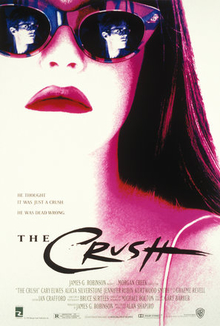
Darien or Adrian? Adrian or Darien? Who does Alicia Silverstone play in The Crush? It depends on which version you saw.
When the movie came out in theaters, she was named Darien because she was based on a real girl named Darien who writer/director Alan Shapiro claimed was obsessed with him. When the real-life Darien saw the movie and saw that she was portrayed as a psycho stalker, she was understandably pissed off and she sued Shapiro. As a result, when the film was re-edited for TV and later released on video, Darien suddenly became Adrian.
Whether Silverstone’s playing Adrian or Darien, the movie is still fairly lackluster. This movie came out when Alicia was still known for playing the lead in several sexually-charged Aerosmith videos and it features her doing the whole Lolita thing, which was very popular in the 90s. She becomes obsessed with her neighbor, Nick (Cary Elwes). Nick tries to be nice but when it become obvious that he’s not going to risk going to jail even if the the girl next door does look like Alicia Silverstone, Adrian/Darien starts trying to make his life Hell. She also tries to kill Nick’s girlfriend with a bunch of bees. Nick’s girlfriend is played by Jennifer Rubin, who was one of the best of the straight-to-video actresses of the 90s.
(Unlike Alicia’s other pre-Clueless starring turn, The Babysitter, The Crush was not straight-to-video but probably would have been if not for those Aerosmith videos. The Babysitter is also not very good but it’s an unsung classic when compared to The Crush.)
The Crush is one of those movies that got a huge push when it came out. MTV was all over it and the commercials were edited to make it look like a steamy thriller starring the girl that every boy had a crush on in 1993. I can’t remember if the movie got an R-rating or a PG-13 but I do know that my friends and I were bummed out when we were told we weren’t allowed to see it. Later, we rented it on video and discovered, not for the first time, that we were misled. The movie itself is really tame and Alicia’s miscast. She actually seems too level-headed to be the type who would try to kill Jennifer Rubin. Cary Elwes goes through the whole movie with a pained expression on his face, like he’s wondering how he went from The Princess Bride to this. Kurtwood Smith plays Alicia’s father and he was always good as a bad parent. It’s also always good to see Jennifer Rubin, even if her role here doesn’t allow her to show off the wicked playfulness that made her a late night Cinemax favorite. She definitely should have been a bigger star.
The main lesson to learn from The Crush? If you are going to portray an acquaintance as a murderous psycho, at least be smart enough to change the name. It will save you a lot of money and trouble.
Last week, I watched the original Robocop (along with Robocop 2 and Robocop 3) and I have to say that the first film holds up far better than I was expecting. Made and released way back in 1987, Robocop may be one of the most prophetic films ever made.
Consider the plot:
America is torn apart by crime and a growing gap between the rich and the poor. That was probably true in 1987 and it’s certainly true in 2021.
Throughout the film, we see news reports about what’s happening in the world. The news is always grim but the reporters are always cheerful and the main message is that, no matter what’s happening, the government is not to blame and anyone who questions the wisdom of the establishment is a fool. If that’s not a perfect description of cable news and our current state-run media, I don’t know what is.
The populace is often too busy watching stupid game shows to really pay attention to what’s happening all around them. I’m writing these words on a Wednesday, which means that Game of Talents will be on Fox tonight, immediately after The Masked Singer.
Detroit, a once proud center of industry, has now turned into a dystopian Hellhole where no one feels that they’re safe. Now, I don’t live in Detroit so I don’t know how true that is but I do know that most of the recent news that I’ve heard about the city has not exactly been positive. Also, this seems like a good time to point out that, even though the film is set in Detroit, it was shot in Dallas. Though the Dallas skyline has undoubtedly changed a bit since 1987, I still recognized several buildings while watching Robocop. Seeing Reunion Tower in the background of a movie that’s supposed to be set in Detroit was interesting, though perhaps not as interesting as seeing our City Hall transformed into the headquarters of Detroit’s beleaguered police force.
OCP, a multi-national conglomerate that’s run by the amoral but occasionally charming Old Man (played by the brilliant Dan O’Herlihy), has a contract with city of Detroit to run their police department. This certainly doesn’t seem far-fetched in 2021. Considering that we now have prisons that are run by private companies and that the government has shown a willingness to work with private mercenaries overseas, it’s not a stretch to imagine a city — especially one on the verge of bankruptcy — handing over the police department to a private company.
Two OCP executives — Dick Jones (Ronny Cox) and Bob Morton (Miguel Ferrer) — are competing to see who can be the first to create and develop a peace-keeping robot, a machine that will replace the need to employ (and pay) human police officers. Dick Jones goes with an actual robot, which malfunctions during a boardroom demonstration and guns down another executive. (The scene where the poor exec is targeted is both terrifying and darkly humorous at the same time. Particularly disturbing is how everyone in the boardroom keeps shoving him back towards the robot in order to ensure that they won’t accidentally be in the line of fire.) Bob Morton, however, takes a mortally wounded cop named Murphy (Peter Weller) and turns him into Robocop!
Robocop turns out to be a huge success and is very popular with the media. (Anyone who doubts this would really happen has obviously never watched news coverage of a drone attack.) As you can guess, Dick is not particularly happy about getting shown up by Morton and his robocop. Dick also happens to be secretly in league with Clarence Boddicker (Kurtwood Smith), the crimelord who blew Murphy apart in the first place.
(A gangster and a businessman working together!? I doubt that was shocking even in 1987.)
Robocop claims that he’s just a machine, without a past or emotions, but he’s still haunted by random flashes of his life as Murphy. Working with Lewis (Nancy Allen), Murphy’s former partner, Robocop tracks down Boddicker and his gang. A lot of people die in outrageously violent ways. (The scene where Boddicker and his gang use a shotgun to torture Murphy is still shocking, even after all these years.) The violence is so over-the-top that it soon becomes obvious that director Paul Verhoeven is deliberately trying to get those of us watching to ask ourselves why we find films like this to be so entertaining. On the one hand, Robocop is an exciting action film with a sense of humor. On the other hand, it’s the type of subversive satire of pop and trash culture to which Verhoeven would return with Basic Instinct, Starship Troopers, and Showgirls. This is the type of film that asks the audience, “What are you doing here?”
34 years after it was first made, Robocop remains a triumph. Peter Weller’s performance holds up well, as he does a great job of capturing Robocop’s anguish while, at the same time, never forgetting that the character is ultimately a machine, one that’s trapped in a sort of permanent limbo. I also really liked the performance of Miguel Ferrer, who takes a character who should be unlikable and instead makes him into a surprisingly sympathetic figure.
Of course, a film like this lives and dies on the strength of its villains and both Ronny Cox and Kurtwood Smith are ideally cast as Dick Jones and Clarence Boddicker. Kurtwood Smith especially took me by surprise by how believably evil and frightening he was. As a I watched the film, I realized that it was his glasses that made him so intimidating. Wearing his glasses, he looked like some sort of rogue poet, a sociopathic intellectual who had chosen to use his talents to specifically make the world into a terrible place. Boddicker’s crew was full of familiar actors like Paul McCrane, Ray Wise, and, as the always laughing Joe Cox, Jesse Goins. Interestingly enough, all of the bad guys seemed to genuinely be friends. Even though they were all willing to betray each other (“Can you fly Bobby?”), they also seemed to really enjoy each other’s company. That somehow made them even more disturbing than a group of bad guys who were only in it for the money. The villains in Robocop really do seem to savor the chance to show off just how evil they can be.
(Incidentally, for all of the Twin Peaks fans out there, this film features three members of the show’s ensemble: Miguel Ferrer, Ray Wise, and Dan O’Herlihy.)
Robocop holds up well as entertainment, prophecy, and satire. Though not much was expected from it when it was first released, it became a surprise hit at the box office. Needless to say, this led to a sequel. I’ll deal with that film in about an hour.
We’re still in the process of recovering from last week’s winter storm down here and I have to admit that, for me personally, it’s been a bit of a struggle to actually maintain my focus. Last week’s combination of power outages and freezing weather threw me off of my usual rhythm and I’m still getting it back.
Fortunately, I have a little help from my friends. Earlier tonight, a group of us watched the 1983 film, Staying Alive.Staying Alive is the somewhat notorious sequel to Saturday Night Fever. If Saturday Night Fever was actually a dark and gritty coming-of-age story disguised as a crowd-pleasing musical, Staying Alive is …. well, it’s something much different. It’s a film about dancing and Broadway, directed and at least partially written by Sylvester Stallone. Why exactly would anyone think that Sylvester Stallone was the right director to make a movie about dancing and Broadway? Your guess is as good as mine but, in the end, the important thing is that Stallone wrote a key supporting role for his brother, Frank Stallone. Frank not only performs several songs but he proves that he can glare with the best of them.
As for the film itself, it opens with Tony Manero (John Travolta) having left behind Brooklyn and the world of disco. Now, he lives in Manhattan, he teaches a dance class, he humiliates himself looking for an agent, and he’s struggling to make it on Broadway. (Basically, he’s turned into Joey from Friends.) When Tony’s lucky enough to get cast in a lavish musical called Satan’s Alley, Tony has a chance to become a star but only if he can …. well, I was going to say control his ego but actually, his ego isn’t that much of a problem in Staying Alive. Actually, there’s really nothing standing in Tony’s way, other than the fact that — in Staying Alive as opposed to Saturday Night Fever — he’s portrayed as kind of being an irredeemable idiot. If Saturday Night Fever was all about revealing that Tony was actually smarter and more sensitive than he seemed, Staying Alive seems to be all about saying, “Whoops! Sorry! He’s just as obnoxious as you thought he was.”
Staying Alive is a notoriously ill-conceived film, though it’s also one of those films that’s just bad enough to be entertaining when viewed with a group of snarky friends. That said, the opening credits montage — which features Tony dancing while Kurtwood Smith glares at him — is actually pretty good. Travolta smolders with the best of them and the sequence does a good job of capturing Tony’s mix of desperation and determination. It’s unfortunate that Kurtwood Smith pretty much disappeared from the film following the opening credits. Judging from what little we see of him, Smith would have been pretty entertaining as a permanently annoyed choreographer. Finally, how can you not love the neon credits? This a scene that screams 80s in the best possible way.
So, while I continue to work on getting back to my usual prolific ways, why not enjoy this scene that I love from Staying Alive?
 John Bourgignon (John Candy) is a man of many talents. He’s a limo driver. He’s a drummer. He is an occasional actor, having starred in Kung Fu U. for his friend, director Sal DiPasquale (Eugene Levy). John is also improbably engaged to Nancy Reece (Alley Mills), the daughter of Congressman and presidential candidate Ed Reese (Pat Hingle). As the wedding approaches, John deals with a number of things. He chauffeurs around a group of Spanish Beatles impersonators. He finds himself handcuffed to a fugitive (Ernie Hudson) who dies at an inopportune time. A cult leader (Richard Libertini) attempts to brainwash John into assassinating Ed, though the process might just turn John into a “schmuck.”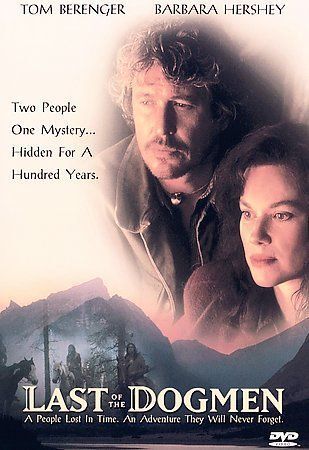



 Through the Shattered Lens