April True Crime: The Wizard of Lies (dir by Barry Levinson)


For many people, Bernie Madoff is a still a name that summons hate.

Madoff was the owner of Bernard L. Madoff Investment Securities, a firm that was a family business.  He ran it with his two sons, Mark and Andrew, and he gained a reputation for being a financial wizard, someone who never lost money and who always returned a profit for everyone who trusted him with their money.  He was someone who took money from the famous and the ordinary, the rich and the middle class, and he promised everyone that he would do wonderful things with that cash.  He lived in a fabulous home in New York City.  He had business and political connections.  His firm was, at one point, ranked as the sixth biggest on Wall Street but Madoff, himself, tried to keep a low-profile.

Of course, Madoff was a liar.  While his brokerage firm actually did make money, the asset management part of his business was actually a massive Ponzi scheme.  He took his clients’ money for himself and then kept everyone at bay by sending them fake documents that showed how well their investments were doing.  As long as the economy remained strong, Madoff had nothing to worry about.  People gave him their money, assumed it was safe, and then went away.  But when the stock market crashed in 2008, Madoff realized that his panicked clients would be coming for their money and he wouldn’t be able to give it to them.

Overnight, Madoff’s life collapsed.  He spent the rest of his days in prison, having been turned in by his own sons.  One son committed suicide, the other would die of cancer with his last words apparently being that his father was dead to him.  It was the biggest case of financial fraud in United State history and the majority of Madoff’s clients lost all of the money that they had given to him.  It was subsequently learned that many people had spotted red flags when it came to Madoff and his business.  (The fact that Madoff claimed to never lose money should have been a huge one.)  But Madoff invested his money in politicians and he never faced a real investigation until it was too late.  Madoff spend the rest of his days as a symbol of everything wrong with Wall Street.

Not surprisingly, quite a few movies were inspired by Bernie Madoff’s crimes, some of them featuring characters based on him and a few being about the case itself.  Produced by HBO, 2017’s The Wizard of Lies stars Robert De Niro as Madoff, Michelle Pfeiffer as his wife, and Alessandro Nivola as his son, Mark.  Directed by Barry Levinson, The Wizard of Lies follows Madoff as his Ponzi scheme collapses and it shows how the grand deception started.  Robert De Niro plays Madoff as being essentially soulless, a sociopath who knew he would eventually get caught but who just couldn’t bring himself to stop stealing people’s money.  Indeed, as played by De Niro, Madoff comes across as being one of the most joyless criminal masterminds in history.  He’s fooled everyone but he can’t enjoy it.  The impression that one gets is that Bernie Madoff was a pretty boring guy.  Perhaps that’s why people were willing to trust him with their money.  Someone that boring had to be trustworthy!  Many people have claimed that there’s no way that Mark and Andrew Madoff couldn’t have know what their father was doing.  In the film, one gets the feeling that Mark and Andrew knew something was going on but they decided to willfully blind themselves to what was happening around them.  The film hints that was Madoff’s secret power.  No one wanted to admit that his success was too good to be true.

The Wizard of Lies really doesn’t reveal anything new about the Madoff case.  Madoff’s crimes were actually pretty simple.  He wasn’t a criminal genius.  He was just someone who understood the importance of telling people what they wanted to hear.  Still, it’s a well-acted movie and, if you’re just looking for the facts of the case, The Wizard of Lies will give them to you.
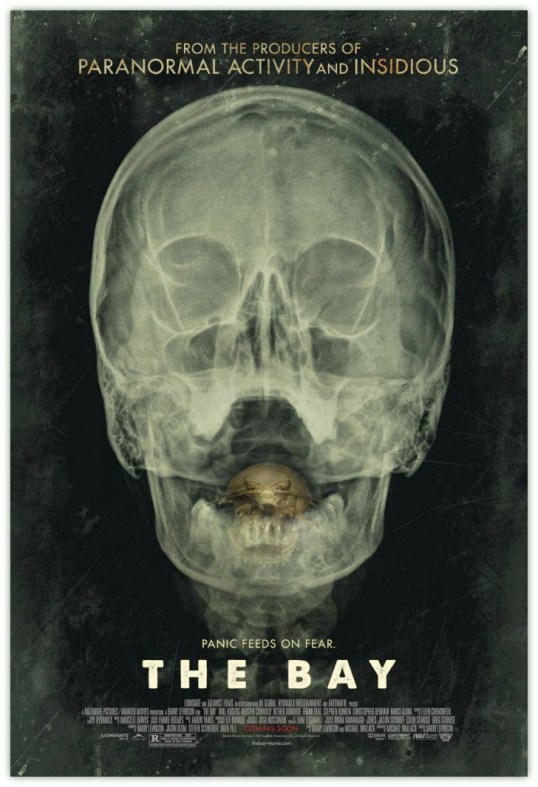
Horror Trailer: The Bay (by Barry Levinson)


Another found footage horror flick is on it’s way to the cinemas in less than a month. This one just happens to have some heavyweight pedigree behind it. While it has producers of the Paranormal Activity series and one of this year’s surprise horror entries with Insidious it’s who ended up directing this found footage horror film that has given the film buzz since it’s premiere at this year’s Toronto International Film Festival.

Barry Levinson, he of Academy Award-winning fame for Best Director for Rain Man, does directing duties for The Bay and from reaction since it premiered at this year’s TIFF he has made a found footage horror film that is worth seeing. The scenes and trailers shown tells the story of an incident a couple years back in a seaside Maryland town which becomes part of a wide-ranging government cover-up. A cover-up meant to hide hundreds of deaths and the cause of it.

I’m not a huge fan of found footage films, but I do enjoy those that are well-done and brings something fresh to the table. If The Bay is even half of what the buzz and hype is saying about it then I think it’s going to be one that I plan to check out when it comes out in the next couple weeks.

The Bay is set for a November 2, 2012 release date from Lionsgate.

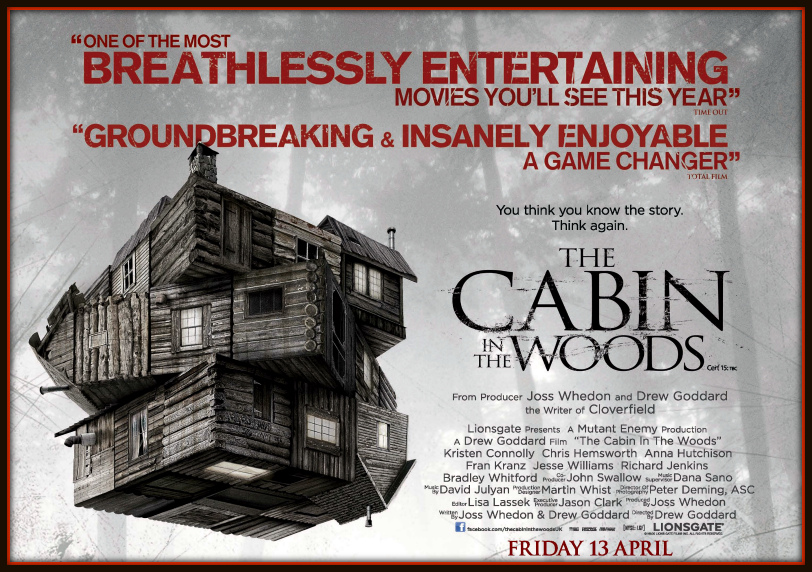
**Spoilers** Review of The Cabin In The Woods


Originally I wasn’t going watch this because of pathological hatred of Zucking Fombies. Fortunately, Arleigh told me that it was more than those wretched Zucking Fombies. The Cabin In The Woods is sheer brilliance because Whedon and Goddard turned the tired and cliched horror formula on its ear. Their collaboration freed us from the oppression of torture porn and loathsome gore for the sake of gory credo.

**Spoilers begin here**

In this film world, every horror film nightmare creature from the shambling zombies to snarling werewolf to a Cenobite analogue to Lovecraftian elder gods exist.  As a fan of Whedon’s Buffy The Vampire Slayer series, I couldn’t help but see similarities between the TCITW’s world and the world of the Slayer.  So the description, “It’s like an episode of Buffy with gore, cussing, and naughty bits, but no Buffy Summers” is pretty accurate. The presence of Amy Acker (Winifred “Fred” Burkle) from Angel fame cemented this opinion. The film cast could easily be stand-ins for the Scoobies with Marty playing Xander Harris, David as Riley, Dana as Willow, etc. The mysterious shadow organization could easily be division of Wolfram & Hart and the slumbering elder gods could replace the Senior Partners as well as Buffy’s Big Bad. I found it interesting and clever that the token victims served as the required sacrifice to appease slumbering boogie men because it explained why the fool, the virgin, the scholar, the jock, and the party girl are always the victims of horror movies. I also loved that the grumpy old man that cryptically warns the kids also served a purpose.

The film is also reminiscent of Mike Mignola’s Hellboy universe in the sense that the evil and violence had a higher purpose.  The nightmare creatures could easily be Ogrdu Hem carrying out the will of their parents, the Ogdru Jahad. The secret organization had the dual role of the BPRD and Rasputin.  They were like the BPRD in the sense they prevented the end of the world and captured/contained/employed the things that go bump in the night. They were like Rasputin because they reverenced the elder beings and paid them annual tribute.

Found the following things interesting:

  1. The plot to keep the elder gods happy was a global one (other nations like Japan were involved).
  2. The wide range of monsters that the organization captured (made me wonder how they were able to capture the most lethal ones like the Cenobite wannabe, werewolf, soul stealing ghost, etc).
  3. The causal office vibe the organization had despite their morbid mission.
  4. The elder gods represented the audience/horror audience (an interesting point brought to my attention by a friend)

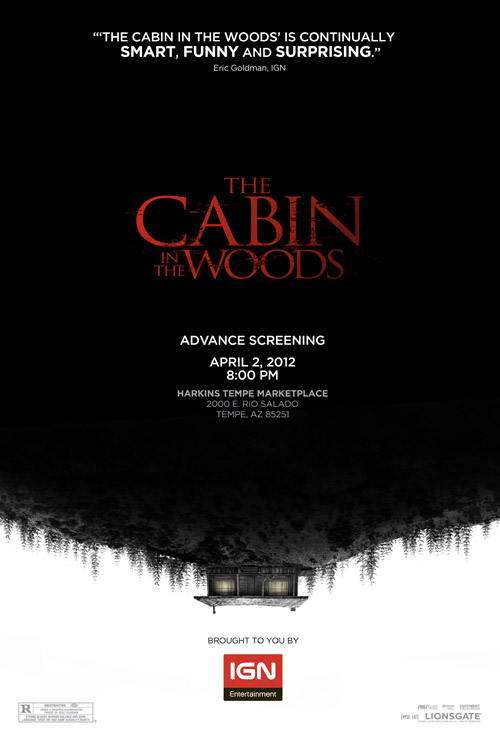
Quickie Review: The Cabin in The Woods (dir. by Drew Goddard)


“If you hear a strange sound outside… have sex.”

If there was one thing the meltdown and subsequent bankruptcy of MGM ended doing it was shelving the Drew Goddard and Joss Whedon horror film The Cabin in The Woods for almost three years. The film was directed by Goddard who also helped co-write the screenplay with Joss Whedon and what we get is one of the smartest and most innovative horror films to come in over a decade. For fans of the tv shows Buffy: The Vampire Slayer and Angel (not to mention Dollhouse) this horror film just reinforces the notion that Joss Whedon knows how to write smart dialogue and premises without ever getting too self-referential and deconstructionist (I’m looking at you Kevin Williamson) or too smart-talky (a stank-eye at you Aaron Sorkin).

There’s really no way to properly review The Cabin in The Woods without spoiling the films many different surprises and twists and turns. I will say that the film does a peculiar opening that focuses not on the five college students headed to the cabin in the woods of the film’s title, but on two men (Richard  Jenkins and Bradley Whitford) in your typical office attire doing the walk and talk about family home life and the like. We see that they’re technicians in an unnamed industrial facility that wouldn’t look out of place in one of the many governmental facilities we often see in film. The film will return to these two men and their facilities and other people working within often in addition to telling the story of the five college students and the growing danger they find themselves in as night falls in the woods.

To say anymore would definitely be a spoiler.

I will continue on and say that for a horror film written to self-reference other horror film conventions and tropes what Goddard and Whedon have ultimately done was celebrate the genre itself and how much of an impact it has had in society. Unlike films like the Scream franchise, The Cabin in the Woods doesn’t knowingly wink at the audience about how cool it is for pointing out all the horror cliches and stereotypes we’ve come to expect in the horror genre. Instead the film actually treats its audience to be smart enough to see the homage to past horror films both good and bad without ever drawing attention to the fact that they’re pointed out.

Another thing which makes this film so fun to watch is how much every character in the film comes across as fully realized individuals. Even the college students who we first think of as your typical horror film stereotypes (the jock, the slut, the virgin, the brain and the stoner) end up being more than we’re led to believe. All of this actually occurs right in the beginning and this helps the audience join in on the fun that both Goddard and Whedon are having in turning the horror genre on its head right up to it’s surprising conclusion. It helps that the cast did quite a great job realizing their characters. As the film progresses we even begin to get a sense that who the villains in the film may or may not be who we think.

There’s a sense of fun and the darkly comic to the film as well. Every one-liner and comedic beats we get throughout the film doesn’t have a sense of the cynical to them. It comes across through dialogue and actions by both groups in the film in such a natural way that they never make those saying the lines break the fourth wall. Most films that try to deconstruct genre films tend to get too cutesy with the breaking the fourth wall gimmick that the audience can’t help but be pulled out of the suspension of disbelief they’ve put themselves in. This has a way of making such genre films less fun and celebratory and more of making fun of the people who enjoy such things.

The Cabin in The Woods manages that rare accomplishment of being a horror film that retains not just the horrific aspect of the genre but also add such a darkly comic sense to the whole proceeding with such a deft touch from Goddard and Whedon that we don’t know whether to call it straight horror or a horror-comedy. Some might even see the film as an entertaining treatise on the nature of the horror film genre of the last quarter-century. Both Goddard and Whedon have already called this film as their answer to the current trend of the “torture porn” that was popularized with the help of such recent horror franchises like Hostel, Saw and those made by Rob Zombie. Where those films celebrated the concept of inflicting pain not just on the characters on the screen but those who watch them with The Cabin in The Woods we finally get a reminder why we love the horror films of the past. It’s through the sense of that adrenaline rush that a tension build-up leading to a horror money shot but without becoming overly gratuitious and reveling in the pain of the horror.

Some have said that The Cabin in The Woods is the best horror film of 2012. I won’t even argue with that statement since it is true. I will put it out there that Cabin in The Woods might just be one of the best films of 2012. The film is just that fun, smart and, overall, just plain awesome.

[I usually attach a trailer to reviews but this time doing it could spoil some of the surprises in the film]