An Offer You Can’t Refuse: Irish Eyes (dir by Daniel McCarthy)


First released in 2004, Irish Eyes tells the story of two brother, born eleven months apart.

Tom Phelan (John Novak) is the older brother, the one who is destined to go to law school, join the Justice Department, and to marry Erin (Veronica Carpenter), the daughter of one of Boston’s most prominent attorneys.  Tom’s future lies in politics.  As he makes his reputation by taking down members of the Boston underworld, he finds himself being groomed for attorney general and then who knows what else.

Sean Phelan (Daniel Baldwin) is the younger brother.  Haunted by the murder of his father and stuck at home taking care of his mother (Alberta Watson) while Tom goes to college, Sean soon pursues a life of crime.  He falls under the influence of the Irish mob, led by Kevin Kilpatrick (Wings Hauser).  Sean quickly works his way up the ranks.  It doesn’t matter how much time he does in prison.  It doesn’t matter how many people he has to kill.  It doesn’t matter if it alienates the woman that he loves or if it damages his brother’s political career, Sean is a career criminal.  It’s the one thing that he knows.  When Sean finds himself as the head of the Irish mob and also the American connection for the IRA, his activities are originally overlooked by his brother.  Sean even threatens a reporter who makes the mistake of mentioning that Sean and Tom are brothers.  But soon, Tom has no choice but to come after his brother.  What’s more important?  Family or politics?

Obviously (if loosely) based on Boston’s Bulger Brothers (Whitey became a feared criminal while brother John became a prominent Massachusetts politico), Irish Eyes doesn’t really break any no ground.  Every mob cliché is present here and so is every Boston cliché.  Don’t rat on the family.  Don’t betray your friends.  The only way to move up is to make a move on whoever has the spot above you.  Every bar is full of angry Irish-Americans.  Every fight on the street turns deadly.  Everyone is obsessed with crime or politics.  The film, to its credits, resists the temptation to have everyone speak in a bad Boston accent.  (The Boston accent, much like the Southern accent, is one of the most abused accents in film.)  Sean narrates the films and you better believe he hits all of the expected points about life on the street.

That said, it’s an effective film with enough grit and good performances to overcome the fact that it’s just a wee predictable.  Daniel Baldwin is appropriately regretful as Sean and John Novak does a good job of capturing the conflict between Tom’s love of family and his own political ambitions.  Curtis Armstrong shows up and is surprisingly convincing as a psychotic IRA assassin.  Admittedly, the main reason that I watched this film was because Wings Hauser was third-billed in the credits.  Hauser only appears in a handful of very short scenes and that’s a shame.  In those few scenes, he has the rough charisma necessary to be believable as the crime boss who holds together the neighborhood and it’s hard not to regret that he didn’t get more to do in the film.  That said, the film still works for what it is.  It’s a good mob movie.

This film was originally entitled Irish Eyes.  On Tubi, it can be found under the much clunkier name, Vendetta: No Conscience, No Mercy.

Lisa Reviews An Oscar Winner: CODA (dir by Sian Heder)


Remember CODA?

I ask that because this 2021 film often seems to be forgotten about when people discuss the films that have won the Oscar for Best Picture. Indeed, when the Oscar nominations were first announced for that year, many commentators treated the film’s nomination as an afterthought.  It was pointed out that CODA only had a total of three nominations, for Picture, Adapted Screenplay, and Best Supporting Actor.  It was expected that Troy Kostur would win Best Supporting Actor but it was also felt that Best Picture would be won by one of the big nominees, like The Power of the Dog, Belfast, or West Side Story.

But, interestingly enough, the momentum began to shift shortly after the nominations were announced.  The nomination brought the film to an entirely new audience, all of whom could stream the movie on Apple TV+.  The members of the Academy who hadn’t seen the film before the nominations were announced watched the film and many reportedly fell in love with the simple but touching story of a teenage girl who must decide whether to go to music school or to stay at home with her deaf parents and older brother.  By the time the Academy Awards were held, CODA had become the new front runner.

How did this happen?  A lot of it had to do with the fact that CODA was an unabashedly emotional story, one that was specifically made to bring tears to the eyes of the audience.  CODA was more humanistic than the remote and cold Power of the Dog.  Whereas both West Side Story and Belfast were obviously made with Oscar glory in mind, the low-budget CODA felt as if it simply wanted to tell a good story.  Unlike Dune, CODA was not made to launch a franchise and, unlike King Richard, it was about more than just one performance.  Its straight-forward approach provided quite a contrast to the stylized flourishes of Nightmare Alley and Licorice Pizza.  (Incidentally, Nightmare Alley and Licorice Pizza were my two favorite films of the year.)  It should also be remembered that CODA, like the previous year’s Nomadland, was watched while many people were still hiding their faces behind masks, terrified of catching COVID.  It was a time when many people were yearning for something that would just make them feel good.

And whatever else one might say about CODA, it’s definitely a feel good movie.  From the wonderful moments when Ruby (Emilia Jones) discovers her love for singing to the slyly humorous and emotionally honest performances of Troy Kostur, Marlee Matlin, and Daniel Durant as Ruby’s parents and brother, CODA is a film that will make you smile and think about the people who you consider to be your family.  It’s a sweet movie, one that reminds us that it’s okay to get emotional and that it’s okay to tell people that you love them and that, as an artform, film can be used for something other than just comic book adaptations.

That’s not say it’s a perfect film, of course.  Those who complained that CODA had the flat look of a made-for-TV movie were not incorrect and the fact that most people ended up watching the movie on TV (or, in my case, on a laptop) did not help with the issue.  As Ruby’s music teacher, Eugenio Derbez gives a rather broad performance that often fells at odd with the more realistic work of the rest of the cast.  The film had its flaws but it also made me smile and the end brought real tears to my mismatched eyes and there’s something to be said for that.  During a year when many people were still afraid to get close to anyone else, CODA was a film that celebrated love, family, and community.

Did CODA deserve to win Best Picture?  Like I said, I would have given the Oscar to either Nightmare Alley or Licorice Pizza but I liked CODA and, looking back, I certainly prefer its positive vibes to the well-made emptiness of Power of the Dog.  The low-key CODA is probably destined to join The Artist and Argo as one of the best picture winners that people tend to forget but no matter.  It’s a film that holds up well and, in 2021, it was exactly the film that a lot of people needed.

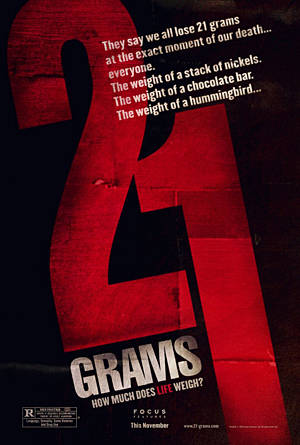
Embracing the Melodrama Part II #103: 21 Grams (dir by Alejandro Gonzalez Inarritu)


21_grams_movieRemember how shocked a lot of us were when we first saw Birdman?  Well, it wasn’t just because Birdman featured an underwear-clad Michael Keaton levitating in his dressing room.  And it also wasn’t just because Birdman was edited to make it appear as if it had been filmed in one continuous take (though, to be honest, I would argue that the whole “one continuous shot” thing added little to the film’s narrative and was more distracting than anything else.)  No, the main reason we were shocked was that Birdman was directed by Alejandro Gonzalez Inarritu and, when we thought of an Inarritu film, we thought of something like 2003’s 21 Grams.

It’s not easy to explain the plot of 21 Grams, despite the fact that 21 Grams does not tell a particularly complicated story.  In fact, if anything, the plot of 21 Grams feels like something that either Douglas Sirk or Nicholas Ray could have come up with in the 50s.  Indeed, the plot of 21 Grams is far less important than the way the Inarritu tells the story.  (In that, the dark and grim 21 Grams does have something in common with the arguably comedic Birdman.)

Inarritu tells his story out of chronological order.  That, in itself, is nothing spectacular.  Many directors use the same technique.  What distinguishes 21 Grams is the extreme to which Inarritu takes his non-chronological approach.  Scenes play out with deceptive randomness and it is left to the viewer to try to figure out how each individual scene fits into the film’s big picture.  As you watch 21 Grams, you find yourself thankful for little details like Sean Penn’s beard, the varying lengths of Naomi Watts’s hair, and the amount of sadness in Benicio Del Toro’s eyes because it’s only by paying attention to those little details can we piece together how once scene relates to another.

The film tells the story of three people whose lives are disrupted by the type of tragedies that the pre-Birdman Innaritu was best known for.

Sean Penn plays Paul Rivers, who is a sickly mathematician who desperately needs a new heart.  He’s married to a Mary (Charlotte Gainsbourg), who devotes all of her time to taking care of him and is frustrated by Paul’s fatalistic attitude towards his condition.  When Paul does finally get a new heart, he gets a new existence but is haunted by the fact that it has come at the expense of another man’s life.

Christina Peck (played by Naomi Watts) is a former drug addict who is now married with kids and who appears to have the perfect life.  That is until her husband and children are tragically killed and, in her grief, Christina falls back into her old lifestyle.  The formerly stable and happy Christina becomes obsessed with the idea of getting revenge for all that she has lost.  Naomi Watts was deservedly nominated for an Oscar for her work here.  Her vulnerable and emotionally raw performance holds your interest, even when you’re struggling to follow the film’s jumbled chronology.

And finally, there’s Jack Jordan (Benicio Del Toro).  Like Christina, Jack is a former drug addict.  Whereas Christina used the stability of family life to help her escape from her demons, Jack uses his new-found Christianity.  And just as Christina struggles after she loses her family, Jack struggles after tragedy causes him to lose his faith.  Like Paul, he struggles with why he’s been allowed to live while other have not.  Del Toro was nominated for an Oscar here and, like Watts, he more than deserved the nomination.

(While Sean Penn was not nominated for his performance in 21 Grams, he still won the Oscar for his role in Mystic River.)

21 Grams is a powerful and deeply sad film, one that will probably shock anyone who only knows Inarritu for his work on Birdman.  21 Grams is not always an easy film to watch.  Both emotionally and narratively, it’s challenging.  But everyone should accept the challenge.


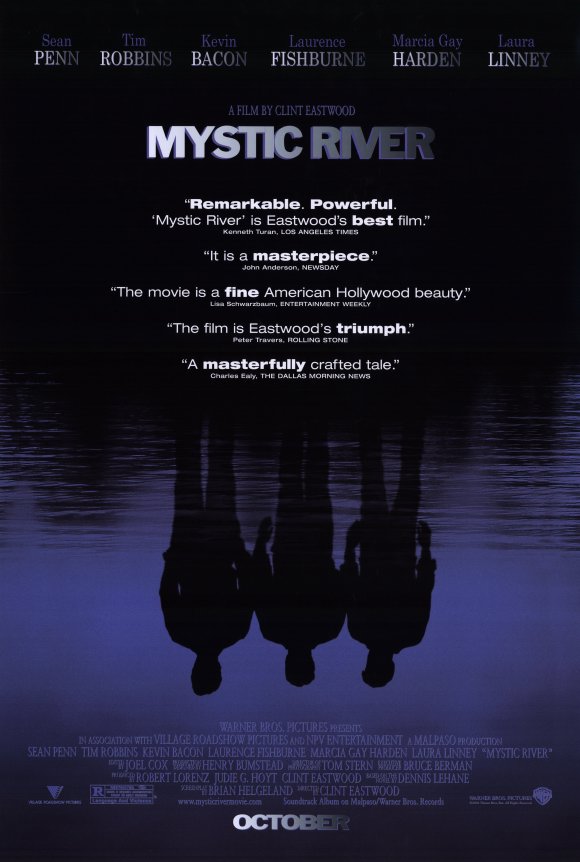
Embracing the Melodrama #51: Mystic River (dir by Clint Eastwood)


mystic-river

Much like In The Bedroom, 2003’s Mystic River is a film that deals with guilt, murder, and vengeance in New England.  Whereas In The Bedroom deals with the guilt of just four people, Mystic River deals with the guilt of an entire neighborhood.

Mystic River opens in Boston in 1975.  Three young boys are writing their names in wet cement when a car pulls up beside them.  An angry-looking man (played by the always intimidating John Doman) gets out of the car and announces that he’s a police officer and that the three boys are under arrest.  He orders them to get in the car.  Of the three boys, Jimmy and Sean refuse but meek Dave gets into the car, where he’s greeted by a leering old man.  Jimmy and Sean watch as the car drives away with their friend trapped in the back seat.  Dave is held prisoner and abused by the two men for four days until he finally manages to escape.

Twenty-five years later, the three boys have grown up but are still haunted by what happened.  Sean is now a detective with the Massachusetts State Police.  Jimmy is an ex-con who now owns a local store and who, despite being married to Annabeth (Laura Linney), the daughter of a local gangster, is trying to lead a law-abiding life.  As for Dave (Tim Robbins),  he is married to Celeste (Marcia Gay Harden) and manages to hold down a job but he’s also the neighborhood pariah.

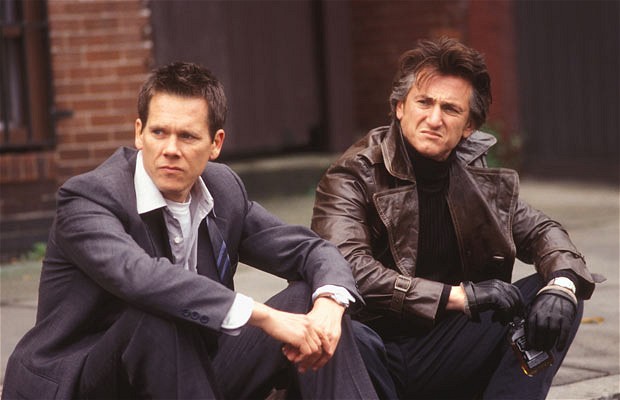
Mystic River 1

When Jimmy’s daughter Katie (Emmy Rossum) is brutally murdered, Sean and his partner Whitey Powers (Laurence Fishburne) are assigned to the case.  The distraught Jimmy, however, starts to investigate the murder himself and, after talking to Celeste, he discovers that, on the night Katie died, Dave came home with blood on his clothes and claiming that he had a fight with a mugger.  That’s all the evidence that Jimmy and his friends need to believe that Dave is the murderer…

I have a lot of friends who will probably never forgive Clint Eastwood for not only endorsing Mitt Romney in 2012 but for also giving the “empty chair” speech at the Republican Convention.  From the way that a lot of them reacted, you would think that Eastwood had filmed himself drowning puppies as opposed to simply expressing his own cantankerous opinions about current events.  (Honestly, do you know any 82 year-olds who weren’t disgruntled in 2012?)  Myself, I thought the empty chair speech was an act of brilliant performance art, one that not only highlighted the fact that most politicians really are just empty chairs but also exposed just how humorless most political activists truly are.  (Admit it — if John Fugelsang had done that same routine at the 2004 Democratic convention and referred to the empty chair as being President Bush, most of the people who went on and on about how terrible it was that Eastwood was being disrespectful to the President would still be using it to create Facebook memes.)

Eastwood

Unfortunately, I sometimes find myself wondering why Clint Eastwood the director sometimes seem to struggle to be as interesting, innovative, and thought-provoking as the empty chair speech.  It sometimes seems that for every Eastwood film that works, there’s a handful films like Hereafter, Changeling, and Jersey Boys.  These aren’t bad films as much as they’re just uninspired films.  (Well, Hereafter is pretty bad…)  Ultimately, Eastwood is more of a storyteller than a Martin Scorsese-style innovator.  If Eastwood has a good story to tell, the film will work.  If he has a weak story — well, then the film will be weak.

Fortunately, with Mystic River, Eastwood has a good story and the end result is one of the best films of his uneven directorial career.  Eastwood uses a fairly standard murder mystery to explore themes of guilt, redemption, and paranoia.  Jimmy may be looking for revenge and Sean may be doing his job but ultimately, both of them are trying to absolve themselves from the consequences of their childhood decisions.  If Dave is guilty, then Jimmy will justified in having let him get in that car.  If Dave is innocent, Sean can finally step up and save him.

And complicating all of this is the Neighborhood, which is as much a character in this film as Jimmy, Dave, and Sean.  The Neighborhood will never allow anyone to forget or live down the past.  When, towards the end of the film, Jimmy is declared to be the “king of the neighborhood” by Annabeth, there’s little doubt that she’s right.  The question is whether Jimmy’s kingdom is one worth ruling.

Mystic River