Film Review: The Eagle Has Landed (dir by John Sturges)


The 1976 film, The Eagle Has Landed, takes place during World War II.

The year is 1943 and, with the war turning against Germany, Heinrich Himmler (Donald Pleasence, in a chilling turn) orders Colonel Max Radl (Robert Duvall) to come up with a plan to kidnap Winston Churchill.  When Radl learns that Churchill is scheduled to visit a small, coastal British village, he recruits a cynical member of the IRA, Liam Devlin (Donald Sutherland), to travel to the village and make contact with a Nazi sleeper agent, Joanna Grey (Jean Marsh).  While Devlin sets up the operation in Britain and falls in love with Molly Prior (Jenny Agutter), Radl recruits disillusioned Colonel Kurt Steiner (Michael Caine) to lead the mission to kidnap Churchill.

At first the village is welcoming to Steiner and his men, who are disguised as being Polish paratroopers.  However, it doesn’t take long for the plan to fall apart.  Soon, Steiner and his men are holding the villagers hostage in a church while battling a group of American soldiers led by the incompetent Colonel Clarence Pitts (Larry Hagman) and Captain Harry Clark (Treat Williams).  Meanwhile, in Germany, Radl learns that Hitler did not actually authorize the mission to kidnap Churchill and that he has been set up as the scapegoat in case the mission fails.

The Eagle Has Landed can seem like a bit of an odd film.  For a film that was released in the same year as Network, All The President’s Men, and Taxi Driver, The Eagle Has Landed feels rather old-fashioned and almost quaint in its storytelling.  This was the final film to be directed by John Sturges, a director who started his career in the 1940s and whose best-known films included The Magnificent Seven and The Great Escape.  Sturges’s direction is efficient but not at all flashy.  (It’s a film that feel like its very much a product of the mid-60s as opposed to the mid-70s.)  The story plays out at a deliberate pace, one that leaves no doubt that the film was based on a novel.  In fact, it sometimes feels as if the film itself should have chapter headings.  The film holds your interest but it’s hard not to feel that a film that should have been an epic action film has instead been turned into something far less ambitious.

Sturges works with an ensemble cast, with no one member of the cast really dominating over the other.  (I guess if the film has a main character, it would be Donald Sutherland’s Liam Devlin but, for all the time that’s devoted to him, he actually doesn’t do that much once the action starts.)  The cast is full of good actors, though a few of them are miscast.  Neither Michael Caine nor Robert Duvall make much of attempt to sound German.  As a member of the IRA, Donald Sutherland sounds as Canadian as ever.  Fortunately, Caine, Duvall, and Sutherland are all strong-enough actors that they can make an impression even with somewhat distracting accents.  Treat Williams is a bit bland as the heroic American but Larry Hagman generates a few chuckles as Williams’s amazingly dumb commanding officer.  The important thing is that ensemble is strong enough to hold the viewer’s attention.

The Eagle Has Landed is an old-fashioned but still entertaining film.  The actors are fun to watch, the action scenes are fairly exciting, and it ends with a clever twist, one that was apparently historically accurate.  It’s a well-done historical melodrama, even if it’s never quite as epic as it aspires to be.
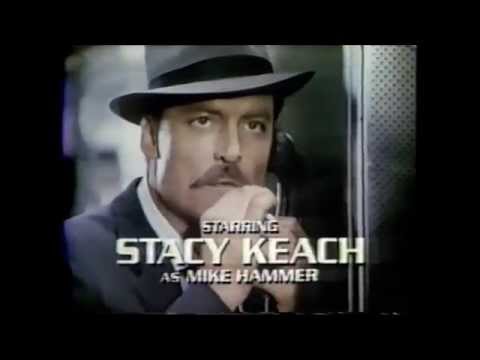
Murder Me, Murder You (1983, directed by Gary Nelson)


When two employees of an all-female courier service are murdered, Private Investigator Mike Hammer (Stacy Keach) is on the case.  The service was owned by his ex-girlfriend, Chris (Michelle Phillips), and she wants him to protect her while she testifies in front of a grand jury.  It turns out that her courier service has gotten involved in some shady business, transporting deliveries between a helicopter company and a South American dictator.  Chris fears that she’ll be murdered to keep her from testifying.  Hammer agrees to protect her and she tells him that he has a 19 year-old daughter who he’s never met.

While Chris is testifying, she suddenly dies on the stand.  The doctors say that it was a heart attack but Hammer knows that it was murder.  Hammer sets out to not only get revenge for Chris but also to find his daughter, who has disappeared into the world of underground pornography.  It’s all connected though, as is traditional with Mike Hammer, it can sometimes be difficult to keep up with how.

Murder Me, Murder You was a pilot film for a brief-lived but fondly-remembered Mike Hammer TV series that aired in the 80s.  Murder Me, Murder You takes Mickey Spillane’s famous detective into what was then the modern age but it allows him to remain a man of the hard-boiled noir era.  Hammer’s narration is tougher than leather, he’s more interested in listening to swing music than new wave, and he still dresses like an old-fashioned private eye, complete with a fedora on his head.  As played by Stacy Keach, he’s also just as dangerous and quick to kill as Hammer was in Spillane’s original novels.  In the novels, Hammer was an unapologetic brute who often bragged about how much he enjoyed killing criminals and communist spies and whose closest associate was his gun, which he nicknamed Betsy.  When Spillane’s novels were filmed, the violence of Hammer’s character was often downplayed.  (A notable exception was Robert Aldrich’s Kiss Me Deadly, which suggested that Hammer was such a fascist that he would eventually be responsible for the end of the world.  The Mike Hammer of Spillane’s novels would probably dismiss Kiss Me Deadly as being red propaganda and set out to deliver American justice to the Hollywood communists who wrote it.)  In Murder Me, Murder You, Mike Hammer is just as brutal an avenger as Spillane originally imagined him to be.  With his hulking frame, grim eyes, and his surly manner, Stacy Keach is the perfect Mike Hammer.

Murder Me, Murder You is a convoluted and often difficult-to-follow murder mystery but with Keach’s bravura lead performance, a strong supporting cast (including notable tough guys Tom Atkins and Jonathan Banks) and good direction from TV movie vet Gary Nelson, this movie comes about as close as any to capturing the feel of Mickey Spillane’s original novels.  Murder Me, Murder You was released on DVD fourteen years ago.  Though it is now out-of-print, copies are still available on Amazon.

Embracing the Melodrama Part II #62: Time After Time (dir by Nicholas Meyer)


TimeAfterTime79So, I just gave the 1979 film Home Before Midnight a fairly negative review but I simply cannot end the 70s section of Embracing the Melodrama on such a negative note!  So, before we move on to the 80s, allow me to suggest another film from 1979 that you could watch while you’re not watching Home Before Midnight!

Time After Time opens in London.  The year is 1893.  Writer H.G. Wells (Malcolm McDowell) is having a dinner party so that he can show off his latest invention, a time machine.  Among his guests is a surgeon named John Stevenson (David Warner).  What nobody at the party suspects is that Stevenson also goes by the name Jack the Ripper and that he enjoys killing prostitutes.  When a detective from Scotland Yard shows up at Wells’s home, Stevenson jumps into the time machine and escapes into the future.  Since Stevenson does not have the “non-return key,” the machine returns back to 1893 but Stevenson has apparently escaped.

Wells uses the machine to pursue Stevenson and soon finds himself in 1979 San Francisco.  Wells had expected to find that the future would be a utopia but instead, he discovers the world of 1979 is loud, polluted, violent, angry, and dangerous.  (Kinda like the world of 2015…)  As Wells pursues Stevenson, he struggles to adjust to the world of the “future,” and he also meets a bank clerk, Amy Robbins (Mary Steenburgen).

Time After Time is probably the sweetest movie ever made about Jack the Ripper and that’s largely because of the romance between both Wells and Amy and the two actors who played them.  After watching Time After Time, I was not surprised to learn that McDowell and Steenburgen got married shortly after appearing in this film.  They were so incredibly sweet together!

Add to that, considering the he’s best known for playing villains and other menacing types, it’s interesting to see Malcolm McDowell plays such a gentle and nice character.  Wells’ befuddlement is charming to watch.  There’s a great scene where Amy calls Wells on a landline phone and Wells stares down at the receiver in frightened amazement.

Time After Time is a really good and likable movie.  It’s sweet and it proves that even hunting for Jack the Ripper can be a romantic experience if it’s done with the right person.  Watch it and enjoy!