On this date, 118 years ago, Katharine Hepburn was born in Hartford, Connecticut. She would go one to become a cultural icon, a performer who survived being labeled box office to poison to eventually become one of our most acclaimed actresses. Hepburn was a total of four acting Oscars over the course of her career, a record that has yet to be topped.
Today’s scene that I love comes from 1940’s The Philadelphia Story and it features Katharine Hepburn acting opposite another one of my favorite performers, the great James Stewart.
Katharine Hepburn was famous for both her relationship with Spencer Tracy and the films that she made with him. They were such frequent co-stars and so associated with each other that “Hepburn-Tracy” became a film genre in and of itself, one that promised a bit of comedy, a bit of drama, and some sharp-witted romance. That said, I have to admit that one of my favorite of Katharine Hepburn’s film is one that she made not with Spencer Tracy but instead with Fred MacMurray. Alice Adams is a Tracy-Hepburn film without Tracy.
First released in 1935 and based on a novel by Booth Tarkington (who was quite a big deal back in the day even if, like Arrowsmith‘s Sinclair Lewis, he’s somewhat forgotten today), Alice Adams stars Hepburn as the title character. Alice is the daughter of Virgil Adams (Fred Stone) and his wife, who is only referred to as being Mrs. Adams (Anne Shoemaker). Virgil is a sickly man who has worked as a clerk at a glue factory for several years. Despite living in a rather large house and having a maid named Malena (Hatti McDaniel), the Adams family is not wealthy. However, Mrs. Adams desperately wants the family to be rich and Alice carries herself with the airs of a wealthy woman, despite the fact that everyone in town knows that she’s not. Alice love her family and is loyal to them, even if her younger brother (Frank Albertson, who later played Sam “Hee Haw” Wainwright in It’s A Wonderful Life) appears to be addicted to gambling and her mother is constantly browbeating her father for not being more ambitious. Her family may embarrass her but we know she wouldn’t trade them for all the money in the world. That’s why we like Alice, even if she does sometimes act like a snob.
However, when Alice meets and falls for the wealthy Arthur Russell (Fred MacMurray), she lies about her social background and tries to present herself as being just as rich as him. When she invites Arthur and his parents to her house for a dinner party, she frantically tries to keep up the charade of being wealthy. Meanwhile, Virgil finds himself wrongly accused of stealing from his boss (Charley Grapewin) and, as a result, the family’s financial future is put in jeopardy.
Alice Adams is a mix of screwball comedy and social drama. On the one hand, Alice’s desperate attempts to throw the perfect party are frequently very funny. Katharine Hepburn was always at her best when she played a flighty character and the contrast between Alice’s sophisticated airs and Alice’s actual personality makes me laugh every time that I watch the film. At the same time, there’s a definite undercurrent of melancholy to the film. Alice and her mother are both so desperate to be rich that they’ve both been blinded to just how wonderful their lives really are. Alice may like Arthur and Arthur definitely likes Alice but one never forgets that a part of Alice’s attraction to Arthur is that Arthur can give her the life to which she aspires.
Alice Adams features one of Hepburn’s best performances and it’s a rare Hepburn performance to which anyone watching should be able to relate. At some point in our lives, we’ve all felt like Alice. We’ve all been Alice, even if we don’t want to admit it. Fred MacMurray’s natural likability serves him well as Arthur. He comes across like a genuinely nice guy and we definitely want him and Alice to end up together.
Alice Adams was nominated for Best Picture but it lost to a much bigger production, Mutiny on the Bounty. Bette Davis beat Katharine Hepburn for Best Actress. Davis later said that she felt Hepburn should have won.
I saw that actor Earl Holliman passed away on November 25th, 2024 at 96 years of age. For someone who loves movies as much as I do, Mr. Holliman has been a pleasant part of my life over the years, and it makes me sad that he’s gone.
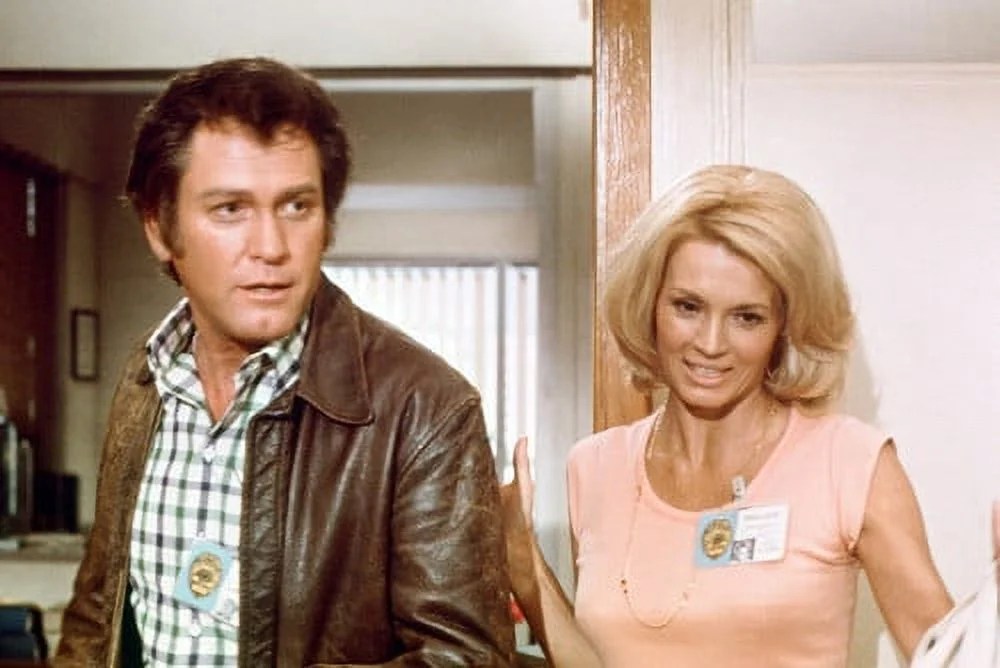
I first really noticed Earl Holliman as one of the sons of Katie Elder along with John Wayne and Dean Martin. I like John Wayne movies so I’ve watched it quite a few times over the years. There’s just something about Holliman that appeals to me, and his fate in the film still makes me sad. Later, in 2006, I acted in the Southwest Arkansas Arts Council production of THE RAINMAKER in Hope, Arkansas. The 1956 movie version stars Burt Lancaster, Katherine Hepburn, Lloyd Bridges and Earl Holliman. I played the Lloyd Bridges part, so I watched the movie several times to help me get into my character. Holliman was just so good in the movie. He won a Golden Globe for his performance in the film, and it just made me notice him that much more. Finally, as part of the THIS WEEK IN CHARLES BRONSON podcast, I had the opportunity to interview actor Jordan Rhodes who had worked with Charles Bronson in MR. MAJESTYK and THE INDIAN RUNNER. As part of the interview, Jordan told us some of the things that made him proud over the years during his time in Hollywood. He told us about the time that his mom was visiting him in Los Angeles, and how proud he was to be able to introduce her to Earl Holliman who was working on POLICE WOMAN with Angie Dickinson at the time. His story was complimentary of Mr. Holliman and just another really nice thing to hear.
Thanks, Earl Holliman, for adding joy to my life over the years through your performances on TV and in the movies. Much love and respect for a job well done, sir. Rest in peace.
Today’s scene that I love comes from the 1940 film, The Philadelphia Story, and it features my favorite Golden Age actor, James Stewart, carrying Katharine Hepburn and singing a song that might sound a bit familiar to our readers.
This is the performance, by the way, that won Stewart an Oscar. Stewart himself often said that he felt the Academy rewarded him to make up for not giving him the Oscar for Mr. Smith Goes To Washington. That’s probably true but still, this film features Jimmy Stewart at his most charming. Teaming Stewart up with not just Katharine Hepburn but also Cary Grant makes The Philadelphia Story one of the best romantic comedies to come out of Hollywood’s pre-war era.
(Before the war, Stewart was Jimmy. After he served bravely in World War II and returned to America, he was definitely James.)
On this date, 117 years ago, Katharine Hepburn was born in Hartford, Connecticut. She would go one to become a cultural icon, a performer who survived being labeled box office to poison to eventually become one of our most acclaimed actresses. Hepburn was a total of four acting Oscars over the course of her career, a record that has yet to be topped.
Today’s scene that I love comes from 1940’s The Philadelphia Story and it features Katharine Hepburn acting opposite another one of my favorite performers, the great James Stewart.
4 Shots From 4 Films is just what it says it is, 4 shots from 4 of our favorite films. As opposed to the reviews and recaps that we usually post, 4 Shots From 4 Films lets the visuals do the talking!
Yesterday was the birthday of one of the most iconic screen legends of all time, the one and only Katharine Hepburn! In honor of her life, career, and legacy, here are….
4 Shots From 4 Films
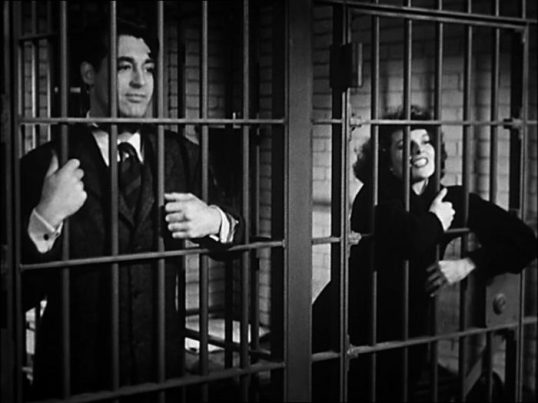
Bringing Up Baby (1938, dir by Howard Hawks)
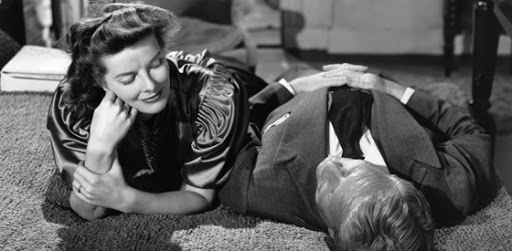
State of the Union (1948, dir by Frank Capra)
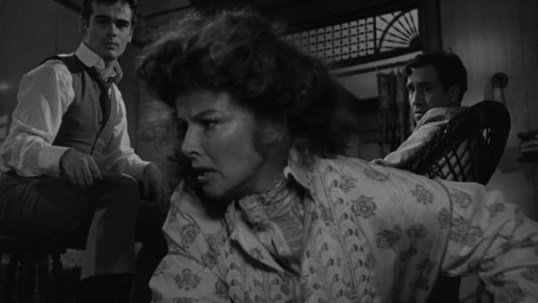
Suddenly, Last Summer (1959, dir by Joseph L. Mankiewicz)
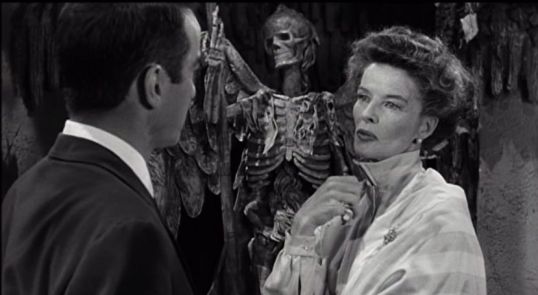
Long Day’s Journey Into Night (1962, dir by Sidney Lumet)
Continuing our look at good films that were not nominated for best picture, here are 6 films from the 1930s.
Frankenstein (1931, dir by James Whale)
Henry Frankenstein may have created life and revolutionized the horror genre but his creation got absolutely no love from the Academy. Starting a very long history of snubbing successful horror films, the Academy failed to nominate Frankenstein for Best Picture. Not even Boris Karloff got a nomination! Fortunately, the public recognized what the Academy failed to see and Frankenstein remains a classic film.
Scarface (1932, dir by Howard Hawks)
Gangster films may have been all the rage with the public in the 1930s but the Academy felt different. Little Caesar, The Public Enemy, and Scarface may have excited audiences but none of them received much love from the Academy. It was hard to decide which gangster film to specifically use for this post. In the end, I went with Scarface because of George Raft and his sexy way with a coin.
King Kong (1933, directed by Merian C. Cooper and Ernest B. Schoedsack)
King Kong thrilled audiences, impressed critics, made a ton of money, and has gone on to influence just about every monster film made since. It received zero Oscar nominations.
My Man Godfrey (1936, dir by Gregory La Cava)
My Man Godfrey, one of the best of the screwball comedies of the 1930s, received a total of 6 Oscar nominations. It was nominated in all four of the acting categories. It was nominated for best screenplay. It was nominated for best director. However, it was not nominated for Best Picture. (My Man Godfrey is the first and, as of this writing, only film to receive four acting nominations without also receiving a nomination for best picture.) Best Picture that year would go to The Great Ziegfield, which, like My Man Godfrey, starred William Powell.
Bringing Up Baby (1938, dir by Howard Hawks)
My Man Godfrey was not the only screwball comedy to be ignored by the Academy. Bringing Up Baby features Cary Grant and Katharine Hepburn at their best. It also features an absolutely adorable leopard. Somehow, it was not nominated for best picture.
The Women (1939, dir by George Cukor)
The competition was fierce in 1939. If you want to know why 1939 is considered to be one of the best years in Academy History, just consider the ten films that actually were nominated for best picture: Dark Victory, Gone With The Wind, Goodbye Mr. Chips, Love Affair, Mr. Smith Goes To Washington, Ninotchka, Of Mice and Men, Stagecoach, The Wizard of Oz, and Wuthering Heights. Amazingly, even with that list of nominees, some equally good film went unnominated. One of those films was The Women.
Based on Clare Boothe Luce’s play, The Women features a witty script, assured direction from George Cukor, and an amazing talented, all-female ensemble cast. Though the competition was undeniably fierce in 1939, it’s still a shock that this film received not a single nomination.
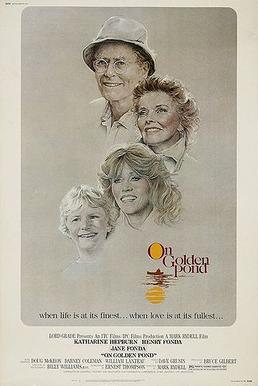
(With the Oscars scheduled to be awarded on March 4th, I have decided to review at least one Oscar-nominated film a day. These films could be nominees or they could be winners. They could be from this year’s Oscars or they could be a previous year’s nominee! We’ll see how things play out. Today, I take a look at the 1981 best picture nominee, On Golden Pond!)
On Golden Pond takes place in a cottage that’s located on a lake called Golden Pond. Hence, the title. As far as title’s go, it’s not a bad one. It’s a film about an elderly couple who spends every summer in that cottage. They’re in their golden years so I guess it makes sense that they would feel an affinity for Golden Pond.
That said, I think that an even better title for the film would be Everything Annoys Norman.
Norman Thayer, Jr. (Henry Fonda) is a cantankerous old man. He’s 79 and not particularly looking forward to celebrating his 80th birthday. He’s a retired college professor. His wife claims that the last time Norma was really happy was when Franklin Roosevelt was elected president. Norman likes to fish and still brags about the time he caught a legendary trout named Walter.
What Norman doesn’t like is having to deal with the world. When he stops to get gas, he loudly complains that, “in his day,” gas only cost eighty-five cents. When he’s told that there’s another “middle-aged” couple on the lake, he says that, unless he’s going to live to be 150, he’s not middle-aged. He gets frustrated because his memory isn’t as good as it used to be. When he goes out for a walk in the woods, he forgets where the path is and he has to return to the house. Sometimes, he calls people by the wrong name. At one point, he struggles to use a landline phone. (I can only imagine how annoyed Norman would be if he was alive today.) Norman doesn’t like to deal with anyone other than his wife.
Ethel (Katharine Hepburn) is Norman’s wife. She loves him. When she hears Norman referred to as being “a son of a bitch,” she replies, “That son of a bitch is my husband.” Ethel is used to Norman and his ways. As she puts it, she understands that he’s like a “lion” who has to roar just to remind himself that he still can. Ethel is … well, basically, she’s Katharine Hepburn.
Ethel has invited their daughter, Chelsea (Jane Fonda), to celebrate Norman’s birthday with them. Norman and Chelsea have a strained relationship. It’s implied that Norman was an emotionally distant and overly critical father and that Chelsea has never been able to forgive him. When she shows up with her new boyfriend, Bill Ray (Dabney Coleman) and his 13 year-old son, Billy Ray (Doug McKeon), Norman barely bothers to acknowledge her. With Bill and Chelsea planning on vacation in Europe, they ask if Billy can stay at the cottage with Norman and Ethel. Ethel agrees. Norman acquiesces.
On Golden Pond is a film that I wanted to like more than I actually did. After all, the film features two classic actors, Henry Fonda and Katharine Hepburn, appearing in their only film together. (Both Henry Fonda and Hepburn won Oscars for their work here.) Henry Fonda gives a good performance as a strong-willed man who is struggling to deal with his own mortality. As for Hepburn, it’s not a great performance, largely because Ethel is a thinly written role, but she’s Katharine Hepburn so it doesn’t matter. But almost everything about the film — from the tasteful music to the pretty but not overwhelming cinematography — feels more like something you’d expect to find in a television production instead of a feature film. On Golden Pond was based on a play and, with almost all of the action set in that cottage, it really doesn’t escape its theatrical origins. That said, it’s a sweet movie. The love between Norman and Ethel feels real. If nothing else, the film gave the great Henry Fonda his only Oscar.
On Golden Pond was nominated for Best Picture but lost to Chariots of Fire.
(With the Oscars scheduled to be awarded on March 4th, I have decided to review at least one Oscar-nominated film a day. These films could be nominees or they could be winners. They could be from this year’s Oscars or they could be a previous year’s nominee! We’ll see how things play out. Today, I take a look at the 1968 best picture nominee, The Lion in Winter!)
“I don’t much like our children.”
— Eleanor of Aquitaine (Katharine Hepburn)
“Oh God, but I do love being king.”
— King Henry II (Peter O’Toole)
“What family doesn’t have its up and down?”
— Eleanor of Aquitaine
To be honest, it’s tempting to just spend this entire review offering up quotes from this film. Based on a play by James Goldman and featuring a cast of actors who all specialized in delivering the most snarky of lines with style, The Lion In Winter is a film that is in love with the English language. As visually impressive as the film and its recreation of the 12th Century is, it’s tempting to close your eyes while watching The Lion In Winter and just listen to the dialogue.
The year is 1183. England has a king. His name is Henry II (Peter O’Toole) and he’s held power for a long time, through a combination of willpower and political manipulation. He’s married to Eleanor of Aquitaine (Katharine Hepburn), though he long since had her imprisoned. Before marrying Henry, Eleanor was the wife of Louis VII. Now, Henry’s mistress is Alais (Jane Merrow), the daughter of Louis and his second wife. In order to get Alais’s dowry, Henry has promised her half-brother, Philip II (Timothy Dalton), that she will be married to the next king of England. Philip, incidentally, is the son of Louis’s third wife. To be honest, it’s confusing as Hell to try to keep up with all of it but that’s medieval politics for you.
Of course, everyone knows that Henry II will not be king forever. He’s already 50 years old, which is quite an advanced age for 1183. Being king means that everyone, even his own family, is plotting against him. It also means living in a remarkably dirty and drafty castle. (If you’re looking for a film that celebrates the splendor of royalty, this is probably not the film to watch.) Henry has three sons, all of whom feel that he should be the rightful heir.
For instance, there’s Richard (a young Anthony Hopkins). Richard is Henry and Eleanor’s eldest son. He is a fierce, outspoken, and judgemental man. He describes himself as being a legend and a poet. He looks and acts like a future king. Of course, he’s also a bit of a pompous ass. Richard is Eleanor’s pick to be king, though Richard is always quick to equally condemn both of his parents.
And then there’s John (Nigel Terry). Early on, John is described as being “pimply and smelling of compost.” For some reason, John is Henry’s favorite. He’s also a sniveling weakling, the type who is never smart enough to know when his father is being honest or when his father is bluffing. Halfway through the film, he comes close to accidentally starting a civil war.
And finally, there’s Geoffrey (John Castle). Geoffrey is the smartest of the princes and the most manipulative. Of the three princes, he’s the only one who is as smart as both Henry and Eleanor. However, whereas Henry and Eleanor enjoy their complicated lives and manage to maintain a sense of (very dark) humor about it all, Geoffrey is bitter about his place as the middle child.
Christmas has arrived and Henry has temporarily released Eleanor from prison so that she can spend the holidays with him, his sons, and his mistress. Also coming over for the holiday is King Phillip II, eager to either take back his sister’s dowry or to attend her wedding to the next King of England. What follows is a holiday of politics, manipulation, and shouting. In fact, there’s lots and lots of shouting.
It’s a thoroughly enjoyable film, one that expertly mixes British history with domestic drama and dark comedy. Obviously, the film’s main appeal comes from watching two screen icons, Peter O’Toole and Katharine Hepburn, exchanging snappy dialogue. Hepburn deservedly won an Oscar for her performance as Eleanor. O’Toole should have won an Oscar as well but he lost to Cliff Robertson for Charly. In fact, O’Toole and Hepburn are so good that they occasionally overshadow the rest of the very talented cast. Anthony Hopkins and Nigel Terry both make indelible impressions as Richard and John but my favorite princely performance came from John Castle, who is a malicious wonder as Geoffrey. As easy as it is to dislike Geoffrey, it’s hard not to feel that he does have a point.
(Of course, in real life, both Richard and John would eventually serve as king while Geoffrey would die, under mysterious circumstances, in France. Reportedly, Philip II was so distraught over Geoffrey’s death that he attempted to jump on the coffin as it was being lowered into the ground.)
The Lion In Winter was nominated for seven Oscars and won three, for Best Actress (Katharine Hepburn), Best Adapted Screenplay (James Goldman), and Best Music Score (John Barry). It lost best picture to Oliver!
(For those following at home, Lisa is attempting to clean out her DVR by watching and reviewing 38 films by the end of today!!!!! Will she make it? Keep following the site to find out!)
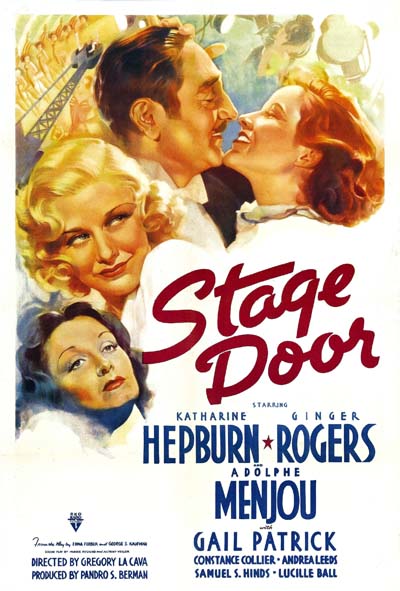
The 1937 film Stage Door is a great example of a unique genre of American film, the Katharine Hepburn Gets Humbled genre.
In the 1930s, Katharine Hepburn went through a period of time where she was considered to be “box office poison.” She was undeniably talented but it was obvious that the studios weren’t sure how to showcase that talent. They put her in high-brow films that often did not have much appeal to audiences. As well, the press hated her. Katharine Hepburn was outspoken, she was confident, she was a nonconformist, and, too many, her refusal to do interviews and sign autographs marked her as a snob. Very few people wanted to see a movie starring Katharine Hepburn and therefore, very few people were willing to make a movie starring Katharine Hepburn.
(Interestingly enough, as I sit here typing this, another KH — Katharine Heigl — is pretty much in the exact same situation, with the main difference being that Hepburn was a far more interesting actress.)
Fortunately, Katharine Hepburn was smart enough to recognize the problem and she started to appear in films like Stage Door. In Stage Door, she essentially played a character who mirrored the public’s perception of her. Terry Randall is a snobbish and pretentious aspiring actress who comes to New York to pursue her career and moves into a theatrical rooming house. At first, her attitude makes her unpopular with the other actresses living in the house. But, as the film progresses, Terry slowly starts to let down her defenses and reveals that she’s just as insecure, neurotic, and vulnerable as everyone else. She also proves herself to be willing to stand up to manipulative producers and condescending directors. When she’s cast in her first Broadway show, it turns out that the show is being financed by her father and his hope is that she’ll do such a bad job and be so humiliated that she’ll give up acting. And, at first, it appears that Terry will be terrible. During rehearsals, she is stiff and mannered. (Hepburn was actually quite brave to portray Terry as being such a believably bad actress.)
Of course, Terry isn’t the only actress at the rooming house who has issues to deal with. For instance, Judy Canfield (Lucille Ball) has to choose between pursuing her career or getting married and starting a family. Kay (Andrea Leeds) is a once successful actress who is now struggling to find roles, can’t pay her bills, and has become suicidal as a result. And then there’s Jean (Ginger Rogers), Terry’s cynical roommate and frequent enemy and occasional friend. Jean is falling in love with Anthony Powell (Adolphe Menjou), the lecherous producer of Terry’s play.
Stage Door is a wonderfully entertaining mix of melodrama and comedy. You’ll laugh, you’ll cry, and you’ll really find yourself hoping that all of the actresses at the rooming house will have their dreams come true. While the film is dominated by Hepburn and Rogers, it truly is an ensemble piece. Not only does the cast include Eve Arden, Lucille Ball and Andrea Leeds (giving the film’s best and most poignant performance) but the great dancer Ann Miller appears as Jean’s equally cynical best friend. Stage Door may be 79 years old but it’s aged wonderfully.
At the box office, Stage Door was a modest success and it directly led to Hepburn being cast in the classic screwball comedy, Bringing Up Baby. Stage Door was nominated for best picture but it lost to The Life of Emile Zola.




 Through the Shattered Lens