It’s not Christmas without the story of Ebenezer Scrooge and his visit with three ghosts. There have been numerous film versions of this story. The one below comes to us from 1938 and stars Reginald Owen in the role of Scrooge.
This version is surprisingly good, considering that it was apparently shot in a hurry. (The movie hit theaters just a few weeks after filming stopped.) Originally, Lionel Barrymore was going to play Scrooge but he had to drop out due to ill-health. Reginald Owen stepped in and gave a good performance as the famous miser.
(Barrymore himself would more or less play Scrooge a little less than ten years later in Frank Capra’s It’s A Wonderful Life.)
Lisa recommended Holiday in Handcuffs to me. I said, “I need a break from Hallmark Christmas romances.” She said, “A.C. Slater in handcuffs.” I said, “I’ll hold onto the key.”
It’s Christmas time but Trudie (Melissa Joan Hart) doesn’t want to go home. She fears that she’s disappointed her parents (Timothy Bottoms and Markie Post) because she’s only a cook in a diner and she doesn’t have a rich boyfriend. Then she sees the obviously successful David Martin (Mario Lopez) having lunch at the diner so she decides to kidnap him, take him home for Christmas, and tell everyone that they’re a couple. That’s a crime, by the way.
I’m almost embarrassed about how much I enjoyed this movie. I respect the law and I don’t think you should break it, even to get a boyfriend. You shouldn’t kidnap anyone, especially at Christmas. Trudie and David won me over, though. This was made for ABC Family so even though it involves a kidnapping, it’s a very nice kidnapping. Trudie may have committed a felony and, at first, David isn’t happy about being kidnapped but soon, Trudie and David are falling in love. David goes from calling the cops to getting down on one knee. June Lockhart plays Trudie’s grandmother and calls the police “pigs.” That’s the power of Christmas. It’s a cute movie that features a heroine who does the exact thing that you should not try at home and who gets Mario Lopez as a result. Maybe it’s just the holiday spirit getting to me but I loved this unhinged Christmas romance.
Welcome to Retro Television Reviews, a feature where we review some of our favorite and least favorite shows of the past! On Sundays, I will be reviewing the made-for-television movies that used to be a primetime mainstay. Today’s film is 1984’s The Night They Saved Christmas! It can be viewed on Tubi and YouTube.
The Night They Saved Christmas argues that there are two types of people in the world.
There are people who still believe in Santa Claus and all that he represents and then there are the people who gave up their belief a long time ago. Those who believe in Santa Claus are still full of the Christmas spirit and, under the right circumstances, they might even get to meet the elves and the jolly old man himself. Those who do not believe are destined to waste their holiday on focusing on material things that aren’t really important.
Petroleum engineer Michael Baldwin (Paul Le Mat) doesn’t believe in Santa Claus and that’s why he had no trouble moving his entire family to the North Pole so that they could freeze while he headed up an oil exploration project. Michael and his boss, billionaire Sumner Murdock (Mason Adams), are determined to find oil and they’ve got an endless supply of dynamite with which to search for it.
Michael’s wife, Claudia (Jaclyn Smith), still believes in the spirit of Santa and she encourages their children to believe as well. For that reason, Ed the Elf (played by singer Paul Williams), is willing to take Claudia and the kids to North Pole City. They get to meet Santa (Art Carney) and they even learn how Santa uses satellite technology to deliver presents all over the world. The city is really quite impressive, with the movie making good use of matte paintings and miniatures to create the impression of a magical metropolis. And Santa turns out to be a pretty nice guy, even if he does tell the elves that he’s sick of them singing Jingle Bells.
Unfortunately, North Pole City is in danger! Every day, the oil company’s dynamite causes a mini-earthquake. With the dynamiting getting closer and closer to North Pole City, Santa and the elves worry that they might be on the verge of getting blown up! Can Claudia and the kids convince Michael to stop blowing up huge chunks of the North Pole before Christmas is ruined!?
Well, listen — I don’t think it’s a spoiler for me to tell you that Christmas is not ruined. It would be pretty cynical for the movie to end with Michael blowing up Santa Claus and cynical is one thing that TheNightTheySavedChristmas is not. This is a very earnest film, full of cheery elves, a paternal Santa, and lots of Christmas music. Even greedy old Mr. Murdock turns out to be not that bad of a guy. In the end, this film says that Santa and the spirit of Christmas is for everyone and that’s certainly not a bad message. It’s a likeable movie for the holiday season and Art Carney is a perfect Santa Claus, even if he does appear to be a little underweight for the role. As played by Carney, Santa is welcoming, good-humored, and still enthusiastic about his job, even after centuries of doing it. He’s exactly the way you would want Santa to be. This is a film that earns the right to wish everyone a merry Christmas!
The 1986 film, Troll, opens with Harry Potter moving into a San Francisco townhouse.
Okay, it’s not that Harry Potter. Troll was produced long before the first Harry Potter book was even published so it’s fair to assume that it’s just a coincidence that this film — about trolls, magic, and faeries — just happens to feature not just one but two characters named Harry Potter. Harry Potter, Sr. (Michael Moriarty) is a typical, dorky father figure. Indeed, he’s such a conventional figure that it’s a bit hard to understand why the always neurotic Michael Moriarty was cast in the role. Harry’s son is named Harry Potter, Jr. (Noah Hathaway). Harry, Jr. is a teenager who is shocked by how bratty his little sister, Wendy (Jenny Beck), becomes after the family moves into their new apartment.
Why is Wendy acting like such a brat? It’s because Wendy has been kidnapped by Torok the Troll (Phil Fondacaro), a grotesque creature who not only abducts Wendy but also steals her appearance so that he can safely move around the world of the humans. Torok, himself, was once a powerful wizard but, centuries ago, he and an army of faeries tried to destroy all the humans in the world. Their plan didn’t work and, as punishment, Torok was turned into a troll.
But now, somehow, Torok is free and he’s taking over the apartment building. One by one, he tracks down each tenant and casts a spell which turns them into a mythological creature, like a gnome or a wood nymph. All of the apartments turns into lushly overgrown forests. Among those tenants that get transformed are Sonny Bono and a young Julia Louis-Dreyfus. I have a feeling that, when Sonny later ran for Congress, he did not include his appearance in Troll in any of his campaign literature. As for Louis-Dreyfus, she was reportedly angered once when a talk show host (I think it was Jay Leno) showed footage from this film while interviewing her. It’s not so much that Julia Louis-Dreyfus isn’t a convincing wood nymph as much as it’s the fact that she’s Julie Louis-Dreyfus and it’s just difficult to imagine her appearing in such a stupid role. This, of course, was her first film and everyone has to start somewhere.
Anyway, realizing that he has to rescue his little sister, Harry Potter, Jr. gets some help from the local witch, Eunice St. Clair (Joan Lockhart). Eunice gives Harry a magic spear to take with him in his quest. It’s not really that much of quest, however. Troll is a low-budget film that was produced by Albert Band so this is not the film to watch if you’re expecting some sort of elaborate fantasy epic.
One positive thing that I will say for Troll is that some of the troll makeup is effective. The plot maks absolutely zero sense but Director John Carl Buechler specialized in creating memorable monsters on a budget and he manages to do that with Troll. And, despite all of the people getting turned into monsters, Troll is a largely good-natured film. It’s not a deliberately cruel or even gory film. It’s a dumb little horror/fantasy film that features Sonny Bono turning into a plant and Julie Louis-Dreyfus turning into a wood nymph. It’s dumb but it’s mild and generally inoffensive.
Finally, I should also note that it is in no way connected to Troll 2. Troll 2, after all, is about goblins.
Welcome to Retro Television Reviews, a feature where we review some of our favorite and least favorite shows of the past! On Sundays, I will be reviewing the made-for-television movies that used to be a primetime mainstay. Today’s film is 1973’s The Bait! It can be viewed on YouTube!
Tracey Fleming (Donna Mills) is the widow of a cop and an undercover detective herself. Unfortunately, her superior, Captain Maryk (Michael Constantine), is not convinced that Tracey has what it takes to be in a dangerous situation and, as a result, Tracey spends most of her time riding the bus and busting perverts and low-level drug dealers. When four woman are raped and murdered by the same serial killer, Tracey writes up a report on what she thinks is motivating the killer. Captain Maryk is, at first, skeptical about Tracey’s claim that the killer is fueled by a puritanical rage but, when it turns out that the killer has been wiping off his victims’s lipstick (just as Tracey speculated that he was), Maryk starts to think that Tracey might have something to offer the investigation.
Tracey becomes the bait in an operation to lure out the killer. Leaving behind her son and her mother, Tracey moves into an apartment in the neighborhood that is believed to be the center of the killer’s activities. Tracey is given a job as a survey taker and soon, she’s walking around the neighborhood and asking random men for their opinions on current events and women’s liberation. A local waitress (Arlene Golonka) recognizes Tracey as a detective but Tracey lies and say that she’s no longer with the force. When the killer makes the waitress his next victim, Tracey becomes even more determined to capture him but will she able to get Marsyk and the rest of the force to give her the room to investigate the murders?
This may sound like an intriguing whodunit but, for some reason, The Bait reveals early on that the murderer is a bus driver named Earl Stokely (played, in a very early performance, by William Devane). There’s really nothing to be gained by revealing the killer’s identity as early as the film does. Perhaps if the film was split between scenes of Tracey investigating the neighborhood and Earl stalking Tracey, that would have generated some sort of suspense but, with the exception of one bus ride, Tracey and Earl barely even interact before he comes after her at the film’s end. Devane does give a good performance as a homicidal lunatic but, when viewed today, it’s impossible to watch him in this film without spending most of the time thinking, “Hey, that’s the usually Kennedyesque William Devane, playing a killer bus driver!”
I was not surprised to learn that The Bait was intended to be a pilot for a weekly television series that would have followed the future investigations of Tracey Fleming. Donna Mills was likable in the lead role and she had a good chemistry with the other actors playing her colleagues so it’s easy to imagine a series in which Tracey solved a new case every week while Marsyk continually underestimated her. Ultimately, though, that series never happened and The Bait would be the sole televised adventure of Detective Tracey Fleming.
In 1947 Los Angeles, the body of 22 year-old Elizabeth Short is discovered in an empty lot. Short, who was nicknamed The Black Dahlia because she always wore black, was an aspiring actress who was violently tortured before being chopped in half. Her murder remains one of Hollywood’s most infamous unsolved crimes.
In this made-for-television movie, Ronny Cox and Efrem Zimbalist, Jr. play the two detectives who are assigned to investigate Short’s murder. Though they struggle to find any clues identifying who could have killed Short, they do learn about her life and how she went from being a naïve innocent who came to Hollywood with stars in her eyes to being a hardened and cynical woman who may have been supporting herself through sex work when she was murdered. The film makes use of frequent flashbacks, in which Elizabeth Short is played by Lucie Arnaz. Her friends and acquaintances are played by familiar television faces like Henry Jones, Mercedes McCambridge, June Lockhart, Brooke Adams, Donna Mills, and Tom Bosley. Also be sure to keep an eye out for Sid Haig, playing a tattoo artist.
What Elizabeth Short went through over the course of her short time in Hollywood was probably too graphic to be put on television in the 70s but this movie still does a good job of recounting the basic facts of her life and murder. Because the film is based on fact, no one is ever arrested for Short’s murder. The only suspect is a doctor who turns out to have an alibi. The movie instead focuses on Short trying make it in Hollywood and discovering that it’s a cruel town. Lucie Arnaz was far better than I was expecting in the role of Elizabeth and brought a lot of vulnerability to the role. The film ended with a title card, asking anyone who had information about the murder of Elizabeth Short to call the LAPD. The case remains open to this day.
In 1983, two years after the release of Strange Behavior, director Michael Laughlin and Bill Condon teamed up for another “strange” film. Like their previous collaboration, this film was a combination of horror, science fiction, and satire.
The title of their latest collaboration?
Strange Invaders.
Strange Invaders opens in the 1950s, in a small, all-American town in Illinois. Innocent children play in the street. Clean-cut men stop off at the local diner and talk to the waitress (Fiona Lewis, the scientist from Strange Behavior). Two teenagers (played by the stars of Strange Behavior, Dan Shor and Dey Young) sit in a car and listen to forbidden rock’n’roll music. A lengthy title crawl informs us that, in the 1950s, Americans were happy and they were only worried about three things: communists, Elvis, and UFOs. On schedule, a gigantic UFO suddenly appears over the town.
Twenty-five years later, mild-mannered Prof. Charles Bigelow (Paul Le Mat) teaches at a university and wonders just what exactly is going on with his ex-wife, Margaret (Diana Scarwid). In order to attend her mother’s funeral, Margaret returned to the small Illinois town where she grew up. When she doesn’t return, Charles decides to go to the town himself. However, once he arrives, he discovers that the town appears to still be stuck in the 50s. The townspeople are all polite but strangely unemotional and secretive. Charles immediately suspects that something strange is happening. When the towns people suddenly start shooting laser beams from their eyes, Charles realizes that they must be aliens!
Fleeing from the town, Charles checks all the newspapers for any reports of an alien invasion. The only story he finds is in a cheap tabloid, The National Informer. The author of the story, Betty Walker (Nancy Allen), claims that she just made the story up but Charles is convinced that she may have accidentally told the truth. At first, Betty dismisses Charles as being crazy. But then she’s visited by an Avon lady who looks just like the waitress from the small town and who can shoot laser beams.
Teaming up, Charles and Betty investigate the aliens and try to figure out just what exactly they’re doing on Earth. It’s an investigation that leads them to not only a shadowy government operative (Louise Fletcher) but also a man (Michael Lerner) who claims that, years ago, he helplessly watched as his family was destroyed by aliens.
Like Strange Behavior, Strange Invaders is a … well, a strange film. I have to admit that I prefer Behavior to Invaders. The satire in Strange Invaders is a bit too heavy-handed and Paul Le Mat is not as strong a lead as Michael Murphy was in the first film. I was a lot more impressed with Nancy Allen’s performance, if just because I related to both her skepticism and her sudden excitement to discover that her fake news might actually be real news. I also liked Micheal Lerner, so much so that I almost wish that he and Le Mat had switched roles. Finally, I have to say that Diana Scarwid’s performance was so bizarre that I’m not sure if she was brilliant or if she was terrible. For her character, that worked well.
Strange Invaders gets better as it goes along. At the start of the film, there are some parts that drag but the finale is genuinely exciting and clever. If the film starts as a parody of 1950s alien invasion films, it ends as a satire of Spielbergian positivity. It’s an uneven film but, ultimately, worth the time to watch.
(Lisa is currently in the process of trying to clean out her DVR by watching and reviewing all 40 of the movies that she recorded from the start of March to the end of June. She’s trying to get it all done by the end of July 11th! Will she make it!? Keep visiting the site to find out!)
The 37th film on my DVR was the 1940 film, All This, And Heaven Too. It originally aired on June 21st on TCM.
All This, and Heaven Too is one of the many melodramatic historical romances in which Bette Davis appeared in the late 30s and early 40s. These films usually featured Bette as a strong-willed woman who was often condemned for not conforming to the rules of society. Typically, she would end up falling in love with a man who society said she could not have. Bette almost always seemed to end up alone, which I guess was the way women who thought for themselves were punished back then.
In this one, Bette plays Henriette Deluzy, a French woman who ends up in America in the 1850s. When she shows up to start teaching at a private, all-girls school, her students immediately start gossiping about her. It seems that Henriette was at the center of some sort of European scandal and everyone is speculating about what happened. Finally, at the start of class, Henriette tells her students that she’s going to tell them the true story of what happened back in France.
It turns out that Henriette was a governess. She took care of the four children of the Duc de Praslin (Charles Boyer) and his wife, the Duchesse (Barbara O’Neil). The Duchesse was mentally unstable and soon came to suspect that her husband had fallen in love with Henriette. Though she may have been insane, it turned out that the Duchesse was correct. When the Duchesse fired Henriette and then lied to her husband about it, the Duc flew into a rage and murdered his wife.
Under the laws of the time, the Duc could only be judged by his fellow noblemen. He was told that if he simply confessed and said that Henriette was the one who drove him to commit the murder, he would be set free. (As opposed to the characters that Bette Davis played in The Letter and The Little Foxes, Henriette was totally innocent.) Would the Duc confess and allow Henriette to be blamed or would he deny his love for her and sacrifice his life as a result?
All This, And Heaven Too is a rather slow movie and it’s hard not to be disappointed that Henriette is such a boring character. She’s so innocent and victimized that the role almost seems like a waste of Bette Davis’s talents. A big production that featured lavish (though black-and-white) recreations of 19th Century France, All This, And Heaven Too was probably a big deal for contemporary audiences and, if you’re a Bette Davis or Charles Boyer completist, you might enjoy it. But otherwise, it’s really nothing special.
All This, And Heaven Too was among the 10 films nominated for Best Picture of 1940. However, it lost to Rebecca.
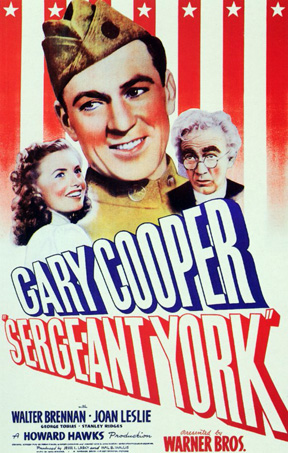
The 1941 film Sergeant York was the American Sniper of its day. A biopic of Alvin York, one of the most decorated American soldiers of World War I, Sergeant York was not only a huge box office hit but it was a film that celebrated American patriotism in the type of unabashed fashion that you would never see in a film made today. Though Sergeant York went into production at a time when the United States was officially pursuing a policy of international neutrality, it was released shortly before the Japanese attacked Pearl Harbor and, whether intentionally or not, Sergeant York served as a strong recruiting tool. According to Wikipedia (and we all know that Wikipedia is never wrong), there were reports of young men going straight from the movie to the nearest military recruitment office.
Clocking in at nearly two and a half hours (and running at least 40 minutes too long), Sergeant York is two films in one. The second half of the film deals with the military career of Alvin York (Gary Cooper), a plain-spoken and honest Tennessee farmer who, because of his strong religious beliefs, unsuccessfully attempts to register as a conscientious objector. Forced into the Army, York is, at first, dismissed as a simple-minded hillbilly. (His fellow soldiers are amused to discover that York doesn’t know what a subway is.) However, to the shock of his commanding officers, he proves himself to be an expert marksman. As he explains it, being from the country means that he’s been shooting a rifle his entire life.
On the basis of his skills as a marksman, York is given a promotion but he still says that he refuses to kill. It’s not until his superior officer reminds him of the sacrifices that past Americans have made that York starts to reconsider his position. Then, a gust of wind opens York’s bible to a verse about giving unto Caesar what is Caesar’s and York realizes that he can go to war and, if need be, he can kill.
And it’s a good thing that he can! Because World War I is heating up and York may be the only guy around with the strength and confidence to single-handedly defeat and capture over 170 German soldiers.
The army section of Sergeant York is predictable but well-done. As you’d expect from a film directed by Howard Hawks, a lot of emphasis is put on how the soldiers work together. York is portrayed not as being super human but instead as just an honest man who is exceptionally good at his job. There’s nothing surprising about the second half of Sergeant York but Hawks keeps the action moving and Cooper gives a good performance.
To be honest, I preferred the first half of the film, which examined York’s life before he joined the Army. When we first meet Alvin York, he drinks too much, he fights too much, and he’s totally irresponsible. It’s not until he falls in love with Gracie Williams (Joan Leslie) that York starts to change his ways. The scenes of York in the backwoods of Tennessee had a lively feel to them and it was enjoyable to see Cooper play a somewhat disreputable character. Cooper seemed to be having fun playing a ne’er-do-well and, in the scenes before York finds God, his bad behavior was a lot of fun to watch.
Considering its success at the box office, it’s not surprising that Sergeant York was nominated for best picture of the year. While Gary Cooper won the Oscar for best actor, the award for Best Picture went to How Green Was My Valley.



 Through the Shattered Lens