What’s an Insomnia File? You know how some times you just can’t get any sleep and, at about three in the morning, you’ll find yourself watching whatever you can find on cable or streaming? This feature is all about those insomnia-inspired discoveries!
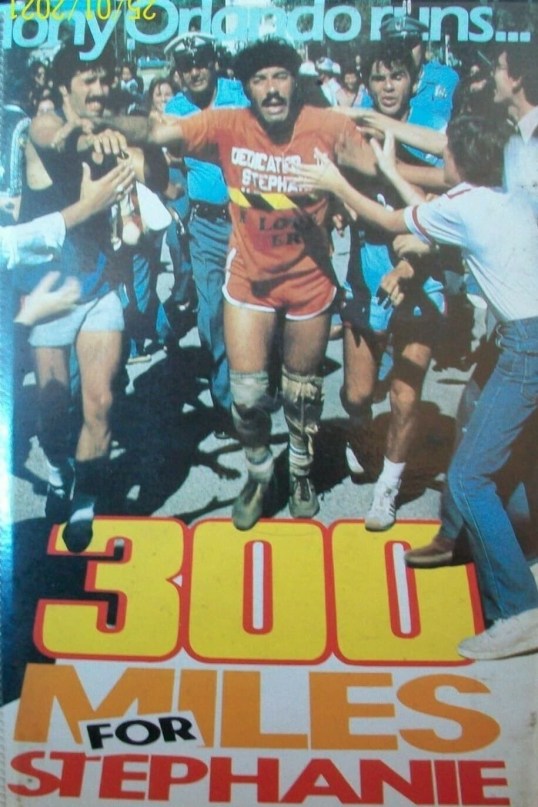
If you were having trouble getting to sleep last night, you could have watched 1981’s 300 Miles For Stephanie.
Tony Orlando — yes, the singer — plays Alberto Rodriguez. When the movie begins, Alberto is a rambunctious military veteran who is notorious for drinking too much and getting into fights. After his latest arrest, he is ordered to turn his life around. With the help of his cousin (Edward James Olmos), he gets a job as a cop in San Antonio. Eventually, he gets married and he becomes a father to Stephanie.
When Stephanie is born, Alberto is told that his daughter probably won’t make it to her fifth birthday. The struggle of raising a handicapped daughter becomes too much for Alberto’s wife and soon, Alberto is a single father. When Stephanie makes it to her fifth birthday, Alberto rides a bicycle 300 miles to a chapel so he can give thanks to God. Later, after his story is picked up the San Antonio media, Alberto resolves to run to the chapel, covering 300 miles on foot in just five days.
300 Miles For Stephanie is clearly a made-for-TV movie from the early 80s. It’s the type of movie where every dramatic beat leads to the inevitable fade-out for commercials. The budget is low and there’s not a single subtle moment to be found in the film but the story itself is so touching that it doesn’t matter. Maybe it’s because it’s Holy Week. Maybe it’s because I’ve recently had to say goodbye to people that I loved. Maybe I’m just as sucker for these type of stories. It doesn’t matter. I cried.
As an actor, Tony Orlando was a little stiff but he still brought a likable earnestness to the role and he got good support from Edward James Olmos, Pepe Serna, Gregory Sierra, and Peter Graves. Graves’s role is small but, as Alberto’s captain, he’s exactly the type of fair-minded authority figure who we could use more of nowadays.
It’s a touching film. In real life, Stephanie, who no one expected to see her second birthday, lived to be 26 years old.
Welcome to Late Night Retro Television Reviews, a feature where we review some of our favorite and least favorite shows of the past! On Thursdays, I will be reviewing Highway to Heaven, which aired on NBC from 1984 to 1989. The entire show is currently streaming on Tubi and several other services!
This week, Mark and Jonathan work at a hotel …. a hotel of dreams!
Episode 1.12 “Hotel of Dreams”
(Dir by Michael Landon, originally aired on December 12th, 1984)
Barry Rudd (Brian Kerwin) may be the son of a wealthy hotel owner but he’s far more comfortable living out in the country, wearing denim and flannel, and helping to raise goats. However, one day, Barry is summoned to his father’s hotel. His father even sends a helicopter out to get him. Barry gets on the helicopter but he insists on bringing his goat with him.
At the hotel, Barry’s father (Jacques Aubuchon) explains that he’s gotten married to a woman who is much younger than him and he needs Barry to run the hotel while he’s on his honeymoon. Barry is stuck running the snootiest hotel in California, despite the fact that he doesn’t even own a suit and all he really wants to do is look after his goat. Unfortunately, the hotel has a lot of problems. The manager (played by Dean Dittman) is a mean-spirited snob who takes bribes from the guests. A child (Douglas Emerson) is running wild through the halls of the hotel, all because his father is too busy working to keep an eye on him. Saintly maid Elena (Julie Carmen) does the best job that she can but she’s looked down upon by the guests and the hotel’s manager.
Can Barry solve all of the hotel’s problems and also find time to attend his high school reunion? Will he stay true to himself or will he sell out in an effort to impress people like his former classmate, Allison Rutledge (Judith-Marie Bergan)? It’s not going to be easy and Barry doesn’t even know where to begin. Fortunately, he has some help. The hotel’s two new bellhops are Jonathan Smith and Mark Gordon!
Especially when compared to the previous two episodes, Hotel of Dreams is a rather light-hearted episode. There’s nothing particularly surprising to be found in this episode. Of course, Allison is going to turn out to be a total snob. Of course, Elena is going to help Barry take care of his goat. Of course, Barry and Elena are going to fall in love and end up together, all with the help of Jonathan. And, of course, Mark is going to become a surrogate father figure for the bratty kid. This is a thoroughly pleasant if not particularly memorable episode, one that plays out more like a pilot for a show about the hotel than an episode about an angel trying to make the world a better place. Brian Kerwin and Julie Carmen make for an attractive couple and, as the episode ends, you can’t help but hope that Barry and Elena are going spend the rest of their lives raising goats together.
There is an unfortunate moment in this episode when Jonathan gives Mark a hard time for smoking. When Jonathan tells Mark that he could die if he doesn’t stop smoking, Mark replies that everyone has to die of something. Mark then asks Jonathan what cause his death.
“Lung cancer,” Jonathan replies.
Victor French, who played Mark, would die of lung cancer just five years later. Shortly afterwards, Michael Landon would also die of cancer.
Billy Turner (Judd Nelson) has always been the bad boy but now he just wants to return to his Florida hometown and reconnect with his estranged father. As soon as he rolls into town, Billy gets into a bar brawl and is arrested. The chief of police (Paul Winfield) informs Billy that his father has been murdered and that his stepmother has since married the local gangster, Perry Kerch (Scott Wilson). Everyone knows that Perry murdered Billy’s father but no one can prove it. He is told to get out-of-town but Billy’s not going out like that. Instead, he gets together with his childhood friends, gimpy legged Joey (David Caruso) and Annie (Ally Sheedy), and seeks his revenge.
No, it’s not a picture of Judd Nelson hanging out with the a member of the Heaven’s Gate cult. It’s the DVD cover for Blue City.
An infamous flop, Blue City was meant to show that the members of the infamous Brat Pack could play serious, adult roles. Unfortunately, Blue City was released right at a time when everyone was starting to get sick of the Brat Pack. (Even John Hughes had moved on, casting Matthew Broderick as Ferris Bueller, instead of Anthony Michael Hall.) After countless magazine covers and the monster success of The Breakfast Club and St. Elmo’s Fire, a backlash was brewing and Blue City walked (or, in Joey’s case, limped) straight into it.
It also did not help the film’s prospects that it matched up the least interesting Brat Packer, Judd Nelson, with the member of the Brat Pack most likely to take herself too seriously, Ally Sheedy. Playing roles that would have been played by Alan Ladd an Veronica Lake in the 40s, both Nelson and Sheedy are miscast and, strangely considering this was their third film together, have no chemistry. Nelson, in particular, gives one of the most annoying performances in film history. He never stops smirking, even when there is no reason for Billy Turner to be smirking. With his wide-eyed stare and his attempts to speak like a tough guy, Nelson comes across like John Bender auditioning for West Side Story. The scene where he manages to floor Tiny Lister with one punch is simply beyond belief.
When Judd Nelson can beat you up, there is only one thing left to do:
Thanks, Duke.
On a more positive note, David Caruso, long before he could usher in the Who by simply putting on his sunglasses, is better cast as Joey but there is nothing surprising about what eventually happens to him. The best performance is from Scott Wilson, showing why he used to always play villains before reinventing himself as Herschel on The Walking Dead. Wilson was so good that I realized, halfway through Blue City, that I actually would not have minded if he succeeded in killing Billy.
The most disappointing thing about Blue City is that it is a Florida noir from the 80s that somehow does not feature even a cameo appearance by Burt Reynolds. Couldn’t Judd have taken just a few seconds during the filming of Shattered: If Your Kid’s On Drugs to convince Burt to drop by Blue City?
This month, since the site is currently reviewing every episode of Twin Peaks, each entry in Move A Day is going to have a Twin Peaks connection. Paint In Black was directed by Tim Hunter, who directed three episodes of Twin Peaks, including the one that I reviewed earlier today.
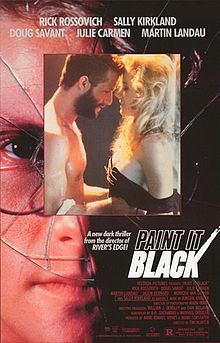
Jonathan Dunbar (Rick Rossovich) should have it all. He is an acclaimed sculptor but he’s being cheated financially by his dealer and sometimes girlfriend, Marion Easton (Sally Kirkland). Things start to look up for Jonathan after he has a minor traffic accident with Gina (Julie Carmen). Not only are he and Gina immediately attracted to each other but it turns out that Gina is the daughter of Daniel Lambert (Martin Landau), who owns the most prestigious art gallery in Santa Barbara. It appears that Jonathan is finally going to get the big show that he has always dreamed of, but only if he can escape from Marion’s management.
One night, Jonathan helps out a man who was apparently mugged outside of an art gallery. The man, Eric (Doug Savant), says that he’s an art collector and that he is a big fan of Jonathan’s work. When Jonathan opens up about his problems with Marion, Eric decides to return Jonathan’s favor by killing Marion and anyone else who he feels is standing in the way of Jonathan’s success. Because of the way that Eric artistically stages the murders, the police suspect that Jonathan is the murderer.
Depending on the source, Paint It Black’s original director was either fired or walked off the project and Tim Hunter was brought in to hastily take his place. According to Hunter, he spent the production “shooting all day and rewriting all night.” Paint it Black is a standard late 80s, direct to video thriller but it is interesting as a tribute to Alfred Hitchcock. Hunter taught a class on Hitchcock at the University of California at Santa Cruz and Paint it Black is full of shout outs to the master of suspense. Marion’s murder is staged similarly to a murder in Frenzy. There are frequent close-ups of scissors, a reference to Dial M For Murder. Probably the most obvious homage is the character of Eric, who appears to be based on Robert Walker, Jr’s character from Strangers on a Train.
Rick Rossovich was best known for playing cops, firemen, and soldiers in movies like Top Gun, Navy SEALS, and Roxanne. He’s not bad in Paint it Black but he is still not the most convincing artistic genius. Doug Savant and Sally Kirkland were better cast and more enjoyable to watch. In fact, Kirkland is killed off too early. The movie loses a lot of its spark once she is gone.
Paint It Black may not live up to being named after one of the best songs that the Rolling Stones ever recorded but Tim Hunter took unpromising material and shaped it into something that is far more watchable than anyone might expect.
In the Mouth of Madness is one of those films that in essence seems like a good idea, but later becomes strange and unwieldily to the point that you have to ask yourself “What am I watching, and why did I do so?”
Jumping right of of Memoirs of an Invisible Man, In the Mouth of Madness reunites Sam Neill (Jurassic Park) with Carpenter. Neill plays John Trent, an Insurance Investigator whose latest case deals with a horror writer named Sutter Cane (Jurgen Prochnow). Cane’s novels have the strange ability to affect anyone who reads them. After Cane’s own agent/publicist falls his influence and is abruptly killed, Trent is sent to find Cane (who is missing) and help bring back his latest story , “In the Mouth of Madness” to the agency. When he sets off on his mission, he slowly finds his sense of reality unraveling.
If Neill’s character is the Scully, Julie Carmen (Fright Night Part II) plays the Mulder in this equation. Sent along with Trent, her character witnesses more of the horror than he does. She’s the audience witness for a while and proves Trent wrong when he’s ready to disbelieve what’s occurring. She good here, but her reactions, mixed with Trent’s had me slapping my forehead. I’ll get to that in a moment.
I’m told that the film is something of a homage to H.P. Lovecraft’s stories. While I’ve never read Lovecraft, I’m somewhat familiar with the Cthulhu myths and there does seem to be some tentacled beasts near the last third of the film. Overall, some of those references escape me. The movie’s fun in a Donnie Darko mind bending way and it’s that strangeness that actually helps the film a little.
I hate the fact that Sam Neill’s character simply won’t accept that what’s happening is real. I’m not a big fan of stuffing square pegs into round holes. If it doesn’t fit – you’re being told “This is how it goes”, and you’re seeing that’s how it’s happening – then why in the world are you still holding on to the same train of thought that isn’t working / fitting the situation? I found that extremely annoying. It’s almost the opposite of Slither, where it didn’t take long for the characters to recognize that:
1.) People were becoming zombies.
-And-
2.) It just wasn’t normal for the situation. Accept and adjust. Cover your mouth.
Overall, it was okay, but it really needed something. I’m just not sure what.
“There are things in this world that go beyond human understanding.”
John Carpenter’s reputation as one of the great American horror directors rests on his ability to merge the cinematic with the philosophical—to craft films that stay frightening not because of what they show, but because of what they suggest. Yet by the early 1990s, Carpenter’s once unshakable relationship with audiences had weakened. His influence remained undeniable, but several of his later films seemed to miss the spark that defined Halloween, The Fog, or The Thing. Then arrived In the Mouth of Madness (1995), a work that signaled a late creative resurgence. It paid intelligent homage to two pillars of horror literature—Stephen King and H. P. Lovecraft—while offering a disturbing reflection on authorship, sanity, and the power of belief. The film reasserted Carpenter’s command not only over frightening imagery but also over the psychological territory that underpins enduring horror.
At a narrative level, In the Mouth of Madness follows John Trent (Sam Neill), an insurance investigator known for exposing fraud and deception. His skepticism becomes both his strength and undoing. Trent is hired by publishing executive Jackson Harglow (played by the legendary Charlton Heston) to locate Sutter Cane, a best-selling horror novelist whose disappearance threatens both the company’s finances and the stability of Cane’s obsessed fanbase. Every sign points to something far stranger than a publicity stunt. Cane’s readers are exhibiting troubling behavior, as though the author’s new book has triggered more than just entertainment—it has become contagion.
Carpenter crafts Trent’s descent into uncertainty with meticulous pacing. At first, Neill’s character regards the assignment as routine, dismissing the hysteria surrounding Cane’s novels as marketing excess. But when his investigation hints that the locations and events in Cane’s fiction may correspond to real places and real disturbances, the film begins to twist the rational into the uncanny. The story’s sense of unreality builds with deliberate restraint—incidents grow progressively stranger, but never so overt that Trent can confidently identify what’s madness and what’s truth. Carpenter thrives on this ambiguity, pulling both protagonist and viewer into an atmosphere where logic erodes and fiction itself seems to rewrite reality.
Accompanying Trent on his search is Linda Styles (Julie Carmen), the publisher’s editor assigned to ensure the investigation runs smoothly. While her performance has sometimes been considered subdued, Styles functions as the audience’s second perspective: observant, mildly skeptical, and gradually aware that the world around her no longer behaves according to its former rules. Carpenter positions her as a necessary counterpoint to Trent’s brittle rationalism, highlighting the conflict between recognizing patterns and succumbing to fear. As they move closer to locating Cane, their surroundings take on the familiar haunted quality of an archetypal New England town—Hobb’s End—built from the shared DNA of King’s Castle Rock and Lovecraft’s Arkham. The town becomes more than setting; it is a physical embodiment of literary influence and psychological instability.
The choice of Sam Neill proves essential to the film’s success. His trademark combination of intelligence and emotional vulnerability allows Trent’s transformation from calculating skeptic to disoriented seeker to feel natural rather than theatrical. Few actors could portray a man so evidently rational who nonetheless finds himself seduced by forces his disciplined mind cannot resist. Neill’s body language carries much of the horror; his expressions shift between dry disbelief and quiet terror, suggesting that intellect offers no protection once perception itself begins to betray you. Carpenter exploits this performance with close framing and asymmetric compositions, visually trapping Trent in spaces that subtly curve or distort. The director’s technical command ensures that even ordinary scenes seem charged with quiet wrongness.
While In the Mouth of Madness never references the mythos of Lovecraft by name, its influence saturates the film. Lovecraft’s hallmark—cosmic indifference—exists here not through tentacled gods but through the crumbling borders between fiction and the human mind. The suggestion is that the very act of creating and consuming stories might awaken something ancient and uncontrollable. When Trent confronts the nature of Cane’s work, Carpenter’s direction avoids overstatement. Instead of grand confrontations, he conveys horror through disorientation—the feeling that language, images, and even memory are slipping toward incoherence. Reality itself becomes a character, unstable and untrustworthy.
Jürgen Prochnow’s portrayal of Sutter Cane adds another layer of unease. His calm, confident manner diverges from standard portrayals of deranged genius. Prochnow makes Cane unnerving precisely because he appears so certain of his vision. The author views himself not as a mere storyteller but as a conduit, claiming that what he writes merely reveals a preexisting truth. Through him, Carpenter explores a potent question that haunts all creators: does imagination serve human purpose, or is it an independent force that uses human minds as tools? Cane’s conviction blurs that line, turning the creative process into possession. To audiences familiar with the concept of “mad artists” in literature, his belief offers both fascination and dread.
Carpenter imbues this theme with visual invention. The cinematography and set design combine the mundane with the surreal—painted walls pulse, corridors bend, horizons vanish. Rather than relying on excessive gore or digital spectacle, the director emphasizes textures and shadows, creating optical unease rather than overt shock. The town of Hobb’s End seems perpetually detached from time, its streets looping back on themselves. By employing low, creeping camera movements and deliberate color desaturation, Carpenter evokes a dreamscape decaying from within. The film’s sound design—especially Carpenter’s own pulsating score, co-composed with Jim Lang—heightens that tension with rhythmic basslines reminiscent of a heartbeat slowing to a stop. Every technical choice reinforces the narrative’s central sensation: uncertainty.
Michael De Luca’s screenplay deserves particular credit for its clever structure. The film is framed as a story told from inside an asylum, immediately hinting that the perspective may be unreliable. This framing allows Carpenter to shift between psychological thriller and cosmic horror without losing cohesion. As viewers, we are made complicit in Trent’s investigation but warned not to trust his perceptions. The resulting experience is disorienting yet coherent—a cinematic maze where each turn feels inevitable once taken. The writing never lingers long on exposition, instead suggesting connections through implication and repetition. In this way, De Luca’s script succeeds in translating Lovecraftian dread into visual terms: a fear of knowledge itself.
Very few directors have managed this particular tone as successfully. Lovecraft’s fiction often resists cinematic adaptation precisely because its greatest horror lies in what cannot be shown. In the Mouth of Madness solves this problem by making the act of storytelling itself the subject of terror. By focusing on an author whose imagination reshapes reality, Carpenter transforms literary horror into filmic language. In doing so, he edges close to achieving what decades of other attempts had failed to capture—a true Lovecraftian mood rendered on screen, grounded not in spectacle but in existential dislocation.
Despite its craftsmanship and intelligence, In the Mouth of Madness struggled at the box office upon release. Its ambiguity, self-reflexivity, and intellectual leanings proved challenging for mid-1990s audiences who expected more conventional scares. Yet over time, the film’s reputation has flourished. Today, it is often regarded as the concluding entry in Carpenter’s loosely connected “Apocalypse Trilogy,” following The Thing (1982) and Prince of Darkness (1987). All three films share a fascination with humanity confronting forces it cannot comprehend—scientific, metaphysical, or divine. In each, Carpenter presents apocalypse not as fiery destruction but as revelation: the moment when human understanding collapses under greater cosmic truth. That philosophical core links these works across more than a decade of filmmaking.
Revisiting In the Mouth of Madness now, one is struck by how prophetic it feels. Its concerns about cultural contagion and media-induced madness anticipate contemporary conversations surrounding viral misinformation, fandom extremism, and the blurring between online identity and reality. The “disease” in the film—ideas that rewrite perception—mirrors our present anxiety about the stories and images that shape collective belief. Carpenter’s horror, always grounded in social awareness, here expands into a warning about a world unable to distinguish narrative invention from lived experience.
Even limited in budget, Carpenter demonstrates confident control of visual tone and rhythm. His filmmaking reminds viewers that suggestion often unsettles more deeply than spectacle. Rather than overwhelming audiences with jump scares, he leads them through gradual disintegration, where each logical step seems to justify the next until coherence itself fractures. The film invites reflection rather than relief, leaving viewers haunted by the possibility that the boundaries between art and life are far thinner than comfort allows.
While Carpenter would go on to direct more films after 1995, In the Mouth of Madness stands as one of his last profoundly accomplished achievements. It encapsulates the elements that made his earlier works enduring: tight pacing, minimalist storytelling, and ideas that resonate beneath genre tropes. The film’s legacy continues among filmmakers who explore metafictional or cosmic horror, from Guillermo del Toro’s long-sought adaptation of At the Mountains of Madness (a feat that may never come to fruition outside of concept art and videos) to the psychological labyrinths of contemporary horror auteurs. Though Carpenter’s film never directly adapts Lovecraft, it succeeds where many literal adaptations fail—by preserving the essence of incomprehensible terror rather than translating it into spectacle.
Ultimately, In the Mouth of Madness remains a rare horror film that asks not just what we fear, but why we need fear in the first place. Its central notion—that imagination itself can undo reality—strikes at the heart of storytelling. Carpenter’s mastery lies in letting that idea linger long after the credits roll. What begins as an investigation grows into a philosophical nightmare, compelling viewers to question how much of their world is built from collective belief. In that sense, the film transcends its genre to become one of Carpenter’s most unsettling reflections on human perception. Decades later, its message still resonates: the stories we consume may shape us more profoundly than we realize.


 This month, since the site is currently reviewing every episode of Twin Peaks, each entry in Move A Day is going to have a Twin Peaks connection. Paint In Black was directed by Tim Hunter, who directed three episodes of Twin Peaks,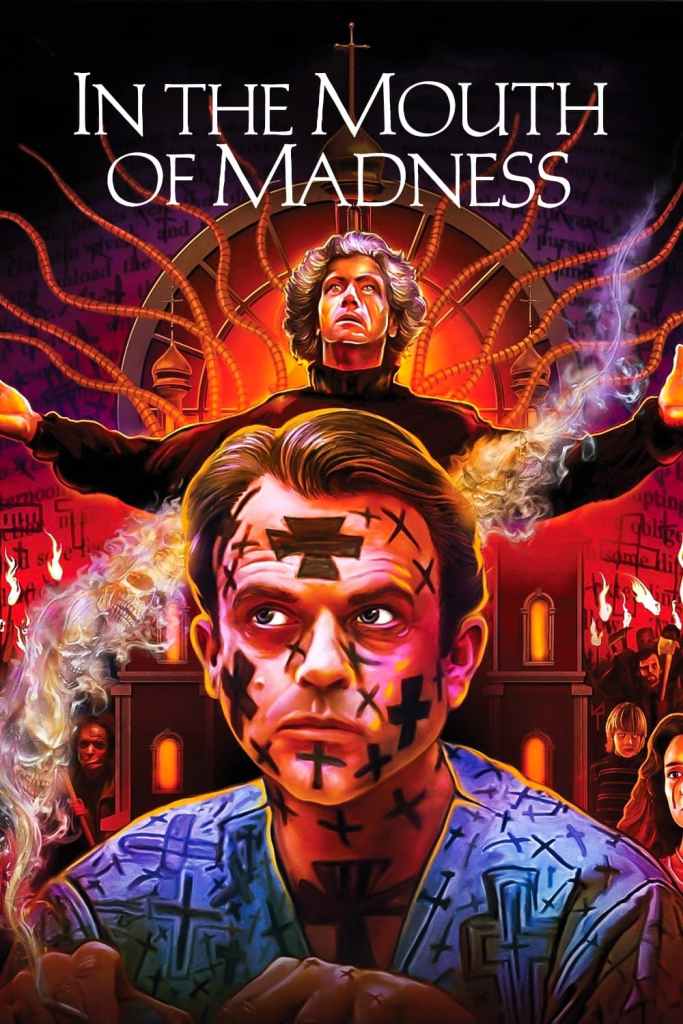
 Through the Shattered Lens