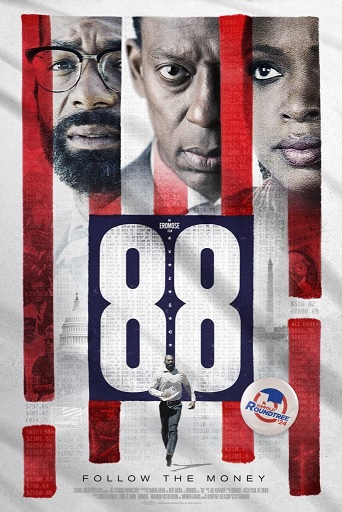
Icarus File No. 10: 88 (dir by Eromose)


Femi Jackson (Brandon Victor Dixon) is a recovering alcoholic with a pregnant wife and a past-due mortgage who totally and completely believes in a presidential candidate named Harold Roundtree (Orlando Jones).  A former baker-turned-politician, Roundtree is running for the 2024 Democratic presidential nomination on a platform of small government and personal responsibility.  That really doesn’t sound like a platform for success in a Democratic primary but whatever.  Let’s just go with it.

Femi has been hired as financial director for a SuperPAC that is raising money for the Roundtree campaign.  Femi notices that many of the donations are being submitted in numbers that add up to 88.  When he takes this news to his friend Ira Goldstein (Thomas Sadoski), Ira reveals that 88 is a code that Neo-Nazis use to identify each other.   Femi and Ira do more digging and they discover that, throughout his entire life, Roundtree has been receiving financial aide from various rich men, all of whom sent Roundtree’s sums of money that all add up to 88.  Femi questions why Neo-Nazis would do something that makes it so easy to identify them.  Ira replies that they’re marking their territory.

While Howard Roundtree records an interview with a left-wing commentator (William Fichtner), Femi tracks down and meets with an elderly and repentant Neo-Nazi (Jonathan Weir), who now needs an oxygen tank to breathe and who lives in an isolated house with his black wife.  Femi is later approached by a volunteer in the SuperPAC’s office, who informs him that the only way that White Supremacy can survive is by latching onto a black politician like Harold Roundtree.  Femi and Ira prepare to meet with Rountree, with Femi still convinced that he has no idea who is secretly funding his campaign.

While this is going on, Femi’s wife (Naturi Naughton) tries to help an ex-con achieve a bank loan despite the opposition of her sister (who also works for the bank) while Femi’s son, Ola (Jeremiah King), gets in trouble at school for showing his classmates a video of a school shooting.  It turns out that Femi’s brother-in-law is not only a cop but he’s also white and he agrees to drive Ola to school so that Ola can see that not all cops are bad.  Ola’s obvious fear as he walks out to the squad car indicates that the experiment, no matter how well-intentioned, is probably not going to work.

88 is certainly an ambitious film and the opening minutes, which features Femi’s wife explaining why Black Panther is not the empowering and progressive film that Femi believes it to be, suggest that the film has the potential to be interesting.  And throughout the film, there are little moments that do work, like the scene where Femi tells his son how to react if he’s ever pulled over by a cop.  Unfortunately, the majority of the film is a clumsily-acted and talky mix of melodrama and heavy-messaging, one that tries to duplicate the style of Spike Lee’s agitprop but instead ends up feeling more like a secular and politically progressive version of the God’s Not Dead films than anything else.  The film drags on for 2 full hours with Brandon Victor Dixon’s nerdy blandness failing to provide the narrative momentum to keep the action interesting.  As well, Orlando Jones is perhaps the least convincing presidential front runner that I’ve ever seen in a film, speaking a cadences that appear to be specifically patterned on Barack Obama but suggesting none of the charisma that would be necessary to captivate a nation.  Again, the film deserves some praise for having the ambition to actually be about something more than just selling toys and comic books but, in the end, it’s earnest dullness and heavy-handed messaging fails to hold one’s attention.
Previous Icarus Files:
  1. Cloud Atlas
  2. Maximum Overdrive
  3. Glass
  4. Captive State
  5. Mother!
  6. The Man Who Killed Don Quixote
  7. Last Days
  8. Plan 9 From Outer Space
  9. The Last Movie

Playing Catch-Up With Four Biopics From 2017: All Eyez On Me, Maudie, A Quiet Passion, and Victoria and Abdul


Continuing with my efforts to get caught up on the major films that I saw in 2017, here are my reviews of four biopics!  Two of them are very good.  One of them is so-so.  And the other one … well, let’s just get to it…

http://www.youtube.com/watch?v=uFttQtY_AVM

All Eyez on Me (dir by Benny Boon)

All Eyez On Me is a movie that I think a lot of people had high hopes for.  It was a biopic about Tupac Shakur, who died over 20 years ago but remains one of the most influential artists of all time.  Starring Demetrius Shipp, Jr. (who, if nothing else, bore a strong physical resemblance to Tupac), All Eyez on Me followed Shakur from his youth as the son of activist Afeni Shakur (Danai Gurira), through his early stardom, his political awakening, his time in prison, his eventual association with Suge Knight (Dominic L. Santana), and his still unsolved murder in Las Vegas.  Along the way all of the expected people pop up.  Kat Graham plays Jada Pinkett and tells Tupac that he’s wasting his talent.  Someone who looks nothing like Dr. Dre is introduced as being Dr. Dre.  Another actor wanders through a scene and says his name is Snoop Dogg.  The film last 2 hours and 20 minutes, with some scenes feeling oddly rushed while other drag on interminably.

The main reason why All Eyez On Me fails is that, unlike Straight Outta Compton, All Eyez on Me never figures out how translate Tupac’s legacy into cinematic form.  For instance, when I watched Straight Outta Compton, I probably knew less about NWA than I knew about Tupac Shakur when I watched All Eyez On Me.  But then there was that scene where NWA performed “Fuck That Police” while surrounded by the police and, at that moment, I understood why NWA deserved their own movie.  There’s no comparable scene in All Eyez On Me, which gets so bogged down in going through the usual biopic motions that it never really comes to grips with why Tupac is such an iconic figure.  Combine that with some less than stellar performances and some amazingly awkward dialogue and the end result is a film that is massively disappointing.

Maudie (dir by Aisling Walsh)

Maudie tells the story of Maud Lewis, a Canadian woman who found fame as a painter despite suffering from crippling arthritis.  Working and living in a one-room house with her husband, a fisherman named Everett (Ethan Hawke), Maud Lewis’s paintings of flowers and birds eventually became so popular that one was even purchased by then-Vice President Richard Nixon.

Maudie is a very special movie, largely because of the incredibly moving performance of Sally Hawkins in the role of Maud.  As played by Hawkins, Maud may occasionally be meek but she never surrenders her dream to create something beautiful out the often harsh circumstances of her life.  Hawkins not only captures Maud’s physical struggles but she also captures (and makes compelling) the inner strength of this remarkable artist.  Ethan Hawke also gives a remarkable performance as the gruff Everett.  When you Everett first appears, you hate him.  But, as the film progresses, Hawke starts to show hints of a sensitive soul that’d hiding underneath all of his gruffnes.  In the end, Everett is as saved by Maud’s art as is Maud.

Directed by Aisling Walsh, this is a low-key but all together remarkable and touching film.  If Sally Hawkins wasn’t already certain to get an Oscar nomination for Shape of the Water, she would definitely deserve one for Maudie.

http://www.youtube.com/watch?v=gh-XATkaRl0

A Quiet Passion (dir by Terrence Davies)

You would be totally justified in assuming that this film, a biopic of poet Emily Dickinson, would have absolutely nothing in common with The Last Jedi.  However, believe it or not, they actually do have something very much in common.  They are both films that, on Rotten Tomatoes, scored high with critics and not so high with audiences.  When last I checked, it had a 93% critical score and a 51% audience score.

Well, you know what?  Who cares?  The idea that you can judge a film’s worth based on an arbitrary number is pure evil, anyway.

Personally, I’m not surprised to hear that audiences struggled with A Quiet Passion.  It’s a very challenging film, one that is more concerned with mood than with traditional narrative.  The film is much like Dickinson herself: dark, uncompromising, sharply funny, and, on the surface, unconcerned with what people might think.  Much as how Dickinson retreated into her Amherst home, the film retreats into Dickinson’s head.  It’s not always the most pleasant place to hide out but, at the same time, it’s so alive with creativity and filled with such a sharp wit that it’s tempting never to leave.

In the role of Emily, Cynthia Nixon gave one of the best performance of the year, bringing Emily to uncompromising life.  Neither the film not Nixon ever make the mistake of sentimentalizing Dickinson.  Her pain is just as real as her genius.  Ultimately, though, both Nixon’s performance and A Quiet Passion stands as a tribute to Emily’s own quiet passion.

Much like Emily Dickinson’s poetry, A Quiet Passion will be appreciated with time.

Victoria & Abdul (dir by Stephen Frears)

If there’s ever been a film that deserves to be known as “generic Oscar bait,” it’s Victoria & Abdul.

Don’t get me wrong.  It’s not a bad movie or anything like that.  Instead, it’s a very respectable film about Queen Victoria (Judi Dench) and her servant, Abdul Karim (Ali Fazal), an Indian Muslim.  While the rest of the royal court is scandalized by Victoria’s close relationship with the foreigner, Karim teaches the Queen about the Koran and encourages her to enjoy life.  The royal court is played by the usual collection of distinguished actors who always appear in movies like this: Simon Callow, Tom Pigott-Smith, and Michael Gambon.  Victoria’s heir is played by Eddie Izzard, which should tell you all you need to know about how the future Edward VII is portrayed.

As I said, it’s not a bad movie as much as it’s just not a very interesting one.  You know that Abdul and Victoria are going to become close.  You know that the Royal Court is going to be a bunch of snobs.  You know that Victoria is going to get a chance to express anti-colonial sentiments that she must surely never actually possessed.  Indeed, whenever the film tries to make any sort of larger statement, all of the characters suddenly start talking as if they’re from 2017 as opposed to the late 1800s.

This is the second time that Judi Dench has played Victoria.  Previously, she played the Queen in a film called Mrs. Brown, which was about Victoria’s friendship with a Scottish servant.  Apparently, Victoria got along well with servants.


Playing Catch-Up With The Films of 2017: Churchill (dir by Jonathan Teplitzky)


2017 is shaping up to be the year of films about Winston Churchill.

For instance, Dunkirk has been an Oscar front-runner ever since it was released last summer.  Winston Churchill does not actually appear in Dunkirk but his shadow hangs over the entire film.  Whenever Mark Rylance says that he’s doing what the prime minister requested him to do, we know that he’s talking about Winston Churchill.

Darkest Hour, which I hope to see this week, features Gary Oldman in the role of Churchill.  For most of the year, a lot of people (like me) assumed that Darkest Hour would be a definite best picture nominee and a probable winner.  While the film seems to have lost a little of its luster, everyone still seems to agree that Gary Oldman is not only going to be nominated by best actor but that he also has a pretty chance of finally winning.

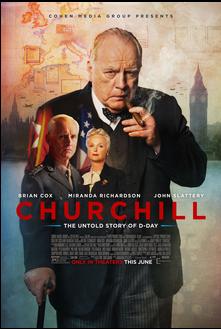
However, before either of those films were released, there was Churchill.  Chuchill received a very limited release in June.  It starred Brian Cox in the title role and it took place in the days leading up to D-Day.  It follows Churchill as he struggles with self-doubt.  He is haunted by nightmares about the men he lost while a military commander in 1915.  He worries that he is being marginalized by the Americans (represented by John Slattery in the role of Dwight D. Eisenhower).  He worries that if he authorizes the invasion of Normandy, he’ll run the risk of losing whatever prestige he has left.  What if the invasion ends in disaster?

That question right there is the main problem with Churchill.  If you know anything about history, you know that the invasion of Normandy was a victory for the Allies, albeit a costly one.  Therefore, for this film to maintain any sort of suspense about what ‘s going to happen, it has to be viewed by people who don’t know about history.  But people who don’t care about history probably won’t be interested in watching a somewhat stuffy film about Winston Churchill.

Despite a few surrealistic nightmare sequences, Churchill ultimately feels like it belongs more on PBS than a movie screen.  It doesn’t surprise me to learn that the majority of director Jonathan Treplitzky’s work has been for British television because Churchill really does feel like a heavily edited version of a 6-hour miniseries.  You watch and you’re impressed by the production values and some of the performances but you find yourself wondering if certain have scenes have been cut out.  If Churchill had been made for HBO, I imagine that Brian Cox and Miranda Richardson (as Churchill’s wife) would be Emmy front-runners.  But, as a feature film, it feels like a decidedly minor portrayal of a major figure.

One final note: all films about the British government during World War II are required to feature at least one scene with King George VI.  Colin Firth, in The King’s Speech, remains the best George.  Laurence Fox in W.E. was the worst.  In Churchill, King George VI is played by James Purefoy.  He doesn’t have a big role but he does a good job with it.  To be honest, I wish that his role had been bigger because he and Cox are entertaining to watch when they’re acting opposite each other.

http://www.youtube.com/watch?v=sVOzMZ4IrMA