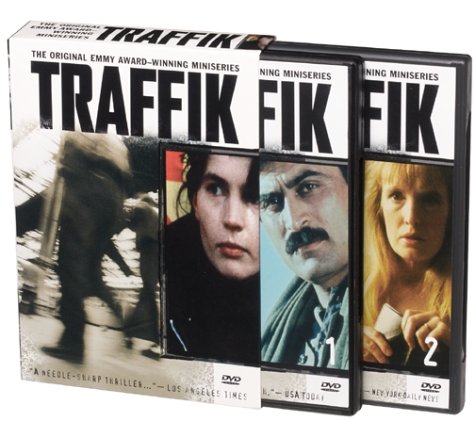
Miniseries Review: Traffik (dir by Alistair Reid)


First aired in 1989 and running a total of six episodes, Traffik is a British miniseries that takes a look at the War on Drugs.

British minister Jack Lithgow (Bill Paterson) has negotiated a treaty with Pakistan.  The UK will send increased aide to Pakistan if the government will crack down on the heroin trade.  In theory, it sounds like a good idea.  Pakistan will get extra cash while joining the effort to stop the flow of heroin into Europe.  In reality, it harms the poor farmers in Pakistan.  After soldiers destroy his village’s poppy fields, Fazal (Jamal Shah) is left with no way to support his family.  He travels to the city, where he gets a job with drug lord Tariq Butt (Talat Hussain).  It’s a job that Fazal has to take in order to feed his family but it’s also a job that puts his family’s safety at risk.

After the heroin in processed in Pakistan, it is smuggled into Europe by men like Karl Rosshalde (Juraj Kukura), a German businessman whose company is a front for his operations.  When two German police detectives (Fritz Müller-Scherz and Tilo Prückner) arrest Jacques (Peter Lakenmacher), one of Karl’s couriers, it looks like Karl might finally being going to prison.  However, Karl’s British wife, Helen (Lindsay Duncan), proves herself to be just a ruthless as he was when it comes to running his operations.

Even with Karl on trial, the drug trade continues.  The heroin that is processed in Pakistan and smuggled through Germany eventually ends up in the UK, where it is used to by Caroline (a very young Julia Ormond), the teenage daughter of Jack Lithgow.  When Caroline runs away from home, Jack searches the streets and back alleys of London and, for the first time, he starts to understand the futility of Europe’s war on drugs.

If Traffik sounds familiar, that’s because it served as the basis for Steven Soderbergh’s 2000 film, Traffic.  When I watched Traffik this week, I was actually surprised to see how closely Soderbergh’s film stuck to the plot of the miniseries.  The only difference, beyond shifting the action from Europe to North America, is that Soderbergh replaced the farmer’s storyline with a story involving Benicio del Toro as a Mexican policeman.  That’s a bit of shame, actually.  Traffic is one of my favorite Soderbergh films but it is a bit cop-heavy.  The people who actually do the day-to-day work in the drug trade, as opposed to the drug lords, aren’t really represented in Soderbergh’s film.  As the British miniseries shows, people like Fazal end up working in the drug trade not because they’re evil but because they literally have no other choice.  It’s either work for someone like Tariq or starve to death.

As I mentioned earlier, Traffic is one of my favorite Soderbergh films.  Considering that I usually find Soderbergh’s films to be hit-or-miss, it’s actually kind of remarkable just how effective Traffic is.  The original miniseries, however, is superior to the film in every way.  Some of that is because the miniseries has six hours to explore its world whereas Soderbergh had to cram a lot of incidents into 147 minutes.  Beyond that, the miniseries succeeds because director Alistair Reid takes a straight-foward, no frills approach to telling his story.  Even at his best, Soderbergh has a tendency to be a bit pretentious.  Even though Traffic deals with real-life issues, it never allows you to forget that you’re watching a film.  Traffik, on the other hand, tells its story with an almost documentary-style immediacy.  One need only compare the scenes where Bill Paterson searches for Julia Ormond in Traffik to the scenes where Michael Douglas searches for Erika Christensen in Traffic to see not only the differences between Reid and Soderbergh’s style but also to see why Reid’s more gritty style works better for the story that’s being told.  Whereas Soderbergh can’t resist framing Christensen with a blonde halo when she’s finally rescued by Douglas, Traffik leaves little doubt that Ormond has been through Hell and that, even if she does eventually beat her addictions, she’ll be carrying the scars of her experience for the rest of her life.  Whereas Traffic ended on a note of hope, Traffik ends with the realization that there is no perfect solution.

Traffic and Traffik are both good looks at the destructiveness of both drug abuse and the efforts to treat drug addiction as a crime.  Both are worth watching.
A Movie A Day #45: Captives (1994, directed by Angela Pope)


captives

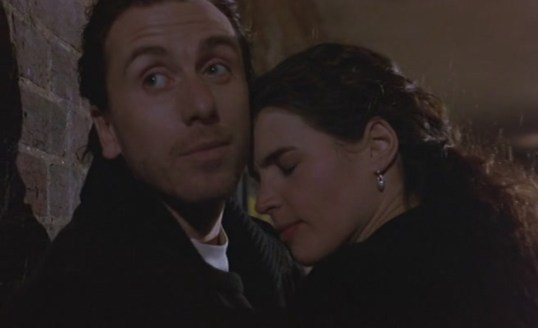
Rachel Clifford (Julia Ormond) is a dentist who has just divorced her unfaithful husband, Simon (Peter Capaldi).  Feeling directionless, Rachel shocks her posh friends by getting a part-time job as the dentist at Wadsworth Prison, the toughest and most notorious prison in Britain.  While most of the inmates in the all-male prison harass and proposition the attractive Rachel, she forms an unlikely friendship with Phil (Tim Roth), a sensitive inmate who is doing time for killing his previous girlfriend.  Phil and Rachel are both captives, Phil of the legal system and Rachel of her upper class existence.  With Phil getting weekly day releases so that he can take computer classes, he and Rachel become lovers outside of the prison walls.  When prison kingpin Tower (Colin Salmon) finds out about their affair, he attempts to blackmail both of them.

A British film which I don’t think ever got much attention in the U.S., Captives is a romantic drama that works because Julia Ormond and Tim Roth both give good performances and share a spark of passion.  Captives is one of the few films that could actually make a hookup in a public restroom seem romantic.  It’s just too bad that, after such a strong start, the movie gets bogged down in melodrama during the final twenty minutes.

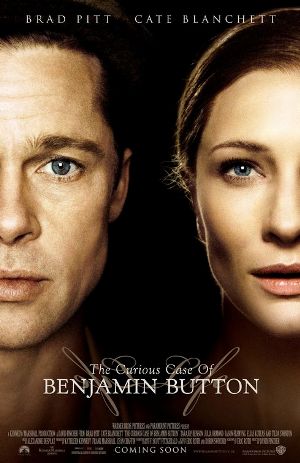
Embracing the Melodrama Part II #112: The Curious Case of Benjamin Button (dir by David Fincher)


Curious_case_of_benjamin_button_ver32010 will always be considered, by many of us, to be the year that Oscar journalism first jumped the shark.  That was the year that a group of self-styled award divas (which Awards Daily’s Sasha Stone being the most obnoxious culprit) went batshit crazy over a film called The Social Network.  

From the minute that David Fincher-directed film premiered, the Sasha Stones in the world not only declared it to be the greatest film ever made but also insinuated that anyone who disagreed had to be stupid, crazy, and evil.  It actually got rather silly after a while.  That is until The Social Network lost best picture to The King’s Speech.  Suddenly, what was once merely enthusiastic advocacy transformed into fascistic fanaticism.  Suddenly, these people started to view the 2010 Oscar race (and each subsequent Oscar race) as a rather tedious battle between good and evil.  For these people, David Fincher represented the forces of good.  And Tom Hooper, the director of The King’s Speech, represented all that was evil.  They took this to such an absurd extreme that they not only subsequently heaped undeserved praise on Fincher’s bastardization of The Girl With The Dragon Tattoo but also unnecessary scorn on Hooper’s Les Miserables.

Of course, what was forgotten in all of that drama was that — before Hooper and The King’s Speech came along, the 2010 Oscar race was predicted be some to be a rematch between Fincher and Danny Boyle (whose 2010 film, 127 Hours, was indeed nominated for best picture, alongside The Social Network, King’s Speech, and Black Swan).  When Fincher and Boyle previously competed during the 2008 Oscar race, Danny Boyle’s Slumdog Millionaire defeated Fincher’s The Curious Case of Benjamin Button.

And indeed, the case of Benjamin Button was curious one!

Loosely based on a short story by F. Scott Fitzgerald, The Curious Case of Benjamin Button told the story of a man who aged in reverse.  When Benjamin is a baby, he has the wrinkled face of an elderly man.  When he’s a teenager, he’s walking with a cane.  When he’s middle-aged, he looks like Brad Pitt in Legends of the Fall.  (In that regard, it helps that Benjamin is played by Brad Pitt.)  And when he’s an old man, he’s a baby.  Though the film, wisely, refrains from offering up a definite reason why Benjamin ages in reverse, it hints that it could have something to do with a clock that was built to run backwards as an anti-war statement.

Benjamin is born in New Orleans in 1918 and raised in a nursing home by Queenie (Oscar nominee and future Empire star Taraji P. Henson).  The love of Benjamin’s life is Daisy Fuller (Elle Fanning when young, Cate Blanchett as an adult), a dancer who also loves Benjamin but who, unlike him, is not aging in reverse.  For this reason, Benjamin and Daisy cannot be together.  That’s the way tragic love works.

The film itself features a framing device.  Daisy, now an elderly woman, is dying and gives her estranged daughter, Caroline (Julia Ormond), the diary of Benjamin Button.  As Caroline reads, Hurricane Katrina rages outside.  I’ve never really been comfortable with the way that the film uses Katrina as a plot point, for much the same reason that it bothered me when Hereafter used the real-life Thailand typhoon and London terrorist bombings to tell its story.  The real-life tragedy of Katrina feels out-of-place in a story about Brad Pitt aging backwards.

As for the rest of the film, The Curious Case of Benjamin Button is … well, it’s a curious film.  Visually, it’s definitely a David Fincher film but, at the same time, there’s something curiously impersonal about it.  You almost get the feeling that this was Fincher’s attempt to show that he was capable of making a standard big budget Hollywood film without getting too Fincheresque about it.  Brad Pitt and Cate Blanchett have chemistry and they look good together but Fincher has never been a sentimental director and his heart never truly seems to be in their love story.  (Ben Affleck and Rosamund Pike in Gone Girl feel more like a natural couple than Brad Pitt and Cate Blanchett do in this film.)  There’s only a few scenes, mostly dealing with the more morbid aspects of Benjamin’s odd condition, towards which Fincher really seems to feel any commitment.

As a result, The Curious Case of Benjamin Button becomes a curious misfire.  It’s a film that struggles with the big picture but is occasionally redeemed by some of its smaller moments.  (The scenes with the elderly Benjamin as a dementia-stricken baby are haunting and unforgettable.)  Ultimately, The Curious Case of Benjamin Button is probably the weakest of the five 2008 films nominated for best picture but it’s still an interesting film to watch.

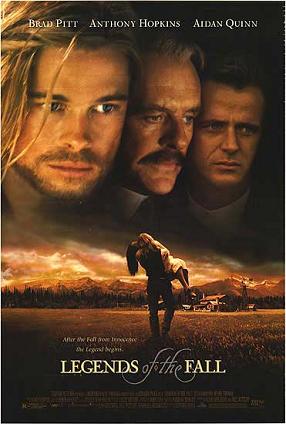
Embracing the Melodrama Part II #89: Legends of the Fall (dir by Ed Zwick)


LegendsoffallposterWhen I first started to watch the 1994 film Legends of the Fall on Encore, I was a little bit concerned when I discovered that it was directed by Ed Zwick.  After all, Zwick also directed Love and Other Drugs, which is one of the worst and most insulting films of all time.  In fact, I nearly stopped watching when I saw Zwick’s name.  But, largely because I want to finish up this series of melodramatic film reviews at some point in the near future, I decided to go ahead and watch the film.

And it turned out that Legends of the Fall is not a bad film.  I probably would have enjoyed it more if I had seen it in a movie theater as opposed to on television but, considering that it was directed by Ed Zwick, Legends of the Fall is definitely watchable.  If nothing else, it’s better than Love and Other Drugs.

Legends of the Fall tells the story of the Ludlows, a family that lives on a Montana ranch at the start of the 2oth Century.  Starting with the final days of the Indian wars and proceeding through World War I and prohibition, Legends of the Fall covers a lot of historical events but does so in a very Hollywood way, which is to say that all of the main characters dress like they’re from the past but they all have very modern social attitudes.  In this case, Col. William Ludlow (Anthony Hopkins) may be a wealthy white military veteran but he’s also totally pro-Native American.  And, of course, all the local Native Americans love him, despite the fact that he’s a representative of the institutions that have destroyed their way of life.

Anyway, Col. Ludlow has three sons.  The oldest, Alfred (Aidan Quinn), is serious and responsible. The youngest, Samuel (Henry Thomas), is naive and idealistic.  And the middle child is Tristan (Brad Pitt), who is wild and rebellious and looks like Brad Pitt.  You have to wonder how the same gene pool could produce both Aidan Quinn and Brad Pitt.

As the film begins, Samuel has returned from studying at Harvard.  With him is his fiancée, Susannah (Julia Ormond, who has really pretty hair in this movie).  Though she loves Samuel, Susannah finds herself attracted to Tristan, largely because Tristan looks like Brad Pitt.  Tristan is also attracted to Susannah but he would never betray his younger brother.  In fact, when Samuel announces that he’s enlisted in the Canadian army so that he can fight in World War I, Tristan and Alfred soon do the exact same thing.

War is Hell, which is something that Samuel discovers when he’s gunned down by a bunch of German soldiers.  Tristan responds by cutting Samuel’s heart out of his body and sending it back to Montana.  He then proceeds to go a little crazy and when we next see Tristan, he’s uniform is decorated with the scalps of dead Germans.

Meanwhile, Alfred has been wounded in battle and is sent back to Montana.  Eventually, he ends up married to Susannah.  And then Tristan comes back home and…

Well, a lot of stuff happens after Tristan returns.  In fact, you could even argue that too much happens.  Zwick obviously set out to try to make Legends of the Fall into an old school Hollywood epic but far too often, it seems like he’s mostly just copying scenes from other films.  There’s a hollowness at the center of Legends of the Fall and the end result is a film that’s visually gorgeous and thematically shallow.

And yet, you should never underestimate the importance of looking good.  Legends of the Fall is a beautiful film to look at and so is Brad Pitt.  I wouldn’t necessarily say that Brad gives a particularly good performance here because, to be honest, Tristan is such an idealized character that I doubt anyone could really make him believable.  But the Brad Pitt of 1994 looked so good and had such a strong screen presence that it didn’t matter that he wasn’t as good an actor as the Brad Pitt of 2015.  Legends of The Fall is one of those movies that can get by on pure charisma and fortunately, Brad Pitt is enough of a movie star to make the film work.

Legends of the Fall is not a great film but it’s still not a bad way to waste 120 minutes.  (Of course, the film itself lasts 133 minutes but still…)

A Quickie With Lisa Marie: My Week With Marilyn (dir. by Simon Curtis)


My Week With Marilyn is apparently based on a true story. 

We know this because the film not only uses the opening title card to tell us that the story is true but the movie itself is narrated by Colin Clark (played by Eddie Redmayne) and Colin tells us pretty much the same thing, over and over again. (Seriously, this film reminded me of why I usually don’t care much for first person narration.)  Anyway, the film takes place in the late 1957.  Colin is the 3rd Assistant Director, working with Laurence Olivier (a haughty and pompous yet oddly touching performance from Kenneth Branagh) on a film called The Prince and the Showgirl.  The film stars Marilyn Monroe (Michelle Williams) who quickly starts to annoy Olivier when it becomes obvious that she’s painfully insecure, self-destructive, and dominated by her agent, acting coach, and cold husband.  Colin, however, is smitten with Marilyn and, despite the ominous warnings delivered by everyone else in the film, he soon finds himself falling in love with her and giving this film a title by spending a week with Marilyn.

My Week With Marilyn has been getting a lot of attention lately because many Oscar watchers are expecting to see Michelle Williams receive a Best Actress nomination for her performance as Marilyn Monroe.  Lately, Kenneth Branagh has become something of a dark horse for a best supporting actor nomination and personally, I would say that Julia Ormond (as a paranoid Vivien Leigh) and Judi Dench (as a supportive actress) both deserve some consideration as well. 

The film is ultimately dominated by Michelle Williams and it works whenever she’s on-screen. (And, unfortunately, it pretty much falls apart whenever she’s not.)  Williams has the daunting job of playing an icon here and she manages to be both believable as an icon and as a very fragile and poignant human being.  The script, to be honest, doesn’t give her much help.  As written, Marilyn is alternatively presented as being a helpless damsel in need of a white knight, a calculating seductress who threatens to lead Colin off of the straight and narrow path (represented here by Emma Watson as the girl that Colin treats quite badly)  and a convenient symbol of a lost age.  The brilliance of Michelle Williams is in how she manages to use these three conflicting characterizations to create one very believable Marilyn Monroe.

The main problem with this film is that it’s not called Marilyn.  Instead, it’s My Week With Marilyn and, as a result, the film is actually about the male gaze of the “My” of the title.  As good a performance as Williams gives, it’s hard to avoid the fact that, as far as this film is concerned, Marilyn ultimately exists just to teach Colin a few life lessons.  Unfortunately, as a character, Colin Clark is so thinly written that he’s never all that compelling and, as the film progresses, it’s hard not to feel that he’s ultimately using Marilyn just as surely as everyone else is. 

(In all honestly, however, I have to admit that one of my issues with Colin is that he’s played by Eddie Redmayne.  Don’t get me wrong, Redmayne is a good actor and he manages to make Colin almost likable but I simply cannot look at him without flashing back to Redmayne’s performance in Savage Grace.  That’s the movie where he plays a schizophrenic who has an incestuous relationship with his mother (Julianne Moore) before murdering her.  Redmayne was so effectively creepy in that film that, as unprofessional as it may be for a film critic, I had a hard time accepting him in the role of white knight.)  

I’ve read a lot of reviews that have complained that this film is basically just a big budget Lifetime Movie and, in many ways, it is.  Director Simon Curtis is a veteran of television and the film has the crisp but flat look of a tv show.  But even more than just the cinematography, My Week With Marilyn feels like a TV movie because its script hesitates to raise any issues that can’t be resolved in two hours.  That said, it’s really not sordid or silly enough to be a great Lifetime movie and it’s far too well acted to be a waste-of-time.  Ultimately, this is a flawed film that deserves to be seen for its performances.  If only the entire film was as compelling and interesting as the performances of Kenneth Branagh, Julia Ormond, and especially Michelle Williams.